


Good morning! It is Thursday, June 11, 2026, and today’s theme is forced passengers. Civilians in Iran are being dragged deeper into Trump’s war. Sailors in the Gulf of Oman are being pulled into America’s blockade. Retirement savers may be conscripted into Elon Musk’s Mars-and-AI empire whether they like it or not. Fans trying to attend the World Cup are discovering that FIFA’s “football for everyone” slogan apparently comes with a passport check, a dynamic pricing algorithm, and a Trump administration footnote. And then, mercifully, the New York Knicks reminded us that sometimes being carried away by events can still mean something joyful, absurd, and beautiful.
Let’s start with the war.
The Iran ceasefire is now a haunted document everyone keeps waving while missiles fly overhead. Al Jazeera and The Guardian are both reporting that the United States has launched another round of strikes on Iran, with Tehran saying the April 8 ceasefire has been rendered “practically meaningless.” Iran’s foreign ministry condemned the U.S. attacks as unlawful and criminal, saying Washington has violated the U.N. Charter and bears responsibility for what comes next.
Iran has retaliated against U.S.-aligned assets and forces in the region, with reports of strikes involving Bahrain, Kuwait, and Jordan. Kuwait says it has responded to 24 Iranian drones in its airspace over the past two days. Jordan says it intercepted 20 missiles launched from Iran. Bahrain says an 11-year-old girl was injured by falling debris after Iranian drones were intercepted over Manama and Hamad Town.
So if anyone in the Trump administration is still selling this as a tightly controlled pressure campaign, perhaps they could define “controlled” before the Strait of Hormuz starts reviewing the paperwork.
The most alarming update may be Trump’s own words. According to The Guardian, Trump threatened to hit Iran “very hard tonight” and said the United States would, “in the not too distant future,” take Kharg Island and other oil infrastructure points, claiming America would “assume total control” of Iran’s oil and gas markets.
Kharg Island is not some symbolic rock in the Gulf. It is Iran’s essential oil-export hub, handling roughly 90 percent of the country’s oil exports. When a U.S. president threatens to seize it, he is not talking about deterrence. He is talking like a man who has looked at a regional war and thought: what if we added conquest and resource control?
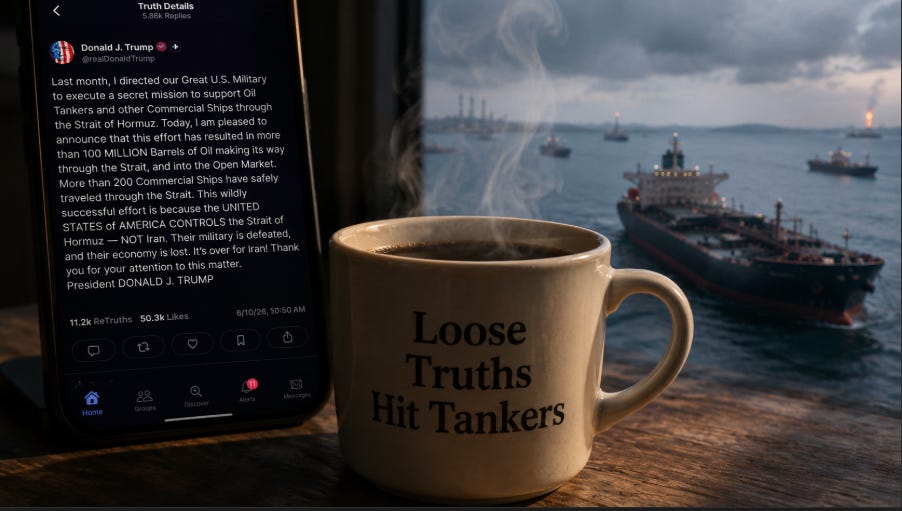
There is also the small matter of the president apparently announcing military intentions on social media like a man live-blogging his own invasion. On Truth Social this morning, Trump threatened that the United States would hit Iran “VERY HARD TONIGHT.” In another post, he boasted that a “secret mission” had helped move more than 100 million barrels of oil and 200 commercial ships through the Strait of Hormuz, declaring that the United States, “NOT Iran,” controls the strait.
This is reckless on multiple levels. Operationally, announcing imminent strikes in public raises obvious security questions. Diplomatically, threatening to seize another country’s oil infrastructure makes the war look less like self-defense and more like imperial resource capture. Strategically, declaring Iran defeated while missiles, drones, tankers, and air defenses are still in play is the sort of triumphal chest-thumping that can box both sides into more escalation.
It is one thing for a president to signal resolve. It is another for him to post war plans, oil ambitions, and victory laps on a social-media platform between meme accounts and flag-burning fantasies.
Apparently, the Trump doctrine is now: first we bomb, then we blockade, then we announce the hostile takeover on Truth Social.
The resource-control frame matters, because the war is already moving from military targets to the systems that keep countries alive.
The New York Times Visual Investigations team is reporting that satellite imagery and videos suggest U.S. precision strikes destroyed what appears to be a drinking-water facility in Bemani, on Iran’s southern coast near the Strait of Hormuz. Iranian state media said water storage buildings were hit, and a local official said water was cut off to more than 20,000 people in the nearby town and villages. Temperatures in the area have reportedly topped 100 degrees Fahrenheit this week.
The Times analysis found two small water structures visible in satellite imagery before the strike, with light-blue pipes and a hilltop location consistent with water distribution infrastructure. Afterward, videos and photos showed one structure with a collapsed roof and another with a small impact hole in the center of the roof. Researchers identified fragments shown by Iranian media as consistent with a GBU-39, a 250-pound class precision-guided glide bomb.
The caveat is important: it is not yet clear whether the U.S. intentionally targeted the facility or knew what the structures were. But that uncertainty is not exculpatory comfort. Precision munitions are called precision munitions for a reason. If the United States is using them on remote structures whose destruction cuts off drinking water to tens of thousands of people during extreme heat, then we are no longer talking about abstract escalation. We are talking about civilian survival infrastructure.
There was a wall left standing amid the rubble, painted with a water-conservation slogan in Persian: “Water is the pulse of life.”
That is the image of this phase of the war: the pulse of life punched through by a precision bomb while the president threatens to take the oil.
Meanwhile, the war is entering the chokepoints.
Iran says the Strait of Hormuz is closed until further notice. U.S. Central Command disputes that, saying commercial traffic continues, but the practical situation is already dangerous. CENTCOM has confirmed that U.S. forces struck the Guinea-Bissau-flagged tanker Jalveer off Oman, saying the vessel violated the blockade on Iranian oil. It was reportedly the third commercial vessel disabled by U.S. forces this week, after the Marivex and the Settebello.
India says all 20 Indian crew members aboard the Jalveer are safe. But three Indian sailors reportedly died in a U.S. strike on the Settebello a day earlier.
The phrase “loose lips sink ships” has apparently been updated for the Trump era: loose Truths hit tankers.
This is how a regional war becomes a global economic crisis: one tanker, one drone, one missile interception, one insurance spike, one LNG shipment, one oil price jump at a time. The war no longer lives only in Iranian airspace or Pentagon press releases. It lives in the shipping lanes, the fuel markets, the grocery bill, the inflation report, and the sailor’s distress call off Oman.
Yet the diplomacy theater continues. Russia, China, Turkey, Saudi Arabia, Pakistan, and the UAE are all urging restraint or a return to talks. There are reports that negotiations may still be moving in some form, including discussions of frozen Iranian funds. But the military logic and the diplomatic logic are now walking in opposite directions. Both Washington and Tehran appear to be trying to negotiate from a position of strength, which is a lovely phrase until you remember that “position of strength” often means someone else’s city, ship, airspace, or water system is being hit.
So the lead this morning is simple: Trump’s Iran war is no longer just a pressure campaign. It is becoming a resource-control war with civilian consequences.
From there, somehow, we move to Elon Musk, because the day was not content with one billionaire-scale forced-exposure story.
The Financial Times has a striking visual piece on SpaceX’s planned IPO, and the central point is not merely that the numbers are enormous. It is that ordinary investors may be dragged into Musk’s orbit whether they choose to go there or not.
SpaceX is reportedly aiming to raise about $86 billion at a valuation around $1.78 trillion, which would make it the largest stock-market debut in history and instantly place the company among the most valuable public corporations on Earth. This is not a normal IPO. Most companies spend years proving themselves in public markets before they become trillion-dollar giants. SpaceX would arrive as one, trailing Mars colonies, orbital AI data centers, and electromagnetic lunar launch systems. The FT’s comparison is blunt: SpaceX would be valued like a mature tech titan while generating only a fraction of the revenue of the companies it would suddenly sit beside.
But the truly important mechanism is passive investing. Once SpaceX enters major indices, pension funds, retirement accounts, ETFs, and other tracker funds may be required to buy the stock automatically. Millions of people could end up financially exposed to Musk’s ambitions not because they decided his Mars-and-AI venture belonged in their retirement portfolio, but because index mechanics did it for them. Musk gets control. The public gets exposure.
The governance risks are not subtle. Musk would reportedly retain overwhelming voting control through super-voting shares, public shareholders would have limited ability to discipline management, and disputes would be forced into mandatory arbitration in Texas. The structure has been further complicated by the merger of SpaceX with xAI and X, folding a rocket company, an AI startup, and a money-losing social platform into a single corporate vehicle just months before filing.
Then there are the growth assumptions. Goldman Sachs reportedly projects that SpaceX’s AI revenues would need to increase 100-fold by 2030, reaching $322 billion from $3.2 billion today. Morgan Stanley reportedly estimates that overall revenue would need to increase 180-fold by 2040, from $18.7 billion last year to $3.4 trillion, with earnings flipping from a multibillion-dollar loss to trillions in profit.
Because of the passive-fund machinery, this is not just a story about Musk fanboys, Wall Street bankers, and sovereign wealth funds fighting over allocation. It is a story about teachers, nurses, municipal employees, office workers, and retirees potentially becoming involuntary passengers on Musk’s most ambitious venture. The same man whose politics have become inseparable from his companies, and whose government contracts touch military communications and satellite infrastructure, may now be positioned to turn SpaceX into a public-market giant while keeping control and spreading the risk across everyone else’s savings.
Musk wants Mars. Your retirement account may get the downside.
Which brings us, naturally, to the World Cup.
The 2026 World Cup kicks off today in Mexico City, with Mexico facing South Africa at Estadio Azteca. It is the biggest World Cup in history: 48 teams, 104 matches, 16 host cities, three host countries, and more than five weeks of global obsession. FIFA expects attendance to soar beyond five million. The audience will be planetary. Messi, Ronaldo, Mbappé, Lamine Yamal, Haaland, Salah, Neymar, Son, Kane, Modric, the whole generational handoff is happening on the same stage.
This is the part where the heart still wins. The World Cup is corrupt, bloated, cynical, commercialized, and governed by people who seem to believe moral compromise is a hospitality package. Yet, the magic is real. World Cups become milestones in people’s lives. They make adults feel like kids again. They give suffering countries a reason to smile. They give small nations a moment in the light.
That is the tension of this World Cup: the institution is ugly, but the thing itself still has magic.
The Athletic framed it beautifully and bluntly: nothing matches the World Cup’s cultural, social, and economic reach. FIFA president Gianni Infantino, because he is apparently allergic to normal human proportion, has called this “the greatest event that humanity — that mankind — has ever seen and will ever see.” This is ridiculous, of course. The invention of antibiotics, the moon landing, and the first person to put peanut butter and chocolate together deserve at least a committee hearing.
The World Cup’s reach is undeniable. It is the only event that can stop whole cities, rearrange sleep schedules across continents, and make strangers in cafes gasp at the same missed chance.
This year, it opens inside a political mess so on-the-nose that a novelist would be told to tone it down. One of the host countries, the United States, is actively at war with Iran, one of the participating nations. Under FIFA’s own logic, a host country has a responsibility to receive and protect delegations from qualified teams. In practice, this tournament is already being shaped by Trump’s border regime.
FIFA promised “everyone will be welcome,” but fans from countries such as Iran and Iraq are finding that the welcome mat has been replaced by a visa maze and a threat assessment. The Iranian team has reportedly faced restrictions, with its base placed in Mexico even though games are in the United States. Iranian fans are facing visa chaos. Iraqi fans have faced denials. A Somali referee, Omar Artan, one of Africa’s most prominent officials, was reportedly barred from entering the United States and removed from the tournament pool.
FIFA’s response has been less “football is for everyone” than “football is for everyone who clears secondary screening.”
A France 24 discussion put the broader frame well: sport, business, and politics are now inseparable. The expansion to 48 teams can be defended as a democratization of the global game. Countries from Africa, Asia, Central America, and the Caribbean have more chances to reach the tournament. That matters. Haiti matters. Curaçao matters. Senegal matters. Ivory Coast matters. Smaller nations and long-suffering countries bring stories and joy the tournament desperately needs.
The expansion also feeds FIFA’s money machine. More teams mean more matches, more travel, more ticket inventory, more broadcast content, and more corporate revenue. Supporters are being priced out. Ticketing practices have drawn scrutiny. Fans from the very countries FIFA claims to be welcoming are running into borders, bans, and bureaucracy. The World Cup has widened its doorway on paper while narrowing the actual entrance with cost, passport power, and political hostility.
Then there is the environmental cost. A 104-match tournament spread across the United States, Canada, and Mexico means teams, fans, delegations, journalists, broadcasters, and officials crisscrossing North America largely by air. Four years after Infantino promised greener football, this may be the most polluting World Cup ever. Apparently, the carbon offset is vibes.
Then there is Trump, hovering over the tournament like a mascot designed by the Department of Homeland Security. Infantino’s relationship with Trump has always looked less like diplomacy than surrender with a commemorative plaque. FIFA wanted access to the world’s most lucrative sports market. It got the market. It also got Trump’s war, Trump’s borders, Trump’s visa chaos, Trump’s pricing spectacle, and Trump’s endless ability to make himself the center of any room, stadium, trophy presentation, or planetary event.
The 2026 World Cup was sold as the most open tournament in history. It opens as a lesson in who gets to belong.
Still, the football begins. Mexico and South Africa at the Azteca. The same stadium where Maradona turned a quarterfinal into mythology. The same country that hosted the 1986 World Cup. Forty years later, the game comes full circle, carrying all of its beauty and all of its rot.
The miracle and the mess are inseparable now.
Speaking of miracles, we would be remiss, deeply, historically, spiritually remiss, if we did not mention the New York Knicks.
The Knicks beat the San Antonio Spurs 107-106 in Game 4 of the NBA Finals last night at Madison Square Garden, erasing a 29-point second-half deficit and taking a 3-1 series lead. They are now one win away from their first championship since 1973.
Those words are real. No, I am not hallucinating from the news cycle. The Knicks are one win from the title.
The ending was perfect New York chaos. Jalen Brunson missed a three in the final seconds. OG Anunoby, who had already scored 33 points and hit seven threes, crashed the rim, slipped past Victor Wembanyama and Dylan Harper, and tipped in the miss with 1.2 seconds left. Just a fingertip. A redirection. A tiny act of basketball sorcery that sent Madison Square Garden into full civic exorcism.
Knicks coach Mike Brown called it maybe the most iconic shot in New York basketball history. That is the kind of thing coaches say when the adrenaline is still rearranging their organs, but honestly, where is the lie? A 29-point comeback in the NBA Finals. A game-winner with 1.2 seconds left. A 3-1 lead. One win from ending a 53-year championship drought.
Somewhere, every Knicks fan who has ever muttered “next year” into a stale beer felt the tectonic plates shift.
This is what sports can still do at its best. Not the FIFA version, not the billionaire extraction version, not the border-policed spectacle version. The other kind. The kind where time stops because the ball is on the rim and an entire city forgets, for one suspended second, that the world is on fire.
So yes, today’s through-line is forced passengers. Civilians in Iran, sailors near Oman, retirement savers in passive funds, and fans at the World Cup are all being dragged into systems they did not design and cannot control. Trump threatens to seize oil infrastructure. Musk asks the public markets to underwrite his empire. FIFA sells unity while outsourcing the guest list to border politics. The global economy watches the Strait of Hormuz like a cardiologist reading a stress test.
And then OG Anunoby gets one fingertip on the ball.
The world is still absurd, the powerful are still reckless, and the systems are still rigged. But for one night in New York, the impossible happened in the good way.
That will have to count for something.
Boy, does this commentary resonate! This morning, my spouse and I were each trying to figure out how to get out of index funds that add Space X. And we’re seeing significant price increases in almost everything we buy or do, with no relief in sight. Plus, today is set to break heat records in every area - east coast to west coast - our family members live.
My disdain - and anxiety - at the Kafkaesque reality of being a forced passenger on the deranged Trump-Billionaire-MAGA train line grow daily.
I enjoy your refulgent prose even when the topics are horrifying