


Good morning! Marz and I slept in today, and honestly, I regret nothing, because the country didn’t fix itself while I was out. In fact, after a night where we rewarded ourselves with the uniquely rural annual Christmas spectacle known as the Lighted Truck Parade, a procession so cheerfully absurd it briefly tricks you into believing America still has a functioning civic heartbeat, we woke to discover that nothing had improved in our absence. While people across the country were trying to figure out how to pay for rent, groceries, insurance premiums, and the privilege of simply existing, Donald Trump stood in the Benjamin Franklin Room and performed a 30-minute monologue about marble maintenance, air-conditioning sponsorships, and his personal journey as America’s Contractor-in-Chief. The Kennedy Center Honors were, in theory, the reason for the event, but the arts themselves were treated mostly as an inconvenience, like background actors who accidentally wandered into a Home Depot commercial.
Trump turned it into a guided tour of the nation’s decorative surfaces, but it was marketed as a celebration of culture. He explained how he “saved” the Kennedy Center by renegotiating its marble destiny, lectured a room full of artists on acoustics, and announced that Carrier donated $17 million in air-conditioning equipment, which is apparently the pinnacle of American soft power. Stallone, George Strait, Gloria Gaynor, Michael Crawford, and KISS stood there smiling politely while Trump explained that nothing, nothing, at the Kennedy Center, the White House, or in the history of human masonry would exist without his willingness to grind a slab for freedom.
Not a word mentioned about the cost of housing, or healthcare. He didn’t mention inflation, wages, debt, or the economic freefall millions of people are living through.
Trump did explain the emotional significance of sanctuary marble and how replacing ugly floor tiles brings him a feeling of relaxation “better than rest.” And really, isn’t that what the working class has been craving this whole time? A president who finds inner peace in grout?
Once the marble meditation concluded, the mask snapped right back into place. Trump looked out on a room of singers and dancers and launched straight into an authoritarian highlight reel. Washington, DC, he said, is now “one of the safest cities anywhere in the world” because he deployed the National Guard. New Orleans and Memphis were “fixed” in three days by sending in troops. Chicago is next, once he’s finished pretending federalism exists. The border, he assured the crowd, has yielded exactly 11,888 “murderers”, such a satisfyingly specific number,nwho are being rounded up as we speak. It was like watching a man read an ICE press release inside a karaoke bar.
Pete Hegseth arrived at the Reagan Defense Forum on Saturday looking less like a defense secretary and more like a man determined to outrun the smell of smoke from the war-crimes bonfire trailing behind him. You almost had to admire the commitment: here was someone under bipartisan scrutiny for ordering, and then publicly endorsing, a second missile strike on a boat full of wounded survivors, trying to rebrand himself as the poet-philosopher of a new foreign-policy era. If a man facing potential legal exposure can’t declare the end of American “utopian idealism,” who can? And declare it he did, with the kind of solemn gravitas usually reserved for men who aren’t actively defending actions Congress is wondering aloud might constitute war crimes: “Out with idealistic utopianism. In with hard-nosed realism.”
There it was, the Hegseth Doctrine in miniature, a punchline masquerading as prophecy.
With the confidence of someone who’s never doubted he’ll be insulated from consequence, Hegseth announced that the age of delusion is over, and then immediately substituted his own. Gone is the childish idealism of preventing great-power conflict, maintaining alliances, or even adhering to international law. In its place, he offered a geopolitical worldview best described as, “the world is a big Risk board and Donald Trump is letting everyone pick their favorite color.” China gets the Pacific. Europe gets… whatever keeps Viktor Orbán smiling. Russia gets the courtesy of not being mentioned at all, because foreign policy now operates under the principle of “don’t say his name or he’ll get mad.”
The United States, of course, gets the Western Hemisphere, which dovetails nicely with the administration’s ongoing Caribbean campaign, a project that has produced around 80 deaths and not a single completed due-process sentence. Hegseth didn’t wink, but he didn’t need to. His vow, “If you bring drugs to this country in a boat, we will find you and we will sink you”, does the winking for him, a sort of unapologetic chest-thumping that suggests the administration believes the best defense against war-crime allegations is simply insisting the crimes are actually national-security triumphs. By this logic, the second strike on wounded survivors becomes not a moral or legal atrocity, but a teaching moment for anyone still clinging to the idea that basic humanity should guide military conduct.
Hegseth framed all of this as the dawn of “hard-nosed realism,” though you could be forgiven for thinking it looked more like a carefully constructed moat of rhetoric meant to wall off the growing chorus of critics demanding accountability. If you pretend that international norms are just “utopian,” he seems to think, then your own violations of them cease to exist. It’s the diplomatic equivalent of covering your eyes and declaring yourself invisible, except now with $150 billion in new military toys and a trillion-dollar budget to underline the point.
The satire practically writes itself: a defense secretary under investigation for an operation that looks like a law school hypothetical about war crimes, lecturing the world about the dangers of idealism. One almost expects him to start selling inspirational calendars. January: Don’t let international law tell you who you can or can’t vaporize.
While he scolds Europe for refusing to embrace the ethnic nationalist parties Trump favors, the administration’s idea of “restoring civilizational confidence”, he also insists the U.S. has no business meddling in other countries’ internal affairs. Apparently it’s only intervention if you disapprove of the government you’re trying to reshape.
The soft-peddled praise of China’s “historic military buildup” was the cherry on top. Here was the man who just greenlit boat-bombings in the Caribbean assuring Beijing that the U.S. simply wants “respectful relations,” because nothing says geopolitical respect quite like ceding the Pacific while ramping up military patrols along your own southern border. The administration’s attempt to cast this as strategic maturity is adorable in the way only something deeply unserious can be: great-power spheres of influence reimagined as an enlightened alternative to the big bad dreamers who spent decades trying to keep the world from blowing itself up.
Yet beneath the theatrics, the speech gave away the real game. The retreat from global alliances, the militarization of the border, the lethal-force-first approach in the Caribbean, these aren’t isolated choices. They’re bricks in a single structure: an inward-facing, authoritarian model of national power dressed up in realist clothing. “Out with utopian idealism, in with hard-nosed realism,” Hegseth declared, as though the words themselves could absolve him of what he’s done and what he plans to keep doing.
But the more he insisted the old world was dead, the more it sounded like he was trying to bury the scandals that have already defined his tenure. You don’t have to be utopian to think that a defense secretary boasting about sinking injured survivors might eventually face something more than sternly worded editorials. You just have to believe that accountability isn’t a relic of the past.
Then again, in Hegseth’s America, maybe that’s the real utopian idealism.
Now we arrive at the third leg of the stool: the Supreme Court, which has spent the last several years quietly removing all the guardrails. Presidential immunity. The demolition of Chevron. The steady expansion of the unitary executive. A shrinking administrative state. Shadow-docket deference. A jurisprudence that increasingly treats oversight as an inconvenience and presidential authority as a blank check. Trump may babble, but the Court has codified the part where he gets to act on the babble.
The Chevron piece matters more than the Court wants anyone to notice. For forty years, Chevron deference was the bedrock principle that said: when Congress writes laws in broad strokes, the expert agencies, the scientists, the regulators, the people who actually know what they’re talking about, get to fill in the details. It was the mechanism that allowed the federal government to function in a world where legislation can’t anticipate every toxic chemical, emerging technology, new financial grift, or corporate attempt to turn groundwater into a suggestion.
By demolishing Chevron, the Court didn’t just “rein in bureaucracy.” It effectively transferred technical decision-making from experts to whichever federal judge happens to hear the case first, judges who may or may not understand climate science, epidemiology, banking regulation, AI safety, or the Clean Water Act, but who are suddenly the final word on all of it. Agencies lose the authority to regulate; corporations gain endless avenues to sue; and the judiciary becomes the new national policy shop, staffed by people whose qualifications range from Harvard Law Review to “owned a decorative Constitution on Etsy.”
This is more than just small-government idealism. It’s turning the country into a choose-your-own-adventure book where industry lobbyists write the endings. And in the Trump era, with courts packed by hand-selected ideologues, it means nearly any presidential whim, from environmental rollbacks to immigration crackdowns to pandemic response sabotage, can be laundered through a judiciary designed to nod politely and say, “Seems fine.”
Destroy the guardrails, expand the executive, hollow out the agencies, and suddenly the babble has legal force. The Supreme Court didn’t simply empower Trump. It built a system in which the next Trump, or the current one on an especially feverish day, doesn’t even need coherence to wield power. The law will bend itself into whatever shape the moment requires.
The precedents aren’t just permissive; they’re inviting. They tell an incoming administration: if you want to send troops into cities, invoke emergency powers, collapse civilian and military authority, treat immigration as counterterrorism, or claim vast spheres of unreviewable executive action, you’ll probably prevail. It is the legal architecture of a government that no longer believes in the distinction between policing and war.
Through all of this, through the marble sermon, through the authoritarian detour, through Hegseth’s wartime cosplaying and the Court’s jurisprudential enabling, not one single breath was spent on the reality of American life. People are exhausting their savings on rent. Parents are skipping groceries to afford their kids’ prescriptions. Hospitals are drowning. SNAP cuts are rippling through entire counties. Insurers are demanding rate hikes straight out of a ransom note.
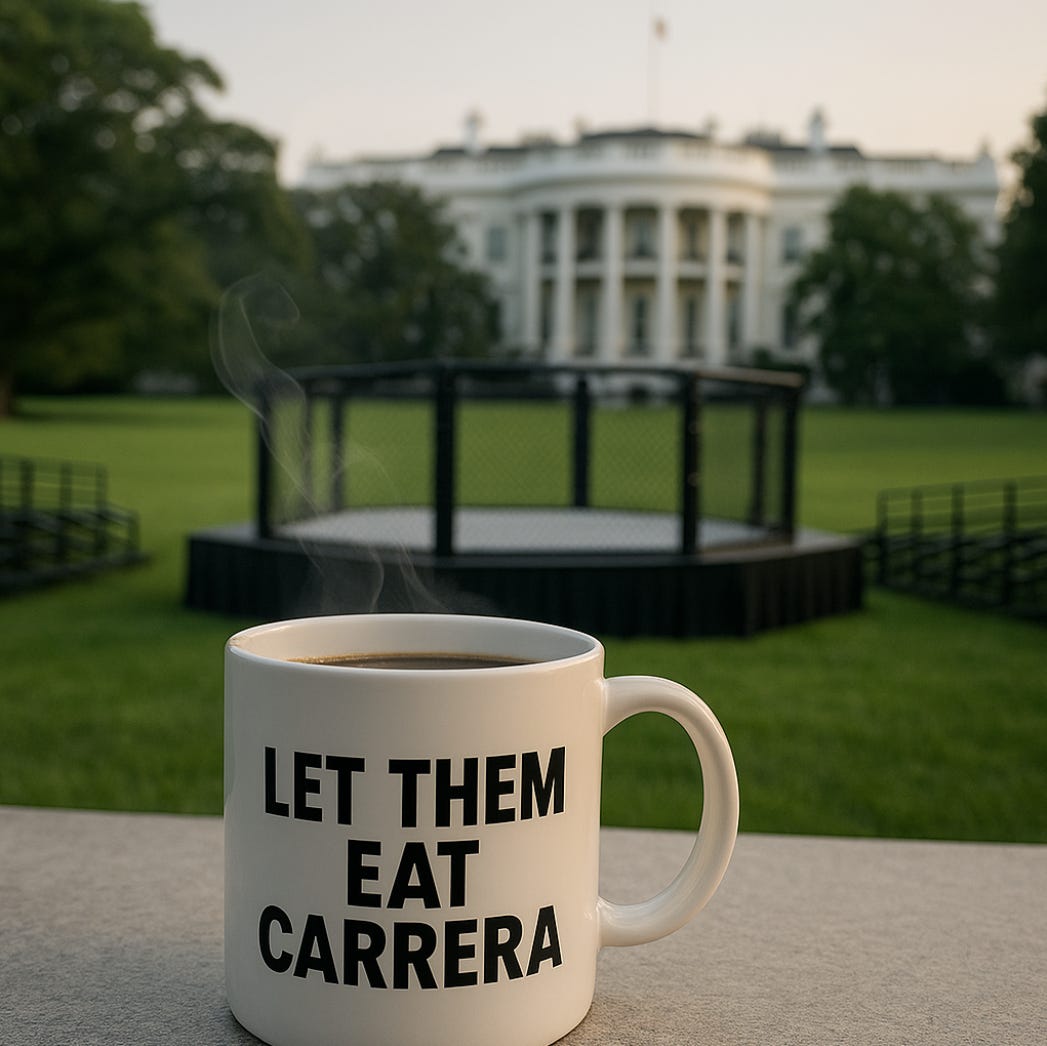
The president’s big idea for America’s 250th anniversary is to build a UFC cage-fighting arena on the White House lawn, because what is democracy if not a backdrop for Dana White’s Pay-Per-View Patriotism? He swears it’s not about his birthday falling on the same date. Absolutely no one believes him.
So here we are once again, watching the spectacle while the fire burns behind it. Trump wanders through the nation’s cultural institutions like an inspector of wainscoting while the economy buckles. Hegseth offers military theory for a nation that didn’t ask for war, and in fact voted for peace. The Supreme Court polishes the crown. And Americans, who just want a doctor they can afford and a place to live that doesn’t require an organ donation, get to hear about marble dust and HVAC units donated by grateful corporations.
Let them eat Carrara.
Today I heard that he has changed the days that are fee free for visitors to the National Parks. Surprise, surprise; Martin Luther King, Jr. Day and Juneteenth are now not included but his birthday is! If people don’t see the outrageous message and absurdity in this move then we are truly sunk. He also wants to charge an additional fee of $100 for non resident visitors. How is that going to work? Is everyone going to have to show their “papers” to gain entrance? Imagine that slippery slope. No wonder he never sleeps - needs 24 hours a day to devise the next obscene affront to our lives.
Your bit on Hegseth is exactly right — the whole thing mirrors what I wrote about the “Don’t Think, Don’t Ask, Just Shoot” doctrine. Hegseth wraps recklessness in the language of “realism,” the same way he wrapped the SignalGate leak in “totally exonerated” spin after accidentally adding an Atlantic reporter to a live ops group chat.
Your Risk-board analogy is perfect: in his worldview, rules of engagement are “handcuffs,” legality is optional, and war crimes become “policy differences.” It’s the same logic he used for the four Venezuela strikes — boast first, deny later, blame the admiral, then summon the Fog of War like a personal smoke machine.
And he gave it all away with his: “Lethality Isn’t Everything — It’s the Only Thing.”
https://jaywilson1.substack.com/p/the-secretary-of-war-crimes?r=10sd39