

Good morning! Sixty economies, the Trump administration announced late Thursday, had failed to “impose and effectively enforce a prohibition on the importation of goods produced with forced labour.”
The United States would therefore impose tariffs of 10% or 12.5% on goods arriving from those economies, encompassing more than 80 countries when the European Union’s members are counted individually.
Forced labor is not some technical disagreement over customs paperwork. It encompasses slavery, coercion, debt bondage, threats, confiscated passports and workers trapped in conditions they cannot safely leave. The administration presented its new tariffs as a moral intervention on behalf of people exploited in global supply chains.
During roughly the same period, at home, the Trump administration suspended enforcement of a Biden-era rule granting additional protections to foreign farmworkers legally employed through the H-2A visa program. It then proposed rescinding parts of that rule.
Under pressure from the agricultural industry, the administration also reduced the hourly wage rates required under the program, a change it expects will save farmers more than $2 billion a year. According to the Economic Policy Institute, those savings could cost individual H-2A workers as much as 32% of their annual wages.
The workers affected are especially vulnerable because their legal status, livelihood, housing and transportation can all be tied to the employers or labor contractors who brought them into the country.
Industry lawyers and lobbyists are seeking still more reductions in wages, regulations and worker protections. One attorney involved in that effort recently acknowledged that, unless Congress changes the law, the Labor Department “can only fiddle around the edges.”
One Georgia farmer complained that H-2A policy seemed designed “solely” for the benefit of migrant workers.
There is a sentence that answers itself.
The program allows American farms to recruit foreign workers temporarily while establishing minimum standards intended to prevent their desperation and dependence from becoming a business model. Naturally, some employers regard protecting the workers as a design flaw.
So there is the ledger, stated without embellishment.
Forced labor abroad: an urgent moral crisis requiring tariffs on much of the world.
Exploited foreign labor at home: an expensive regulatory burden requiring cheaper wages and fewer protections.
Representative Linda Sánchez supplied the transition the administration would prefer we not make. Trump, she noted, has weakened federal efforts to combat forced labor and rolled back domestic worker protections while applying essentially the same tariff rate to countries with radically different records.
“If he was serious,” Sánchez wrote, he would not treat China and Australia as though they presented comparable forced-labor problems.
Then came the dagger:
“Then again, unlike China, Australia doesn’t manufacture any Trump corporation products.”
Nor does the administration need to inspect distant supply chains to locate a serious forced-labor question.
The Thirteenth Amendment abolished slavery and involuntary servitude “except as a punishment for crime whereof the party shall have been duly convicted.” The Constitution Annotated describes that exception as permitting the government to compel a person convicted of a crime to perform labor.
International labor standards are considerably less accommodating. The International Labour Organization says incarcerated people working for private businesses must consent freely, must be able to refuse without punishment or loss of privileges, and should work under conditions resembling a free employment relationship.
The broader American prison-labor system raises its own coercion problem.
A 2022 investigation by the ACLU and the University of Chicago Law School estimated that roughly 800,000 people work while incarcerated in state and federal prisons. The report found that, for non-industry prison jobs, the average minimum hourly wage was 13 cents and the average maximum was 52 cents. Seven state prison systems paid nothing for the vast majority of work assignments.
That labor produces more than $2 billion annually in goods and commodities and over $9 billion in services used to maintain the prisons themselves. Among the incarcerated workers surveyed, 76% reported facing punishment, including solitary confinement, loss of family visits or denial of sentence reductions, if they declined or were unable to work.
More than 80% of that labor consists of general prison maintenance, janitorial work, food service, laundry and grounds upkeep that subsidizes the cost of incarceration itself. A smaller share supports public agencies. A narrower share still flows through private industry.
All of it exists beneath a constitutional exception written during Reconstruction and retained by a country now taxing Australia for insufficient vigilance against forced labor.
Several states have removed similar punishment clauses from their own constitutions, though the federal exception remains. The country has therefore begun debating whether compelled prison labor belongs in a constitutional order that claims to prohibit involuntary servitude everywhere else.
Trump’s tariff policy skips over that uncomfortable domestic examination. Forced labor becomes an intolerable affront when discovered in another country’s supply chain and a constitutionally permitted source of cheap labor when found behind an American prison wall.
The moral emergency only begins at customs.
H-2A exploitation is not automatically forced labor as a matter of law, and it would be careless to pretend otherwise. But the administration’s treatment of its own visa-dependent agricultural workforce offers something close to a control group for testing the sincerity of its newly discovered humanitarian concern.
When worker protection can serve as the legal foundation for preserving Trump’s tariff wall, exploited labor becomes a moral emergency. When protecting workers might require American employers to spend more money, the same concern becomes bureaucratic overreach.
Foreign suffering supplies the rhetoric. Domestic vulnerability supplies the discount labor.
That does not prove the administration has no concern whatsoever about forced labor. Large governments contain many people doing serious work for serious reasons. But it does demonstrate that worker welfare is not the principle consistently organizing Trump’s policies.
The consistent principle is finding a legally defensible way to keep his tariffs alive.
Forced labor is the costume. The tariff is the character who keeps returning for another scene.
The timing makes the performance particularly difficult to take seriously.
Trump’s original “Liberation Day” tariff regime relied on the International Emergency Economic Powers Act, a law no previous president had interpreted as granting unilateral authority to impose sweeping global tariffs. The Supreme Court rejected that theory in February, ruling 6–3 that the power to impose broad peacetime tariffs still belonged to Congress.
The ruling set in motion refunds estimated at roughly $165 billion for duties collected under the invalidated regime.
A normal administration might have treated that as a signal to reconsider the policy. Trump treated it as a signal to find a different statute.
Almost immediately, he imposed a nearly universal 10% tariff under Section 122 of the Trade Act of 1974. That authority was designed for narrow balance-of-payments problems and could be used for only 150 days without congressional approval.
A federal court found that Trump had not satisfied the law’s requirements, although it allowed the tariffs to remain temporarily while the government appealed. Congress made no move to extend them. At one minute past midnight Friday morning, the statutory clock ran out.
Fortunately for Trump, his concern about forced labor matured at precisely the moment his 10% global tariff was about to disappear.
The replacement tariffs took effect immediately.
What an extraordinary coincidence.
Trump has not learned that tariffs raise prices, disrupt supply chains or invite retaliation. He has not learned that Congress possesses powers the Constitution did not assign to the man sitting behind the Resolute Desk. He has not even learned that repeatedly losing in court might suggest a problem with the underlying policy.
He has learned that each tariff needs a new statutory costume and a thicker severability clause.
The Financial Times describes him as rebuilding the tariff wall the Supreme Court knocked down. The New York Times offers an even clearer picture: Trump’s trade war is no longer a single wall but an overlapping maze of legal authorities, special duties, industry restrictions and country-specific punishments.
Section 301 now supplies the forced-labor tariffs of 10% or 12.5% on 60 economies. Another series of Section 301 investigations targets the European Union and 15 countries for alleged industrial “excess capacity,” with more tariffs expected later. A separate Section 301 action imposes duties on Brazil, after Trump repeatedly complained about the prosecution of his political ally Jair Bolsonaro.
Section 232 supports national-security tariffs on steel, aluminum, automobiles, pharmaceuticals, lumber, furniture, semiconductors and a growing assortment of other products apparently vital to the defense of the republic, including bathroom cabinets.
Section 338 of the Tariff Act of 1930 has now been pulled from the attic to support a planned 50% tariff on selected Canadian goods.
The White House is no longer conducting trade policy so much as hosting an estate sale for obscure statutory authorities.
Every old provision must go. Delegations are stretched beyond recognition, dusty statutes hauled back into service, and congressional silence treated as permission.
The tariff remains under the cup. Only the statutory citation moves.
Canada provides a particularly elegant example of the resulting incoherence. Goods compliant with the United States-Mexico-Canada Agreement are generally exempt from the new forced-labor tariffs. But some of those same goods may be hit by Trump’s separate 50% Canadian tariff beginning in August.
Canada can therefore comply with Trump’s own trade agreement and still be punished under another law because Trump has decided that his agreement is insufficiently deferential to Trump.
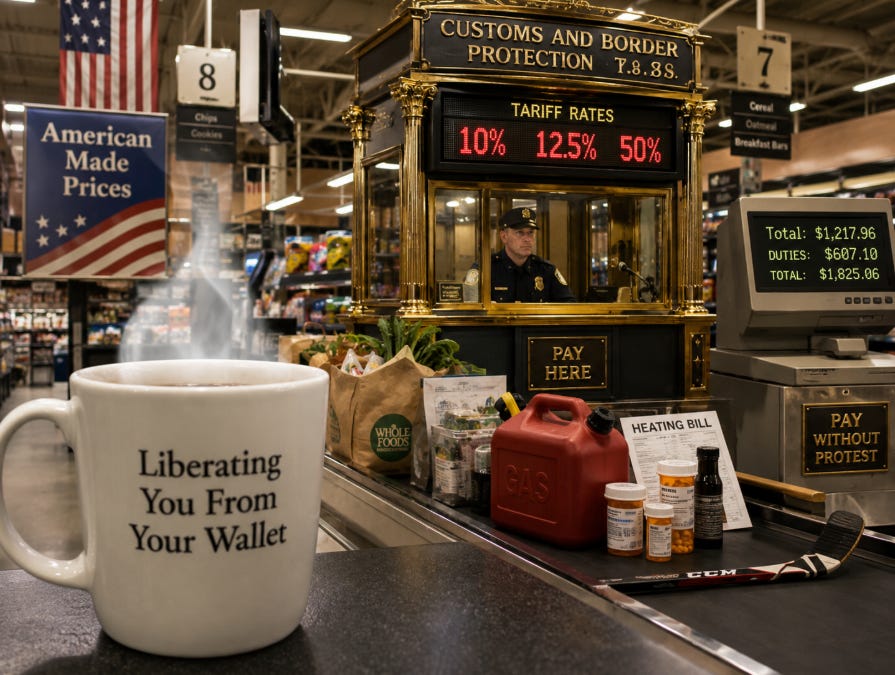
The administration says the Canadian tariffs are necessary because Canada discriminates against American industry. Among the products reportedly targeted are wine, paper, plywood, dairy products, cement and hockey sticks.
Building materials, groceries and youth sports equipment: the unlikely front line of American renewal.
The exemptions built into the larger tariff system reveal another truth the administration denies whenever someone asks directly who pays these taxes. Oil, gas, fertilizer, scarce goods and products already subject to other duties receive various carve-outs because the White House understands perfectly well that indiscriminate tariffs can cause shortages, raise costs and damage American businesses.
The administration insists foreigners pay the tariffs. Its own exemption list reads like an inventory of the costs it fears Americans would notice.
Trump’s trade representative, Jamieson Greer, demonstrated the official level of denial during a Senate hearing this week. Asked by Elizabeth Warren whether tariffs had increased prices for American families, Greer answered, “No.”
Senator John Cornyn, a Texas Republican nearing the end of his Senate career and therefore temporarily liberated from the obligation to pretend gravity is optional, offered a different answer.
“There’s no question that tariffs on imports raise prices,” Cornyn said.
This is not a particularly radical economic insight. Tariffs are taxes collected from American importers. Companies may absorb some of the cost through lower profits, pressure suppliers to accept less, shift production or pass the expense to consumers. Usually the burden is distributed among those possibilities.
The foreign government does not arrive at a Treasury Department window carrying an oversized ceremonial check while a Marine band plays “Hail to the Chief.”
Americans pay the tariff. Trump merely decides whom they should blame for the receipt.
That would be damaging enough during a period of economic calm. Unfortunately, Trump has chosen to rebuild his tariff wall just as the renewed war with Iran delivers another price shock.
For a few brief weeks, the economy seemed to be catching its breath. Energy markets had started to settle. Gasoline and jet-fuel prices were retreating from their spring highs. Inflation cooled in June, including the largest one-month decline in consumer prices in six years.
The respite, alas, did not survive contact with Trump’s foreign policy.
Renewed fighting with Iran has pushed global oil prices toward $100 a barrel. The national average gasoline price has climbed above $4 a gallon. Shipping through the Strait of Hormuz has again slowed dramatically, threatening higher costs for transportation, fertilizer, manufacturing and nearly every product that must travel from one place to another, which, inconveniently, is most of them.
Consumer prices were already 3.5% higher in June than a year earlier, well above the Federal Reserve’s 2% target. Economists had expected inflation to continue easing as energy prices declined. Now they are warning that prolonged hostilities could keep prices elevated and complicate the Fed’s decisions.
Households using heating oil may face especially painful bills this winter. One industry association estimates that if crude remains near $100 a barrel, the average cost of heating an oil-dependent home could rise from roughly $1,100 last winter to about $1,700.
Lower-income households will feel the damage first and longest because energy, transportation and food consume a larger portion of their budgets.
Into that environment Trump has introduced another broad tax on imports.
The Yale Budget Lab estimates that Trump’s evolving Section 301 tariff scenario could cost the average household roughly $1,100 annually, compared with about $550 under current law.
Trump insists inflation is “way down.”
He also promises that energy prices will fall below where they were when he took office.
“But just give me a little time,” he told supporters in Georgia this week.
He needs more time to finish liberating whatever remains in the family checking account.
Representative Brendan Boyle, citing an estimate from Democratic staff of the Joint Economic Committee, said the average family had already spent $3,500 more because of inflation, tariffs and the Iran war. That figure measures a cumulative burden already incurred, while the Yale estimate projects an annual cost under the new tariff scenario. Different calculations, same pocketbook.
Trump’s administration has now positioned the economy between two policy-driven price shocks. The war sends oil, gasoline, fertilizer, shipping and heating costs upward. The tariffs raise costs on goods imported from nearly every major trading partner.
Then the president stands at a rally and asks for applause because inflation briefly declined before the consequences of his latest decisions arrived.
It is the economic equivalent of setting two ends of the house on fire and bragging that the living room was comfortable yesterday.
The American economy has shown remarkable resilience. Analysts still expect growth this year. Employers continue adding jobs, though more slowly than before. Consumers continue spending because consuming food, fuel and shelter remains stubbornly mandatory.
Resilience is not an inexhaustible natural resource, and it should not be mistaken for an invitation to inflict another round of damage.
Trump seems to treat every surviving economic indicator as proof he hasn’t pushed hard enough.
Gas prices fell? Resume the war. Inflation cooled? Tax imports. Courts struck down the tariffs? Find another law. Families complain? Tell them China is paying.
The tariff story has become about more than tariffs.
Trump devotes extraordinary creativity, persistence and federal manpower to schemes that collect money, create leverage, punish perceived enemies or force governments and businesses to negotiate directly with him. His administration can scour a century of trade law for dormant authorities, construct dozens of theoretically separate tariff actions, design elaborate carve-outs and prepare severability provisions for the litigation everyone knows is coming.
Imagine if half that energy were directed toward governing.
Housing remains unaffordable in much of the country. Healthcare costs continue climbing. Communities struggle with infrastructure, disaster preparedness and increasingly destructive climate events. Families are paying more for insurance, utilities, groceries and transportation.
Those problems require sustained administration, congressional cooperation, technical competence and policies whose success might not produce a gold-plated signing ceremony.
Naturally, they receive less attention than discovering whether a provision from 1930 can be used to slap a 50% tariff on Canadian hockey sticks.
Governing requires solving problems. Extraction requires only finding another tollbooth.
That is the governing philosophy taking shape here. Trump treats the federal government as a vast collection agency equipped with an Army, a trade representative and access to Westlaw. Foreign countries are presented with demands. Businesses seek exemptions. Industries plead for protection. Donors seek access. Consumers pay the resulting costs while the president declares that everyone else has been defeated.
The new forced-labor rationale is especially cynical because it takes an actual human-rights abuse and converts it into another instrument of presidential discretion.
Richard Neal, the ranking Democrat on the House Ways and Means Committee, called the justification “too convenient to be taken seriously.”
The documentary record makes that sound less like partisan rhetoric than a restrained description.
The administration did conduct formal investigations. USTR did produce notices and findings. The tariffs are not imaginary, and neither is forced labor. But the breadth, timing and near-uniform rates make the actual purpose difficult to miss.
A genuine forced-labor enforcement policy would identify particular products, industries, companies and supply chains associated with abuse. It would distinguish carefully between governments based on their laws, enforcement records and exposure to exploited labor. It would strengthen the agencies responsible for investigating violations and protecting workers.
Trump’s policy instead divides most of the trading world into two remarkably convenient categories: 10% and 12.5%.
China and Australia can receive the same rate. The European Union, Canada, India and the United Kingdom land in another broad bucket. The 10% tariff happens to reproduce the global duty that expired at midnight.
The humanitarian concern may exist somewhere inside the federal bureaucracy. The tariff rate was apparently nonnegotiable.
And so we arrive at the actual labor principle governing this administration: worker exploitation is objectionable when committed by a foreign competitor and profitable when it reduces costs for a favored American industry.
Trump cares deeply about exploited foreign workers, provided they remain foreign enough that American employers are not expected to pay them properly.
The Supreme Court struck down his tariff wall. Congress declined to preserve its temporary replacement. Trump’s lawyers rebuilt it anyway, one statute at a time, while the administration invoked abused workers abroad and weakened protections for vulnerable workers at home.
At the same moment, his war is pushing energy prices higher, his tariffs threaten another round of inflation, and his economic officials continue insisting American consumers will not pay the bill.
“Liberation Day” has become Extraction Day.
Foreign governments receive the accusations.
American families receive the invoice.
This comprehensive essay underscores how manipulative and cynical Trump’s seditious operatives are in cherry-picking “legal” language to get around constraints on their free exercise of power.
As a lawyer, I can say without hesitation words in legal documents and legislation can mean anything if cited in bad faith for a particular agenda. The law has interpretive guidelines that provide some protection against absurd claims, but the legal process isn’t set up for the avalanche of absurdities this administration is orchestrating with intent.
The ACLU, Democracy Defenders (Norm Eisen), Mark Elias’s firm, and other legal groups challenging this administration in courts across America are heroes in the fight for justice and sanity.
What a mess he has made with the express agreement of the Republican Congress who seem in a trump trance unless like Cornyn, you are on your way out. This speaks so loudly for term limits of some kind and campaign financing. Without these. we appear to be doomed to continue making mistakes regardless of the party in charge. We are in the thick of being governed by a gerontocracy of men and women who will not live to see what they have wrought. They have not planted enough trees for the comforting shade of our younger inhabitants. So sad! :(