


Good morning! Jack Smith finally put the case against Donald Trump on the record, calmly, under oath, in full sentences, before Congress, and therefore before history.
Smith appeared before the House Judiciary Committee speaking softly enough at times that transcription software struggled to keep up, armed with nothing more than a legal pad, a pen, and the kind of prosecutorial discipline that comes from having already tried the case in your head, and knowing exactly where the evidence leads. Smith never raised his voice, no matter how often Republican members tried to provoke him, and he was not partisan. That is precisely why his testimony landed like an indictment. He simply stated, again and again, what his investigation found.
“President Trump was charged because the evidence established that he willfully broke the law,” Smith said at the outset. “No one should be above the law in this country, and the law required that he be held to account. So that is what I did.”
Smith told Congress that his investigation developed “proof beyond a reasonable doubt” that Donald Trump engaged in criminal activity to overturn the 2020 election and prevent the lawful transfer of power. He did not hedge that conclusion. Proof beyond a reasonable doubt is the highest standard in American criminal law, and Smith invoked it deliberately, repeatedly, knowing exactly what it meant.
Central to that proof was Trump’s state of mind. Smith was unequivocal: Trump knew he lost the election. He was told by his own attorney general, and by senior Justice Department officials, and by his campaign advisers. Even Republican state officials who had voted for him, campaigned for him, and wanted him to win made it clear to him he had lost. Trump privately acknowledged the loss, gesturing at Joe Biden on television and asking, “Can you believe I lost to that effing guy?”, and then proceeded to lie anyway.
“Our proof was that he knew his claims were false,” Smith testified, “and we intended to prove that at trial.”
This was not, as defenders still insist, a case about sincerely held beliefs or protected political speech. Smith addressed that head-on. The First Amendment, he explained, does not protect speech used to facilitate crimes. Fraud is carried out with words. Conspiracies are coordinated with words. Dressing criminal conduct in rhetoric does not transform it into constitutionally protected expression. Courts have been clear on this point for decades, even if cable news has not.
Smith’s most damning testimony came when he addressed January 6 directly.
“Our investigation revealed that Donald Trump is the person who caused January 6,” Smith said. “That it was foreseeable to him, and that he sought to exploit the violence.”
That sentence alone will be cited for years. “Caused.” “Foreseeable.” “Exploited.” This is the language of criminal causation, not political commentary. Smith explained that when the violence began, Trump did not act to stop it. Instead, he and his allies worked the phones, not to call in the National Guard, but to call members of Congress, urging them to delay certification and nullify the election results. The violence was not an interruption of the scheme; it was folded into it.
Throughout the hearing, Republicans tried, and failed, to move Smith off this terrain. They yelled about process, fixated on subpoenas for phone metadata, and demanded explanations for nondisclosure orders. They asked who swore him in and when, then accused him of “weaponization,” of “lawfare,” of stretching statutes, of personal vendettas. Then they attacked witnesses from the January 6 committee, particularly Cassidy Hutchinson, whose testimony Smith did not rely on, as if discrediting a single account could undo an entire evidentiary record built largely on Republican testimony.
Smith did not take the bait. He corrected misstatements, and he kept returning to the same factual core.
The toll records, he explained, were non-content metadata, who called whom and when, sought to corroborate evidence that Trump directed Rudy Giuliani and others to contact members of Congress as part of the scheme to obstruct certification. Had Trump called Democrats instead of Republicans, Smith noted dryly, he would have subpoenaed Democrats’ records, too. Conspiracies do not receive constitutional exemptions based on party affiliation.
When asked whether partisan politics played any role in his decisions, Smith’s answer was as flat as it was final: “None.”
And when asked whether he would prosecute a former president again on the same facts, regardless of party, Smith did not hesitate. “I would do so,” he said.
At one point, Smith acknowledged the environment in which he was testifying, an environment shaped by Trump’s public threats, calls for disbarment, and promises of retribution. “The statements are meant to intimidate me,” Smith said. “I will not be intimidated.” He added that such threats were also “a warning to others what will happen if they stand up.”
That warning was no abstraction. During a recess in the hearing, former Metropolitan Police officer Michael Fanone, who was beaten by rioters on January 6 and suffered a heart attack during the attack, was confronted by Ivan Raiklin, a well-known election denier and conspiracy activist. Fanone accused Raiklin of threatening his family and children, including explicit threats of sexual violence, prompting a security response and increased Capitol Police presence in the room.
The incident was brief, unsettling, and clarifying. While Republicans accused prosecutors of overreach and minimized January 6 from the dais, the threat environment Smith described materialized in real time, inside the hearing room, directed at the very officers who defended the Capitol. History has a sense of timing.
Someday, with luck, a summary of this testimony will hang beneath Donald Trump’s portrait, not as commentary, but as caption. Because by the end of the day, Jack Smith had done what Republicans quietly feared and the courts were never allowed to do: he put the case against Donald Trump into the permanent congressional record, line by line, without theatrics and without apology. He did not debate or emote, just stated what the evidence showed, what the law required, and why he acted. History can argue with many things, that record will not be one of them.
Despite that record and after new polls showed his approval sinking into the mid-30s, Trump hopped on Truth Social to declare “RECORD NUMBERS” and ask whether he should “try for a fourth term,” apparently counting the 2020 election he lost as a presidency because reality is optional now. The Constitution’s 22nd Amendment still caps presidents at two elected terms, but that hasn’t stopped Trump from openly testing how normalized constitutional disregard has become. Instead of responding to voter discontent, he’s attacking “fake polls,” threatening lawsuits against media outlets, and workshopping term-limit denial in public.
Then, in stark contrast to Smith’s testimony the Trump administration was proving there really is no depth to which they will not sink, whether they’re staging pretend global summits for ego gratification or digitally manipulating arrest photos like a third-rate authoritarian meme factory.
On Thursday, Donald Trump rage-uninvited Canada from his so-called “Board of Peace,” an imaginary international body he unveiled at Davos with the solemnity of a child unveiling a treehouse clubhouse and insisting it be recognized by the United Nations. In a Truth Social post addressed directly to the Canadian prime minister, Trump announced: “Please let this Letter serve to represent that the Board of Peace is withdrawing its invitation to you regarding Canada’s joining, what will be, the most prestigious Board of Leaders ever assembled, at any time.” One almost expects the next sentence to read PS you can’t sit with us.
During Trump’s rollout of the “Peace Board” at Davos, a venue already strained by the weight of his self-regard, his son-in-law Jared Kushner quite literally presented a slideshow of a rebuilt Gaza that looked less like postwar recovery and more like a Dubai tourism ad filtered through a Marriott pitch deck. Skyscrapers rose where rubble still sits. Palm trees lined pristine boulevards. Luxury condos gleamed, and swimming pools shimmered. It was Gaza as imagined by a man whose primary experience with the Middle East appears to be beachfront redevelopment fantasies and tax-advantaged shell companies.
This was the visual accompaniment to what Trump declared would be “one of the most consequential bodies ever created in the history of the world.” The premise of the board was simple, deranged, and very on-brand. Trump would chair it. Permanent members would wire him a cool $1 billion each for the privilege. And once assembled, Trump explained with startling candor, “we can do pretty much whatever we want to do.” The board was initially pitched as a temporary mechanism to oversee the governance and reconstruction of Gaza, but like most Trump ventures, it immediately metastasized into a permanent vanity platform, complete with a buy-in fee, no guardrails, and no visible rules beyond Trump’s mood swings and Kushner’s PowerPoint transitions.
Canada, to its mild credit, responded like an adult dropped into a toddler’s birthday party. Mark Carney said Ottawa had accepted the idea “in principle” but wanted to review the structure, the financing, and how exactly this thing was supposed to work, and gently added that Canada was not, in fact, planning to cut a $1 billion tribute check for access to a slideshow and a chair at Trump’s imaginary roundtable. That hesitation was apparently the unforgivable sin.
By Wednesday, Trump was openly snarling from the Davos stage, “Canada lives because of the United States. Remember that, Mark, the next time you make your statements.” By Thursday, the tantrum was formalized. In a Truth Social post that read like a petulant royal decree, Trump announced: “Please let this Letter serve to represent that the Board of Peace is withdrawing its invitation to you regarding Canada’s joining, what will be, the most prestigious Board of Leaders ever assembled, at any time.” Canada was out of the clubhouse, the treehouse ladder pulled up behind it.
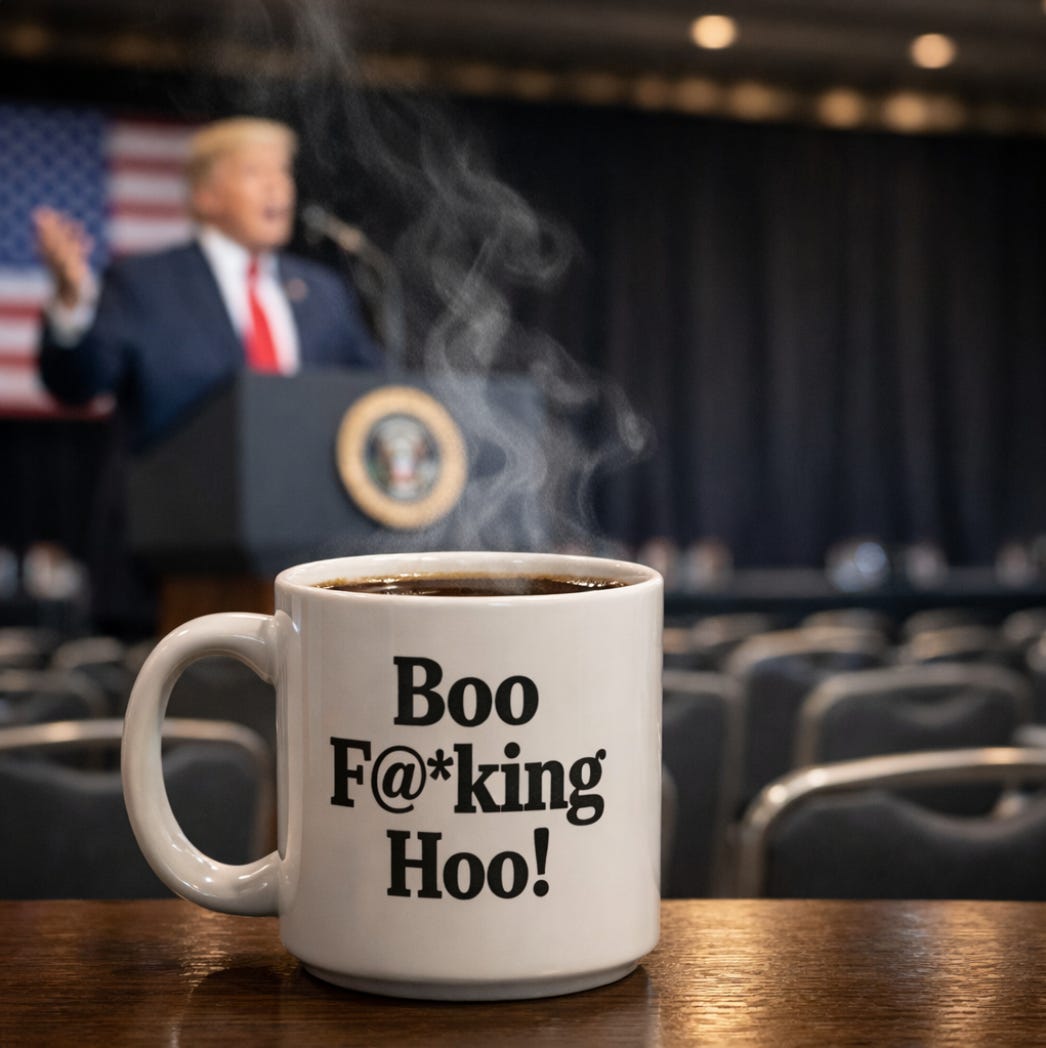
And just like that, a supposedly historic peace initiative, endorsed with glossy renderings, billion-dollar entrance fees, and breathless self-praise, collapsed into exactly what it always was: a grift-shaped mood ring, flashing red the moment anyone declined to clap hard enough or pay on demand. Somewhere in the Canadian internet, the response to Trump’s meltdown was distilled into three immaculate words: boo fucking hoo.
“Canada lives because of the United States,” Trump sneered from the Davos stage, having clearly nursed the insult overnight. Carney replied the next day with the kind of calm, lethal sentence that only enrages narcissists further: “Canada doesn’t live because of the United States. Canada thrives because we are Canadian.” No theatrics, no tantrum, just a reminder that sovereignty is not a subscription service and dignity doesn’t require a buy-in fee.
Britain, France, Italy, and most other liberal democracies quietly declined to join Trump’s prestige HOA as well, leaving the “Board of Peace” populated by a grab bag of transactional strongmen and countries willing to humor him. Even the United Nations hastily clarified that any engagement would be strictly limited and strictly about Gaza, diplomatic shorthand for please don’t drag us into whatever this is.
In the end, Trump didn’t withdraw Canada from a global peace project. He withdrew an invitation to an imaginary club after being told no one was wiring him a billion dollars for the privilege of watching Jared Kushner’s beachfront Gaza slideshow. And the rest of the world, it turns out, responded more or less the same way Canada did: with a shrug, a raised eyebrow, and an increasingly global sense that this is not serious governance, it’s grievance theater with a logo, or worse, full blown dementia.
While Trump was busy play-acting emperor of the world abroad, his administration was doing something arguably darker at home. The White House posted a digitally altered image of a woman arrested at an ICE protest in Minnesota, and did so deliberately, proudly, and without apology. The original photo, posted by Homeland Security secretary Kristi Noem, showed Nekima Levy Armstrong composed as she was escorted by law enforcement. Less than an hour later, the White House reposted the same image, altered to make Armstrong appear sobbing and distraught. Guardian analysis confirmed the images were identical down to the positioning of the arresting officer’s arm and background figures. The only changes were Armstrong’s face, contorted into visible anguish, and her skin tone, darkened just enough to activate every racist trope the MAGA ecosystem relies on.
When asked if the image had been digitally altered, the White House didn’t deny it. They didn’t even pretend. Instead, a deputy communications director responded with open contempt, dismissing concerns and promising that “the memes will continue.” The federal government is no longer merely messaging, it is manufacturing emotional reality and daring the public to object.
This is the throughline that matters. Abroad, Trump is inventing institutions to flatter himself and punish allies who won’t pay tribute. At home, his administration is using AI and digital manipulation to humiliate dissenters, racialize enforcement, and turn arrests into propaganda content. This is what power looks like when it stops caring about persuasion and starts leaning on spectacle, intimidation, and outright fabrication.
Authoritarianism doesn’t always arrive in jackboots. Sometimes it arrives as a “prestigious board,” a meme account with a blue check, and a press secretary reposting a doctored image of a protester to make repression look righteous. Sometimes it arrives giggling, insisting it’s all just jokes, until the jokes are backed by handcuffs, budgets, and the full force of the state.
But there is hope. And there’s Minnesota, cold as hell, resolute as steel, and quietly modeling what collective power actually looks like. A “no work, no school, no shopping” blackout in subzero temperatures isn’t just protest; it’s proof of concept. Labor unions, faith leaders, childcare workers, small businesses, city officials, and families all moving together, not waiting for permission, not outsourcing courage. They aren’t just marching, they are disrupting the economy. They told the truth out loud: when the government won’t stop violence, people will.
This didn’t happen because Minnesotans are uniquely brave. It happened because they organized, listened to one another, and decided that solidarity was worth the inconvenience, and even the risk. That’s the part worth carrying forward. Imagine this model replicated: coordinated days of action, local economic blackouts, community-wide refusals to normalize cruelty. Imagine ICE forced onto the defensive not by speeches, but by empty storefronts, quiet offices, and whole cities saying no.
This is how power starts to shift, not all at once, but unmistakably. Minnesota lit the match. The rest of the country has to keep it going.
Great newsletter today. The first half was so hopeful describing Jack Smith, the coolest cat in the universe, and his steady hand. That was not performance; that was discipline. He made those idiot Republicans look like, well, idiots. And, yes, for history, it is all on the record.
The second half of the newsletter was so different in tone. It seemed to shriek with its descriptions of Twump's behavior like the audience shrieks when the bad man is behind the door. We can see it and our hearts are beating faster, but damn it, why can't that person walking into the room know that the monster behind the door is Twump? Get out!
Everyone should watch the 4 minute presentation that Jared Kushner gave on the "re-building" of Gaza. It was totally disgusting, and Jared comes across as a junior high schooler giving a book report. Note when he talks about all those who are contributing to the PLAN that there are no Palestinians on the Peace Board being asked about their vision for the future of their country. Another way fascism slips past our view.