


Good morning! If today’s news feels like it was assembled by six different editors who have never spoken to each other, that’s because it was. Depending on where you look, we are either on the brink of a global recession, in the middle of a triumphant stock market rally, negotiating peace with Iran, not negotiating with Iran at all, being stalked by shadowy forces targeting scientists, or… bringing back firing squads.
Let’s start with the small matter of the global economy hanging by an oil tanker. The war with Iran has now tightened the Strait of Hormuz to where something like normal no longer applies. A critical artery of global energy supply is choked, oil is hovering around $100 a barrel, gasoline in the U.S. has crossed $4, and the world’s top economic institutions are gently clearing their throats and using phrases like “recession risk” in the tone one might use to describe a hurricane that has already made landfall. The International Energy Agency is calling this the largest energy crisis in history, with hundreds of millions of barrels effectively removed from circulation and infrastructure damage that could take months or years to repair.
Somehow, this is also being presented as a diplomatic breakthrough. Donald Trump says Iran is preparing an offer that will satisfy U.S. demands. His envoys are being dispatched to Pakistan. The White House is projecting momentum, progress, and forward motion. Iran, on the other hand, is saying: we are not negotiating, do not call this negotiation, we will not negotiate until the United States lifts its blockade. We have, once again, two parallel realities: one in which a deal is forming, and another in which the premise of the deal does not exist.
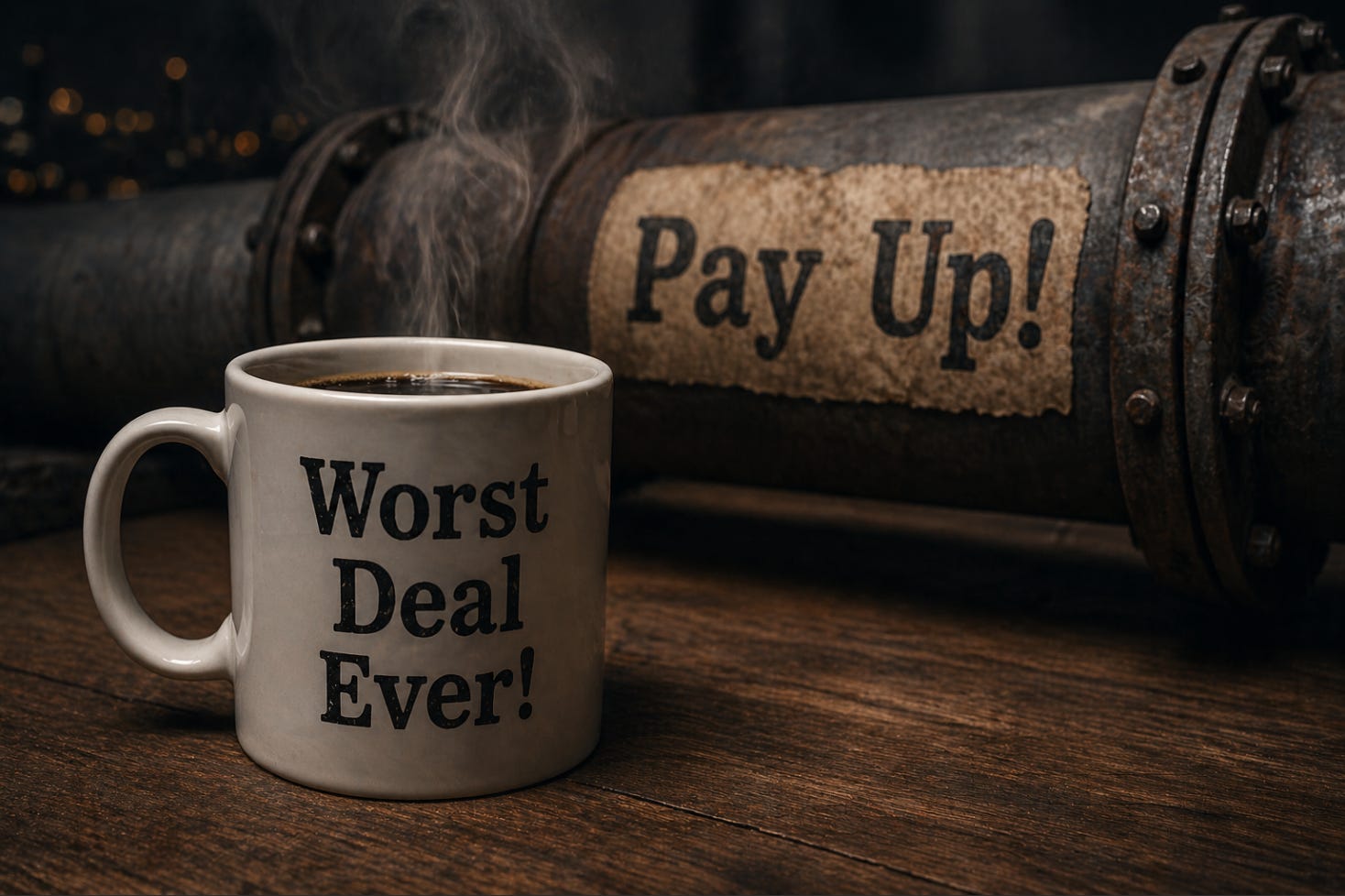
This might be easier to take seriously if we weren’t also dealing with the small historical footnote that the current crisis is, in large part, self-inflicted. The Obama-era nuclear deal, imperfect, limited, and politically unpopular in certain circles, nonetheless forced Iran to ship out roughly 97 percent of its uranium stockpile, leaving it without enough material for even a single bomb. Then Trump tore it up, declared it the “worst deal ever,” and replaced it with nothing. Iran responded by enriching uranium “with a vengeance,” building up a stockpile now measured in tons, enough, with further processing, for dozens of nuclear weapons.
So here we are: the same administration that dismantled the system containing Iran’s nuclear program is now attempting to negotiate the elimination of a stockpile that grew because that system was dismantled. This is a man trying to negotiate with the consequences of his own decisions and insisting, loudly, that the new deal will be better than the one that prevented the problem in the first place.
In a completely different universe, one located somewhere between Wall Street and the collective denial of reality, everything is apparently going great. The Nasdaq is up 15 percent this month. The S&P 500 is hitting record highs. Tech stocks are soaring on the back of AI enthusiasm, and investors have decided that the United States can simply power through an energy shock because it produces a lot of oil and really likes semiconductors.
To be clear: the same moment that is producing warnings of recession, disrupted global supply chains, rising inflation expectations, and gasoline prices creeping upward is also producing what Bank of America politely describes as “bubble-like price action.”
Even central bankers are starting to sound uncomfortable. Bank of England Deputy Governor Sarah Breeden, whose job description does not typically include public anxiety, has warned that markets appear to be ignoring multiple overlapping risks. Translation: asset prices are behaving as though nothing is wrong, while a number of very large things are, in fact, wrong.
It’s almost impressive. The market has looked at war, oil shocks, supply chain disruption, and tightening financial conditions and concluded: have you considered buying more chips?
Which brings us to the part of the story that should be obvious by now but somehow isn’t. If one war can push the global economy toward recession because oil shipments slow down, refineries get hit, and shipping lanes become geopolitical choke points, then fossil fuels are not a source of stability. They are a structural vulnerability.
Even as this becomes painfully clear, the United States is managing to trip over its own solutions. Across the country, solar projects, cheap, scalable, and increasingly essential, are being stalled or blocked because of unfounded health fears. Critics warn about electromagnetic radiation, contamination, noise, and other hazards, even though environmental lawyer Michael Gerrard put it bluntly: “there’s no basis for that.” One farmer whose solar lease was blocked was even more direct: “The health and safety issue… that is just a joke.”
Yet, the fear works. As Arizona State law professor Troy Rule noted, restrictions on solar development are spreading nationwide, often rooted in “misinformation or unfounded fears.” Public officials do not always test those claims against evidence. In St. Clair County, Michigan, one administrator warned that the county medical director’s memo “did not address the question or provide support” for the alleged risks. Another local official accepted it anyway.
While not every local solar fight can be traced to fossil-fuel money, the broader pattern is not exactly subtle. The Energy and Policy Institute has documented fossil-fuel interests, dark-money networks, and allied front groups working to block wind and solar projects before they are built, while earlier ProPublica reporting found a retired gas-industry executive and a “grassroots” group spreading misinformation against an Ohio solar project.
This is not merely organic local anxiety; it is anxiety made politically useful. The public-facing message is health and safety; the material result is delay, scarcity, and protection for the fossil-fuel business model. The health concerns may be unfounded, but the economic incentives are not.
You could stop there and call this a misinformation problem, but it’s more than that. Solar doesn’t just generate electricity; it disrupts an established business model. It reduces dependence on extraction, centralization, and scarcity, the very conditions that have historically made fossil fuels so profitable. So instead of adapting, the system does what it does best: it manufactures doubt, amplifies fear, and slows the transition just enough to preserve existing revenue streams.
Industry-specific economic incentives remain, and that’s how you end up in a world where a global energy crisis is unfolding in real time, and we are still arguing about whether the sun is dangerous.
If the economic reality is fragmented, the informational reality is something closer to… interpretive fiction. A conspiracy theory about missing and dead scientists, originating in the usual corners of the internet, has now made its way into the White House. The theory suggests a coordinated pattern of disappearances tied to sensitive research. The problem is that there is no evidence linking the cases, many of which already have explanations ranging from unrelated crimes to simple misidentification. But that hasn’t stopped it from being taken seriously enough to prompt investigations and public commentary from the president.
This is the pattern: speculation becomes narrative, narrative becomes repetition, repetition becomes “something we’re looking into,” and suddenly the absence of evidence is just another detail to be resolved later.
Which brings us, inevitably, to the darkest corner of today’s news cycle. While all of this is unfolding, war, economic fragility, informational breakdown, the Justice Department has decided it is a good time to expand the federal government’s execution methods. Not just resume executions, but broaden them: firing squads, electric chairs, gas, alongside the restoration of a previously contested lethal injection protocol.
There are some headlines you can process. This isn’t one of them, because this is not only about law enforcement; it is about moral authority. Taking a life, if it happens at all, is so profound and irreversible that it should never be reduced to bureaucracy, politics, or performance. It belongs, as much as anything human can, to a state of grace, not a checklist in a federal protocol.
The state presents execution as procedure: regulated, justified, operational. But human beings experience death as sacred rupture. What feels so offensive here is the normalization. The bureaucratic flattening of the unthinkable. A government calmly updating the menu of acceptable ways to kill a person, as though this were an administrative modernization rather than an expansion of state violence.
A system that treats killing as tragic is one thing. A system that treats killing as necessary is another. A system that treats killing as normal, even useful, even politically clarifying, even proof of strength, has crossed into something far darker. It’s not just that the machinery of death is being restarted, but that it is being expanded with visible comfort. The method becomes the message, and the spectacle becomes the point. The state is not merely saying it can kill; it is making sure we understand that killing has been reabsorbed into ordinary governance.
Today’s news is dissonant. War is sold as negotiation, markets celebrate risk, and misinformation shapes policy, and the system that underpins all of it, the one that ties energy, economics, and geopolitics together, continues to run on a resource that turns every conflict into a global crisis. We do not have an energy-security system; we have a ransom note with pipelines.
For me, today is a little more grounded. My oldest son, John, is coming to visit and help me wrestle the yards back into submission, front and back. Marz, of course, is thrilled. John is one of the few humans who understands that “playing” with Marz is less a pastime and more a full-contact sport.
So we’ll take the wins where we can: fresh air, dirt under our nails, a dog who thinks life is perfect because someone showed up ready to wrestle.
Enjoy your weekend. Take care of each other. As always, Marz and I hold you all in our thoughts during our moonbeam vigils.
"The sky is falling. The sky is falling"! Not sure if it is yet, but if not, can it be far behind with all the other unthinkable's happening. Your observation's are so keen and spot on that I feel we have a coffee conversation each morning with you doing most of the talking and me, shaking my head and saying occasionally,"Oh, my god"! The unbelievable happens each day and with it comes the eroding of the belief we had in any salvation our laws and constitution could possibly afford us. Trump has shattered lives, dreams, hopes, and laws as he and his administration stagger across the world in lockstep with all the heinous names of the present and past. Can we recover is the question and if so, when?
When I was outside yesterday giving my yard some of the serious attention it is well beyond needing (Spring IS springing), I was struck by how much I have missed and could've already accomplished had I not had so much of my time STOLEN by this last year and a half and the miserable people who are destroying everything. And I thought how possibly about almost the last half of what I may have in my remaining years have been scarred and traumatized by all these lousy f--kers!! Meanwhile, it was great getting so physical and dirty!!
The other thing, in reading this essay, is that it reminded me of how the government of Israel celebrated the acceptance of making hanging of Palestinians and ONLY Palestinians for their crimes legal. They proudly wore gold noose lapel pins! Firing squads, among the menu of other death sentences for our justice system...?...holy crap!