


A tip is a strange kind of courage. Not the cinematic kind, not the kind that makes you feel brave. The kind that makes you feel sick, the kind that arrives with trembling hands and a dry mouth and the conviction that if you don’t say it out loud now, it will rot inside you forever. You don’t call the FBI because you feel powerful. You call because something feels wrong, because a memory won’t sit still, because a name you’ve carried in private has suddenly become public. You call because you saw a face in the news and your body reacted before your mind caught up, heart slamming like a trapped animal, hands going cold, metal in your mouth, time collapsing. You call because you’re trying, late and imperfectly, to protect someone else. You call because silence has started to feel like participation.
In the Epstein case, that kind of courage carries a weight most people can’t imagine. This wasn’t rumor. Jeffrey Epstein’s crimes were real enough to sustain prosecutions in Florida and New York. Real enough to convict an accomplice. Real enough that the government itself has said its review “confirmed that Epstein harmed over one thousand victims.” Over one thousand. Not a scandal, not a headline, a thousand separate nervous systems still bracing for impact. A thousand people whose bodies learned the same lesson: power can do what it wants to you, and you will be the one who has to keep living afterward.
So, when the government announces it will release millions of pages of “Epstein files,” the public treats it like spectacle, like a name hunt, a dirty scavenger hunt for famous people. But if you are a survivor, you don’t hear spectacle. You hear a drawer being yanked open. You hear: We are going to make your pain searchable. You hear: We are going to turn the worst thing that ever happened to you into a public archive. And your first question isn’t “Who else is in it?” Your first question is smaller and more desperate:
Did anyone ever do their job? Did anyone listen when people tried to warn them? Did anyone connect the dots before more children were fed into the machine? Did anyone move fast enough to interrupt harm instead of documenting it afterward? Did anyone treat the girls, the coerced and cornered and groomed, as human beings and not as evidence?
That’s what survivors want, not voyeurism, not gossip. Proof of process, proof that courage was met with action.
But when the files arrive, the thing you need most is the thing you can’t consistently see. We can see tips, allegations, names. What we can’t reliably see is the follow-through, the bridge between we received this and we did something with it. And I need you to understand what that absence does to a person.
Imagine you are the one who makes the call. Imagine you haven’t said the words out loud in years, or maybe ever. Imagine you’ve built a life around not touching it, therapy, EMDR, whatever you had to do to keep functioning. And still there are nights when your body wakes you at 3:17 a.m. like it’s warning you something is coming.
Then you decide to speak. Not because you think it will save you, but because maybe it will save someone else. So, you sit across from an agent and do the thing survivors are always asked to do: translate terror into sentences. Turn fragments into chronology. Drag your nervous system through the details while someone watches you take it apart. You make yourself credible, calm, precise. You try not to cry too hard because you know what people think when women cry; you try not to sound too angry because you know what people think when women are angry. You try to become the kind of victim the world rewards: articulate, composed, believable.
You go home and you can’t eat, or you eat everything. You scrub your skin until it’s raw because your body still feels like someone’s hands are on it. Your relationships strain, your work suffers, you cancel plans, you stare at the wall with your chest full of bees. And you tell yourself: this is the cost of doing the right thing.
Now imagine the government releases “the files,” and you scroll. You see your pain in there, or something like it. You see the kind of tip you made reduced to a line item, your life flattened into “allegation,” formatted like inventory. And you look for one thing: a trace that someone carried your words forward into action. But the bridge isn’t there, or it’s redacted, or it’s inconsistent. Or it vanishes into the fog that always appears when accountability climbs toward power. From the outside, we can’t conclusively prove whether the follow-through exists somewhere unseen or whether it doesn’t. But that inability, the fact that we can’t tell, is the wound.
Because in cases like this, uncertainty is not neutral. Uncertainty becomes an injury. Survivors know what it is to be doubted, to be weighed and measured for credibility, to watch adults protect reputations while young people absorb the cost. So, when the public is shown allegations but denied proof of follow-up, the message doesn’t land as “due process.” It lands as the oldest story: you can give them everything and still be left with nothing.
This is what survivors are asking for when they ask about “transparency.” Not exposure, not volume, but traceability. A visible chain between information received and decisions made. And that’s why the way institutions frame this matters as much as what they release. If DOJ tells the public in advance that some documents contain “untrue and sensationalist claims” about President Trump, it isn’t only warning about misinformation. It is shaping how the public will treat any allegation that points upward, it is pre-loading disbelief. It is teaching people, before they even read, which direction to squint in skepticism.
In a case already riddled with withholding and redactions, that kind of priming doesn’t calm suspicion. It heightens it. Because when allegations climb toward the Oval Office and the trail goes cold, the absence doesn’t read as caution, it reads as protection. Not because anyone has proven that’s what happened, but because that is what opacity communicates in a system with a history of shielding powerful people.
And then, layered on top of that, Trump is telling another story to the world: mess with me and I’ll sue you for billions of dollars. This isn’t abstract bravado, it’s a pattern. Lawsuits and legal threats launched against institutions that displease him, universities, government agencies, media entities, framed as retaliation for “damage,” for reputational harm, for the supposed injustice of information becoming public. In recent days alone, he’s publicly escalated a damages fight with Harvard, and he’s sued the IRS and Treasury for at least $10 billion, claiming that leaks of his confidential tax information caused reputational and financial injury, injury framed as existential, as contaminating, as something the system “did” to him.
In that context, legal action stops being just a tool of redress and becomes a signal. Power doesn’t only defend itself after the fact; it advertises its willingness to punish in advance. And when the person making that threat is the president, it lands not as bluster but as instruction.
So potential victims and witnesses aren’t only being asked to accept that their stories may become public material without visible follow-through. They are being warned, by the most powerful man in the country, about what it costs to speak. Not just emotionally, not just socially, but financially, legally, and existentially. And it does something else, too: it competes for oxygen. If you can keep generating fresh conflict, fresh lawsuits, fresh villains, fresh headlines, you can make the Epstein files harder to hold in the center of the national gaze. You can turn the story into one more weather system passing through, one more outrage among many, until attention diffuses and the missing middle stays missing. You can’t erase what’s in the record, but you can try to bury it under volume.
Which makes the moment in the Oval Office feel less like impatience and more like strategy. When pressed about the Epstein files at a press event, Trump lashed out and told the country to “get onto something else,” to move on. Not answer this, not clarify the process, not show the bridge, Just: stop looking here.
What sharpens the cruelty of that demand is the contrast it exposes. Trump has been quick to describe himself as damaged by disclosures, by documents released, by oversight exercised, and by scrutiny applied. Yet the Epstein case is defined by damage on a scale that dwarfs reputational discomfort: over one thousand victims, according to the government’s own accounting. Those people did not get teams of lawyers; they did not get to frame their harm as an injustice to be avenged. They were not protected from exposure; they were exposed. Their damage was not hypothetical or reputational, it was physical, psychological, and lifelong.
So, when Trump presents himself as a victim of transparency while presiding over a release that makes survivors’ pain searchable without making accountability visible, the message is unmistakable: power will litigate to defend itself, and it will demand the nation look away, but it will not reliably expose itself to protect the powerless.
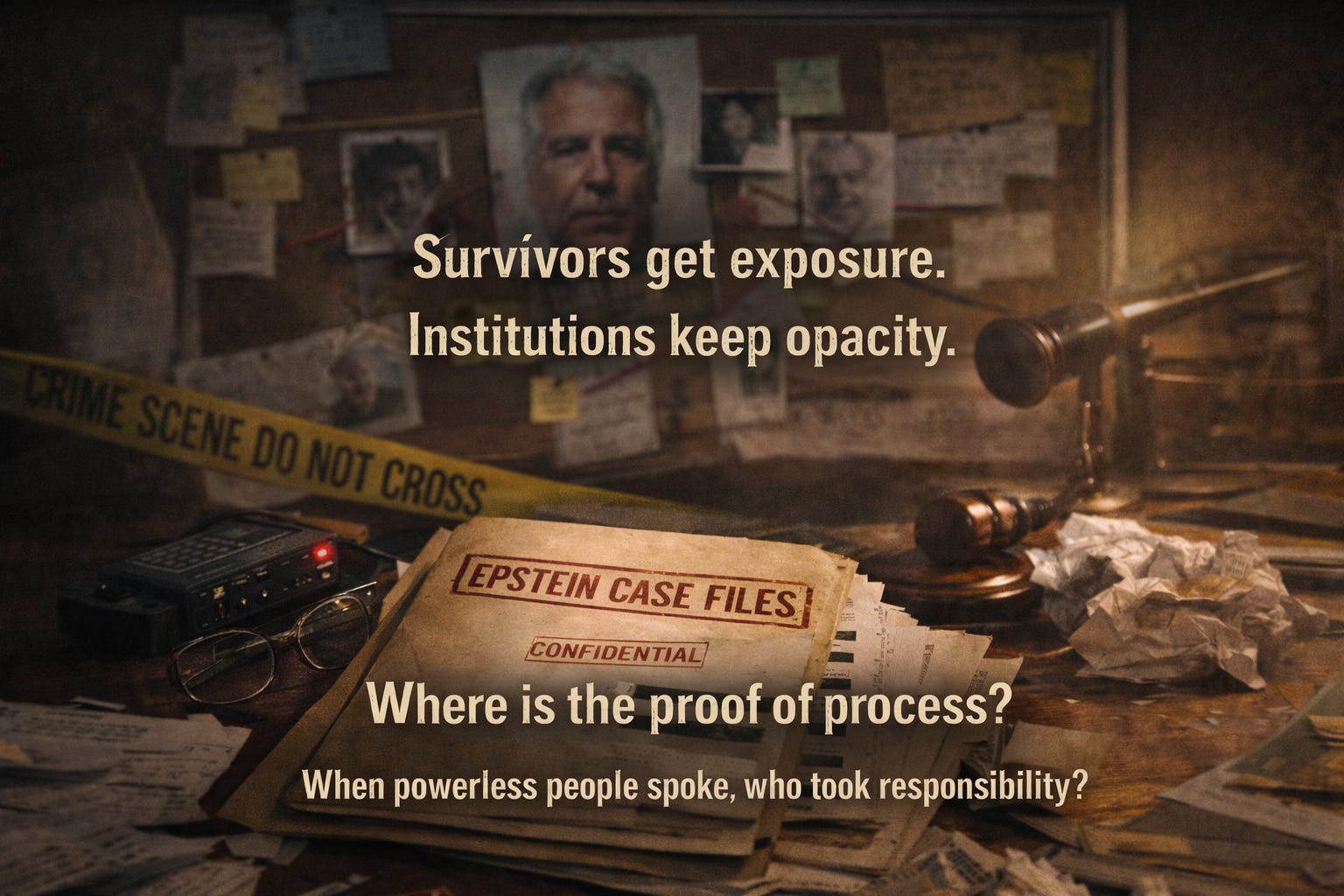
That is how a country manufactures silence: not by banning speech, but by making speech feel like self-destruction. So yes, release documents. But understand what “release” becomes without a bridge. It becomes a flood, it becomes a room filled with paper where no one can see the one thing that would restore trust: proof that when powerless people spoke, someone with power took responsibility for what happened next.
A democracy can live with “insufficient evidence to charge.” It can live with “we investigated and could not corroborate.” Those are outcomes, they are legible, they can be audited. What a democracy, and what survivors, cannot be asked to live with is: trust us, it was handled, while the handling is hidden. Because in a case built on the exploitation of powerless people by powerful ones, the least the government owes is not scandal, not voyeurism, not a searchable archive of pain. It owes proof of process. A consistent, verifiable accounting of what happens after a tip: what was logged, what was checked, what was pursued, what was escalated, what was closed, and why.
Until that exists, we stay in the missing middle, where survivors get exposure and institutions keep opacity; where uncertainty metastasizes; where the absence of transparency becomes its own kind of harm. Because in the end, this is the simplest demand: not that the public be entertained, not that the powerful be presumed guilty, but that the country be able to prove, in a way survivors can see, that courage met action. Proof that when powerless people spoke, the system didn’t quietly decide that power mattered more.
Thank you for so eloquently stating the tragedy that is happening right now. I have no doubt Trump is guilty of atrocious acts against those children, now women. Why would so many lie. Trumps administration are all guilty. They know the truth and choose to ignore it. Now is the time to protest!!
Halfway through today's piece, I couldn't breathe. The cruelty of taking an abused young woman's testimony and not doing anything about it. It took courage for her to come forward. Shame!