


Good morning! We begin with a small bright flare from the accountability desk, because sometimes the universe throws a biscuit before it asks us to walk back into the refinery fumes.
The Supreme Court has declined to rescue Donald Trump from the $5 million E. Jean Carroll verdict. The civil jury’s 2023 finding that he sexually abused and defamed Carroll stands. No sweeping opinion, no noted dissents — just the quiet procedural sound of a door closing. Trump’s legal team responded by calling the cases a “Democrat-funded travesty,” because even final appellate failure now has to be dressed up as campaign merch. The separate $83.3 million defamation verdict may still make its way toward the justices, but this first one has reached the end of the line.
Accountability is not galloping across the plains. But today it found the sidewalk.
Now, unfortunately, back to the part where foreign policy becomes everyone else’s gas bill.
The energy story is the spine today because it is where all the abstractions stop being abstractions. A war in Iran is not just a war in Iran when the Strait of Hormuz becomes a bargaining chip, oil markets twitch, shipping slows, insurance costs rise, and gasoline prices become the household translation of diplomatic stupidity. Energy is how foreign policy leaves the Situation Room and enters the grocery aisle. It moves the trucks, powers the factories, heats the homes, shapes fertilizer costs, feeds plastics and chemicals into supply chains, and quietly turns every bad decision made by men in suits into somebody else’s monthly budget problem.
This is the part of the story that gets treated like a sidebar until it is suddenly the whole board. Energy is not one issue among many. It is the operating system underneath the rest of the economy. All business starts with energy, as one pipeline executive put it in a Bloomberg segment that was ostensibly about North American trade but was really about dependence, leverage, and the plumbing beneath modern life. The United States imports oil from Canada. Mexico depends heavily on U.S. natural gas. Canada depends heavily on the U.S. market. Everyone calls this “integration” when things are working and “leverage” the moment politics starts kicking the pipes.
The useful phrase from the Bloomberg segment was “parallel play.” North American energy is not really one tidy multilateral machine. It is two very large bilateral relationships pretending to be a continent-wide architecture: U.S.-Canada on one side, U.S.-Mexico on the other. Oil, gas, electricity, pipelines, refineries, export markets, nationalized companies, trade rules, and state politics all moving beside each other, not always together. Parallel play with flammable materials.
That is also the Middle East today. Trump wants to sell the Iran memorandum as one grand deal: ceasefire, denuclearization, shipping, oil prices, regional stability, talks in Doha, all wrapped in one shiny bow and stamped “greatest diplomatic achievement in human history” before the ink dries. But the region is behaving more like a stack of fragile side arrangements. Qatar is the switchboard. Oman is the alternate channel. Iran is talking through intermediaries while insisting it controls the Strait of Hormuz. Washington says passage must remain free. Israel keeps testing the seams. Hezbollah rejects the Lebanon framework. Gaza remains trapped inside a “ceasefire” that continues to produce bodies. And the global oil market is trying to decide whether to believe any of these people long enough to price a barrel.
Welcome to Schrödinger’s Talks in Doha. Trump announced that Iran requested a Tuesday meeting in Qatar. Iran did not confirm it. U.S. officials say envoys are heading to Doha. Iranian officials say technical meetings with the United States are not scheduled this week. Consultations with Qatar are continuing. Technical talks are coming. Or they are not. The meeting exists and does not exist. The ceasefire is working and failing. The war is over except for the part where ships are attacked, missiles are launched, and everyone is arguing over who controls the most expensive doorway in the room.
The nuclear file was supposed to be the story. Hormuz shoved it aside and took the microphone. The Strait of Hormuz is not just a body of water. It is a pressure point in the global economy. Iran says ships can pass only if they coordinate with Tehran. Washington says commercial passage must be free. There it is, the whole sovereignty fight wearing a calendar costume. If ships cannot move normally, or if insurers decide the risk is too high, or if energy markets decide the ceasefire is less a ceasefire than a screensaver between explosions, the consequences do not stay neatly inside diplomatic cables. They move through oil prices, gas prices, fertilizer costs, manufacturing inputs, shipping routes, food prices, and the invisible surcharge of living in a world run by people who confuse belligerence with strategy.
And that is why the administration’s domestic response is so grotesque.
The answer to an energy shock, partly born of reckless foreign policy, should be resilience. It should be efficiency, conservation, clean energy, diversified supply chains, better infrastructure, and less exposure to the whims of fossil-fuel chokepoints and authoritarian petrostates. It should be an adult conversation about why household budgets are perpetually held hostage by oil markets and why every war scare becomes a tax on commuters, farmers, truckers, small businesses, and families already using coupons like tactical equipment.
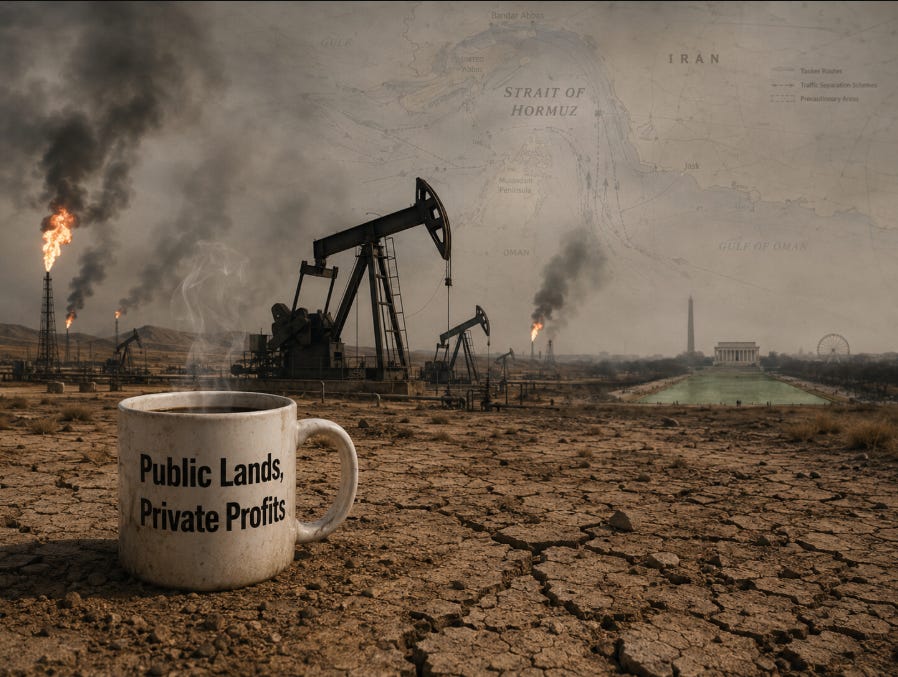
Instead, the Trump administration’s answer is more drilling, less oversight, weaker methane rules, lower cleanup guarantees, and fewer chances for the public to object before public lands are handed over for private extraction.
The Interior Department wants to slash public input on oil and gas leasing on federal lands. Under current rules, the public can weigh in at multiple stages: before lease parcels are made available, during environmental review, and again through a protest period. The new proposal would eliminate the first two comment opportunities and shrink the protest period from 30 days to 10. Ten days. Democracy on a shot clock. Bring your land-use expertise, your wildlife concerns, your water worries, your tribal consultation issues, your health questions, your legal arguments, your map of the watershed, and your lunch, because apparently the public now gets the civic equivalent of a speed date with the oil and gas industry.
The proposal would also gut the financial assurances companies must post for cleanup, dropping the statewide bond from $500,000 to $25,000 and the individual lease bond from $150,000 to $10,000. Set that $10,000 against the government’s own numbers: the BLM reports it costs an average of $71,000 to plug a well and reclaim the surface, and in some cases as much as $200,000. That gap is not a rounding error. It is a neon sign reading: “Taxpayers, please form a line to inherit the mess.” When wells stop producing and operators move on, nearby communities can be left with leaking methane, polluted water, and the bill. The same package would loosen the methane rules, stripping out the leak-detection-and-repair requirements entirely for a gas roughly thirty times more potent than carbon dioxide in its first century in the atmosphere. So the companies get faster access, lower upfront responsibility, looser pollution obligations, and less public scrutiny.
Very normal. Very “energy dominance.” By which they appear to mean: the companies dominate, the public gets ten business minutes to object, and the atmosphere is expected to take one for the team.
This is the moral laundering at the center of the day. Ill-thought foreign policy choices create pressure on energy markets, and then that pressure is used to justify environmental destruction at home. They are using the consequences of their own choices as an excuse to loot the landscape.
First they shake the oil markets. Then they tell us the cure is less democracy and more drilling.
That is the part that feels most visceral. It is not only the inflation. It is not only the gasoline price. It is not only the fact that a disputed shipping lane halfway around the world can reach into a household budget in Oregon before breakfast. It is the disregard. The ease with which land, water, air, climate, and public process are treated as collateral damage for decisions made elsewhere by people who will never have to live beside the well, drink from the watershed, or pay the cleanup tab after the corporation has exited through the executive compensation lounge.
All of this is happening while Trump stages America’s 250th birthday like a man who looked at civic ritual and thought, “What if this had more cage fighting?”
In the Guardian, the historian David Blight calls the semiquincentennial, which should have been a national moment of reflection, “theatre of the absurd.” The official bipartisan America250 effort has been elbowed aside by Trump-aligned Freedom 250 spectacle. UFC on the White House lawn. A Great American State Fair on the National Mall. Military jets. “YMCA.” A proposed triumphal arch to out-Paris the Arc de Triomphe. A stalled Ferris wheel. And a Reflecting Pool whose $14.7 million renovation promptly produced green algae water and peeling “American flag blue” coating, because occasionally metaphor clocks in early and demands overtime.
The trouble is not merely that it is tacky, though it is tacky with the confidence of a gold toilet ordering a flyover. The trouble is that the tackiness is doing ideological work. It turns civic memory into branding, history into set dressing, the country’s founding contradictions into a merch table. It asks people to watch the fireworks, the jets, the stagecraft, the fake triumph, the carnival midway, and not the public comment windows being closed, the environmental reviews gutted, the courts attacked, the museums pressured, the history sanded down, the government quietly converted from a public trust into a private extraction platform with patriotic bunting.
That contrast is the point. Public comment is not glamorous. It does not come with fireworks or fighter jets or a presidential birthday cake large enough to shelter a militia. But it is democracy in its work clothes, one of the places ordinary people still get to say, before the lease is signed and the methane is leaking, that their land, water, and health are not obstacles to somebody else’s quarterly report.
The birthday spectacle wants democracy as performance. The permitting rollback wants democracy as obstruction, something to be shortened, bypassed, or eliminated when it slows the preferred customers. And the energy crisis shows what happens when men who mistake domination for strategy discover that physics, geography, and shipping lanes are not impressed by slogans.
There is a grim elegance to it. Abroad, Trump announces talks Iran will not confirm. At home, he announces a celebration while the public process is stripped for parts. In the Gulf, Hormuz becomes the world’s most expensive question mark. On the Mall, the pool turns green while America is instructed to admire the pageant. In the courts, for one morning, a verdict survives. In the agencies, the public’s right to speak is filed under red tape. And in the economy, the bill arrives.
Today’s story is energy as consequence: the cost of war at the pump, the cost of dependency in the economy, and the cost of turning public land into the apology note for reckless foreign policy.
The administration wants us to call this strength. Energy dominance. Peace through power. Patriotic renewal. America’s comeback. But the evidence keeps pointing in the other direction. A strong country does not have to silence the public to drill. A confident democracy does not need to turn its birthday into a loyalty rally. A competent foreign policy does not produce ceasefires that require quantum physics to describe whether the meeting exists. And a serious government does not respond to inflation anxiety by handing polluters a shorter complaint line and a smaller cleanup bill.
The war comes home as a gas bill. The gas bill becomes an excuse. The excuse becomes policy. The policy becomes damage. And then the damage is wrapped in flags, sold as dominance, and staged beside a green pool painted blue.
Happy Monday.
This was good -- excellent analysis, less rhetorical ornament.
I repeatedly try to work out how to be “oil free”: solar panels, electric vehicles, etc but then run into all the daily products & life that require oil: plastics, non personal transportation, goods farmed and moved using oil & gas.