


Good morning!
Donald Trump decided that if six months of war, a naval blockade, missile exchanges, threats, negotiations, counter-threats and one mostly dead diplomatic framework have not persuaded Iran to surrender, the missing ingredient must be capital letters.
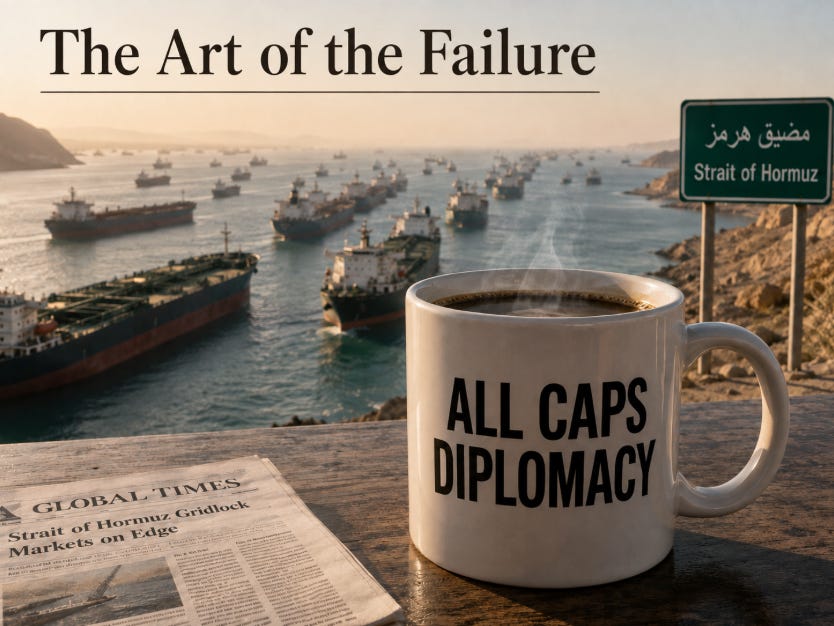
Trump announced what he called the “MOST CRUSHING ECONOMIC OPERATION EVER TAKEN AGAINST ANY COUNTRY,” alternatively branding it “ECONOMIC D-DAY,” because sanctions policy now requires the marketing sensibility of a monster-truck rally.
The substance beneath the typography is important. Trump is threatening severe economic consequences not merely for Iran but for essentially anyone who continues providing Tehran with a commercial or financial lifeline: countries, banks, businesses, airports, government entities, exchange houses, ship registries, and front companies. Oil smuggling, swap lines and cash transfers are all supposed to stop. “You know who you are,” Trump wrote, which is odd Treasury guidance but does save on footnotes.
This is the administration’s answer to the collapse of its latest diplomatic effort.
For weeks, Washington had been trying to negotiate an arrangement that would fully reopen the Strait of Hormuz. The talks ultimately stalled because Iran insisted that normal shipping would resume only if the United States met conditions, including lifting its naval blockade of Iranian ports and allowing Tehran access to assets frozen overseas. Neither side moved enough to get there.
An Arab diplomat described the administration’s new strategy to the Financial Times as “strategic patience.” A less elegant description would be an economic staring contest involving two countries, several navies, and a large share of the world’s energy supply.
The idea appears to be that Washington can use the blockade, sanctions, and threats against third countries to inflict enough economic pain that Iran eventually gives in. Tehran believes almost the opposite: that it can withstand American economic pressure longer than Washington can tolerate the costs Iran can impose through Hormuz, energy markets and the broader region.
It is worth noting because Trump is not really announcing a return to the old “maximum pressure” campaign. Iran is already heavily sanctioned. The United States has spent the war targeting Iranian oil exports, vessels, financiers, foreign-exchange networks, weapons procurement, cryptocurrency infrastructure and foreign businesses accused of helping Tehran evade restrictions.
What is new is the threatened scale of the secondary pressure. Trump is effectively telling the rest of the world that continued economic relations with Iran may increasingly mean economic trouble with the United States.
So what happens when the rest of the world says no?
China did exactly that Thursday morning, rejecting Trump’s sanctions strategy and calling for diplomacy instead. China bought more than 80 percent of Iran’s shipped oil last year, and smaller buyers are testing the edges too, with Tajikistan requesting 2.55mn tonnes of Iranian petroleum products this week. Georgetown’s Paul Musgrave argues that enforcing this kind of sanctions regime unilaterally will be difficult without broad international coordination, though Iran’s trade is concentrated enough that closing a few major channels could still hurt. If Washington cannot meaningfully constrain Chinese purchases, there is an obvious hole in the “isolate Iran from the global economy” part of Economic D-Day.
One of those channels may already be closing. The UAE, historically an important Iranian trading and financial hub, has suspended commercial and financial ties with Tehran after accusing Iran of firing two ballistic missiles toward the country. Iran denies responsibility. The move reverses more than two months of cautious de-escalation between the two sides.
Then there is Hormuz, still the economic heart of the war.
Kpler estimates that oil flows through the strait nearly tripled during the 60-day U.S.-Iran memorandum of understanding, averaging about 6.1mn barrels per day. That is perhaps the clearest evidence yet that diplomacy had a measurable economic effect.
Before the war, roughly 20mn barrels per day moved through Hormuz. Current estimates range from about 4mn to 9mn, depending on whom you believe and how much dark shipping you think is being missed.
Four, six or nine: it is not twenty.
Saudi Arabia and the UAE are routing some exports through pipelines, but geography remains annoyingly resistant to executive orders. Brent was around $92 Thursday, a useful reminder that “strategic patience” is being conducted on top of the world’s fuel bill.
There is a deeper problem with Washington’s bet. Iran has spent years adapting to sanctions, and Sanam Vakil of Chatham House argues that its leadership sees resistance rather than capitulation as essential to regime survival. Economic pressure can be immense without producing surrender.
Washington is gambling that time and isolation favor it. Tehran is betting that endurance favors Tehran. Everyone else finds out what this theory costs at the petrol pump.
Treasury data released Wednesday showed gross U.S. federal debt above $40tn for the first time. According to the Financial Times, debt has risen about $3tn in the past year, its fastest pace outside the pandemic era. Debt held by the public now exceeds $32tn, roughly the size of the U.S. economy. And Washington is paying more to borrow: 30-year borrowing costs recently hit their highest since 2001, while a 10-year auction Wednesday produced the highest yields since 2007.
Debt service now costs more than national defense.
The New York Times says the U.S. is on course to borrow more than $2tn this year, with interest payments accounting for roughly half of that red ink. Higher debt pushes up interest costs; higher interest costs require more borrowing. Washington has reached the charming stage of personal finance where it is borrowing increasingly large sums partly to pay for having borrowed increasingly large sums.
The U.S. bond market presently remains the deepest and most important in the world. Investors, however, are plainly charging Washington more, and the administration has noticed: Treasury is doubling its long-term debt buybacks, while Scott Bessent has even intervened to support the Japanese yen partly out of concern that Japan might otherwise sell Treasuries.
This is where the story meets Iran. Trump returned promising fiscal discipline, and Bessent set a goal of cutting the deficit to 3 percent of GDP by 2028. Instead, Bessent now acknowledges deficits are moving the wrong way. The Iran war is raising military spending and energy costs; the Supreme Court-triggered tariff refunds are returning more than $160bn to importers; and provisions in the 2025 tax cuts are adding to near-term borrowing. DOGE, meanwhile, promised $1tn in savings and claims a little over $200bn, estimates the GAO says lack adequate reliability and transparency.
Trump did not personally create $40tn of debt. Republicans and Democrats built this pile over decades through wars, recessions, tax cuts, entitlement spending, a financial crisis and a pandemic. But he did promise to change the trajectory.
Instead, his administration is financing an expensive war, absorbing enormous tariff refunds, implementing tax cuts, contemplating dramatically larger defense budgets, and paying rising interest on everything Washington borrowed before he got there.
The danger is declining room for error: enormous deficits during relative economic strength leave less flexibility for the next recession, financial shock, or overseas conflict.
Which makes “Economic D-Day” slightly awkward. The United States is betting that it can economically outlast Iran while its own cost of financing that contest is climbing.
Iranian Foreign Minister Abbas Araghchi naturally seized on the juxtaposition, claiming Trump’s sanctions offensive was meant to distract from America’s “unprecedented debt and surging interest costs.”
America is not collapsing under $40tn of debt. It is simply paying considerably more to carry it at exactly the moment Washington keeps finding new things to finance.
When the government is simultaneously asking how many wars, blockades, energy shocks, tax cuts and defense increases it can comfortably finance, all this begins to matter.
One housekeeping note before I disappear for a couple of days: I’m going to spend a little less time chronicling every presidential utterance and a little more time on several deeper pieces I’ve been neglecting.
There is a point at which “Trump opens mouth, nonsense comes out” stops being useful journalism. We know because he has demonstrated the phenomenon daily under laboratory conditions.
The more important task is distinguishing the noise from statements and decisions that actually tell us something new about how this administration governs, then following those things far enough to see what they change.
“Economic D-Day” matters because it marks a change in strategy after diplomacy failed, with consequences for China, Gulf allies and the world’s energy supply. Forty trillion dollars matters because the cost of carrying that debt is rising just as Washington keeps finding new reasons to borrow.
Those seem worth spending a little more time on.
Trump may not be responsible for how we got to a $40 trillion deficit, but he’s certainly adding to it by spending millions on his vanity projects…gilding horse statues, building ballrooms, defacing national monuments, building helipads, outfitting Qatari jets, etc. as well as the exorbitant amounts on his weekly golf trips at his own resorts. On another note, under Trump, ICE now has a budget of $38 billion vs $9 billion under Biden. And, this conflict with Iran (that Trump started!) is draining us by $200-$900 million per day! But, his strategy to end it is to wait Iran out until THEY are economically spent! Good luck to us!
I applaud your refocus.