


By the time Donald Trump finally hauled himself into today’s press conference, he had already spent the Easter Egg Roll turning a children’s event into a campaign ad for himself, boasting about the Iran rescue, puffing up the scale of the operation, and teasing the later Oval Office performance like it was the season finale of a reality show. Even with the White House lawn full of eggs, children, and the ceremonial Easter Bunny, he could not resist making the day about Donald Trump, Commander of Greatness, narrating the recovery of the two airmen as proof that America’s military is unmatched and, more importantly in his mind, that he is unmatched. He framed the mission not as a fraught episode in a widening conflict but as one more trophy for his shelf, bragging about “200 people,” jet fighters, helicopters, and the extraordinary courage of the men involved, all while literally previewing the afternoon spectacle, “we’re going to be having a news conference today at 1:00 at the Oval Office,” as if the country should tune in for his personal coronation.
And the later performance did not disappoint, if by “did not disappoint” you mean it delivered exactly the kind of bombastic, self-glorifying, deeply unnerving spectacle one has come to expect from a man who treats war like a cable special with himself as executive producer, narrator, and lead actor. He opened by declaring the rescue “one of the largest, most complex, most harrowing” combat search-and-rescue missions ever attempted, then promptly lurched into one of those Trumpian riffs where every sentence sounds like it is trying to nominate itself for a medal. The F-15 had gone down “deep inside enemy territory in Iran.” The mission was “historic.” The military is the greatest in the world. Iran could be “taken out in one night,” and, just in case anyone missed the little fleck of apocalypse sparkling in his eye, he added that “that night might be tomorrow night.” This was less a briefing than a man standing at a podium and flirting with catastrophe in front of live cameras.
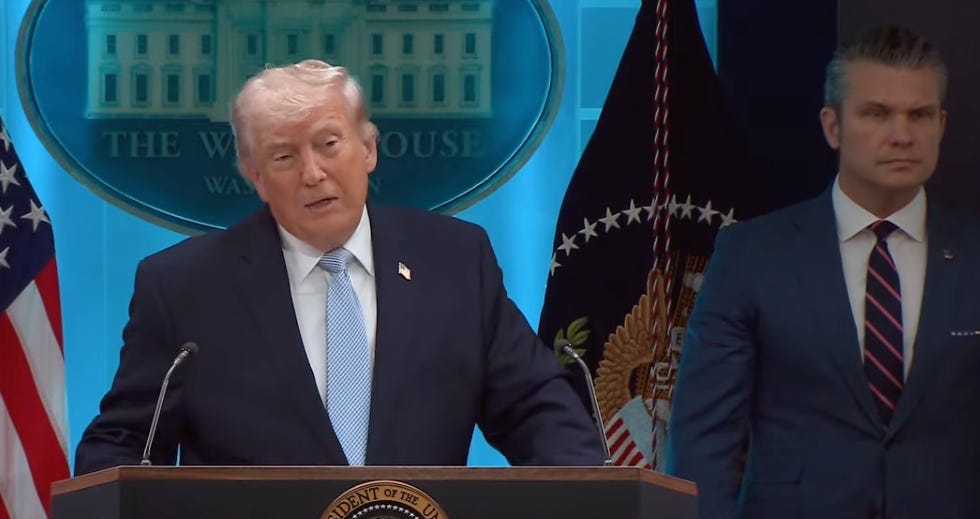
The actual rescue story, buried under all the chest-thumping, was dramatic enough without the Trump-brand shellac. He described the first crew member being extracted after the plane went down and the second, a badly injured weapons systems officer, evading capture for nearly 48 hours in mountainous terrain, climbing higher while bleeding and trying to stay ahead of Iranian forces. There were real details here, scattered amid the performance: multiple aircraft in hostile airspace, helicopters taking hits, an A-10 struck by enemy fire, a rescue force moving in under combat conditions, the second rescue requiring a much larger force package, and the abandoned transport planes later blown up after getting bogged down in wet sand at what Trump charmingly described as “a farm, not a runway.” That part matters, because for all the propaganda, the transcript does confirm this was a dangerous and messy operation, not the frictionless movie montage the White House wanted to sell.
But the administration could not simply tell the story. It had to turn it into scripture. CIA Director John Ratcliffe dutifully stepped up to praise the president’s “leadership and resolve,” invoking “human assets and exquisite technologies” and proudly describing a CIA “deception campaign to confuse the Iranians.” It was all rendered in that particularly baroque style favored by people who want you to confuse secrecy with genius and propaganda with destiny. Ratcliffe said the missing airman had been “concealed in a mountain crevice, still invisible to the enemy, but not to the CIA,” while Trump added that intelligence teams spotted “something moving” from 40 miles away and “kept the camera on him for 45 minutes” until they could confirm, “We have him.” Even the surveillance details were narrated like a thriller trailer, as though someone in the communications shop had been ordered to produce zero-dark-thirty fan fiction for the Easter news cycle.
Then Pete Hegseth took the stage and laid it on with a shovel. He declared Iran “embarrassed and humiliated,” informed the audience that one rescued pilot’s first message was “God is good,” and transformed the whole operation into a resurrection pageant: shot down on Good Friday, hidden on Saturday, rescued on Easter Sunday, “a pilot reborn.” If there was any subtlety left in the room by then, Hegseth hunted it down and strangled it with a flag pin. He insisted that “none of this would have been possible without the courageous leadership and ironclad determination of President Donald J. Trump,” because of course he did. The briefing had fully crossed over from military update into devotional theater, with Trump cast as commander-in-chief, redeemer, and patron saint of stage-managed peril.
Trump, never one to let other people monopolize the adoration, jumped right back in to bask. He praised Hegseth, praised General Kaine, praised Ratcliffe, praised the CIA, praised the special operations planning, praised the contingency flights, praised the helicopters that were rebuilt in under ten minutes, praised the goggles, praised the genius, praised the sand, probably would have praised the mountain if someone had handed him a note. He described the contingency operation with the delight of a man reviewing a casino floor, marveling that planes came in “like magic. Boom. Boom. Boom.” He seemed almost more excited by the drama of the backup plan than sobered by the fact that American crews had been shot at over hostile territory for hours.
Then came the part where the performance curdled into menace. Trump raged about a leak revealing there was a second missing airman and openly threatened the press, saying the administration would go to the media company and demand, “national security, give it up or go to jail,” before adding, “the person that did the story will go to jail if he doesn’t say.” So there it was: in the middle of a supposedly triumphant briefing about military courage and operational genius, the President of the United States casually threatened journalists with imprisonment because reality had interrupted the mythmaking schedule.
The Q&A somehow made things worse. Asked about whether protesters in Iran might rise up, Trump encouraged it in theory while also painting a lurid picture of inevitable slaughter. Asked whether bombing power plants and bridges would punish civilians, he insisted Iranians wanted the bombing to continue, claiming intercepted pleas of “Please keep bombing,” as if the population of an attacked country were all sitting around yearning for more infrastructure collapse from the skies. He declared that if no deal came by the deadline, Iran would have “no bridges,” “no power plants,” and “stone ages,” which is not the phrasing of a mob boss who found a map and an Air Force.
When a New York Times reporter raised the rather minor and fussy question of whether deliberate attacks on civilian infrastructure might violate the Geneva Conventions, Trump did not exactly rise to the level of statesmanship. First came the sneer: “Who you with?” Then, “Are you failing? Are you concerned circulation way down at the New York Times?” Then the usual slurry about fake news, credibility, and landslides, culminating in “people like you who I know are fake. You’re fake.” So yes, in a press conference about a widening war, he responded to a question about international law by insulting the reporter like a drunk uncle who had the karaoke microphone pulled away.
Trump made it clear that strategy, at least as normally understood by mammals with frontal lobes, is optional. Asked whether he was winding the conflict down or escalating, he answered, essentially, who knows, depends what they do. He said Iran had until 8:00 p.m. the next day, after first explaining that he had granted an extension because he wanted to be “a nice person” and thought the day after Easter was somehow too sacred for mass devastation. He threatened to wipe out bridges and power plants by the next night, while simultaneously suggesting that the United States might later help rebuild Iran. It was geopolitical arson with a contractor’s bid tucked in the back pocket.
No Trump press conference is complete without at least three unrelated vanity projects rolling by in clown cars, so he veered into Venezuela, where he bragged yet again about having effectively conquered the place, taken the oil, and brought home the spoils. He mused that the U.S. should charge tolls for the Strait of Hormuz because “we’re the winner. We won.” He complained about NATO being a “paper tiger,” mocked British help, mocked Australia, South Korea, and Japan, praised Saudi Arabia and Qatar, and somehow ended up back at Greenland because his brain appears to function as an attic where every grievance is stored in unlabeled boxes and periodically dumped down the stairs.
What made the whole spectacle so grotesque was the contrast between the triumphant tone and the instability humming underneath it. Instead of a steady leader trying to reassure a nervous world, he was a man intoxicated by spectacle, thrilled by danger, and increasingly unable to separate governing from performing. Across the Atlantic, British broadcasters were not just rolling their eyes at another Trump outburst. They were openly asking whether the President of the United States is still a rational actor at all, whether the man threatening that Iran could be wiped out “tomorrow night” is in command of himself, and whether the world is now being forced to gamble its future on the impulses of someone who appears unable to regulate his own emotions. Think dread with a British accent.
Then there is the “duty to warn” layer that hangs over all of this like smoke. None of us can diagnose a public figure from a transcript, and pretending otherwise is irresponsible. It is also irresponsible to pretend not to see what so many people plainly see. Dr. John Gartner’s analysis, whatever one thinks of each clinical claim, captured the central fear: that what the public is watching is not merely bluster or bad manners, but escalating aggression, disinhibition, grandiosity, visible decline, and a terrifying lack of guardrails. His bleakest point was not even diagnostic, but structural. He argued that there is no one left around Trump inclined or able to restrain him, which is exactly what today’s press conference looked like: not aides grounding a volatile president in reality, but loyalists like Pete Hegseth contorting themselves into pretzels to debase themselves, turning a military briefing into a public act of submission before Trump’s ego.
Then there are the mental health professionals and medical voices who, while stopping short of anything like a formal diagnosis, are increasingly ringing the same bell: something is wrong, something is worsening, and something about the president’s public behavior has moved beyond the usual categories of shamelessness, lying, and narcissism into something darker and more dangerous. Dr. John Gartner’s remarks are especially chilling not because they offer certainty, but because they insist on the pattern: escalating aggression, increasing disinhibition, visible decline, growing grandiosity, and a terrifying absence of internal guardrails. His point is not that we can peer through a screen and pronounce a clinical verdict from afar. His point is that millions of people can see with their own eyes that the man before them is not behaving like a well-regulated adult entrusted with civilization-ending power. He describes a president growing more erratic, more impulsive, and more drawn to domination and destruction just as the restraints around him have all but vanished.
So today’s press conference was not reassuring. It was clarifying. It showed a president using a perilous rescue mission as a vanity project, an administration wrapping military action in cinematic propaganda, and a broader political culture still too timid to say what much of the world can already see: that the scariest thing in the room is not just the war itself, but the man grinning at the center of it, basking in the fear he creates, and demanding applause while the rest of the planet wonders how much longer this can go on.
Thank you, I have written my Congress critters and asked why they are abandoning their duties. Unfortunately, I think many of them are cheering him on.
"Dr. John Gartner’s analysis, whatever one thinks of each clinical claim, captured the central fear: that what the public is watching is not merely bluster or bad manners, but escalating aggression, disinhibition, grandiosity, visible decline, and a terrifying lack of guardrails"
You don't have to be a mental health professional to see that Trump is clearly INSANE. Dr Gartner and others call it frontotemporal dementia or FTD.
https://jaywilson1.substack.com/p/its-not-about-the-flowers?r=10sd39