


Dow 50,000. A round, glorious, headline-ready number. The kind of number that practically writes its own chyron. The Dow Jones Industrial Average crossed 50,000 for the first time in its 129-year history, and somewhere in lower Manhattan a trader probably put on a commemorative hat while cable news anchors practiced their “historic milestone” voice.
The Dow soared more than 1,200 points that day. Fire the confetti cannons and queue the archival footage. A solemn reminder that Charles Dow once walked the earth in suspenders. We are told this is emblematic of resilience, optimism, of the unstoppable American machine grinding ever upward despite geopolitical turmoil, tariff tantrums, artificial intelligence upheaval, and whatever fresh chaos the week delivers.
To be fair, 50,000 is eye-catching. It feels like altitude, like momentum. It feels like winning if you own stocks. But economists, those joyless killjoys, have a deeply irritating habit when confronted with a big number. They ask: Compared to what?
50,000 is not a measurement of economic greatness. It’s not 50,000 factories or 50,000 new businesses. It’s definitely not 50,000 thriving households. It’s an index level, a scoreboard number that started at 40.94 in 1896 and has been climbing, with interruptions, ever since. It is the financial equivalent of a birthday candle.
Under Trump’s second term the Dow has risen roughly 15–16% from where it stood when he took office. That’s not nothing. If you had invested at the beginning of the term, you’re up several thousand dollars. Your 401(k) looks a little more plush, and on paper, that’s pleasant.
But then we zoom out. And this is where the confetti starts to drift gently back to the floor. If you actually want to treat the stock market as a scoreboard, if you want to use it as proof of national economic dominance you don’t get to grade yourself in isolation. Economist Justin Wolfers explains that you have to compare the United States to the rest of the field using the same measuring stick.
That’s where the MSCI total return indices come in. MSCI, which stands for Morgan Stanley Capital International, is basically the outfit that builds the global yardsticks Wall Street actually uses when it wants to compare countries properly. Unlike the Dow, a quirky little museum piece of 30 handpicked blue-chip stocks, weighted by share price for reasons that made sense sometime around the invention of the telephone, MSCI indices are broad, modern, and designed for international apples-to-apples comparisons.
They’re market-cap weighted, meaning bigger companies count more because that’s how real money is invested. And crucially, they’re “total return” indices, which means they don’t just track stock prices, they include dividends too, assuming those payouts are reinvested. That matters enormously over time, especially across countries where dividend policies differ. In other words, this is not a vibes-based number, it is the neutral referee with the spreadsheet.
So when you look at the same time period, Trump’s second term, through that standardized lens, the U.S. stock market is up about 16%. But the rest of the developed world? Up nearly 38%.
That’s not a rounding error, that’s the rest of the world more than doubling America’s pace using the benchmark global investors rely on to allocate trillions.
The Dow hitting 50,000 makes for a beautiful patriotic headline. But once you step back and use the actual global measuring tape, the story shifts from “America is winning” to something more awkward:
In other words the Dow should be sitting at 60,000. America is jogging, while everyone else is sprinting. Look at the G7. Italy up 53%. The U.K. up 41%. Japan up 40%. Canada, yes, that Canada we keep telling ourselves is economically besieged, is up 39%. Germany and France both ahead of the United States. Expand the list to 23 developed markets and America ranks 21st, third from the last.
50,000 is the number that gets invoked in congressional testimony, even in hearings that have absolutely nothing to do with markets. When the Attorney General swerves from discussing Jeffrey Epstein to citing Dow 50,000 as proof that Americans “never had it so good,” you know the milestone has become a political prop. It’s hard not to wonder if that was the exact moment the market decided to clear its throat.
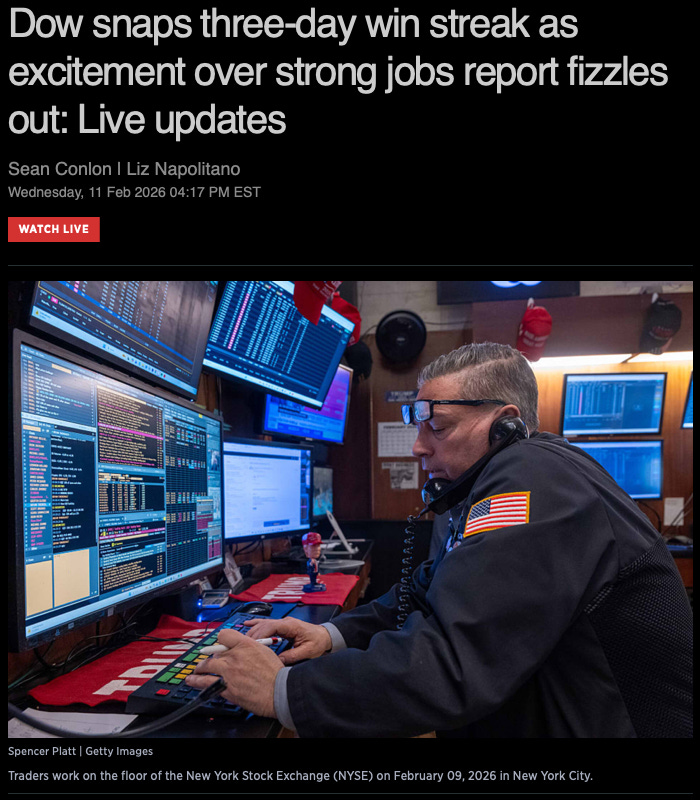
Almost immediately after the celebrations, the wobble began. The Dow slipped back below 50,000, and the Nasdaq fell harder. Software stocks entered bear market territory, with a major tech-software ETF nearly 30% below its 52-week high. Salesforce, ServiceNow, Intuit, all down. Financial stocks, down. Brokerage firms, commercial real estate names, down. Even private-credit firms exposed to software, down.
The culprit? The same artificial intelligence boom that powered three consecutive years of double-digit gains. For years, investors told themselves a simple story: AI equals productivity equals profits equals higher stock prices forever. Entire portfolios were constructed on that thesis.
Now they are discovering the other half of the equation: if AI truly works, if it automates tax strategies, legal drafting, research, advisory services, then entire business models may not survive.
Wall Street is having what one strategist delicately called a “schizophrenic personality” about AI. It wants AI to revolutionize everything, it just doesn’t want AI to revolutionize its own holdings. When a fin-tech firm unveils a tool that can generate personalized tax strategies without manual input, brokerage stocks tumble. When an AI company adds legal automation features, software names get dumped. Investors who once cheered “disruption” now appear to be asking, “Yes, but disruption of whom?”
A stronger-than-expected January jobs report briefly ignited enthusiasm. Payrolls rose 130,000, more than double forecasts. Unemployment ticked down to 4.3%. At session highs, the Dow was up more than 300 points.
Then the realization hit: stronger jobs mean fewer rate cuts. Treasury yields jumped, rate-cut bets were dialed back, and the rally fizzled. By the close, the Dow was down 66 points, snapping its win streak with the emotional force of a shrug.
Even the “strong” jobs report carried caveats. Nearly all the gains came from healthcare. Revisions to prior months have been relentlessly downward, and the average monthly job growth last year, after revisions, was just 15,000. Consumer spending data has been weaker than expected. Inflation remains above the Fed’s target, with core measures stubbornly firm.
The market wants a strong economy, but not so strong that the Fed holds rates higher for longer. It wants inflation to cool, but not because demand is collapsing. The market wants AI-driven growth, but not AI-driven displacement. It wants blue chips to rally, but also wants valuations to expand, even as price-to-earnings multiples are already stretched. Think of this as Schmoo Tree economics.
After three back-to-back years of double-digit gains fueled by AI exuberance and rate-cut anticipation, the market is standing at Dow 50,000 like a marathon runner who just crossed a symbolic line and suddenly realizes there are still miles to go.
Yes, retirement accounts are healthier than they were and corporate earnings have improved. But the internals tell a subtler story. Gains are uneven. Stock ownership remains concentrated, with the top 10% of households owning 93% of equities while the bottom half controls roughly 1%. International markets are quietly outperforming. Bond demand is rising on volatility and economic uncertainty. Software is in bear territory even as data center infrastructure names surge.
When you zoom out globally, sector by sector, across labor data, inflation prints, and AI tremors, the 50,000 headline looks less like a triumphant exclamation point and more like a question mark.
This read is a piece long needed, Mary . The set-up focal point likely only 10% of the population plays with..where the greatest wool pull is ,were I a betting person.
Our real strength is day in and day out the quest for leveling the playing field, democracy’s ballgame.
Everyone can cite the high points but it never gives credit it’s due, in fact, hedge funds bet against it. Get rich quick wets the appetites of ponzi people.
The strongest affidavit is the return on ‘decor’ -being pretty ‘looking good’ versus the durability of quality , equipment that last. If it sounds too good to be true …talk is cheap the walk is what counts. Some call it integrity. The real story …could it be ..planned obsolescence? The divergence marked by a hollowed out middle class, the elitists have less touch with reality and likely the overwhelming stock or control..
Obvious increasingly is how reality is met… by louder lies , lost rights, more death or dying…that old ‘ protesteth too much’ syndrome/saying/smoke screen/selling point?
America isn’t buying it anymore….LETS MAKE THAT VERY CLEAR,FOLKS
See ya at the protest
Call you Reps
Donate/VOTE 💙
Excellent explanations.