


Good morning! Donald Trump spent ninety minutes in Fort Myers on Friday asking Floridians to “pretend I’m on the ballot,” then gave them every reason to be glad he isn’t. He opened by scolding his staff for booking too small an arena, then drifted into a lengthy appreciation of White House doorknobs, the evils of hollow-core doors, and the four-by-eight marble slabs that replaced what he called “Home Depot” tile renovations he said hadn’t happened “since 1792.” Having renamed the Gulf of Mexico and Lake Ontario, he announced plans for the Atlantic (“the American Ocean”) and the Strait of Hormuz (“the Trump Strait”), reporting that Google’s CEO had finally told him, “I cannot do oceans, sir.” Tariffs, he confided, have been demoted to his fifth-favorite word. At one point he told the crowd “Bye everybody,” walked toward the exit, and came back, explaining that his chief of staff said he was driving the Secret Service crazy. He also praised Robert F. Kennedy Jr. for having “the body of a 30-year-old.”
Somewhere in there, he also demanded Representative Ilhan Omar’s resignation over an unsubstantiated allegation about her name.
The president’s preoccupation with names wasn’t confined to the rally. It had already found its way into federal court.
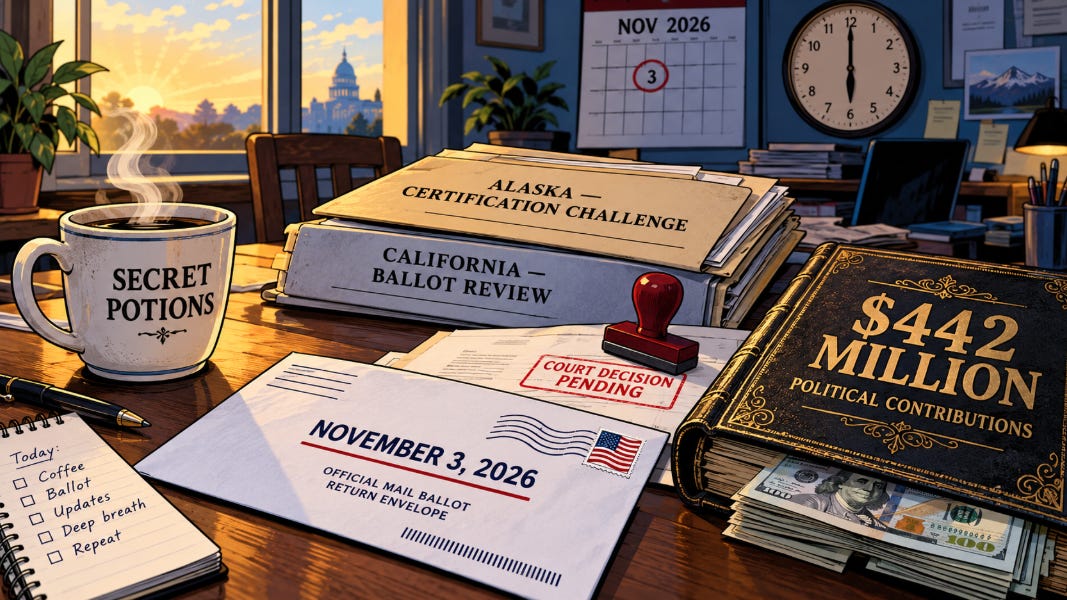
By Friday, the administration had moved beyond complaining about the midterms to challenging how votes would be counted and results certified. Trump confirmed he personally ordered the Justice Department to sue Alaska, seeking to block certification of its Senate election if Republican incumbent Dan Sullivan loses under circumstances in which votes for another candidate named Sullivan could change the outcome. “I’m the one that said do it,” he told reporters. Alaska’s Supreme Court had already ruled in June that the other Sullivan was entitled to appear on the ballot.
That same day, federal prosecutors gave at least 18 California counties 48 hours to turn over records for voters the government suspects, based on disputed data, are noncitizens. They demanded that ballots be set aside where citizenship couldn’t be verified and warned election officials of criminal consequences for knowingly counting noncitizens’ votes.
Meanwhile, Elon Musk contributed another $76 million to his political operation in the first two weeks of October, bringing his reported midterm contributions to more than $442 million.
The election is ten days away. Californians are mailing ballots, and Alaskans are ranking candidates. The fight over whether their votes will count, and whether the results will be certified, has already begun.
The Justice Department’s complaint asks a federal court to pause Alaska’s certification “pending an investigation,” on the theory that Daniel J. Sullivan, a retired schoolteacher from Petersburg, entered the Senate race for “the sole purpose” of draining votes from Republican Sen. Dan S. Sullivan. But the requested intervention has a peculiar condition: the incumbent must lose, and giving every vote cast for the other Sullivan to the senator must be enough to reverse the result. Votes for one legally qualified candidate, under this theory, may belong to another if the arithmetic is convenient.
Alaska has already been through this. In June, the state’s elections director tried to disqualify the second Sullivan, saying he was running to confuse voters. A state judge ruled she had abused her discretion, and the Alaska Supreme Court affirmed three days later. On the November ballot, the incumbent is identified as a registered Republican and the incumbent. The challenger appears under his fuller name, Daniel J. Sullivan Jr., without a party designation.
Alaska’s ranked-choice system also provides a remedy for much of the alleged confusion. When a candidate is eliminated, ballots transfer to each voter’s next-ranked candidate, if there is one. A voter who mistakenly puts the wrong Sullivan first but ranks the incumbent second can still have that vote counted for the senator. The system cannot correct every possible mistake, but it certainly doesn’t assume that everyone voting for Daniel J. Sullivan actually meant to vote for Dan S. Sullivan.
The president, for his part, has dropped any pretense that this is a routine legal matter. “I’m the one that said do it,” he told reporters Friday. Sen. Lisa Murkowski, a Republican, said the department “should never have filed this lawsuit.” Notre Dame law professor Derek Muller called the legal claim “absurdly thin.”
And there is the small matter of the remedy. DOJ wants to investigate whether votes cast for one Sullivan were meant for the other. Alaskans vote by secret ballot. Short of a séance, there’s no reliable way to find out.
In Alaska, the administration wants to stop the count after the votes are in. In California, it wants to intervene while ballots are still arriving.
On Friday, federal prosecutors sent letters to at least 18 California counties, giving them 48 hours to turn over identifying records for voters the government calls “likely” noncitizens, including Social Security numbers, ID information and registration documents. They also demanded that ballots be set aside where citizenship could not be verified. San Bernardino County’s list alone contains 1,133 names. “Any election official who knowingly processes the ballot of a noncitizen is opening themselves to legal jeopardy,” warned First Assistant U.S. Attorney Bill Essayli.
The evidence behind those demands is rather less certain than the deadline. In July, the administration identified as many as 190,000 potentially ineligible registrants. Its current lawsuit targets more than 20,000 people it considers higher-confidence cases. Prosecutors have charged 28 people from that list, all presumed innocent. Meanwhile, Los Angeles County examined a preliminary sample of 200 names and found 112 canceled or inactive registrations, roughly 71% with no voting history, and a substantial share whose records indicated they were born in the United States.
Nor has any court ordered a single ballot set aside. A prosecutor’s letter is not an injunction. In a separate campaign to obtain states’ sensitive voter rolls, DOJ has filed 31 lawsuits and lost 26. In the current California case, the administration appealed to the Ninth Circuit before the district judge could hold his scheduled hearing on Tuesday. Late Friday, the Ninth Circuit ordered California to respond to the Justice Department’s emergency motion by noon Saturday. As of this writing, the court has not ruled.
More than 330,000 California mail ballots have already been counted, according to state court filings cited by the Associated Press, although results cannot be released before Election Day.
The government is contesting how votes are handled. One extraordinarily wealthy private citizen is spending hundreds of millions trying to influence the choices those ballots record.
Elon Musk is no longer campaigning alongside Republicans; the party privately decided he was bad for business after he became both the top funder and a top campaign issue in Wisconsin’s 2025 Supreme Court race. His money, though, is welcome. In the first two weeks of October he gave another $76 million to his super PAC, bringing his political contributions this cycle past $442 million, according to Politico. That’s well above the roughly $290 million he spent in all of 2024, and Politico says no donor in modern American history has come close.
Much of it has gone to Senate races. Musk contributed $158 million to the Senate Leadership Fund, the Republican Party’s main Senate super PAC. According to the Texas Tribune, he gave $75 million on September 9 and $83 million approximately two weeks later. On each occasion, the fund transferred the same amount to Texas PAC, which is spending heavily to support Ken Paxton, the following day. Democrat James Talarico has made that the center of his campaign, calling it a trillionaire’s attempt to “buy his own personal U.S. Senator.”
Then there’s Alaska. Musk gave $1.5 million to Aurora Action Network in July. Aurora subsequently contributed $1 million to Repeal Now. Alaska’s true-source reporting requirements exposed Musk as an underlying donor. The ads focus on ranked-choice voting. They say less about the measure’s other effect: it would also repeal Alaska’s 2020 requirements that major political donors disclose the true sources of their money. In other words, the rules Musk is paying to repeal are the rules that revealed he was paying. A recent poll found voters split 48–48 on the measure, even though most of them support the disclosure rules it would eliminate.
Measure 2 governs future elections, not this November’s Senate race, but the pattern is hard to miss. The richest man in the world is paying to change how Alaska votes, and the same measure would make it harder to see who pays next time.
Which brings us to the question of what $442 million buys.
If Democrats win the House, Musk faces something he’s mostly avoided: questions he can’t answer on X. Democrats have said they want to look at his work running DOGE, the federal contracts that keep SpaceX in business, and the throttling of Ukraine’s military satellite service this month. On that last one, Trump’s own Secretaries of State and Defense have blamed Musk, while Trump says Musk “has done nothing wrong.”
Musk’s response to the prospect of oversight was a threat: “Those who pick fights with me should understand that I will find out who is really pulling the strings and come for them, not just their puppets.” Trump’s was a pledge. “People have an obligation to protect our geniuses,” he said Friday.
Under this administration, that protection has been generous. An SEC case seeking about $150 million over Musk’s late disclosure of his Twitter stake ended in a $1.5 million settlement, a discount even Tesla’s sales team would admire. The same week Trump defended Musk from congressional questions, his Justice Department searched a Democratic congresswoman’s home over her late father’s thirty-year-old paperwork.
A Democratic Congress can’t indict Elon Musk. It can do something he may like even less: put him under oath, on camera and on the record, where his answers would outlast this administration’s Justice Department. Seen that way, $442 million starts to look less like political enthusiasm and more like legal strategy.
Back in Fort Myers, the president was offering his own version of election integrity. Republicans, he promised, would send every adult American citizen $5,000 if they keep Congress, a pledge he first made in September and now prices at about $1 trillion. Reuters puts it closer to $1.35 trillion. If Democrats win, he warned, the country faces “a 1929 style economic depression.” As for the second Dan Sullivan, Trump allowed that putting him on the ballot was “cheating like hell, but it’s not the dumbest thing in the world.” Hours earlier, the president had confirmed that he ordered a federal lawsuit over it.
It is a punishing schedule for a man of 80, with rallies in Florida, Michigan and Mississippi packed into four days. With Halloween approaching, one can only imagine what’s bubbling in the White House medical cauldron to keep the traveling show going. Whatever it is, it isn’t helping with the doors.
Musk’s money buys ads, voter-canvassing and turnout efforts, not ballots. Trump’s promises cost nothing until someone tries to collect.
They share an assumption that the outcome is negotiable: that enough money, pressure or legal maneuvering can make up for what voters decide. Holding power is different from having a mandate, and the gap between the two is filled by people who rarely make headlines: county clerks verifying ballots under federal threat, Alaska judges who settled the Sullivan question months ago, and voters filling in ovals at kitchen tables from Fairbanks to San Bernardino.
The election is ten days away. Mail your ballot early, and make them count it.
loved your blog-- talk about CHAOS-- im still worried about safest way to vote; either drop box v/s vote in person -- 1 can be be broken into while the other hacked -- all i know is that all democratic votes Have to count // proud Nevada democratic
We have voted. The Trump condition-chaos,callousness, confusion , and caustic cacophony …is ranting up….no surprise, no class, no cards..VOTE THEM ALL OUT💙