

“Don’t try this at home.”
As a child, that sounded straightforward. Do not attempt a piledriver in the backyard. Do not whack your cousin with a folding chair unless you are prepared for your mother to enter the room like an avenging regulatory agency. The warning was about bodies. Bones. Gravity. The ordinary physics of why human beings should not model their domestic lives on WrestleMania.
Perhaps we misunderstood the warning. Maybe the most dangerous thing professional wrestling ever taught anyone was not how to jump from the top rope, but how to live inside a storyline.
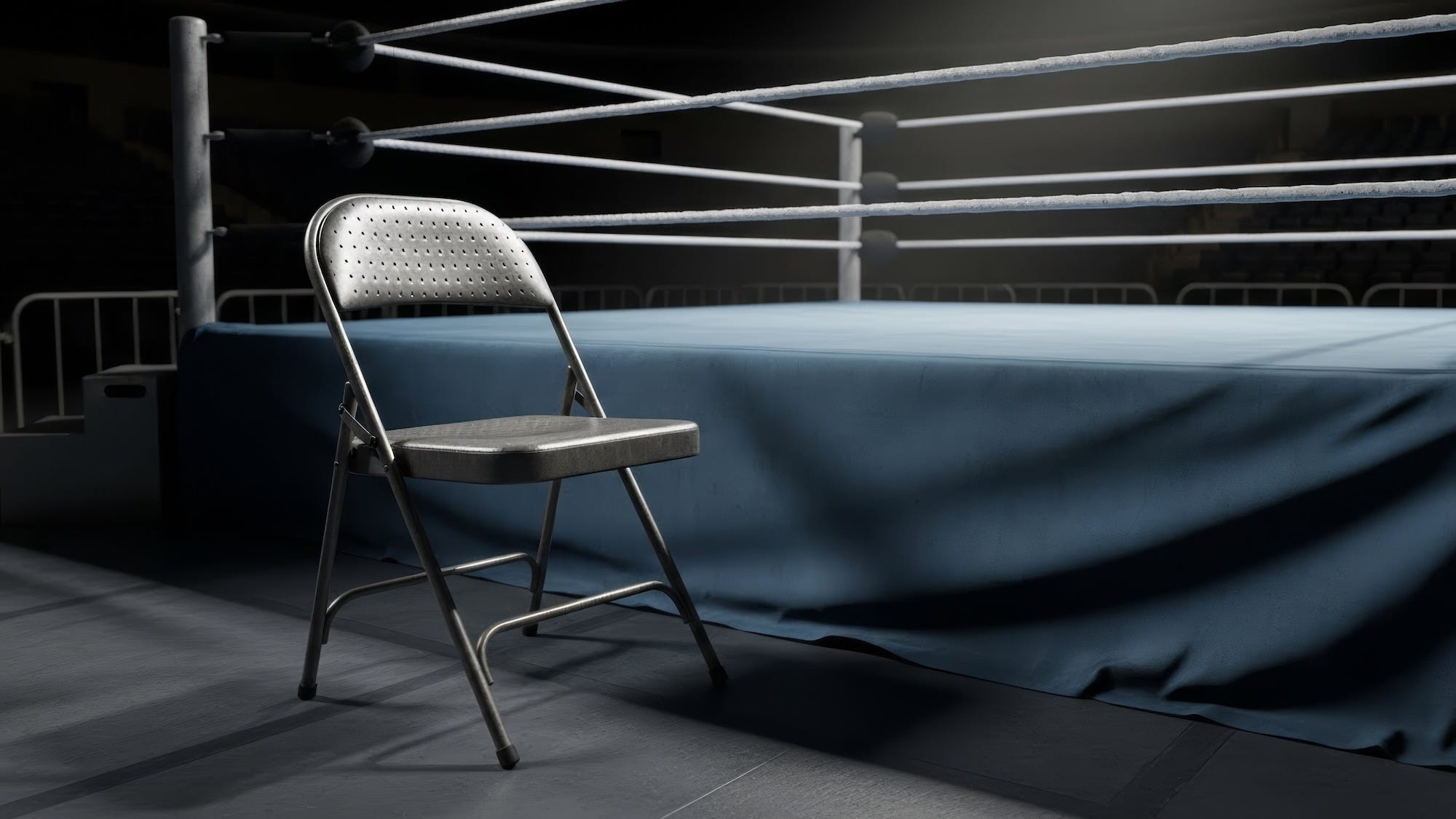
For newer readers: kayfabe is the wrestling term for the shared fiction that makes the whole enterprise work. It is not simply “fake.” Wrestling fans are not necessarily dupes. They are participants. They agree to suspend disbelief because the performance gives them something real: release, belonging, rage, enemies, heroes, catharsis. The match may be scripted, but the emotion is not. That distinction turns out to matter enormously outside the arena.
Donald Trump did not import wrestling’s aesthetics into politics. He imported its operating system. The nicknames. “Crooked Hillary.” “Sleepy Joe.” “Too Late Powell.” “Lyin’ Ted.” “Little Marco.” “Crazy Nancy.” “Radical Left Lunatics.” The chants. The foreign villains. The stable of loyalists. The ritual humiliation. The strongman who is always betrayed, always winning, always persecuted, always moments away from the greatest comeback in history. Trump did not merely learn that politics could be entertaining. He learned that entertainment could replace politics.
In kayfabe, contradiction is not a liability. When the performer says something outrageous and it happens, he is a prophet. When it fails, you were an idiot for taking him literally. He can threaten, retreat, escalate, deny, and declare victory in the same breath because coherence is not the point. The point is dominance. The point is keeping the crowd inside the story. In wrestling, kayfabe makes a great story. In politics, it becomes Kevlar.
Which brings us to this week, and the Strait of Hormuz, and a ceasefire described by the President of the United States as being on “life support.” Asked whether the ceasefire remained in effect, Trump dismissed Tehran’s latest proposal as “a piece of garbage” and noted he had not even finished reading it. There it is: the promo voice, the insult, the dominance posture, the refusal to treat diplomacy as anything other than a humiliation contest. A nuclear crisis becomes crowd work. A ceasefire becomes a catchphrase.
The Strait of Hormuz, however, is not a folding chair. You cannot smash it over an opponent’s head and reset after the commercial break. The strait remains effectively closed. A vital passage for global oil and gas shipments sits under Iranian control. Fuel prices have surged past $4.50 a gallon. And Trump’s response is to float a suspension of the federal gas tax, a measure requiring congressional approval, draining more than $23 billion annually, offering a momentary illusion of relief while preserving the spectacle that caused the pain.
In wrestling, a cheap pop is when a performer gets easy applause by shouting the name of the city. Hello, Cleveland! The crowd cheered even though nothing had happened.
Suspending the gas tax while the Strait of Hormuz remains closed is the policy equivalent of shouting Hello, Cleveland while the building is on fire.
Kayfabe politics is proving dangerous. It trains people to experience catastrophe as spectacle. The ceasefire is not a ceasefire; it’s a ratings beat. Diplomacy is not diplomacy; it’s a toughness test. A blockade, a closed strait, a regional war, rising fuel prices, and nuclear brinkmanship become props in a dominance narrative. The performer does not have to solve the crisis. He only has to narrate it like the main event.
The audience knows its role. Calling Trump’s supporters willing victims is too gentle. It lets them settle into the moral recliner of passivity, as if all of this simply happened to them. But kayfabe does not happen to an audience. It happens with one.
The wrestling crowd is not decorative, or mere background noise. It is literally one of the instruments. The boos, the chants, the signs, the ritual hatred, these are not incidental to the show, they are its power source. Trump understood that, perhaps from standing inside a WrestleMania roar and feeling what a crowd that size could do to reality. In that space, humiliation became entertainment, cruelty became comedy. The wrong thing, performed with enough confidence, became the right thing.
Enabler is the more honest word. Every chant, every rally ovation, every gleeful share of a dehumanizing clip helps sustain the fiction. The crowd does not write the script, but it keeps the script alive. A script kept alive long enough becomes policy. Becomes a closed strait and a gas tax stunt and a ceasefire described in the language of a pay-per-view promo.
The audience did not close the Strait of Hormuz. But it helped build the political universe in which a president can treat that closing as a prop. That is a share of authorship.
Authorship is what people want to avoid. It is easier to say they were fooled. Victims can be pitied without being held responsible. But the kayfabe frame denies that comfort. The crowd is part of the act. The chants, the permission, the thrill matters.
In wrestling, everyone eventually goes home.
In politics, people have to live inside the aftermath.
The warning was always there. Don’t try this at home. Do not confuse smack talk with strategy; treat humiliation as justice, or turn nuclear diplomacy into a pay-per-view feud.
In wrestling, kayfabe ends when the lights come up. In politics, the lights do not come up on their own. Someone has to break character.
The MAGA enablers deserve their fate - the reams of objective evidence they consistently choose to ignore or write off with repetitive propaganda and insults confirm their immutable devotion to the Trump cult. They seem willing to tolerate anything, even their own suffering, to stay a member.
Which leaves the majority of us who saw the impending disaster of this regime beginning in 2016 and cannot escape its consequences.
As Mary’s daughter Shanley wisely wrote, hope is not passive. Those who regret their 2024 votes or sat out the election need to be inspired by more than pointing out who and what is to blame. We in the pro-democracy community need to fashion a coherent vision for the future and make the case for it.
Americans First: healthcare and housing affordability, realism/pragmatism/accountability in government, anti-corruption and a fair tax system seem candidates for this vision.
The is an extraordinary and important piece of writing. To end this show, the theater needs to be shut down by the ownership. That needs to be your next chapter…. Thank you for your work