


Good morning. Diesel is now averaging $6.23 a gallon nationally, the highest price AAA has ever recorded. Brent crude is hovering around $109 a barrel, and the Saudi East-West Pipeline, the infrastructure built specifically to move oil around the Strait of Hormuz when the Strait becomes a problem, is expected to stay largely offline for weeks after Thursday’s drone strike. The line can carry up to 7 million barrels a day.
All of that matters. But the story I want you watching this morning is what Donald Trump is offering American voters instead, and in one remarkable case, he’s already told us the terms himself.
Last week, standing before Republicans at their midterm convention in Dallas, Trump unveiled the “Trump Dividend”: $5,000 for every adult American, conditioned, in his own words, on “if the Republicans win the House of Representatives and the United States Senate.”
Trump suggested he could issue the payments without Congress. House Speaker Mike Johnson said Monday that he cannot; Congress would have to authorize the money, which the AP estimates could cost more than $1 trillion. So the check is not in the mail. Right now it lives in the space between a campaign-stage promise and an appropriations bill.
But the transaction is plain enough. Give Republicans the House. Give Republicans the Senate. Get $5,000.
Once you see that stated so plainly, a few other stories from the past few days look different. We don’t need a conspiracy; the public record already gives us plenty. We just need to ask what voters are being asked to believe about their own pocketbooks before November.
The next day, the administration announced that nearly one million people in thirty states would get $500 refunds beginning in October. Five hundred dollars is five hundred dollars, and I have yet to meet anyone whose electric company accepts payment in presidential accomplishments.
The White House calls the checks refunds for “excessive” user fees the Biden administration collected through the ACA exchanges. Trump went further in a recorded address, accusing his predecessor of pocketing the money outright: “They kept it. They just kept it. They never let anyone know.” The AP noted he offered no evidence.
The claim gets shakier when you ask the people who track the fee for a living. Cynthia Cox, who directs KFF’s ACA program, told the AP that a surplus doesn’t necessarily mean anyone was overcharged and if one exists, it may not even be Biden’s surplus. Some of the unspent balance may trace back to Trump’s first term, when his administration also collected more in fees than it spent. Meanwhile, the current administration cut spending on enrollment assistance while continuing to collect the fee.
So the “Biden overcharged you” story may be, at least in part, the “we cut services and kept collecting the fee” story wearing someone else’s name.
There’s another catch beneath the headline “Trump Sends Obamacare Customers $500.” The checks go only to people who receive no premium assistance and paid their full premiums themselves, not to the millions of ACA customers whose costs spiked when enhanced subsidies expired at the end of 2025, the affordability crisis now driving coverage losses.
Two different groups. Two different piles of money.
If you receive a check, take it. Cash it. Buy groceries. Pay the electric bill. Feed the dog.
Just know that the check is not a restoration of subsidies. It isn’t a fix for the affordability crisis draining ACA enrollment. And a real check in a real mailbox doesn’t make every claim printed alongside it equally real, including the claim about who’s to blame.
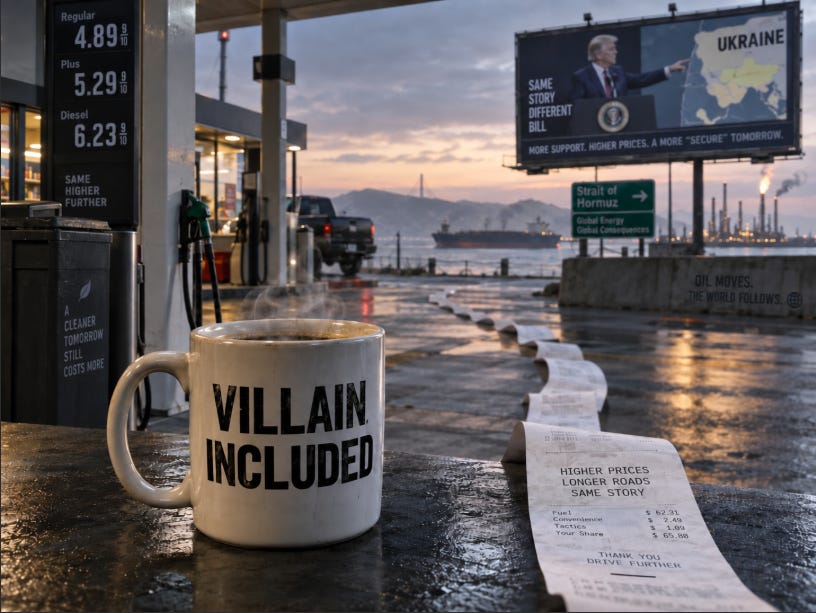
A similar exercise is happening at the diesel pump. Sunday, at his golf resort in Doonbeg, Trump explained why diesel is so expensive.
Ukraine.
“Mr. Zelenskyy has to do one thing,” he told reporters. “He has to stop knocking out diesel fuel in Russia.”
Hold two facts at once. Ukraine really is blowing up Russian refineries, and those attacks really are tightening the global diesel market. Russia has curtailed fuel exports, and the IEA says the near-halt of Russian product exports has compounded the shortage.
All true.
It’s also not where the crisis began. American diesel averaged about $3.76 a gallon in late February, when the U.S. and Israel launched the war against Iran. Prices climbed as crude became more expensive and tanker traffic through Hormuz collapsed. The IEA’s numbers make the scale hard to hide behind Zelenskyy alone: Gulf countries exported only about 390,000 barrels a day of diesel and gasoil in August, barely a quarter of their prewar level. Combined Gulf and Russian diesel exports are now roughly 1.6 million barrels a day below February.
Also this week, a drone knocked out the Saudi pipeline built to route around exactly this problem.
Here’s the trap, and here’s how you don’t fall into it.
Ukraine’s attacks made a genuine global shortage worse. But the American price surge was already underway after the U.S.-Israeli war with Iran choked traffic through Hormuz, months before Ukraine’s refinery campaign escalated.
Those are two separate facts, and this weekend Trump emphasized one while omitting the other. Whether that’s strategy or reflex is almost beside the point when you’re standing at the pump watching the numbers spin.
Call it “Make the Mess, Assign the Bill.”
We’re less than two months from a midterm fought substantially over affordability, and the administration knows people experience the economy at the fuel pump and the electric bill, not in a GDP table. That makes those experiences political terrain.
The common denominator here is your wallet. A $5,000 pledge turns control of Congress into the condition for a promised payday. A $500 refund arrives wrapped in a story about Biden-era overcharges. At the diesel pump, Zelenskyy becomes the explanation for a price surge whose chronology begins elsewhere.
Different policies, different facts, different degrees of merit all converging on the same anxiety: what Americans can afford.
The next seven weeks require something more useful than outrage: attention and agency.
The provocations will be inexhaustible. Some will carry enormous consequences; others will be theater, and plenty will perform the familiar Trump-era trick of being both at once. Heroes and villains will arrive preassigned, along with checks bearing one politician’s credit and bills carrying somebody else’s blame.
We don’t have to accept the casting. This isn’t sophisticated work. Mostly it’s refusing to let the person making the argument decide which half of the timeline you’re allowed to see.
Because Monday needed one more Russia story, ProPublica arrived at 5 a.m. with this one.
Donald Trump Jr.’s lavish May wedding in the Bahamas was secretly subsidized by Umar Kremlev, a Russian oligarch close to Vladimir Putin. According to records reviewed by ProPublica and interviews with people familiar with the event, Kremlev paid hundreds of thousands of dollars in expenses, renting a private island, covering the fireworks and helping plan the affair through a Dubai entity affiliated with the International Boxing Association, which he runs. Trump Jr.’s spokesman didn’t dispute the payments.
This was not a struggling young couple accepting a little help from Uncle Umar with the catering bill. ProPublica cites Forbes estimating Don Jr.’s net worth at roughly $300 million. Which raises the obvious question: why?
A month before the wedding, Putin awarded Kremlev Russia’s Order of Friendship. Ukraine has sanctioned him, citing his ties to Putin and Russian security services. His IBA was once heavily financed by Gazprom and later stripped of its Olympic role amid governance and financial concerns.
Kremlev had also been looking toward the United States. In January 2025, shortly after Trump’s inauguration, he wrote publicly to the president seeking help in the IBA’s dispute with the Olympic movement. Eight months later, Don Jr. appeared with him at an IBA event in Istanbul, after which the organization promised the relationship “will not remain symbolic.”
Then Kremlev helped pay for the wedding.
Also present was Jared Kushner, who has been involved in the U.S. government’s negotiations with Russia over Ukraine.
Before anybody connects dots with a Sharpie: there is no evidence in ProPublica’s reporting that Kremlev’s payments influenced American policy, and no evidence connecting this relationship to Trump’s demand that Ukraine stop bombing Russian refineries.
The access itself is news. Former senior FBI counterintelligence official Frank Montoya Jr. told ProPublica the obvious question is what someone expects after spending that kind of money cultivating the president’s son. Holden Triplett, Trump’s first-term counterintelligence director, pointed to money as a longstanding means of gaining access to government officials and their families.
The concern is access, influence, and obligation, and the juxtaposition is striking enough without embellishment.
Sunday, the president tells Ukraine to stop destroying Russian refining capacity because the diesel shortage is hurting Americans.
Monday, we learn that a Putin-connected oligarch secretly helped pay for his politically influential son’s wedding.
There is no evidentiary bridge between those facts, nor any journalistic reason to pretend one of them didn’t happen because somebody might object to seeing them next to each other.
We are back to the numbers. Six dollars and twenty-three cents, five thousand dollars, five hundred dollars.
Numbers are useful in politics because they feel solid. They fit on signs. They make good television. Put a dollar sign in front of them, and they become even more persuasive.
Last week, on our live video, I talked about the weight Americans are carrying right now, not because we’re uniquely wise, God knows the available evidence would make that a tough PowerPoint, but because this country remains powerful enough that our choices don’t stop at the shoreline.
What happens here matters elsewhere. Congress controls appropriations, writes laws and oversees the executive branch. American decisions about war, energy, trade and climate ripple through economies and governments far beyond our borders.
Between now and November, every political actor will work very hard to tell us not only what happened, but what it means, whom to credit, whom to blame and which part of the story we’re supposed to remember when we vote.
Don’t surrender that work; urgency demands we use our agency.
Check the mechanism. Check the chronology. Follow the money.
The easiest thing in politics is letting someone else choose your villain for you.
Don’t.
Mary, in writing about trump calling on Zelenski to stop bombing Russian refineries, because it is driving up the worldwide cost of diesel, you fail to mention that this is Putin's war of aggression. Ukraine will stop bombing as soon as Russia gets the F out of Ukraine. However, trump is such a reliable Russian asset he would never suggest THAT. Ukraine bombing refineries is the result. Russia invading Ukraine is the cause.
Russian Oligarch rents Trump's son an ISLAND for his wedding reception
?? WT actual F??
Sorry, but I just had to scrape my jaw off the floor. It is so glaringly obvious that Trump is a Russian "asset", and few of us want to come right out and say so.