

On Tuesday, May 5th, 2026, the Trump administration staged three public events that were, on their surface, about completely different things. A youth fitness proclamation ceremony at the White House. A foreign policy press briefing. A campaign rally for a vulnerable House incumbent in Des Moines. Different rooms, different audiences, different ostensible subjects.
What they shared was a quality more revealing than any policy position: none of them were actually about what they said they were about.
This is not a new observation about this administration. But Tuesday was unusually instructive, because the gap between performance and reality did not require close reading or leaked documents or anonymous sources. It announced itself in real time, with the particular confidence of a machine that has long since stopped worrying about whether anyone is paying attention.
Secretary of State Marco Rubio stood at a White House podium and declared that Operation Epic Fury, the sixty-six day bombing campaign against Iran, was concluded. Objectives achieved. While he was speaking, a cargo vessel in the Strait of Hormuz took a hit from an unknown projectile. By evening, Iran’s president had declared negotiations with the United States impossible. By nightfall, Trump had announced a pause in the very operation Rubio had spent fifty minutes explaining and defending. Same day. Same afternoon, more or less. The press conference and the struck vessel, simultaneous.
It is a reasonable place to begin asking what, exactly, this administration thinks governance is for. The answer suggested by Tuesday’s events is not reassuring. Across three venues and three very different performances, the Trump administration demonstrated something that has less to do with ideology than with method: they are not building arguments, they are scavenging them. Trump reached into the trophy case. Rubio reached into the legal brief. Vance reached into Reagan’s attic and came back with a Lamborghini.
Instead of message discipline; it was message scavenging. The warehouse, it turns out, has been open for business for a very long time.
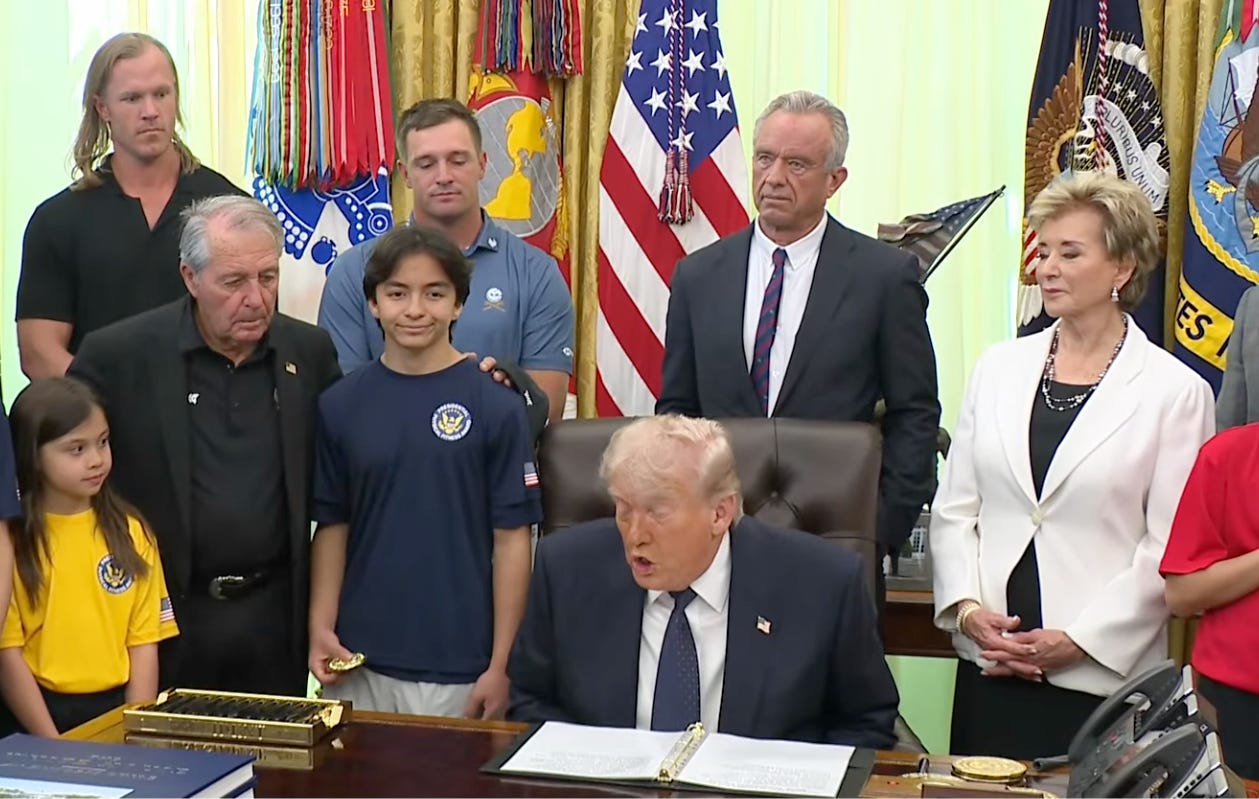
The Trump event was nominally about youth sports, physical fitness, and the revival of the Presidential Fitness Test. In another universe, this could have been one of those harmlessly corny civic rituals where children stand politely in the Oval Office, a president says something about teamwork and sit-ups, someone mispronounces “calisthenics,” and everyone goes home with a certificate suitable for framing.
That is not the universe we currently inhabit. Children were not the audience; they were the backdrop. Athletes were not the subject; they were the set dressing. The proclamation was not the point; it was the excuse to assemble the room.
Trump began with the familiar ceremonial gestures, praising the young athletes, the sports figures, the cabinet secretaries, and the greatness of American physical fitness. But almost immediately, the event dissolved into the purest form of Trumpian performance: associative, boastful, grievance-driven, strangely intimate, and structurally allergic to the stated purpose of the gathering. Gary Player’s golf record led to Bryson DeChambeau’s body, which led to the Presidential Fitness Test, which led to Obama, which led to Trump’s election lies, which led to the World Cup, the Olympics, the 250th anniversary, a UFC event at the White House, and then, because apparently no children’s fitness proclamation is complete without a little light military apocalypse, Iran.
This is not persuasion in the traditional sense. It is not even propaganda in the classical sense, where a message is shaped, repeated, and aimed. Trump’s rhetorical mode is saturation. He floods the zone until the original occasion dissolves. What remains is atmosphere: grievance, domination, enemies, triumph, golf.
The Iran war and the children doing pull-ups occupy the same register. There is no hierarchy of seriousness in Trump’s performance. A child’s sport, Gary Player’s 90-year-old golf game, the claim that Iran has no navy, an attack on Obama, a boast about the stock market, a riff on trans women in sports, a fantasy about doing 50 push-ups on a historic table, everything enters the same blender. If everything is spectacle, nothing can demand accountability. War is just another story. Children are just another prop. Public health is just another branding exercise. The presidency is just another microphone, and the microphone is always his.
The silence underneath the noise is part of the story. All this sound and fury, all these children and athletes and cabinet secretaries assembled, and at no point does anyone in the room ask what happens in Iran tomorrow, or what the fitness test will actually cost to implement, or whether any of this connects to anything.
The most grotesque moments came when Trump interacted with the children directly. He asked what sports they played. He told one child interested in powerlifting that he would “never compete against women,” then launched into a story about a male powerlifter supposedly breaking a women’s record by more than a hundred pounds. A boy was asked whether he thought he could “take” him in a fight. He mused about getting on the Oval Office table to do push-ups.
It was all so casually inappropriate that the inappropriateness became part of the spectacle. Children were standing inside a culture-war machine, smiling through an adult’s need to turn every room into a referendum on his enemies. The formal subject was youth fitness. The actual subject was domination.
Trump’s rhetoric tells the audience that the world is simple: enemies are weak, Trump is strong, the military is unbeatable, Democrats cheat, Obama ruined things, Iran is humiliated, and everything good happens because Trump willed it into being. It is a closed loop, and it is remarkably effective at what it does. What it does not do, what it is not designed to do, is answer the question of what comes next. What is the plan after the boast? Explain the strategy after the threat. What happens in the strait tomorrow, or next week, or when the cameras leave and the children go home with their certificates?
There is no answer, because the show has already decided the question is out of order.
Which is precisely what makes the next room so instructive. Because Rubio’s job, the careful arguments, the legal vocabulary, the reluctant superpower framing, is to build a floor under a building that has no foundation. He is very good at it. The floor looks solid. And if you don’t look too closely at what’s happening in the strait while he’s talking, you might almost believe it holds.
There is a version of Marco Rubio that is genuinely impressive. He is fluent, organized, and capable of constructing an argument that holds together under pressure. At Tuesday’s briefing he demonstrated all of these qualities in service of a proposition that did not survive the afternoon.
The proposition was this: Operation Epic Fury is over. The United States achieved its objectives. What comes next is Project Freedom, a defensive, he used that word with some insistence, operation to escort stranded commercial vessels through the Strait of Hormuz, restore freedom of navigation, and bring Iran’s campaign of maritime piracy to a close. Not offensive. Defensive. He wanted to be clear about that.
“There’s no shooting unless we’re shot at first,” Rubio said. He then described guided missile destroyers, over a hundred land and sea-based aircraft, unmanned platforms, fifteen thousand service members, and seven Iranian fast boats currently resting at the bottom of the sea. Defensive, he reiterated, in case anyone had lost the thread.
This is Rubio’s particular gift: he can build a careful architecture of language around a situation and make the language feel more real than the situation. Freedom of navigation. International law. Humanitarian mission. Reluctant superpower answering the calls of grateful allies. It is the foreign policy vocabulary of the post-9/11 era, dusted off and redeployed, Bush-era legitimacy aesthetics in the service of an undeclared war that had, as of that morning, exceeded the legal limit set by the War Powers Act.
That detail is worth pausing on, because Rubio did not pause on it. The War Powers Act requires a president to wind down a military conflict within sixty days unless Congress has authorized it. The administration passed that deadline approximately a week before Tuesday’s briefing. The declaration that Operation Epic Fury was “concluded” was not, in this context, purely a military assessment. It was a legal maneuver. If the offensive operation is over, the clock arguably resets. If the clock resets, the questions about congressional authorization become, for the moment, awkward rather than urgent.
When a reporter asked about the War Powers Act directly, Rubio did not reach for obfuscation. He reached, with what appeared to be genuine relish, for candor. The War Powers Act, he explained, is unconstitutional. Has always been unconstitutional. Every administration has taken that position. They comply with the notification requirements as a courtesy, to maintain good relations with Congress, but they do not acknowledge the law’s legitimacy. He said this pleasantly, as though explaining that he tips generously even though tipping is technically optional.
It was, in its way, the most honest thing said at the briefing. The mask did not slip on Iran. It slipped on the question of whether Congress has any role in deciding when the United States goes to war. The answer, delivered with the mild confidence of a man who has thought this through, was: not really, no.
Meanwhile, back in the strait, the situation Rubio had just declared resolved was not behaving accordingly. Bloomberg reported that a cargo ship had been struck by an unknown projectile while Rubio was at the podium. Iran’s president called American demands for negotiations “impossible.” Trump announced a pause in Project Freedom a few hours after Rubio had finished explaining it. The Bloomberg piece noted, with admirable restraint, that “the pathway to a deal remains distant.”
This is the specific texture of the administration’s relationship with reality: not that they lie carelessly, though they do, but that the performance of resolution has become indistinguishable from resolution itself. Rubio is not confused about the difference. He is betting, with considerable historical justification, that the press will file the story about the declaration and not the ship. That “Operation Epic Fury is concluded” will land in headlines and the struck vessel will appear three paragraphs down, below the fold, if at all.
It is a coherent strategy. It is also, to borrow a term Rubio applied to Iran with apparent sincerity, a form of piracy. Not of shipping lanes, but of language. Of the vocabulary that a democratic public uses to hold its government accountable. If the words mean whatever the administration needs them to mean on a given afternoon, if “concluded” means “ongoing under a new name” and “defensive” means “fifteen thousand troops and a naval blockade,” then the words stop working as tools of accountability and become tools of evasion instead.
Rubio knows this. That is what makes him the most useful person in the room, and the most instructive. Trump’s chaos is visible. Vance’s recycled mythology is detectable, if you’re old enough to remember the Cadillac. Rubio’s obfuscation arrives wearing a suit, citing treaties, and expressing reluctance. It is the most dangerous product in the warehouse, because it is the one that looks least like what it is.
Then there was Vance in Des Moines. Vance flew to Iowa to campaign for Republican Congressman Zach Nunn, a vulnerable incumbent in a competitive district, and delivered a speech that was supposed to be about manufacturing, farmers, trade, E15, the 2026 midterms, and why Nunn deserved reelection.
The setting was useful: a manufacturing shop floor, American-made products, the language of workers and supply chains and farmers and families. The speech began with all the expected gestures toward manufacturing pride and economic nationalism. China was stealing jobs. Democrats were not fighting for Iowa. Trump and Nunn were protecting American workers with tax cuts and tariffs. Iowa farmers needed access to markets. Everyone loved E15. The factory backdrop practically saluted.
But if you listened closely, the policy content thinned out quickly.
Tariffs, arguably the policy most directly affecting farmers and manufacturers in that room, were praised as “incredible trade policies” and reframed as a weapon against foreign dumping. Then the speech moved on. Fertilizer prices, which Vance acknowledged were a problem, received the immortal policy formulation: “we are working on it.” Somewhere, an Iowa farmer surely felt the warm embrace of detailed governance.
Then came the fraud section. Vance said he was leading the fraud task force in Washington. He described finding fraud in the federal government as “fishing in a barrel with dynamite,” which is vivid, if not typically associated with careful stewardship of public institutions. He claimed that a program meant to support autistic children had been abused in suburban Minneapolis by “Somalian fraudsters” in what he called the “illegal immigrant community.” He then moved to SNAP, claiming 355,000 people were receiving duplicate benefits, 186,000 dead people were receiving benefits, and that “people with Lamborghinis” were receiving SNAP.
There it was. Reagan had the Cadillac-driving welfare queen. Vance has SNAP recipients with Lamborghinis.
The car got an upgrade, but the lie did not. The original welfare queen story became a defining piece of conservative mythology in the 1970s and 1980s, built around the real case of Linda Taylor but inflated into a racialized morality tale about social programs and fraud. Josh Levin, author of The Queen, documented how Taylor’s image as a Cadillac-driving welfare recipient lived on long after the complicated facts of her actual case had been forgotten. That was always the point. The myth did not need to describe the typical welfare recipient. It needed to contaminate the idea of welfare itself.
Vance’s Lamborghini line works the same way. It is moral contamination, not fraud prevention. The goal is to make the audience hear “SNAP” and picture the exception rather than the rule. Not the elderly woman on a fixed income, or the disabled veteran, or the working parent whose wages do not cover groceries after rent, gas, and utilities. Certainly not the child. USDA’s own data shows that children, the elderly, and people with disabilities make up the substantial core of the program’s actual population, people whose existence in the data is inconvenient if your argument requires a sports car. So they don’t appear in the speech. The Lamborghini does, because the Lamborghini is useful. It always has been; only the make and model have changed.
This is the domestic module of the same machine running the show in Washington, the one that flooded a children’s fitness ceremony with Iran and dressed a naval blockade in the language of humanitarianism. The setting changes, but the mechanism does not. In Iowa, the mechanism requires a villain with a luxury vehicle and a government check, and Vance, dutiful as ever, provided one.
Then came the attack on Nunn’s opponent. Vance admitted he was flipping through his notes trying to find the name of the person Nunn was running against because, as he put it, they were going to “make fun of her a little bit.” He had to ask Zach Nunn for the name: Sarah.
That moment should have ended the attack before it began. If you have to ask for your opponent’s name, perhaps you are not ready to explain her agenda to a room full of voters. But the script does not require knowledge. The script requires a slot.
Sarah Trone Garriott becomes “Sarah,” and then “Sarah” becomes the standard enemy: transgender kindergartners, girls’ sports, wrong priorities, not farmers, not workers, not take-home pay. Nunn, in his own introduction, had already primed the room by accusing his opponent of pretending to preach from the pulpit while overseeing a “satanic wedding,” telling Americans they are too white or racist, and calling Iowa bigoted. Vance did not need to know her. She was not a person in the speech. She was a placeholder for the enemy.
That is the entire machinery of the campaign stop. The farmers got platitudes; the base got triggers, and Nunn got a vice presidential appearance that may have told swing voters exactly what they needed to know about who this administration actually serves.
Line the three performances up, and the pattern becomes clearer.
Trump is spectacle and domination. Rubio is security-state legitimacy. Vance is austerity and resentment. These are not facets of a unified governing philosophy. They are modules. They come from different decades, different campaign traditions, different emotional vocabularies. They are pulled from the warehouse and deployed based on the setting.
The tell is the recycled material. An administration with a genuine strategic vision generates new arguments because new circumstances require them. This one reaches into the warehouse for whatever tested well before: a little Reagan, a little post-9/11 Bush, a lot of Trump, and the baseline assumption that the buttons still work if you press them hard enough.
That is why the speeches do not need to cohere. They are not designed to produce a shared understanding of reality. They are designed to activate different emotional receptors in different audiences.
Trump’s audience gets the show: the strongman as host, narrator, hero, victim, comedian, coach, general, market analyst, and golf historian. Rubio’s audience gets a permission structure: yes, this looks like escalation, but actually it is defensive; yes, Congress has questions, but actually the statute is unconstitutional; yes, ships are still being hit, but actually the offensive phase is over. Please enjoy your complimentary tote bag from the Institute for Responsible Empire. Vance’s audience gets the domestic enemy: immigrants, fraudsters, dead people cashing benefits, Lamborghini-driving SNAP recipients, trans kids, Democrats, and a woman whose name he did not know but whose role in the script was already written.
This is the junk drawer theory of governance. Need a screwdriver? Here is a Reagan myth. Need duct tape? Try “international law.” Need batteries? Trump has a story about a ship being stopped with one bullet. Need to explain fertilizer prices? Don’t. Say you’re working on it and pivot to illegal aliens.
The absence of strategy is itself the revelation. They are not hiding a plan behind the noise; the noise is the plan.
This is where it is important not to confuse the contempt of the propagandists with the intelligence of the audience.
The anger these speeches tap into is not fake. Housing costs are real; grocery bills are real, and war anxiety is real. Distrust of institutions is earned. Fear of economic decline is not paranoia. Farmers do face pressure. Workers have watched factories close. Young people are struggling with rent and homeownership. Parents are worried about their kids. People are tired, overcharged, underpaid, and lied to constantly by institutions that often deserve the distrust they receive.
That is the raw material. The propaganda is what happens to it next. Vance tells workers that SNAP fraud is stealing from them. Rubio tells Americans that Iran forced the United States into military action. Trump tells everyone their enemies are already losing and that only he can see how completely they have been defeated. The common move is displacement. The anger that could be aimed at power, at the people in the room, on the podium, at the press conference, writing the laws, cutting the deals, directing the wars, protecting the donors, and managing the economy, gets redirected toward immigrants, fraudsters, trans kids, dead Iranian admirals, and a Democratic opponent whose name had to be supplied from offstage.
That is the cruel elegance of it. People are not wrong to be angry, but they are being handed the wrong address. Can’t afford a house? Blame immigrants. Groceries too high? Blame fraud. War expanding? Iran made us do it. Congress irrelevant? Call it constitutional theory. And if a children’s fitness event somehow becomes a discussion of missiles, killing, and whether a small boy can defeat the president in a fight, call it patriotism.
What it really is emotional pickpocketing. By the end of the day, the three images remained. A children’s fitness proclamation became a war-and-grievance monologue, with children standing in the Oval Office while the president folded youth sports, Iran, Obama, trans athletes, the stock market, and golf into one endless performance of dominance.
A war briefing became a legal escape hatch, delivered while a cargo ship was being hit in the strait and after the War Powers clock had already become inconvenient. Rubio gave the conflict a new label, a new frame, and a new set of words, while the blockade remained, the ships stayed trapped, and the shooting had not meaningfully left the stage.
A campaign stop for a vulnerable incumbent became a welfare-queen revival with no meaningful agricultural policy, a Lamborghini hood ornament, and an opponent attacked not as a person but as a placeholder in a script written long before anyone bothered to remember her name and probably before she was born.
That is the contempt machine at work. Not simply the administration’s contempt for its enemies, that part is loud enough to need no interpretation. The deeper insult is its contempt for its own audience. The recycled material is not just laziness. It is a bet that voters will not remember and that voters will not compare.
They are betting voters will not notice that the Cadillac became a Lamborghini, that Operation Epic Fury became Project Freedom, that Project Freedom became a pause, that the ships stayed stuck, that the blockade stayed in force, that the War Powers deadline passed, that “defensive” somehow included destroyed boats and 15,000 service members, that a speech to farmers barely bothered with farming, and that a proclamation for children became another episode of the Trump Show.
Trump and his operatives lazily dig into “the junk drawer theory of governance” because they apparently believe they have achieved their goals: unchecked power and the financial and institutional means to advance their interests without popular support. They seem to be telling us, as voters, citizens and humans, we have exhausted our use to them.
We can only hope their rancid corruption, lazy lying and incompetence will break the MAGA spell and persuade the growing ranks of independents to reclaim American values of evidence-based pragmatism, hope and commitment to a better, fairer future for all.
A picture is worth a thousand words, or so they say. I can't remember where I have seen it this morning, but there is photo taken of the group that you show with this essay that made me laugh. The cut off person on the extreme right in the red shirt is a girl who is trying to stifle an enormous yawn...