


Earlier this week, a UK reader asked whether King Charles should cancel any planned visit to the United States while Trump remains in office. The concern was straightforward: Trump would seize on the imagery and use it to inflate himself, turning constitutional ceremony into yet another tribute reel. I said I thought that concern was well-founded. Trump does not experience pageantry as neutral statecraft; he experiences it as personal affirmation. And that reader’s question opens onto a larger issue. What we are now seeing in these bilateral meetings is not just old-fashioned vanity, but the beginnings of a more deliberate White House effort to convert foreign visits into branding material, with allied leaders recast as supporting players in the ongoing marketing campaign for Trump’s presidency.
The bilateral meeting with Japan made that painfully clear. What should have been a sober discussion of trade, regional security, China, and the spiraling consequences of Trump’s Iran fiasco quickly turned into another one-man festival of self-worship. Trump welcomed Japan’s prime minister with the usual syrupy praise, declaring that she had just won “a tremendous election in a record-setting fashion” and adding, “we have something in common,” because of course even a foreign leader’s electoral success had to be dragged back into the orbit of Trump’s own vanity. He then boasted about his endorsement and inflated her victory into “the biggest win in the history of Japan,” because naturally no foreign leader can simply succeed on her own without first passing through the cleansing car wash of Trump’s ego. From there the event dissolved into the now-familiar slurry of boasting, threats, and historical vulgarity. Asked about Iran, Trump lurched into stock market brags, rambling that “the Dow just hit 50,000” and that everything was going great until he had to take what he repeatedly called his “little excursion.” He then bragged that the United States had “obliterated their Navy,” “obliterated their just about everything there is to obliterate,” and that Iran’s leaders kept being replaced and wiped out again. It was an Oval Office hostage situation in which Japan’s prime minister had to stand politely by while Trump narrated his own delusions of omnipotence.
Then came the Pearl Harbor line, which should have been disqualifying all by itself. When a Japanese reporter asked why U.S. allies had not been informed in advance about the attack on Iran, Trump responded by smirking, “Who knows better about surprise than Japan? … Why didn’t you tell me about Pearl Harbor?” There it was: the historical illiteracy, the cheap-jack cruelty, the schoolyard nastiness, all wrapped in the usual Trumpian belief that if he gets a reaction, he has scored a point. In one sentence he managed to trivialize one of the most consequential events in U.S.-Japan history, insult the country of the visiting prime minister, and remind the world that he treats diplomacy as an opportunity to say something outrageous and then bask in the attention.
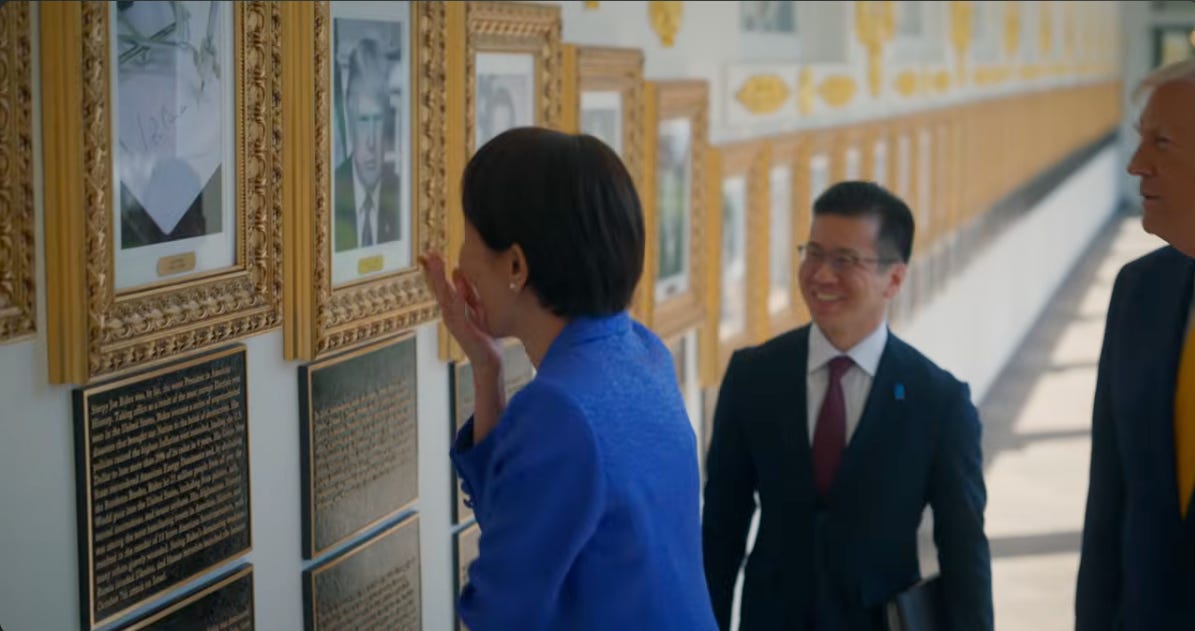
What makes this more than mere vulgarity, though, is what happened afterward. The White House then released a glossy promotional video built from the visit, pairing carefully selected audio clips from the earlier meeting with soft-focus imagery of Trump and the prime minister strolling the colonnade, cherry blossoms blooming, and presidential portraits lining the wall. At one point, the prime minister appears to pause and gesture quizzically toward the absurd Biden autopen display Trump has installed there, as if even a visiting ally could not quite miss the fact that the White House has been redecorated as a shrine to Trump’s grievances. But the real tell was the soundtrack. The video lifts the prime minister’s line that “it is only you, Donald, who can achieve peace across the world” and lays it over those stately visuals like a benediction. In context, it was diplomatic flattery. Out of context, it becomes a cinematic endorsement. The rambling, the threats, the Pearl Harbor crack, the incoherence, all of that was cut away. What remained was a carefully polished myth: Trump the peacemaker, Trump the historic figure, Trump the man affirmed by allies and framed by presidential grandeur. Diplomacy was recut into a legitimacy commercial.
The same formula appears to have been used with Ireland. There too, the White House stitched together pleasant lines from the bilateral meeting and laid them over scenic shots of green fountains, Capitol vistas, the gold-plated Oval Office, the presidential portrait walk, and even a bizarre close-up of shamrock socks and Florsheim shoes, as though statecraft had been handed over to a lifestyle influencer with authoritarian sympathies. Taken together, these videos look less like innocent highlight reels than the early stages of a new White House branding effort, one that seems to have accelerated after Trump’s disastrous invasion of Iran and the international backlash that followed. Having shredded his own credibility through recklessness and bombast, Trump now appears to be using foreign leaders, ceremonial settings, and the visual language of alliance to market himself back into respectability.
That is what makes the reader’s concern about King Charles so relevant. The danger is not only that Trump enjoys pomp. It is that he is now systematically repurposing it. Every bilateral meeting can be mined for clips, every visiting leader can be turned into a supporting character in a soft-focus presidential trailer, every act of courtesy can be edited into proof that serious people admire him, trust him, and still regard him as a legitimate figure on the world stage. In that sense, these visits are no longer just diplomatic necessities; they are raw material for Trump’s image-laundering operation. Foreign leaders who tell themselves they are merely showing respect for the office need to understand that, in Trump’s hands, they are extras in a legitimacy campaign designed to restore his stature after his own conduct has diminished it.
Unless and until those with influence stop kissing Trump’s ring he will continue to feel invincible. Trump might be the most vilified person on the planet but he is buoyantly drunk on the power others give him. Cowards and enablers are also culpable for the disaster of this regime. The leaders of Ireland and Japan fall in this category.
Both those meetings made me throw up in my mouth. Pearl Harbor? She should have retorted, "Well, you didn't tell us about Hiroshima either." I applaud ANY foreign dignitary that stands up to Trump. The sooner the better for us all. Push him down until he can't get up. Reveal him for the sniveling bully he is.