


Good morning! The United States is winning the war with Iran.
Donald Trump said so Wednesday night. Speaking at a Rose Garden campaign dinner for Republican lawmakers, a gathering of increasingly nervous incumbents who have about two months left to persuade voters everything is going wonderfully, Trump assured them it is.
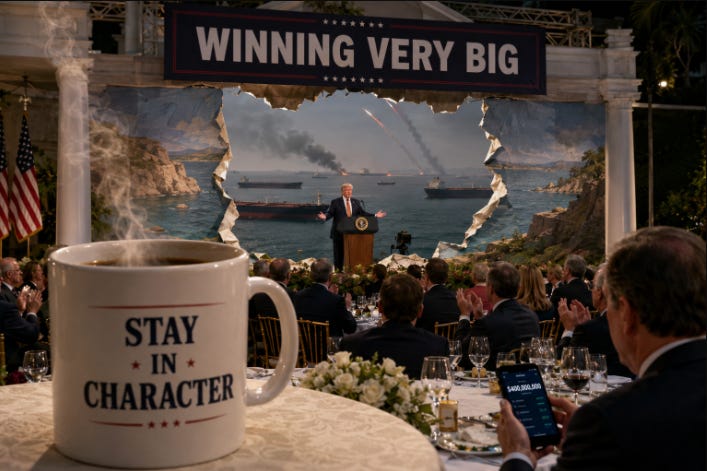
“We’re winning. We’re winning that one very big,” Trump said of Iran, moments after congratulating Pete Hegseth for having “knock[ed] the hell out of them.”
Iran, unaware it was losing “very big,” was by Thursday morning launching missiles and drones at military facilities in Kuwait and the United Arab Emirates.
Iran said the attacks targeted American-supported installations, including satellite communications, aircraft hangars, troop positions and radar systems. Kuwait condemned the repeated attacks as violations of its sovereignty. Qatar warned that the widening confrontation threatened the diplomatic effort still struggling to keep the region from falling into something much worse. The latest round followed an American strike in southern Iran that hit a wedding gathering in Kuhestak. According to the Iranian Red Crescent, four people were killed, two women and two children, ages four and sixteen, and dozens more were wounded. The organization has asked the International Criminal Court to investigate.
There will be arguments about the target, the intelligence, proportionality, and culpability. But there is no abstraction capable of turning a dead four-year-old at a wedding into a strategic accomplishment.
Prolonged war creates the conditions in which strikes like this become more likely: a misidentified target, stale intelligence, a commander who calculates that the military value outweighs the civilian risk. And this war escalated after Hegseth gutted the Pentagon’s Civilian Harm Mitigation program over CENTCOM’s own objections, discarding safeguards built from Iraq and Afghanistan because they didn’t fit his doctrine of “maximum lethality.” That makes “fog of war” a much harder excuse to accept.
Trump told his guests that Iran no longer has much of a navy or air force, that its leaders and technology are gone, its economy wrecked and its currency worthless. “It’s just a question of time,” he said.
Time until what was less clear. The administration keeps confusing its ability to destroy things with its ability to obtain the political result it wants.
“We now control the Hormuz Strait,” he told the Republicans assembled at the White House, adding that “many boats” are moving through day and night.
Al Jazeera reported Thursday morning that tracked commercial traffic through Hormuz has fallen roughly by half, although transponder data is imperfect because vessels often turn their signals off when operating in dangerous waters. The head of the International Monetary Fund is still describing the strait’s disruption as severe enough to increase borrowing costs and worsen debt pressures around the world.
Iranian officials, meanwhile, are saying exactly the opposite. Ebrahim Azizi, chairman of Iran’s parliamentary National Security Commission, said the strait cannot be reopened without Tehran’s consent.
Trump has offered another solution: simply rename the Strait of Hormuz “Trump Strait.” American grand strategy has reached the stage where contested waterways can be subdued through branding.
Trump can rename gulfs and lakes all he wants, even a strait, but he cannot force other countries to recognize these names and he cannot reopen Hormuz by Truth Social.
When control proves elusive, declare control anyway. If declaration is insufficient, put your name on the problem.
Netanyahu has removed another layer of ambiguity from the war: “All of our systems, under my direction, are working to bring down this regime and defeat it,” he said of Iran.
Israel is speaking just as plainly about Gaza. Defense Minister Israel Katz said Wednesday there is “no real solution for Gaza in the end without this migration,” and that Israel is prepared to move Palestinians “by sea, by air, by every way possible.” He wants Trump’s backing to convince neighboring countries to take them. Trump’s 2025 depopulation proposal, Katz said, was never cancelled, only “frozen.”
In Gaza, remove the population. In Iran, remove the regime. And in Gaza, Katz is explicit that American backing could make the rest possible.
Just a question of time.
Trump didn’t endorse regime change Wednesday, but his rationale keeps creeping. He told the Rose Garden the war protects Israel, the Middle East, “eventually” Europe, and American cities, Iran might otherwise “take out a couple of cities before we put them away.” That’s a long way from stopping a nuclear weapon.
Nuclear capability, shipping, deterrence, regional security, Israel, Europe, American cities, maybe regime survival; whatever keeps the war justified.
The people applauding Trump included Republican lawmakers staring at a difficult midterm election while Trump’s political operation sits on a $400 million war chest. According to the Financial Times, MAGA Inc has spent less than one percent of that money on advertising this year, even as vulnerable Republicans plead for help.
Ryan Mackenzie, whose name Trump called from the Rose Garden, told the FT that Republican resources should be deployed “sooner rather than later.” Mike Collins, another candidate Trump praised that evening, offered an even better summary.
“Trains run on coal,” Collins said. “Campaigns run on gold.”
Trump is sitting on the gold.
Picture the scene. A collection of nervous Republicans gather at the White House, applauding as Trump discusses the magnificent new helipad and the ballroom. He recounts candidates he has personally saved, boasts about his rallies and endorsements, and reminds everyone of his ability to drag people over the finish line. Before dinner is over, he has promised to spend the final thirty days campaigning in perhaps thirty-five competitive races.
Wonderful, now about that $400 million.
Trump has said the money is essentially his to deploy as he chooses. The FT describes MAGA Inc as another gravitational field around Trump, drawing wealthy donors and business leaders into an orbit that also encompasses his ballroom, presidential library and the wider constellation of enterprises surrounding the presidency.
Republicans need Trump’s money almost as badly as Trump needs their seats.
Lose the House and suddenly committees acquire subpoenas. Investigations become less theatrical. Appropriations become harder. Oversight stops being something done exclusively to other people.
So Trump stood before lawmakers who need tangible help and offered them something he values even more highly than money.
Trump.
He promised speeches, endorsements, tele-town halls, and personal appearances. He assured them that Iran was a victory, the economy was spectacular, the border perfect, crime almost extinct, factories everywhere, and Democrats communists.
Beneath the applause, you could almost hear the calculators.
The Texas Senate race illustrates the problem perfectly. Trump helped make that contest more expensive and competitive by backing Ken Paxton over incumbent Republican Senator John Cornyn. Now Republicans are worrying about a seat they ordinarily would not expect to spend enormous sums defending.
Trump used part of his Rose Garden speech to praise Paxton as perhaps the best attorney general in America, albeit one whose clothes, appearance, and television performances Trump apparently finds disappointing.
Republicans would now appreciate Trump spending some of Trump’s $400 million solving the problem Trump helped create. Government by branding has become campaign strategy by personal rescue.
The same evening also produced a delightful collision involving Pete Hegseth. Trump congratulated Hegseth for the previous night’s strikes.
“Pete, you did a good job last night.”
Senator Thom Tillis, meanwhile, has decided Hegseth should be fired. Tillis says the defense secretary has created a leadership void and is “intimidated by competence,” preferring culture-war performance to the serious business of managing the military.
It is an excellent line and would have been even more useful before Tillis cast the 50th Senate vote confirming Hegseth.
Hegseth bears responsibility for the institution he runs. Trump bears responsibility for keeping him there and praising him. Tillis bears responsibility for helping put him there after the warnings were already plentiful.
Everyone would now like credit for discovering the obvious.
The speech grew darker when Trump turned from foreign enemies to domestic ones. Democrats oppose voter ID, he told the Republican candidates, for one reason: “They want to cheat. There’s no other reason.”
Ordinarily, that’s the familiar grievance pile. Not this week; his administration is building new machinery around mail voting, including a Postal Service ballot-screening system a whistleblower has warned could see entire batches denied, while courts and states brace for the fallout. Rhetoric and machinery are starting to occupy the same space. If your opponents are cheating, extraordinary precautions become reasonable. Trump doesn’t need to abolish an election, only to convince enough people beforehand that one he loses was illegitimate.
Almost by accident, he gave the clearest statement of his governing philosophy all night. Explaining his decision to return education to the states, Trump conspicuously declined to say whether Congress needed to authorize it. If you had to go through Congress, he said, “you wouldn’t get it.” So he didn’t. Congress would not approve it, so do it anyway and deal with anyone who objects later.
That instinct is everywhere once you see it: act before Congress can stop you. Call destruction victory if Iran won’t surrender. Declare control of Hormuz if it won’t reopen. Rename it after yourself. Tell voters beforehand that the other side intends to cheat.
The common thread isn’t simply lying. It’s substitution: declaration for achievement, performance for control, branding for sovereignty, coercion for persuasion, personal authority for institutional permission, then applause on command.
Reality doesn’t care how confidently it’s announced. A four-year-old is still dead. Iran is still firing missiles. Hormuz is still disrupted. Republicans are still nervous. MAGA Inc’s $400 million is still mostly sitting there. The world keeps refusing to stay in character.
I keep thinking my level of disgust cannot get any higher. I go back and forth about not reading any news as it gets me so angry, but I realize that sticking my head in the sand accomplishes nothing. best to stay informed, support where i can, stand up where i can, vote and get others to vote. get others to understand what is really happening, how it is not "politics as usual" and what the implications will be for their futures and the futures of their families. i am stunned how many do not give a crap about their kid's futures or the future of the country. the disposable economy that we live in where food, containers, clothing, etc. are all viewed as use it once and throw it out has now moved to the national level... lots of those on the right think that "it was a nice run while we had it... dont care what happens next" to the extent that they have glommed onto the doomsday religious cult scenario of "end times".... hey, if end times are near, why is JD preparing for a run for the presidency? guess he is covering his bases. maybe time for another of his name changes.
one of several things will happen... assuming that the elections are remotely free and fair and the democrats take control of the house and even the senate, then there will be hearings and subpoenas, and gnashing of teeth and rending of garments, but whatever the democrats put forth unless they have a veto proof majority, will get killed by trump. he will continue to govern by fiat, by executive order, and clearly neither the justice dept nor the supreme court has any intention of reining him in. they will then accuse the democrats of not getting anything done, and morons will lap that up. he is not parting with his money as he may think that he does not need it. there are more and more people concerned that he is going to execute some sort of coup, either by canceling the election or simply seizing ballot boxes before anything can be counted and then declaring all the republicans winners. hegseth has busily purged the military of anyone that he thinks may stand up to the destruction of the constitution, and installed his own group of yes-men. like all the people surrounding trmp, most of the republicans in congress and the senate appear to be quite comfortable with the concept of jobs for life (assuming that they do not cross trmp) and not actually having to do anything as congress and the senate will cease to exist as a functioning body. they are close to that precipice now, and if trmp steals the mid terms, then game over. i think he does care about the mid terms, but does not care about the election... he has other plans in mind and i suspect it involves ICE, the national guard and possibly declaring a national emergency or invoking the insurrection act or some such thing. he will take a page from Putin and Netanyahu
I wonder how much of that money is in Trump's pocket by now? 😡