


Good morning! One of the small pleasures of watching foreign commentary on Trump is that the hosts and guests are often less burdened by the American press’s pathological need to translate obvious instability into “unorthodox style.” They just say the thing.
It is why I endured the NATO summit in Turkey, even after Trump’s press conference had become a one-man demolition derby of Greenland fixation, Iran threats, Ukraine confusion, and TikTok boasting. Some stubborn part of me was still hoping a technocrat or two inside the alliance would sit him down and say: that is not how any of this works.
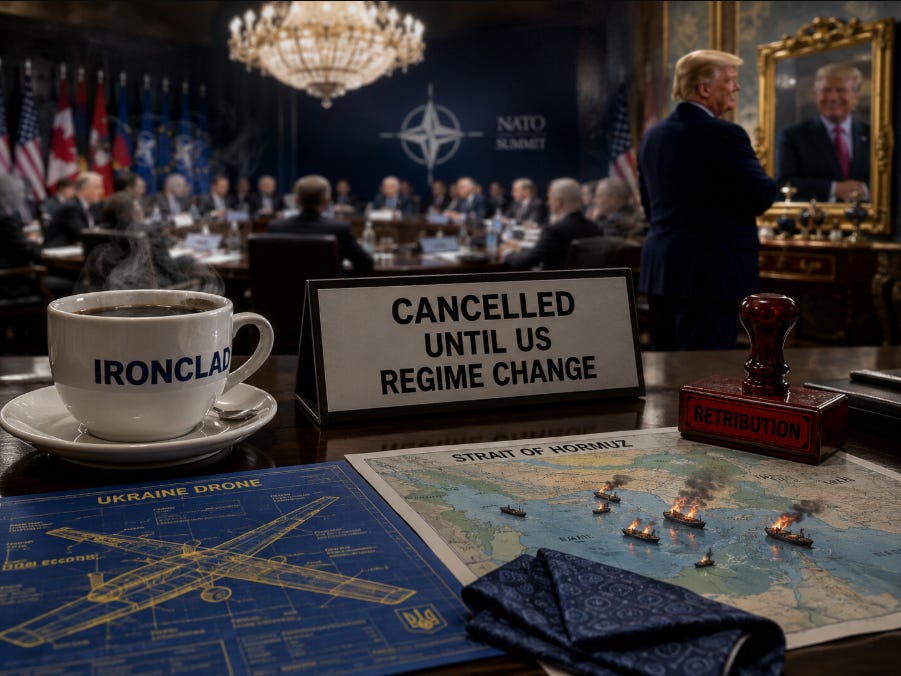
Mark Carney came closest, from a safe Canadian distance. Giorgia Meloni did her part by refusing to turn Italian sovereignty into fealty. But inside the summit itself, the dominant public performance was Mark Rutte flattering Trump hard enough to keep the chandelier from falling, while everyone else practiced the international language of biting one’s tongue until the meeting ended. They smiled, praised, and wrote “ironclad” into the declaration. They let him claim the room loved him.
Yesterday, in an essay that should post here tonight, I argued that this was the whole story of the trip, that Trump left Turkey certain he’d been adored, while the adults at the table were quietly managing him and building for a world that can survive American unreliability.
Then, blessedly, I found a panel that said it out loud. On Deep State Radio, David Rothkopf’s foreign-policy channel, retired Lt. Gen. Mark Hertling called the summit “management of our president.” Ivo Daalder, former U.S. ambassador to NATO, went further: the allies seem to have concluded that managing Trump isn’t enough, so they’ve scrapped the annual summit itself, canceling the one planned for Albania in 2027 rather than do this again while he’s in office. Ed Luce of the Financial Times described the deeper shift already underway: a “dense web of networks,” in Carney’s phrase, as Europe and Canada build alternatives that lessen their dependence on the United States, not only militarily, but in tech and digital.
Containment with a pocket square. The premise held.
One of the useful things the Deep State Radio panel did was drag Ukraine back into the center of the frame, where it belongs.
That has been one of the quieter obscenities of Trump’s Iran spectacle and NATO theater: Ukraine, the largest land war in Europe since World War II, keeps getting shoved to the margins by the latest Trump tantrum, the latest Greenland hallucination, the latest “love in the room” boast, the latest missile-count word salad. But Ukraine has not become less important because Trump has become louder.
If anything, Ukraine has become more remarkable.
For over four years now, Ukrainians have endured an invasion by a larger, nuclear-armed neighbor, absorbed staggering losses, adapted under fire, and turned necessity into a military revolution. The panel made the point plainly: Ukraine is no longer merely receiving technology from the West. It has become a global leader in drone warfare. Other countries are now signing agreements because they want Ukrainian technology, Ukrainian battlefield knowledge, Ukrainian innovation born under bombardment.
Russia entered this war assuming mass would decide the outcome: more troops, more artillery, more missiles, more terror, more indifference to death. Ukraine answered with resilience, improvisation, intelligence, and speed. Deep strikes inside Russia have hit oil facilities, threatened the logistics that sustain Moscow’s war machine, and made Crimea harder to supply. The country that expected to roll into Kyiv now has to defend its own fuel system, its own bases, and its own rear areas.
Business Insider reports that Ukraine’s drone campaign has deepened Russia’s fuel crisis, with shortages, purchase restrictions, and disruptions tied to sustained strikes on oil infrastructure and supply routes. The Daily Beast likewise reports that Ukrainian drone strikes have set tankers ablaze in the Sea of Azov and hit oil depots and facilities inside Russia, part of what Zelenskyy has called “long-range sanctions.” That is an excellent phrase, because it contains both the strategy and the insult. Western sanctions move through lawyers, loopholes, shell companies, maritime registries, and somebody’s cousin in Dubai. Ukrainian sanctions arrive at night and set the refinery on fire.
This is one of the central stories of our time, and yet, even at NATO, Ukraine had to fight for oxygen. Zelenskyy sat beside Trump and tried to talk about air defense, drones, and survival. Trump talked about “great land,” “great assets,” rare earths, and whether Ukraine might someday manufacture Patriot missiles itself. That may sound, at first, like a clever solution. The experts were blunt about the reality: building that production capacity could take years. Ukraine does not need the promise of a theoretical factory two years from now. Ukraine needs interceptors before the next Russian missile barrage.
That is the moral clarity Trump cannot provide. Ukraine has proven itself again and again, not only by fighting and innovating, but by defending the principle that borders cannot be erased because a stronger country decides history owes it land. Every inch of that lesson has been paid for in blood.
While Trump turns every summit into a mirror, Ukraine keeps reminding the world what courage looks like when nobody has time to perform it. While he talks about deals, assets, land, and who likes him, Ukrainians are building drones in workshops, repairing power systems under attack, holding cities through the night, and adapting faster than the empire trying to destroy them.
The war has not paused because American attention wandered. Russia has not stopped because Trump discovered a new grievance. Ukraine has not survived this long because of vibes, flattery, or “love in the room.”
It has survived because its people refuse to be erased, and that deserves to be back at the front of the news.
Then, as if the universe had decided to footnote the NATO argument in live fire, the Strait of Hormuz started burning again. Trump’s ceasefire, claimed as proof of his own mastery, is now, by his own account, “over.” The memorandum of understanding that was supposed to end the war is either dead or being kept alive by officials who understand that saying “the president blew up his own off-ramp” is not a career-enhancing sentence. The United States has bombed Iranian cities for a second consecutive night, with blasts reported along the Strait of Hormuz in Bushehr, Chabahar, Bandar Abbas, and Sirik. Iranian officials say the U.S. attacks over two days have killed 14 people and wounded 78. Iran has responded by attacking what it called “US bases and strategic centres” in Bahrain, Kuwait, Qatar, and Jordan. Kuwait says it intercepted three ballistic missiles, one cruise missile, and ten drones, with one person injured by falling debris. Jordan says it intercepted eight Iranian missiles. Qatar and the UAE have condemned the attacks as violations of regional sovereignty.
By all means, let us write “ironclad” into another declaration and pretend the chandelier is not swaying.
The immediate trigger, according to Trump, was alleged Iranian attacks on ships moving through Hormuz. His answer was “retribution,” because of course it was. Strategy was not the point. Congressional authorization was not the point. Nor was there any coherent explanation to the American people of why a war he said would last three or four weeks is now lurching back toward regional escalation. Retribution was the point: the foreign policy of a man who thinks every crisis is either a personal insult or a bill someone else owes him.
Al Jazeera’s Mike Hanna reported from Washington that the administration appears to be holding firm on canceling the Iran memorandum negotiations, even as some officials continue to suggest talks “should and could continue” despite the ongoing military action. That is the Trump doctrine in one sentence: the deal is canceled, the war is resumed, the ceasefire is over, and the talks may continue, depending on who has the microphone and whether the president has posted yet.
Hormuz is doing what Hormuz does when powerful men decide to make it the stage for their credibility crises. Oil tanker traffic through the strait was reportedly near a standstill Thursday, with only two tankers passing through in the early hours. Iran moved at least 10 million barrels of crude and fuel oil overnight, apparently anticipating the possible resumption of a U.S. Navy blockade. France is already discussing Syria as an alternative oil route, because apparently the emergency plan is to solve one regional war by routing around it through the bones of another.
The Financial Times adds a detail that makes this even darker: the United States did not merely strike “infrastructure” in the abstract. It struck railway bridges on the route to Mashhad, where Khamenei was being buried Thursday, as huge crowds gathered for the funeral. One bridge was reportedly only 55 kilometers from the holy city. Passenger train service from Tehran and other southern cities to Mashhad was disrupted. The line also carries cargo and connects Iran to trade routes through Central Asia, which gives the United States an obvious dual-use argument. But the timing and effect matter. This was not just a bridge on a map. It was a civilian transport route to a major religious funeral.
That does not automatically make it a war crime. But it absolutely belongs in the “possible war crime” file, not the “clean military target” file.
International humanitarian law does not allow “dual-use” to become a magic spell that turns civilian infrastructure into a free-fire zone. The question is not simply whether cargo also moves over the bridge. The question is whether the target made an effective military contribution, whether destroying it offered a concrete and direct military advantage, whether feasible precautions were taken, and whether the civilian disruption was proportionate. A strike that disrupts passenger rail to a burial city during a massive funeral procession demands legal scrutiny. Was the bridge being used for military movement at that moment? Was the strike necessary? Or was it intended, at least in part, as a symbolic message to a grieving and mobilized civilian population?
Not just academic questions, they are the difference between a lawful strike on a military objective and an attack on civilian infrastructure dressed up in military language.
The symbolism is hard to miss. Khamenei’s coffin was moving through Mashhad with the bodies of family members killed in the same U.S.-Israeli strikes. Crowds were gathering under red religious flags calling for revenge against Trump. Then the United States hit rail bridges on the route to the burial city, while also striking electricity infrastructure in Chabahar and Konarak, cutting power to parts of the region. Even if Washington claims every target had a military purpose, the public message landing in Iran will be simpler and more dangerous: the United States struck the roads to the funeral.
Wars become sacraments over strikes like this. It is how retaliation becomes recruitment. A president who says the flare-up will be “over very quickly” helps manufacture the next decade of grievance before the current fire is even out.
CENTCOM, according to reporting cited by Al Jazeera, said U.S. forces struck more than 170 Iranian military targets near the Strait of Hormuz over two days, including air defense systems, drone and missile storage sites, military speed boats, and logistics infrastructure. The stated aim was to degrade Iran’s ability to attack commercial shipping. The obvious risk is that in trying to degrade Iran’s ability to threaten the strait, Trump has helped turn the strait into the center of a wider regional fire.
Because no crisis in this region is ever allowed to remain neatly bordered, Lebanon and Gaza are still there, still bleeding beneath the larger headline.
Lebanon’s foreign minister is now insisting that negotiations with Israel are “an exclusively Lebanese responsibility,” after Iran tried to fold Israeli withdrawal from southern Lebanon and an end to months of attacks into the interim deal with the United States. Hezbollah supporters have blocked roads in protest, and one Hezbollah lawmaker warned of civil war if Lebanon’s government tries to force the group’s disarmament as demanded by Israel. Israeli forces have reportedly demolished homes in Haddatha in southern Lebanon’s Bint Jbeil district, continuing the campaign to make parts of southern Lebanon unlivable by fact, even when the word “occupation” is treated as impolite.
In Gaza, blood banks and laboratories are nearing shutdown. Gaza’s Health Ministry says lab-material shortages have reached 87 percent, while essential diagnostic supplies are running at a 74 percent deficit. Eight Palestinians were killed and 17 wounded by Israeli attacks over the past 24 hours, and since the “ceasefire” took effect last October, at least 1,092 Palestinians have been killed and 3,507 wounded. A ceasefire that requires quotation marks is really a press release with a body count.
All of this is happening as Iran buries Ali Khamenei in Mashhad after funeral processions in Tehran, Qom, Najaf, and Karbala. His coffin moved through enormous crowds while U.S. strikes, Iranian retaliation, regional condemnations, and competing claims of restraint piled up around the ceremony. Every side insists escalation is still controlled. The United States says it is not restarting the war, merely enforcing consequences. Iran says it is not attacking Gulf countries, but U.S.-linked bases and strategic centers. Gulf states say they are not party to the conflict, despite hosting the infrastructure Iran is now targeting. Israel says it is defending itself while Lebanon and Gaza remain under attack. Trump says the ceasefire is over, but somehow this is still not the full-scale war he promised to avoid.
This is where the NATO summit matters. The danger was never simply that Trump went to Turkey and sounded ridiculous. Trump sounding ridiculous is now priced into the lunch menu. It is that everyone around him keeps converting the ridiculous into policy, then asking the rest of us to admire the seriousness of the paperwork.
At NATO, allies managed him. They flattered him. They let him leave convinced he had dominated the room. But if Daalder is right, and the allies have quietly concluded that the only way to manage Trump is to avoid giving him another annual summit stage until he leaves office, then the public performance and the private planning have fully split apart. Publicly, they praise American leadership. Privately, they build a world with less America in it. Call it risk management.
And who could blame them? The President of the United States left a summit about collective defense and immediately returned to a war he keeps narrating like a casino dispute. Adoration, in his telling, replaces anxiety. Peace is declared over the sound of missiles. Strength becomes a costume for drift. Control becomes another boast, even as every actor in the region calculates how much more fire it can absorb before the whole map changes shape.
Containment with a pocket square, yes.
Containment is not leadership. It is what adults do when leadership has become a hazard. The allies can flatter Trump through another press conference. Pundits can praise the “tone” of another declaration. The American press can keep sanding the splinters off instability and calling it style. But the Strait of Hormuz does not care about palace management. Tankers do not move through vibes. Regional wars do not pause because Mark Rutte found the correct adjective.
In a small but satisfying domestic coda, a federal judge has ordered the release of the $5.8 million Trump owes E. Jean Carroll after the Supreme Court declined to hear his appeal of the 2023 sexual abuse and defamation verdict. Trump tried, naturally, to delay payment while asking the Court to reconsider its refusal. Judge Lewis Kaplan was unmoved, writing that Trump “has been stalling this case for years” and that it was time for him to “do equity” and pay the judgment. The 2nd Circuit then denied Trump’s emergency bid to stop the money from moving.
It is not the $83.3 million judgment. That one is still making its way through Trump’s beloved delay machine. But $5.8 million is now headed toward E. Jean Carroll, which is a perfectly respectable serving of schadenfreude with morning coffee.
Trump left Turkey thinking the room loved him. The adults left Turkey looking for exits. Ukraine kept fighting the war that proves why alliances matter. Hormuz caught fire because vanity is not a doctrine. And somewhere in New York, a court finally told Donald Trump that the money can move.
Not enough justice for one morning, but better than none.
Thanks for the truth behind all the smoke screens.
And on the way home from Turkey, as oil prices are climbing, Trump dusted off his familiar line-“Iran called, they’re begging for a deal”.