

Good morning! In April, a letter signed by 36 medical experts and mental health professionals, raising concerns about Trump’s judgment, decision-making, and relationship to reality, was entered into the Congressional record. Jamie Raskin was among the members who helped get it there.
On May 20th, 20 of those same experts wrote directly to White House physician Dr. Shan Barbabella, invoking the Tarasoff duty-to-warn doctrine, the legal principle established by the California Supreme Court in 1976 that “the protective privilege ends where the public peril begins,” to argue that safety supersedes presidential medical confidentiality. They asked the president’s physician, Dr Barbabella, to obtain a comprehensive neuropsychiatric evaluation, not the cognitive screening tool his predecessors have used, and to brief Congress on his findings. Carbon copies went to Raskin and, per protocol, to House Judiciary Chairman Jim Jordan.
The institutional critique beneath the legal argument is well-documented and not new: White House physicians are structurally disqualified from independently evaluating their own commander-in-chief. Ronnie Jackson declared Trump “mentally fit for duty” based on a 10-minute cognitive screen in 2018. A geriatric internist, Dr David Benjamin, reviewing Trump’s available records this week noted that the labs released by Barbabella are “the most rudimentary” available, no electrolytes, no modern Alzheimer’s biomarkers, no neuropsychological testing, and that Trump’s visible physical deterioration includes observable muscle wasting, daytime somnolence, and hand bruising consistent with skin fragility and aspirin noncompliance, none of which appear on his official diagnosis list.
Trump left Walter Reed on Tuesday after a multi-hour examination, his third visit in 13 months, and posted that everything checked out “perfectly.”
The paper trail now runs: April congressional record, May 20th letter to the White House physician, Walter Reed visit, “perfectly.” What it does not yet include is a response from Barbabella, a response from Congress, or any indication that anyone in a position of institutional authority intends to treat the documented concerns as anything other than a messaging inconvenience to be waited out.
The question that silence refuses to answer is whether the surrounding systems will acknowledge observable instability while he is making decisions that can move oil markets, widen famine, shape war powers, and discipline Congress through fear. That non-response is the context for everything else this week.
Oil crossed back above $100 a barrel on Tuesday after fresh US strikes on Iranian missile launch sites and mine-laying vessels reminded traders that the Charlie Brown and Lucy football routine they have been running since February is, in fact, still the routine. The day before, Brent had fallen to $95.95 on reports that a deal was close. Then strikes. Then $100. Then Iran’s state TV published details of an “Islamabad framework,” a draft memorandum of understanding under which Iran would reopen the Strait of Hormuz within a month and the US would lift its naval blockade and withdraw forces “from the area surrounding Iran.” Iran’s deputy national security secretary, speaking from a summit in Moscow, promptly clarified that Iran and the US had not reached an agreement. “Until we agree on all the issues, we consider that we have agreed on nothing,” he said, which is exactly the kind of statement that sounds like diplomatic boilerplate until you realize it is being delivered in Moscow.
The structural problem underneath the diplomatic loop: global emergency oil stockpiles have been covering roughly 2 million barrels a day of the 14.4-million-barrel-per-day gap left by the Hormuz blockade. Those releases end in July. The IEA is warning about a “red zone” in July and August. JPMorgan is describing inventories as “critically low” and says the market will remain tight even in a best-case resolution scenario. UK pump prices hit their highest since the conflict started this week, and the average household energy bill is set to rise by another £209 a year when the price cap adjusts Wednesday.
The more revealing wrinkle is the nuclear issue. Trump said earlier this week that Iran’s enriched uranium would be transferred to the United States “immediately” for destruction, a claim that functions as either a genuine negotiating position or a Truth Social post, depending on how charitably you’re feeling. Ali Bagheri, Iran’s deputy secretary of the supreme national security council, said in Moscow it was “not on the agenda.” These are not reconcilable statements. Tehran, watching closely, understands that Trump may be negotiating terms he cannot deliver without congressional authorization he does not have, the Iran Nuclear Agreement Review Act still exists, and they have the 2018 JCPOA walkout as a recent data point on US treaty reliability. The Hormuz chokehold is not just a war tactic. It is their insurance policy against the next time.
This is the command-and-control environment in which an oil crisis with a hard July deadline is being managed.
Four months after Donald Trump launched the Board of Peace with characteristic fanfare, describing it as one of the “most consequential” international organisations ever created, its World Bank fund has received zero dollars. Not a rounding error. Zero. Donors have been directed instead to a JPMorgan account, which, unlike the World Bank mechanism, carries no independent transparency or reporting requirements. A Board of Peace official told the Financial Times that contributors had simply “opted to use other options” and that financials would be reported “at a time deemed appropriate.” To its own executive board, of Trump administration officials.
The $17 billion in pledges remain pledges. Morocco contributed approximately $3 million. The UAE contributed $20 million. A separate $100 million UAE commitment to train a Gaza police force is frozen. The State Department’s $1.2 billion in aid reallocation for board-adjacent projects has not moved. The $50 million the department wants to send directly to the board has not moved either, because the financial controls required to receive US funds do not yet exist. “Not one US dollar” has been deployed for Gaza reconstruction, according to people familiar with the planning.
Jared Kushner’s renderings of an AI-powered Gaza with gleaming towers and luxury amenities, meanwhile, remain aesthetically ambitious. Contractors won’t touch the project because no one can establish what law governs Gaza, who is legally responsible for it, or what liability attaches to working there. The Board of Peace’s own spokesperson acknowledged the board is “not operating in Gaza yet” because Hamas has not disarmed, which was also true four months ago when the board was announced. The gap between the press release and the spreadsheet is the entire Gaza Strip.
Trump was originally scheduled to bring his cabinet to Camp David on Wednesday, the site of the Egyptian-Israeli peace accords, the Kennedy-era retreat where presidents have historically gone to think hard about hard things, for a meeting at what the Guardian is describing as “a crucial stage” of Iran negotiations. He canceled, citing rain forecasts.
Trump will hold the meeting at the White House instead, because showers are expected in the Thurmont, Maryland area.
To understand what the cabinet meeting is actually about, you need to understand what happened in Texas on Tuesday. Ken Paxton, the state attorney general who survived impeachment, a federal securities fraud investigation, and a years-long corruption saga that would have ended most political careers, romped to a 64-point margin over incumbent Senator John Cornyn in the Republican primary runoff. Cornyn’s forces spent nearly $100 million trying to stop him. It was the costliest Senate GOP primary on record. Money did not move this race.
Trump endorsed Paxton late, and Paxton won anyway, which is precisely the point. Indiana, Louisiana, Kentucky, now Texas: Trump has spent the past several weeks demonstrating to his Senate caucus that incumbency, institutional standing, and $100 million in opposition spending are insufficient protection against a late Trump endorsement of your opponent. The message to Lindsey Graham, Roger Wicker, and anyone else inclined toward hawkishness on Iran is not subtle. Your seat is contingent on staying in line.
The cabinet meeting is not a war council. It is a loyalty demonstration, an occasion for public expressions of confidence in Trump’s Iran management, designed to show that he has his right flank subdued enough to pursue a deal. The substance of the negotiations is, in this framing, somewhat secondary to the domestic political performance surrounding them. The Iranian government, watching closely from Tehran, understands this too: Trump may be negotiating terms he cannot deliver, making promises contingent on a congressional acquiescence he is managing through fear rather than persuasion.
The unintended consequence of the Paxton endorsement is that Democrats now have their most credible Texas Senate pickup opportunity in decades. James Talarico versus Ken Paxton in November is a race Democrats can run nationalized; Paxton’s scandals are voluminous and well-documented. Trump is apparently willing to accept that downstream risk. He needs his senators quiet through the summer. November is a problem for November.
The midterms are in the fall. Oil is at $100. His approval ratings are declining. Outgoing Director of National Intelligence Tulsi Gabbard is set to leave her post June 30th and will be at the table Wednesday, which raises its own questions about intelligence continuity through the final stretch of negotiations. The institutional response to a visible command-and-control crisis is, in every direction, more performance and less function.
Marz and I thought you should know: 363 million people are now at risk of acute hunger globally. Forty-five million of those cases are directly attributable to the Middle East conflict and the resulting oil price spike, according to the UN World Food Programme. US contributions to the WFP have been cut by more than half. “We take from the hungry to give to the starving,” the WFP’s acting executive director said this week. “That’s the reality.”
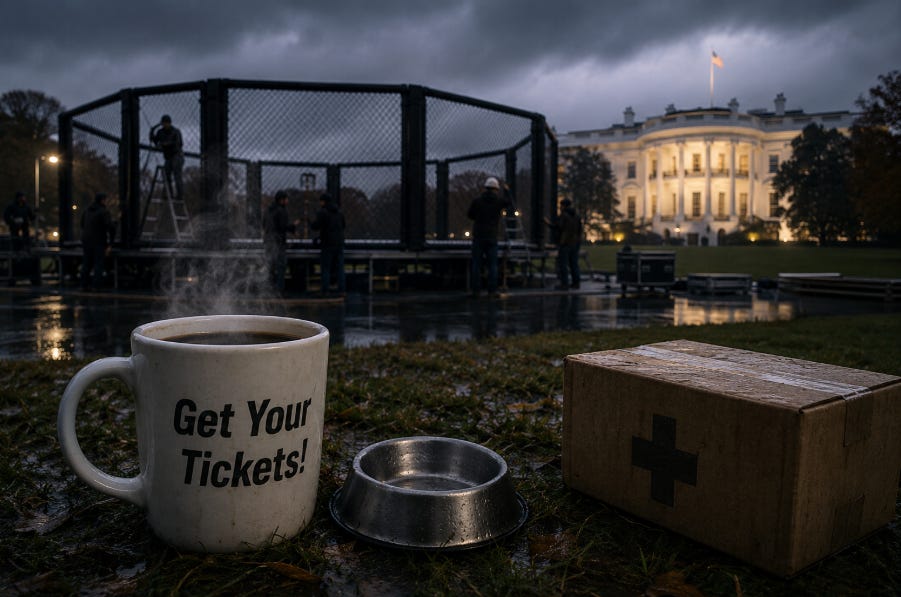
The other reality is that the UFC fight cage is going up on the White House lawn.
The fight is June 14.
Can we just call 1600 Pennsylvania Avenue what it is? White trash palace.
The global number at risk of hunger is about the size of US population. I believe S. Miller wants people (children) to die who are in families who can't afford food. Eliminating and rendering powerless people who are not wealthy and healthy is part of the plan.