


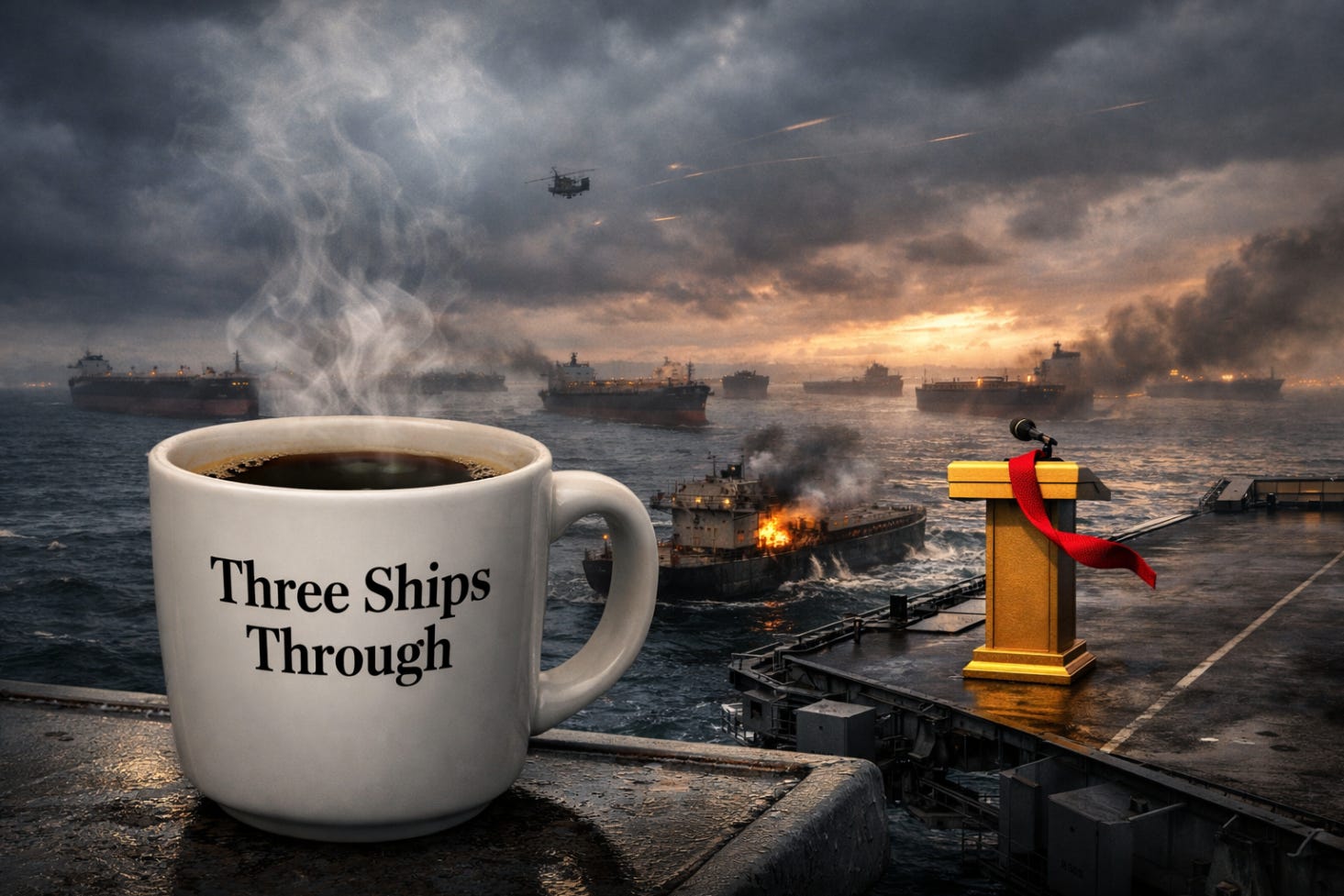
Good morning! Let’s do some math first. Before the war, more than 120 ships a day transited the Strait of Hormuz, carrying roughly a fifth of the world’s oil and liquefied natural gas. On Saturday, after Trump announced from an airplane that he had essentially solved everything, 24 ships made it through. By Monday, that number was three. Three. The Nova Crest, the Starway, and the Axon 1, flying the flags of Barbados, Liberia, and Gambia respectively, apparently missed the memo that the strait was now a live fire zone and kept going anyway. Everyone else turned around. You will be unsurprised to learn that Trump spent the weekend calling this a great victory.
On Sunday, a US Navy destroyer spent six hours shadowing an Iranian cargo ship called the Touska, firing several rounds from its Mk-45 deck gun, that’s a 70-pound shell containing roughly 10 pounds of TNT, for those keeping score at home, into the vessel’s engine room before helicopter-borne Marines swooped in and seized it. US Central Command described this as “deliberate, professional, and proportional.” Tom Sharp, a warship captain with over 25 years in the Royal Navy and about as friendly a witness as you’re going to find, described it somewhat differently. His assessment, delivered with the pained patience of a man watching someone parallel park into a fire hydrant, was that the sequencing was “very odd,” the weapon chosen was “clumsy,” and the decision to fire at all was unnecessary given that they boarded it, anyway. The ship, he noted, now has no functioning engine room, may still be on fire, and needs to be towed somewhere, making the inspection the whole operation was designed to enable considerably more complicated than it needed to be. Sharp’s professional summary: “very gung-ho, very forward-leaning.” High praise from a ally. Imagine what the other side is saying.
There is also the small legal matter, which Sharp raised with the careful tone of someone who knows it will be ignored, that firing on a commercial vessel with civilian crew aboard is “legally tricky.” These are merchant sailors, not combatants. But details of that kind tend to get lost somewhere between the Truth Social post and the ticker tape.
Trump announced from his airplane on Friday that Iran had agreed to everything, that the strait was essentially open, and that a deal was basically done. Saturday morning, Iran’s military command announced the strait was under “strict control” and would not fully reopen. Iran’s chief negotiator went on X and itemized Trump’s claims one by one, calling all seven of them false. “With such lies,” he said, “they did not achieve victory on the battlefield and will certainly get nowhere in the negotiations.” An Indian tanker with IRGC-granted clearance to transit the strait was fired upon anyway. A French container ship took a hit from an unknown projectile. Both ships turned around.
JD Vance, who had already spent 21 hours in Islamabad the previous weekend negotiating without securing a deal, then declared a “final and best offer” and flew home, boarded another plane this week to go back and try again. Pakistan deployed 10,000 extra security personnel and cleared the Serena Hotel. Iran’s foreign ministry said there were “no plans” for talks. Everyone proceeded as if talks were happening anyway, which at this point is the closest thing to a diplomatic framework on offer. Vance, it should be noted, recently campaigned for Viktor Orbán in Budapest. Orbán lost. He also suggested the Pope should be more “careful” when discussing theology. The Pope has not visibly adjusted his approach. These things are not directly related to the Iran negotiations but they do establish a pattern of outcomes worth tracking.
The BBC has identified a pattern of trading spikes in the minutes, not hours, not days, minutes before Trump’s public announcements about the Iran war. On March 23rd, between 14 and 16 minutes before Trump posted on Truth Social that the US had enjoyed “very good and productive conversations” with Iran, hundreds of millions of dollars in oil futures contracts changed hands. Oil subsequently dropped 14 percent. The traders who went short in that narrow window made, to use the technical term, an absolute fortune. One account called Burdensome Mix, and someone named it that, which tells you something, opened in December, placed $32,000 on Nicolas Maduro being ousted, collected nearly half a million dollars the next day when US special forces seized him, changed its name, and has not placed a bet since. Both prediction market platforms where these bets were placed, Polymarket and Kalshi, count Donald Trump Jr. among their advisory board members. Trump Jr. did not respond to the BBC’s request for comment. The White House did not respond either, though a spokesperson previously said the administration “did not tolerate any official illegally profiteering off inside knowledge.” Noted.
It is of course possible, as the BBC carefully acknowledges, that some traders have simply become very good at anticipating when Trump will reverse course. Fourteen minutes good. Consistently. Across multiple announcements. About a war. You may draw your own conclusions.
The Wall Street Journal, that noted left-wing propaganda outlet owned by Rupert Murdoch, published a piece this weekend titled “Behind Trump’s Public Bravado on the War, He Grapples With His Own Fears.” It is, by any measure, a remarkable document, sourced from senior administration officials who are either very brave or have already updated their résumés.
When an American F-15 was shot down over Iran on Good Friday, Trump screamed at aides for hours in a nearly empty West Wing. The Europeans aren’t helping, he said repeatedly. Gas was $4.09 a gallon. The ghost of Jimmy Carter stalked the corridors. “If you look at what happened with Jimmy Carter,” Trump had said in March, “with the helicopters and the hostages, it cost them the election. What a mess.” His aides, making a command decision of their own, kept him out of the situation room during the minute-by-minute rescue operation because, a senior administration official told the Journal, “they believed his impatience wouldn’t be helpful.” Vance dialed in from Camp David. Chief of Staff Susie Wiles joined from Florida. Trump received updates by phone, at meaningful moments, like a relative who has been gently redirected to the waiting room.
While the rescue operation was unfolding, and while his 8pm deadline for Iran to agree to terms or face civilizational destruction ticked down, Trump discussed endorsements in an Indiana state race, prepped for the midterms, listened to briefings on cryptocurrency and artificial intelligence, and had multiple conversations about the ballroom he is building on White House grounds, for which he has appointed himself general contractor. He is, aides say, amazed at all that can be built underground.
Kori Schake of the American Enterprise Institute, a right-leaning think tank, for those who might otherwise dismiss the source, put it with the precision of someone who has run out of diplomatic alternatives: “We are witnessing astonishing military successes that do not add up to victory and that is squarely on the president and how he’s chosen to do his job, lack of attention to detail and lack of planning.”
The generals, for their part, are leaking to the press with what one observer described as firehose consistency. The Army Chief of Staff was fired. The Chairman of the Joint Chiefs, the Chief of Naval Operations, the Vice Chief of Staff of the Air Force, and the top JAG lawyers were all removed. When current military leaders were asked by Congress why General Randy George was fired, they said, with the weary precision of men who have checked with their lawyers, that the question should be directed to Secretary Hegseth. Hegseth has not answered, but Congress would very much like to know. The building is leaking, generals are talking, and the situation room has a new guest list policy.
One evening in March, at a White House reception for donors and top staff held the night after Trump had threatened to destroy Iranian civilization, the President of the United States mused aloud about awarding himself the Medal of Honor. The Medal of Honor, for context, is the nation’s highest military decoration, awarded for conspicuous gallantry and intrepidity at the risk of life above and beyond the call of duty.
Trump explained why he felt he deserved it. On a trip to visit troops in Iraq during his first term, his plane descended in the dark toward an unlit runway. It was very scary. The pilots kept reassuring him. They landed safely.
White House counsel David Warrington, who happened to be standing nearby, quietly indicated this would not be possible. Karoline Leavitt says he was joking and The Wall Street Journal reported it anyway.
Marz and I drove to Portland yesterday to say goodbye to my uncle, and I want to thank all of you for the kind messages and good wishes. I pulled this roundup together on my iPad, in the middle of the usual interruptions and emotional whiplash that come with sitting beside a loved one in their final days, so I appreciate your patience with any occasional gaffe or places where today’s post feels a little less stitched together than usual. We made it home in the wee hours of this morning, and somewhere along the way I found myself going through a car wash because apparently the bugs in Portland are not insects so much as low-flying aircraft.
Sometimes all we need is someone on the same side. Thank you, that in the midst of personal sorrow, you've chosen to support me/us ❤️
Sorry to hear about your uncle but glad you had a chance to visit him, despite the fact that "the bugs in Portland are not insects so much as low-flying aircraft." I will be sure to let my son who will be moving out there after June, is aware of that! LOL
Thanks for the updates, though.