


If a press system claims the privileges of the Fourth Estate, claims constitutional protection, claims public trust, and claims the prestige of democratic necessity, then it also inherits responsibility for what happens when it knowingly abandons that role. When profit-driven media chooses access over scrutiny, spectacle over truth, and shareholder comfort over democratic duty, it is participating in the damage.
That damage now looks so obvious from abroad that the foreign press is increasingly dispensing with the euphemisms that still hobble much of American coverage. In recent exchanges on LBC, James O’Brien and Simon Marks sounded less like outside observers than incredulous witnesses to a political system in open decay. O’Brien captured the lunatic whiplash of Trump’s presidency with his mocking litany of wars won, lost, won, lost and negotiations that succeeded, failed, succeeded, failed, while Marks went straight for the question American journalists still seem reluctant to ask plainly: at what point does visible instability become impossible to ignore as a matter of presidential fitness? In another segment, O’Brien made the comparison even sharper, arguing that American journalism once rose to the challenge of Richard Nixon because Nixon’s abuses were legible to a system built for normal scandal. But what happens when there is a Watergate every other day, and the institutions that should expose it are too overwhelmed, too compromised, or too profitable to respond?
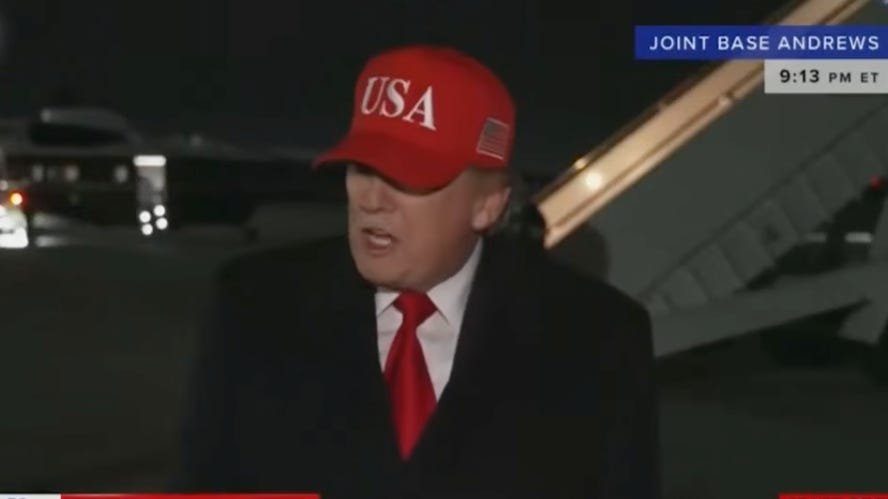
That is where the crisis stops being merely about Trump and becomes an indictment of the media order that surrounds him. As Listening Post argued, more than half of the traffic to major U.S. news sites last year, over 25 billion visits, went to outlets controlled by just seven families or their corporate entities. It is a concentrated ownership structure in which a very small number of ultra-wealthy people can shape what millions see, what editors fear, and which truths become too inconvenient to pursue. Jeff Bezos owns The Washington Post while also remaining Amazon’s founder and largest individual shareholder; after blocking a presidential endorsement, he later narrowed the paper’s opinion section to focus on “personal liberties and free markets,” a move that triggered resignations and intensified concerns that the owner’s ideology and business interests were now overtly steering the institution. Rupert Murdoch’s empire spans Fox News, The Wall Street Journal, and the New York Post, and the family’s 2025 succession deal ensured that Lachlan Murdoch would retain long-term control over that political-media machine rather than any moderation of its ideological direction.
The same pattern extends further. The FCC approved Skydance’s acquisition of Paramount in July 2025, putting CBS under the control of David Ellison, backed by his father Larry Ellison, Oracle’s billionaire co-founder. Listening Post is right to frame that not as an isolated ownership change but as part of a larger oligarchic consolidation: owners with vast interests in tech, regulation, mergers, contracting, or adjacent businesses do not need to bark newsroom orders for the pressure to be felt. When your owner’s wealth depends on government approvals, market confidence, political access, or the smooth handling of other billion-dollar enterprises, truth-telling becomes an expensive habit and watchdog journalism starts to look less like a public service than a liability. In that world, the next Watergate is not just embarrassing, it is a business risk.
The public is left staring at a darker possibility. What if Trump’s apparent incapacity is not simply being ignored, but quietly found useful? What if the chaos, the incoherence, the grandiosity, the inability to hold a line from one hour to the next, all serve a purpose for the people around him? A visibly unstable president can still sign what he is handed, repeat what he is told, absorb the outrage, and take the blame. He can be a shield for handlers, enablers, donors, fixers, ideologues, and media owners who prefer that the story remain centered on one deteriorating man rather than on the system exploiting him. It is a cruel possibility, but cruelty has never disqualified anyone in this political ecosystem. If it is even partly true, then the failure of the press is not merely professional but moral. While the spectacle keeps rolling, the cost is borne not just by Americans, but by people across the world forced to live with the consequences of a superpower governed through profit, cowardice, and managed delusion.
Foreign outrage matters. O’Brien and Marks are not merely sharper or funnier than their American counterparts, though they are certainly both. They are exposing a gap in perception that has become impossible to ignore. From outside the United States, Trump’s behavior often looks exactly like what it is: erratic, menacing, contradictory, and increasingly untethered from any recognizable standard of presidential conduct. What is striking is their willingness to say so plainly, and their bafflement that so much of the American press still strains to process the same conduct through the exhausted rituals of balance, access, and performative neutrality. O’Brien’s observation that Nixon-era journalism could rise to the challenge of Watergate because it was confronting scandal on a human scale now feels devastatingly apt. Today it struggles to withstand a presidency that manufactures a fresh Watergate daily.
American media’s structural decay becomes impossible to separate from its moral failure. The point made in Listening Post is not just that billionaires own too much of the press; it is that ownership itself has changed the mission. News organizations that once claimed public purpose are now folded into portfolios whose real priorities lie elsewhere: defense contracts, mergers, shareholder returns, regulatory access, ideological projects, personal influence. Journalism does not have to be censored outright in such a system. Pressure can be subtle, managerial, even ambient. A retreat from investigative ambition dressed up as a strategic reset. A preference for voices that flatter power rather than confront it. Technically, the watchdog is still alive, but it has been house-trained.
It explains one of the strangest features of this era: the simultaneous abundance of coverage and scarcity of accountability. Trump is everywhere, dominating headlines, chyrons, clips, panel discussions, push alerts, and breaking-news banners. He is arguably the most over-covered political figure in modern history. Yet the central truth of his presidency is still too often approached sideways, diluted by euphemism, or buried beneath the profitable churn of daily outrage. The public receives a torrent of content but only intermittent clarity. The result is a press culture that can describe every eruption in minute detail while still evading the full meaning of the pattern.
Once you see that, the darker possibility comes into focus. If Trump is indeed unstable, increasingly incapable, or easily manipulated, then his condition may not simply be a source of alarm to the people around him; it may be an asset. A president who draws all scrutiny toward himself is useful to those who prefer to govern from the shadows of his spectacle. He takes the heat, fills the cameras, absorbs the ridicule, the legal jeopardy, the constitutional panic. Meanwhile, the handlers, loyalists, donors, opportunists, and owners who benefit from his continued usefulness can stay one step removed, insulated by the very chaos they help sustain. This makes the whole arrangement feel not merely dangerous, but grotesque. Even if Trump deserves no personal sympathy, the possibility that his deterioration is being tolerated or exploited for political and financial gain reveals a level of cruelty that extends far beyond him. It means millions of people, in the United States and far beyond it, are being forced to live with the consequences of a system that finds a failing strongman more useful than accountability.
The indictment must finally widen. It is no longer enough to say that Trump is dangerous, or erratic, or perhaps no longer fully equal to the office he holds. The harder truth is that a great many powerful institutions appear willing to live with that danger because they still find him useful. The press keeps cashing the ratings checks. Owners keep protecting larger business interests. Political allies keep borrowing his reach while dodging his liability. Enablers keep treating his incoherence as manageable so long as it remains profitable, useful, or transferable. A constitutional emergency is instead being managed as a business model.
The cost of this arrangement is not theoretical. Ordinary people who do not own newspapers, sit in boardrooms, or ride Air Force One, and do not get to disappear behind a public relations statement when the damage is done, pay for it. Americans living under an increasingly degraded political system and people far beyond American borders who are forced to absorb the shocks of its instability are paying for it. That makes the media’s failure so much more than professional embarrassment. Institutions that claim democratic purpose knowingly choose profit, access, and self-preservation over truth and vigilance, not merely fail to prevent harm; they help administer it.
Perhaps that is why the foreign voices sound so clear. They are not necessarily more virtuous than their American counterparts. Distance makes them less likely to be caught inside the same web of incentives, less likely to answer to an owner with an FCC merger pending, a defense contract at stake, a stock price to protect, or a White House relationship to preserve. That buffer makes them less captive to the access rituals and commercial calculations that have taught so much of American media to package democratic collapse as content. They can still see, with a clarity that now feels almost foreign in itself, the obscenity beneath the spectacle. They can still ask what American journalism too often will not: What happens when a president has so obviously lost the plot? What does it say about a country when the institutions charged with holding power to account decide instead to monetize its breakdown? What, exactly, will it take before they answer for the damage they helped normalize?
If the American press wants to invoke the prestige of the Fourth Estate, then it must also face the moral consequences of abandoning that duty. It cannot claim the protections of democratic necessity while behaving like another profit center in an oligarchic marketplace. It cannot spend years normalizing corruption, laundering extremism through euphemism, and mistaking spectacle for scrutiny, only to plead helplessness when the wreckage is too large to ignore. The public has the right to say that this was not just a failure to warn; it was complicity in the damage.
While reading this I kept getting a mental picture of Grima Wormtongue and King Theoden (Tolkien's Return of the King).. I hadn't thought of the angle of Trump's court using his obvious dementia for their own purposes, so good for you Mary for pointing it out. I can just see Stephen Miller acting in a major way in taking advantage of Trump like this, which scares the hell out of me.
I’ve wondered for a while whether trump’s words and actions were conveniently providing cover for those behind the scenes. Thanks for voicing it!