


TrumpRx is the kind of thing you announce when you want Americans to feel, briefly and spiritually, like they are the main character in a country that loves them back. A brand-new government website, with a name that sounds like a steak seasoning, that will make prescription drugs cheaper. The White House describes it as a major affordability breakthrough. The vibe is “miracle cure,” except the miracle is a landing page.
To be clear, a tool that helps some people pay less for some medications is not a bad thing. In a system where patients ration insulin and split pills like they are sharing a single mozzarella stick at a group dinner, any genuine discount can matter. But the problem with TrumpRx is not that it exists, the problem is what it pretends to be.
It wants to be a plot twist that fixes American health care, when it is, in practice, is closer to a coupon dispenser wearing a tuxedo.
Here is what TrumpRx is, clinically speaking. It is a portal that lists cash prices for a limited set of drugs and routes you to discounts, manufacturer options, or printable coupons. It does not sell medications directly and it does not replace insurance. It is designed for people paying cash instead of using their insurance. Reporting on the launch is pretty blunt about this, the site is for consumers to find discounts if they pay cash, and the fine print warns that insured patients may do better through their plan anyway.
The drug list at launch is 43 medications. Forty-three. That number matters because the rhetoric suggests sweeping transformation, while the reality is more like a museum exhibit titled “Various Pharmaceuticals We Could Get a Deal On.” Critics have noted that many of the listed drugs are older, have generic alternatives, or were already available cheaper through other channels. The Guardian described it as “not a solution” for many patients and pointed out examples where other options can be cheaper.
And then there is the detail that makes the whole thing feel like performance art staged in the aisle of a CVS. GoodRx is a core integration partner for TrumpRx, meaning a big piece of what the site does is powered by an existing discount platform that already saturates the market with little cards and pop-up ads that appear exactly when you are googling “why does my throat feel like sand.” GoodRx itself announced it is powering pricing for leading brand medications on TrumpRx.
So TrumpRx is not exactly a new invention so much as a government re-skin of something Americans already use, now wearing a presidential signature like it is cologne. “Now with more authority.” “Now with more branding.” “Now with the subtle promise that if you don’t like it, you are anti-savings.”
That branding matters because it invites a particular fantasy, the fantasy is that the problem in American medicine is the sticker price on the bottle. We are a country that loves to treat a crisis like a shopping problem. Find a cheaper version, compare prices, maybe add a promo code at checkout, but health care is not a purchase, it is a relationship with a system. Most people are not failing to access treatment because they forgot to look up a discount website. They are failing because the entire route from symptom to diagnosis to prescription is booby-trapped with time, paperwork, delayed care, and bills that appear later like a jump scare.
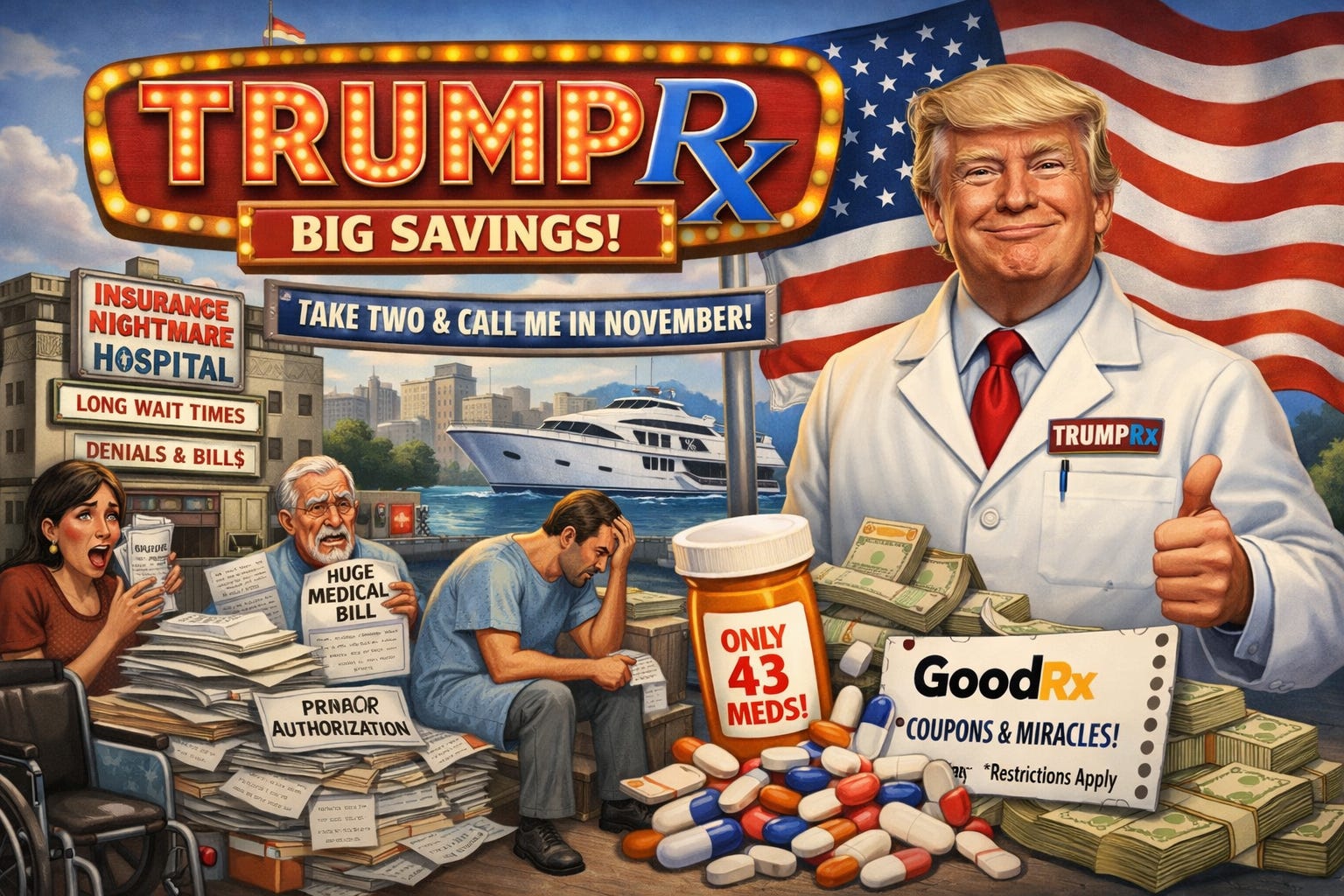
This is where TrumpRx’s “who benefits” reality crashes into its “everyone benefits” marketing. TrumpRx, at least right now, primarily benefits cash-pay and uninsured patients. That is not a small moral category, but it is a minority of the country. The CDC reports that 8.2% of Americans, about 27.2 million people, were uninsured in 2024.
Which means roughly 92% of Americans have some form of insurance coverage, private or public. They are not outside the system, they are deep inside it, pinned under it, receiving automated messages from it that say “Your request is very important to us,” while simultaneously denying the request because you did not first try a cheaper medication that does not work for you, because you did not fail properly, because you did not document your suffering in the preferred font.
For the insured majority, the cash price of a medication is not the price that governs their life. The governing forces are the deductible, the formulary tier, the prior authorization, the step-therapy requirements, and the spectacularly modern experience of being told by your insurer that your doctor can appeal, being told by your doctor that the insurer can be appealed to, and being told by the pharmacy that they have faxed something to someone, an act of communication so ancient it should be written on a clay tablet.
And even when a discount exists, many cash-pay discounts do not count toward your deductible or out-of-pocket maximum. That is not a niche technicality, that is the difference between “I saved money today” and “I protected myself from financial catastrophe this year.” Coverage is supposed to function like a safety net, cash pay can be a trap door.
But let’s zoom out, because there is a deeper issue here that makes TrumpRx feel so aggressively like a misunderstanding of how sick people actually live. Prescription drug prices are not the only framework driving American medical costs. They are not even the biggest one.
Total national health spending reached about $5.3 trillion in 2024, according to Health Affairs’ analysis of CMS National Health Expenditure data. Prescription drugs are a huge bill in human terms, but they are one category among many, in a system where hospital care, physician services, and administration devour enormous sums. CMS’s NHE materials underscore the broader spending growth and the scale of overall expenditures.
The point is not to minimize drug prices. The point is that treating drug prices as the main storyline is like treating the price of a movie ticket as the main reason going to the theater is expensive, when the real damage is the concessions, the parking, the babysitter, and the existential dread of sitting through thirty minutes of ads.
And nowhere is this more obvious than in the category TrumpRx keeps spotlighting like it is a shiny new toy: GLP-1 weight loss drugs like Wegovy. Because Wegovy is not just a medication, for many patients, it is the front door to an entire clinical pathway, and that pathway has costs that do not live in the pharmacy aisle.
Imagine a patient who needs Wegovy. Often that patient is not simply seeking a smaller pants size, they are treating a chronic disease that tends to travel with friends. Prediabetes, diabetes, high blood pressure, sleep apnea, fatty liver disease, joint pain, elevated cholesterol, depression, anxiety, stress eating, trauma, all the normal human suffering that becomes medicalized once it has an ICD-10 code.
Before a patient even gets to “pick up Wegovy,” there is usually a visit, sometimes multiple visits. A primary care appointment, maybe an obesity medicine specialist. A consult that includes history, risk assessment, comorbidities, a discussion of goals, and a plan for titration and follow-up. Then there are the labs, because clinicians are trying to practice medicine, not influencer marketing. A1c, glucose, lipids, kidney and liver function, sometimes thyroid testing depending on symptoms and risk. Depending on the patient, there may be referrals. Sleep study, nutrition counseling, behavioral therapy, physical therapy for joint limitations. Cardiology if the risk profile is high, or gastroenterology if there are liver concerns.
And this is the smooth version, the controlled trial version. The version where everyone gets appointments in a reasonable timeframe and nobody’s insurance portal crashes at 2 a.m. and your prescription is not “pending” for three weeks like it is waiting to be admitted into college.
In real life, Wegovy treatment can also include side effects that prompt extra care. Nausea that leads to dehydration, severe abdominal pain that triggers evaluation for pancreatitis, or symptoms that prompt gallbladder workups. The drug’s safety profile includes serious risks that clinicians are trained to watch for, which translates into additional visits and testing for a subset of patients.
So even if TrumpRx lowers the cash price of Wegovy for some people, it does not automatically lower the cost of the clinical ecosystem required to use the medication responsibly and effectively. It does not make doctor visits free, it does not make labs free, it does not make the follow-up schedule disappear. It does not pay for the nutrition counseling that everyone pretends is easy until they try to do it inside a life where groceries cost more than your car payment.
This is what “accessible treatment” actually means. It means you can afford the medication and the care around the medication. It means you can keep showing up, it means your access does not evaporate because you changed jobs or because your insurance decided obesity is a personal failure that should be treated with vibes.
The TrumpRx pitch is a perfect example of how politicians talk about health care like it is a one-time purchase. Like you buy the drug and you are done, like the prescription is the only aspect of treatment. But the prescription is often the prize at the end of the maze.
It is the thing you get after proving you are sick in the correct way, at the correct time, with the correct documentation, and after you have made the required offerings to the gods of utilization management. Sometimes you must fail first on cheaper therapies, sometimes you must demonstrate “lifestyle modification,” as if your body has been ignoring you simply because you failed to discover salads. Sometimes you must wait until the next available appointment, which in certain cities is scheduled sometime between “summer” and “the heat death of the universe.”
In that context, a portal that helps some people compare cash prices is not irrelevant. It is just not what most Americans need most. Most Americans need a system where care is not an endurance sport. They need coverage that is stable, benefits that treat chronic disease like chronic disease, and prices and out-of-pocket costs that can be understood by a human brain without a finance degree and a stress ball. They need the administrative friction to stop functioning as a stealth tax on illness.
TrumpRx is not nothing. It may help some uninsured and cash-pay patients for some drugs, and there is value in that, but a website cannot negotiate the way an economy negotiates. A portal cannot restructure the incentives that inflate costs across the system, and a coupon cannot replace insurance design. Branding cannot substitute for policy.
What TrumpRx really reveals is not that the administration has solved health care. It reveals, with almost comedic clarity, how easy it is to confuse a headline with a cure. You can name a website TrumpRx, you can put a podium behind it, you can even claim it is transformative, but Americans will still wake up tomorrow and do what they always do. They will make appointments, they will wait, they will get labs. They will argue with insurers, they will stare at bills that arrive weeks later like a mean little surprise, and they will try to get treatment, not just medication.
And if they are lucky, they will find a discount. Not because the country finally fixed the system, but because the system is so broken that discounts have become a parallel health care infrastructure, like little rafts floating beside a sinking ship. A raft can save someone, but it is not the same thing as repairing the ship.
As much as our health system in Canada has flaws, when I read this I am so grateful for that flawed system. 🇨🇦💙
A key signifier of how civilized a country is, is how it treats its sick. God knows the NHS in the UK has its problems, but no one denies that it tries and live-saving health care doesn’t equate to probable bankruptcy yet.