

Good morning! Clarity is rarely gentle. It arrives late, often after damage is done, and almost always without apology. But clarity, even when it’s grim, is a form of power. It gives shape to what must be confronted and strips away the comforting myths that keep real change just out of reach. This moment, heavy as it is, offers that kind of clarity. Jack Smith’s testimony belongs to that category, not as catharsis, but as record; not as resolution, but as grounding.
Normally, when Donald Trump speaks, I listen at double speed while sketching or cleaning the kitchen, just fast enough to catch the lie before it mutates into five more. I mark the moment, check the transcript, quote accurately, and move on. Trump’s speeches are built for volume, not durability. Jack Smith’s deposition was different. Even at 2x speed, eight hours is still four, so I read the transcript first and then searched the video for the passages that mattered, not to see how loudly he said them, but how quietly. The contrast was the point.
I remember a brief clip from early in Jack Smith’s tenure that stuck with me far more than any press conference ever could. He was walking down a Washington sidewalk with a couple of colleagues, no entourage, no scowl, no performance. Just a man in motion, carrying what looked like a brown bag lunch. Calm, grounded, comfortable in his own skin.
Smith is a triathlete, and it shows, not in swagger, but in bearing. The posture of someone who understands endurance matters more than speed. Someone who knows you don’t finish a long race by chest-thumping at mile two. You finish it by pacing yourself, trusting the work, and staying upright when others burn out.
That same discipline runs through the eight-hour deposition transcript now circulating widely, released despite, not because of, the House Republicans who insisted on keeping it closed-door. Smith had offered to testify publicly, but was refused. Transparency, it turns out, was only appealing until it involved the full record. Once the transcript escaped containment, however, the effect was immediate. Strip away the bad-faith questioning and cable-news caricatures, and what you’re left with is not a man on the defensive, but a prosecutor doing something deeply inconvenient to his critics: calmly telling the truth, under oath, without theatrics.
Over and over again, Jack Smith returns to the same foundational point, one that detonates years of talking points. He did not charge Donald Trump because Democrats wanted him to. He charged him because, in his professional judgment, the evidence met the highest standard in American criminal law. Proof beyond a reasonable doubt. In both cases, January 6 and classified documents alike.
These cases didn’t dissolve because the facts collapsed. They were dismissed because Trump regained power. History will notice the difference, even if some members of Congress pretend not to.
Smith is equally blunt about responsibility. Trump, he explains, was not a bystander caught in a swirl of overzealous aides. He was the central actor, the most culpable, the most responsible. The crimes benefited him. The pressure campaign, the lies, the scheme to subvert lawful government functions all flowed outward from him. No fog of euphemisms, just causation.
On January 6, Smith’s language tightens further. The attack, he says, does not happen without Trump. Trump sent people to the Capitol, refused to act once violence erupted, and then used the chaos as leverage. The violence was foreseeable, and useful. Smith states it plainly: Trump’s actions “endangered the life of the Vice President.” The sitting vice-president of the United States, placed in mortal danger by the man who put him there.
And then Smith dismantles the last refuge of Trump’s defenders: the claim that he genuinely “believed” the election lies he told. Under oath, Smith explains that Trump was repeatedly informed by advisers, courts, and state officials that the fraud claims were false, and was briefed on why certain vote-counting patterns were entirely normal. None of it mattered. As Smith put it, the evidence showed a “pattern of knowingly false claims,” one marked by its “depth, length, and repetition.” Trump didn’t stop when the claims were debunked, instead he refined and focused them. The conduct, Smith concluded, was far too consistent and selective to be confusion. It was deliberate deceit.
This is where Smith adds a detail that seems to genuinely irritate his interrogators: his witnesses were not Democrats. He makes the point plainly. Many of the key witnesses were Republicans; some were lifelong Republicans. Some worked directly for Trump and voted for him. Some supported him until they didn’t, until the facts made continued loyalty impossible. Smith was not relying on partisan opponents or liberal activists. He was relying on Trump’s own people, from his own administration and his own party. This is usually the moment when the room goes quiet, because the “witch hunt” narrative doesn’t survive contact with its own witness list.
The same precision applies in the classified documents case. Smith lays it out without embellishment: Donald Trump “willfully retained” highly classified national defense information after leaving office, stored it in unsecured locations “including a ballroom and a bathroom,” and then “repeatedly attempted to obstruct justice” to conceal his continued possession of it. Smith confirms that Trump showed sensitive materials to people who lacked clearance or any legitimate need to know, including at Bedminster. This was not carelessness or nostalgia. As Smith made clear under oath, the evidence pointed to intent, retention, concealment, and obstruction, in sequence.
Finally, Smith addresses the part that always gets waved away as “tone policing” until someone’s life is actually threatened: witness intimidation. Trump’s public statements, Smith explains, endangered witnesses, court staff, prosecutors, and their families. The threat didn’t need to be explicit to be effective. Courts agreed. Appeals courts agreed. Smith makes no apologies for acting to protect the process. None.
In that sense, this deposition reads less like a defense than a reckoning. History will likely remember it as the moment Jack Smith was finally allowed to litigate the case he was denied by circumstance. Not before a jury, not with a verdict at the end, but on the record, under oath, with the facts laid out cleanly and without adornment. The cases didn’t fail. They were interrupted. And this testimony preserves what interruption could not erase.
The facts are still here, the witnesses are still on the record, and the evidence still says what it says. The lies didn’t win by becoming true; they won by force. Force is loud, but brittle. Truth, patiently documented, even when carried in a brown paper bag, has a longer shelf life.
Jack Smith’s quiet walk down that sidewalk turns out to be the right image after all. Forward motion, steady, unglamorous, grounded in the belief that doing the work still matters, even when the finish line keeps moving.
All of this comes with a side of structural collapse, polite authoritarianism, and a faint but stubborn whiff of hope rising out of a decommissioned subway station.
We’ll start where the administration would very much prefer you not look: the plumbing. Not the metaphorical kind, actual financial plumbing. While Donald Trump congratulates himself for having “achieved more than anyone could have imagined” in what he charmingly calls the second of his first years, the overnight lending markets have been quietly screaming for help. Trillions of dollars slosh through the repo market every night to keep the global financial system functioning, and lately the Federal Reserve has been forced to step in again and again, outside quarter ends, outside crises, outside any normal explanation, to keep those rates from blowing out. This is the sort of thing that only happens during events like 2008 or COVID, which is why everyone involved is pretending very hard that it’s no big deal. Don’t worry, they tell us, AI will save us in 2026. The markets are crossing their fingers while the Fed is mopping up leaks weekly.
What this actually means is that banks don’t trust each other. They’re demanding a risk premium just to lend money overnight, like dogs circling each other with their teeth half-bared. They might sniff, and they might bite. Either way, it’s not a sign of confidence. While the administration keeps insisting that rate cuts are just around the corner, the market is effectively responding, “Absolutely not.” Treasury yields remain high, mortgage rates remain brutal, and credit cards are still eating households alive. The cost of money is staying expensive because the world is charging America a trust surcharge.
Trump insists this is all in your head. Inflation, he says, is coming down “very fast.” Wages, he says, are rising “much faster than inflation.” More people are working than ever before, he assures us, apparently excluding everyone who remembers the past seventy years. In reality, inflation is still hovering around three percent even as oil languishes in the $50s, job losses pile up, and mass deportations should, under any sane economic model, be producing deflation. Instead, prices stay sticky. Wages, once adjusted for inflation, are flat. Labor force participation is lower than when Biden left office. Consumer confidence has collapsed to the lowest level ever recorded, not during COVID, not during the Great Recession, not during the 1970s malaise. Literally ever. Americans have never felt worse about the economy, which is impressive when you consider how many historical disasters they’ve lived through.
According to Trump, everything’s great. Ignore the 700-plus corporate bankruptcies this year, the tens of thousands of household filings, the fact that bankruptcy season hasn’t even peaked yet. Ignore the rising credit card balances, the stagnant paychecks, the sense that the ground is quietly giving way beneath everyone’s feet. This is all part of the illusory 4-D chess economic plan. Recessions are a feature, not a bug, unless you’re a consumer, in which case you’re on your own.
And here’s where the story goes global, because the real problem isn’t just domestic dysfunction. It’s that the rest of the world is starting to exit the room. Japan, the largest foreign holder of U.S. debt, has begun raising interest rates for the first time in decades. That’s triggering the unwind of the yen carry trade, an arcane but enormously consequential mechanism that has quietly propped up U.S. borrowing for years. As Japanese capital flows back home, Treasury data now shows net outflows from the United States, from both private investors and official institutions. Foreign dollar reserves are near historic lows. Translation: the “sell America” narrative is no longer fringe; it is today’s portfolio strategy.
The Fed will intervene to save banks. Credit will tighten. Consumers will get crushed. And over the long term, the dollar’s privileged position erodes, not in a dramatic collapse, but in a steady, grinding loss of confidence that no amount of coal plants or AI data centers can reverse.
Now, keep all of that in mind and shift scenes, way underground, literally to a shuttered Gilded Age subway station beneath City Hall, where Zohran Mamdani took the oath of office as New York City’s youngest mayor in more than a century. It was a deliberate choice: a monument to a time when government built ambitious public infrastructure to improve ordinary lives. Mamdani didn’t pick that space to be cute. He picked it to remind people that cities weren’t always managed like hedge funds with police departments attached.
The Wall Street Journal, doing what it does best, frames this moment as a test of whether Mamdani will quickly learn to stop being himself. The clock is ticking, they warn. New Yorkers have no patience. Business leaders are nervous. His ideas are “untested.” He should probably moderate. You can practically hear the unspoken plea: please keep doing the same thing, just with more deliberation and patience.
What’s missing from this framing is the obvious point: the system they’re defending has already failed. New York didn’t become unaffordable because leaders were too bold. It became unaffordable because for decades the city treated housing, transit, and child care as market luxuries rather than public necessities. Mamdani isn’t being asked to prove his policies work. He’s being asked to prove that alternatives may exist or even co-exist.
This pressure campaign isn’t happening in a vacuum. Hovering over it all is Donald Trump, who previously threatened to deploy the National Guard if Mamdani won, and then smoothed it over with a congenial White House meeting, because authoritarianism works best when it smiles first. The threat was never really about crime. Trump has been laying the groundwork for years to redefine dissent as disorder and federalize force as a routine response to political opposition. Democratic-run cities aren’t targets because they’re dangerous; they’re targets because they’re visible counterexamples.
So Mamdani governs under a warning. If he moderates too quickly, the doctrine succeeds without troops. If he doesn’t, any protest, any spike in unrest, real or manufactured, can be used as justification. Create the conditions, then claim necessity. It’s an old playbook.
This is where the contrast becomes unavoidable. At the national level, we’re watching a president accelerate economic decay while preparing coercive tools to manage the fallout. At the city level, we’re watching a mayor attempt, constrained, imperfectly, under intense pressure, to rebuild social capacity instead of extracting from it. One model responds to stress by tightening control. The other responds by expanding care.
Which one succeeds isn’t just a question of policy. It’s a question of whether change is given the opportunity to try before it’s declared a failure.
Trump may have dragged a reckoning that was once decades away right to our doorstep. Mamdani, standing beneath the tiled arches of an abandoned station, is betting that people are ready to build something different. The system, as always, is already sharpening its knives.
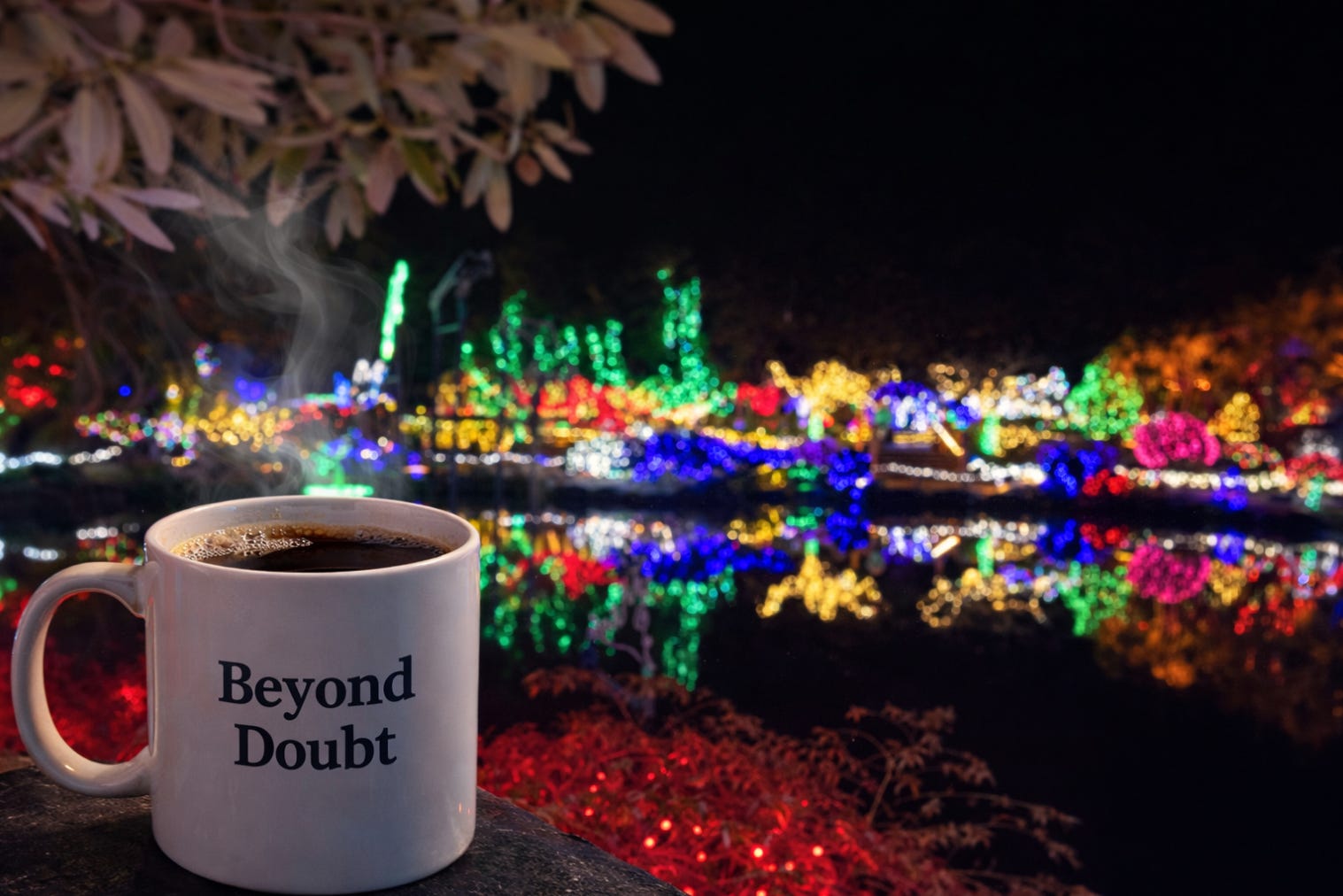
As we step into the new year, I want to leave you with a quieter image than the headlines usually allow. My moonbeam vigil was held beneath the holiday lights at Shore Acres State Park, where the cliffs meet the Pacific and everything glitters a little more fiercely than it needs to. Among the cascading LEDs and engineered wonder, I lit a small moonbeam of my own. It may have seemed trivial beside all that spectacle, but intentions don’t measure themselves against wattage. They travel differently. I like to think that somewhere between the surf and the stars, a little peace and joy shook loose and scattered itself where it was needed.
This past year asked far too much of all of us. It demanded attention without offering relief, resilience without rest, and clarity in a fog of bad faith. Yet here we are, still watching, still caring, still insisting that truth matters and that the future is something we participate in, not just endure. In itself, that is no small thing.
So to each of you reading this: may the new year bring steadier ground, sharper light, and moments of grace that arrive when you least expect them. May your coffee be hot, your bullshit detectors finely tuned, and your capacity for wonder stubbornly intact. Wherever you are, however you mark it, I wish you peace, joy, and a new year that gives back more than it takes.
Thank you so much for this wonderful piece. And for all the work you have put into this year. Your writing is one of the greatest sources of clarity for me, in all this swirling muck and miasma. Here's to the power of moonbeams, and the emerging cracks beginning to let all kinds of light through.
I turned 75 today, so I would appreciate it if we can acceleration the freeing the White House and Congress of the darkness within.