


Good morning. If you were looking for a textbook example of how to bury inconvenient truths under a geopolitical explosion, Donald Trump delivered one with terrifying efficiency this weekend.
Just days after Special Counsel Jack Smith testified that he was confident he could prove beyond a reasonable doubt that Donald Trump incited the January 6 insurrection and unlawfully retained classified documents, reopening the full scope of Trump’s legal exposure, the president detonated a crisis overseas. Without congressional debate, without warning to allies, and without addressing the American public, Trump announced in a middle-of-the-night post that the United States had launched a large-scale military strike inside Venezuela and seized its president, claiming Nicolás Maduro and his wife had been captured and flown out of the country. Perhaps I’m cynical, but one has to ask: is there no limit to how far Trump will go to shove the Epstein files further down the memory hole?
What followed was confusion, panic, and a growing realization that whatever this operation is being called, it almost certainly crossed a constitutional line. U.S. forces reportedly struck multiple military and infrastructure targets across Venezuela, including air bases, ports, and communications sites. Venezuelan officials say there were casualties, with the full toll still unknown. The government insists it was blindsided: Vice President Delcy Rodríguez says she was unaware of any negotiated exit and is demanding proof of life, while the defense minister condemned what he called criminal U.S. aggression. Colombia moved troops to its border and called for an emergency UN Security Council meeting. Russia demanded immediate clarification and condemned the strike. The UK rushed to distance itself, emphasizing international law, a phrase suddenly doing a lot of work.
Inside Washington, the administration scrambled to retrofit a legal rationale. Senator Mike Lee claims Secretary of State Marco Rubio told him the strikes were necessary to protect U.S. personnel executing an arrest warrant tied to a New York indictment. Attorney General Pam Bondi then confirmed that Maduro, and, newly revealed, his wife, Cilia Flores, have been indicted in the Southern District of New York.
According to Bondi, Maduro faces charges including narco-terrorism conspiracy, cocaine importation conspiracy, and weapons offenses involving machine guns and destructive devices. Bondi did not specify the charges against Flores. Declaring that the couple would “soon face the full wrath of American justice on American soil,” she publicly thanked the U.S. military for what she described as a “highly successful mission” to capture them.
That explanation may play on cable news, but it collapses under even minimal scrutiny. Indictments, even serious ones, do not give a president the authority to launch unilateral military operations inside a sovereign nation without congressional approval. The Constitution vests the power to declare war in Congress, and the War Powers Act permits unilateral action only in narrow circumstances: immediate self-defense, rescue operations, or a response to an attack on U.S. forces. None of those conditions appear to apply here. If Canada, Mexico, or China claimed the right to bomb U.S. military facilities to seize a fugitive they had indicted, even a notorious one, Americans would rightly call it an act of war. The principle does not change simply because the United States is the one dropping the bombs. Bombing military installations across a country to extract its leader isn’t law enforcement.
That’s why Democratic senators are accusing the administration of misleading Congress and bypassing the War Powers Act. It’s why allies are openly questioning the legality of the move. And it’s why analysts warn that the precedent is dangerous: if the United States claims the right to abduct foreign leaders by force, it effectively green-lights the same behavior by Russia, China, or any other power willing to test the limits.
All of this, the chaos, the confusion, the international backlash, arrived at a remarkably convenient moment. Epstein headlines were gaining traction again. Jack Smith’s testimony reopened uncomfortable timelines. The administration needed oxygen. And suddenly, the news cycle was on fire.
While Trump was detonating attention and daring Congress to stop him, the rest of the world was doing something far quieter, and far more consequential.
As Max at UNFTR laid out this week, December marked a turning point in the slow, methodical construction of a post-dollar financial order. BRICS, the economic bloc originally formed by Brazil, Russia, India, China, and South Africa, and now expanded to include or align with countries across Asia, Africa, and the Middle East, has moved into a more operational phase. The group is rolling out a gold-anchored settlement unit designed to facilitate cross-border trade outside the U.S.-dominated dollar system and its backbone, the SWIFT international payments network. This isn’t a consumer currency you’d use to buy groceries. It’s plumbing, the behind-the-scenes infrastructure that governs how money actually moves between governments and banks. And plumbing is where power really lives.
Max’s warning isn’t that the dollar is about to collapse. It’s that dollar dominance rests on trust, trust in stability, rule of law, and predictable governance. That trust doesn’t erode because of one bad decision. It erodes because of patterns: erratic policy, weaponized sanctions, alliance burn-downs, and yes, unilateral military strikes that treat constitutional and international constraints as optional.
BRICS doesn’t need to replace the dollar to matter. It just needs to exist as a credible alternative. And every time the United States behaves like the rules no longer apply to it, that alternative looks a little more attractive.
And it’s not just emerging economic blocs that are adapting to America’s instability. One of the clearest geopolitical shifts of the past year has been Canada’s unexpected rise as a steady, credible counterweight to Trump’s chaos. After being openly threatened, ridiculed, and economically targeted by the Trump administration, Canada didn’t fold, it consolidated. Under Prime Minister Mark Carney, Ottawa deepened ties with Europe, reaffirmed support for Ukraine, and positioned itself as a reliable democratic actor at a moment when Washington increasingly looks erratic and unbound by rules. Trump didn’t weaken Canada; he clarified it, and in doing so, helped elevate a middle power into a de facto stabilizer in a fraying Western alliance. Go Canada!
While Trump distracts with force and spectacle, while Congress is sidelined, allies recoil, and constitutional lines blur, the world is quietly preparing for a future where America is no longer the default. That’s the real story unfolding beneath the chaos. And unlike a weekend crisis, it doesn’t go away on Monday.
Obviously, I hadn’t planned on writing about this today. But here we are again, reacting to spectacle and crisis instead of responding to policy, governance, or anything resembling strategy. That, more than any single strike or statement, is the through-line of the Trump era: chaos as a governing tool, distraction as a defense mechanism, and consequences outsourced to everyone else.
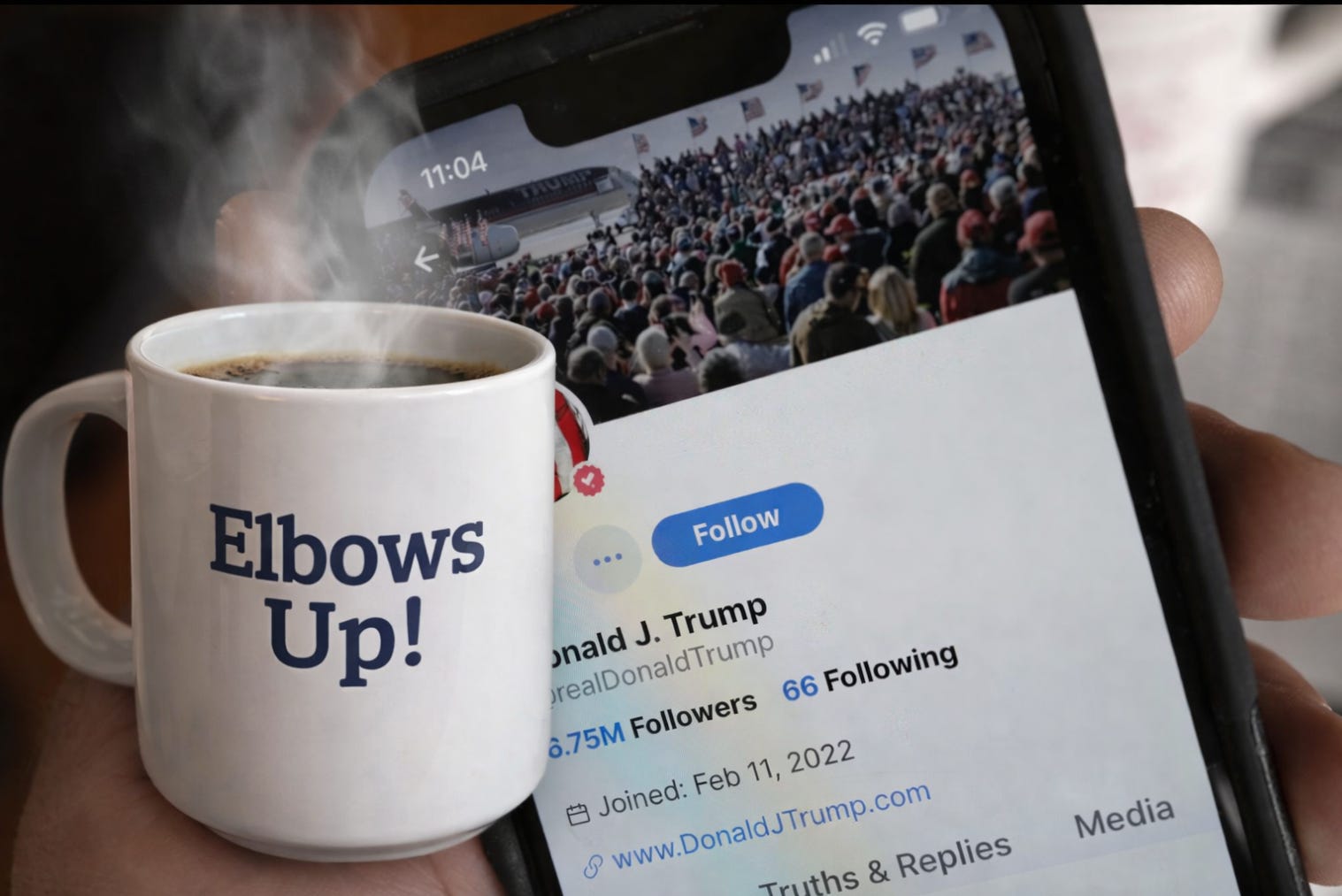
It’s telling that Trump once again scooped his own State Department, announcing a major military operation on Truth Social before diplomats, allies, or even Congress had been briefed. Foreign policy by social media isn’t just reckless, it actively undermines the institutions meant to manage escalation, prevent miscalculation, and keep the world from spiraling.
What this moment demands isn’t bravado or loyalty tests. It demands grownups in the room, people willing to reassert constitutional limits, rein in Trump’s worst impulses, and remind the world that the United States is not supposed to function by midnight posts and fait accompli military actions.
For now, Marz and I are going to pull on our rain gear, step away from the noise, and try to clear our heads. But the reckoning this weekend set in motion isn’t going anywhere. And neither is the damage, unless someone finally decides to stop it.
We are a lawless country. I hope the international community puts us in our place. This is a disgusting and shameful chapter in America.
As per the Felon who ordered US Delta forces to kidnap a sitting president and his wife from another country
“A couple of guys were hit but they came back and they're supposed to be in pretty good shape." DJT
"It is only those who have never heard a shot... that cry aloud for more blood": General William Tecumseh Sherman “War is Hell”
Going for another walk as well. Stay safe and thank you Mary