

Good morning! Donald Trump may have achieved a breakthrough in international diplomacy. After centuries of complicated negotiations, delicate compromises, and the tiresome business of getting warring nations to agree on something, the president has discovered a simpler approach. Just announce that they’ve agreed, and apparently the agreement exists.
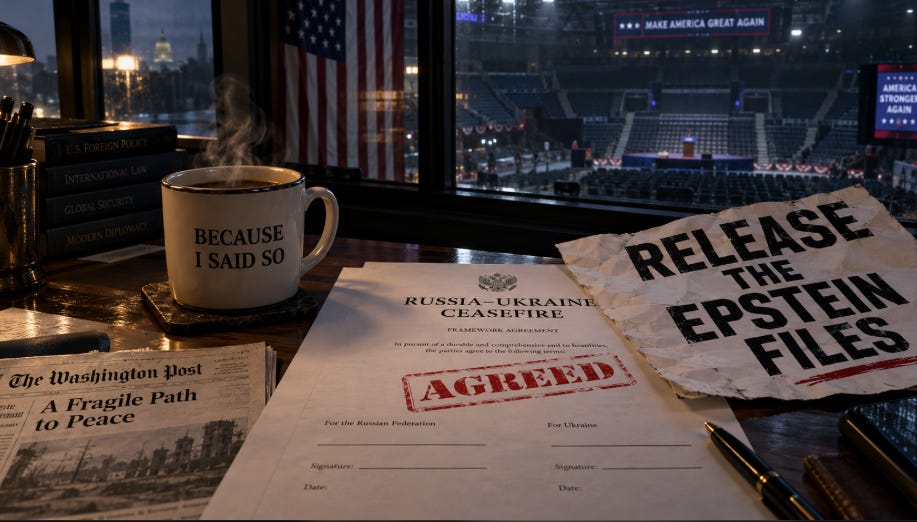
On Sunday, Trump declared that Russia and Ukraine had agreed to an immediate ceasefire covering attacks on each other’s energy infrastructure. He offered no terms, no enforcement mechanism, and no indication that either government had actually accepted the arrangement. He included a stern instruction: “Do not break it!”
By Monday, reporters were asking the obvious question. Both Russia and Ukraine were saying they had not agreed to the ceasefire Trump had announced. How, exactly, did the president reconcile that inconvenient fact with his declaration?
“They agreed,” Trump insisted. “You know why? Because I said you agreed. That’s why.”
There you have it.
Trump has decided that diplomacy works like ordering room service. You tell the other parties what they’ve agreed to, and their consent becomes a minor administrative detail.
Within hours of Trump’s Sunday announcement, Russian forces struck a power plant in Kharkiv, along with a gas production facility and a civilian gas station. Ukrainian President Volodymyr Zelenskyy said his government had been surprised by the announcement but was willing to observe a reciprocal ceasefire. Ukraine had refrained from attacking Russian energy infrastructure after Trump’s declaration, he said, hoping Moscow would do the same.
Moscow did not.
Kremlin spokesman Dmitry Peskov declined to confirm any agreement, saying only that contacts were continuing.
When a reporter asked Trump about the Russian attacks, he replied that he would have to look into them because there had been violations on both sides. The evidence available at the time did not establish reciprocal violations of the ceasefire he had just announced. More fundamentally, there was no demonstrated bilateral agreement to violate. The Associated Press documented both Zelenskyy’s willingness to accept a mutual pause and Russia’s continued attacks.
The president also assured reporters that Vladimir Putin wanted peace more than Zelenskyy.
Considering Zelenskyy was publicly offering to stop attacking Russian energy facilities if Russia reciprocated, while Putin’s forces continued striking Ukraine, the assessment falls pretty flat. Trump offered no evidence supporting his comparative judgment of the two leaders’ intentions.
Trump has eased sanctions to facilitate the Russian diesel deal we’ve already covered, despite objections from six senators, including four Republicans, who warn that the arrangement could help finance Putin’s war. Moscow gets an economic concession while Zelenskyy gets blamed for obstructing peace.
Later Monday, Trump arrived in Youngstown, Ohio, to campaign for Republican Senator Jon Husted and gubernatorial candidate Vivek Ramaswamy. He spent part of his 81-minute speech describing Husted’s impressive football career, admiring his physical attributes, and explaining that his campaign appearances were producing extraordinary benefits for Republican candidates.
There was the customary assortment of immigration claims, attacks on political opponents, boasts about the economy, and warnings that Democratic victories would bring national catastrophe.
The most revealing event of the evening happened in the audience.
A woman wearing a T-shirt demanding the release of the Jeffrey Epstein files interrupted the president’s speech. Video shows a male Trump supporter shoving her, striking her in the face, grabbing her hair, and attempting to force her head toward the bleachers as nearby attendees chanted “USA.” Police escorted the woman out. Her attacker remained in the arena, exchanging high-fives with other spectators. On Tuesday, the Mahoning County Sheriff’s Office confirmed that no arrests had been made.
From the stage, Trump accused the protester of being paid by Democrats and mocked her appearance and weight, apparently mistaking her for a man. There is no evidence she was paid, and we cannot establish how much of the assault Trump witnessed.
The woman was demanding government records concerning Jeffrey Epstein, who sexually abused and trafficked underage girls. Whatever the people celebrating the attacker believed about those records, they responded to a demand for accountability with violence and congratulations for the man responsible. The woman was removed, and the president offered ridicule rather than concern. Whatever else happened in Youngstown, it was a public failure of the moral standards America claims to uphold.
For decades, American presidents have told the world that the United States represents freedom, democracy, human rights, and the rule of law. We have frequently failed to live up to those ideals. Vietnam, the invasion of Iraq, Abu Ghraib, and other chapters of our history have provided the world with ample reasons to question America’s moral authority.
Our standing has recovered before.
After the damage inflicted by the Iraq War and the Bush administration’s handling of detainees, Barack Obama’s election produced a dramatic improvement in international opinion of the United States. Pew Research Center documented a substantial rebound in 2009, particularly among European allies.
Something similar happened after Trump’s first term. In 2020, a median of just 34% of respondents across 12 countries surveyed by Pew viewed the United States favorably. In 2021, following Joe Biden’s inauguration, that figure climbed to 62%.
The world seemed willing to give America another chance. After Trump’s first term, foreign governments could reasonably tell themselves that his presidency had been an aberration, a temporary departure from America’s established political traditions. His reelection makes that considerably harder to believe.
For America’s allies, the worry now goes beyond any one president. Abrupt reversals may be a permanent feature of our politics rather than a passing disruption. A security guarantee made today could be gone after the next election, and sanctions imposed to punish aggression can be lifted when a president wants cheaper diesel.
No government can stake its national security on American voters choosing a dependable administration every four years. So allies adapt. They diversify trade, build up their own defenses, and look for partners other than Washington. Those changes don’t reverse just because a new president declares America respected again.
The polling shows how deep the problem runs. In Pew Research Center’s June 2026 survey, a median of just 37% across 36 countries viewed the United States favorably. In Canada, our neighbor and one of our closest allies, the share calling America a reliable partner fell from 83% in 2022 to 35% this year.
The world doesn’t judge us only by our presidents. It watches our elections, our courts, our treatment of immigrants, and how we respond when someone challenges those in power.
Which brings me back to the woman in Youngstown.
One ugly incident doesn’t define 340 million Americans, and not everyone in that arena cheered. But it can’t be dismissed as a few overheated supporters, either. The crowd’s response, the attacker’s apparent celebration, the victim’s removal, and the president’s ridicule are all on the record. So is the fact that people filmed it and journalists are asking questions.
Free expression means telling the difference between removing a heckler and allowing an assault. The rule of law means applying it even when the man throwing punches has the crowd on his side. A nation that wants the world’s respect has to protect the people who criticize its leaders.
The hard truth is that electing a different president won’t, by itself, restore America’s reputation. The world is watching not only our failures but how we respond to them. I’ve lived long enough to see America’s standing collapse and recover, but I doubt the world will extend the benefit of the doubt indefinitely. We may regain our popularity without regaining our indispensability, and some of the trust we once took for granted may be gone for good. No presidential declaration can repair that. Only our actions can.
Because that is an awfully heavy thought to carry into a Tuesday morning, a small serving of schadenfreude with our coffee.
The White House has asked Kimberly Guilfoyle to resign as America’s ambassador to Greece.
Kimberly Guilfoyle has resigned as America’s ambassador to Greece after the White House asked her to step down.
Guilfoyle, a longtime Trump loyalist and former fiancée of Donald Trump Jr., had been under scrutiny following a Wall Street Journal investigation into allegations that she solicited $100,000 from a Trump donor to cover an American Express bill before her Senate confirmation hearing.
On Monday, before departing for Youngstown, Trump was asked whether he was considering firing Guilfoyle.
“We’re looking at it,” he said. “Yeah, we’re not happy.”
By Tuesday morning, the administration had finished looking, and White House press secretary Katie Zacharia confirmed that Guilfoyle had been asked to resign, adding that she had been a “wonderful asset to the team” and wishing her well.
A wonderful asset.
Yesterday, Trump was unhappy. Today, Guilfoyle is a wonderful asset who has resigned. Perhaps tomorrow someone will explain why such a treasure is no longer needed in Athens.
The US has always had two faces: Lady Liberty and Uncle Sam. Lady Liberty represents the ideals of freedom, justice, and equality. Uncle Sam is a hard-nosed symbol of military power and imperialism.
These contradictions have existed since the birth of our nation. Among the signers of the Declaration of Independence, 41 out of 56 were both freedom fighters and slave owners.
Since WWII, American diplomats have worked hard to burnish the image of our country as a bastion of democracy governed by the rule of law, freedom of speech, and religious tolerance.
But the world has always seen both sides of the US: personal freedom and wealth for US citizens combined with global imperialism and economic domination of other nations. Our country has been at war for over 229 years out of 250.
Has Trump permanently disabled our diplomatic ability to present our better side? Will our longtime allies ever trust the US again? These are difficult questions to which there are no clear answers.
But the American people can best determine our future reputation by never again electing corrupt charlatans to the presidency, Congress, or any other public office. Our democratic ideals will prevail — but only if we the people diligently pursue them. A democracy is only as strong as its citizens’ commitment to it and a government is only as good as its citizens make it.
I just “restacked” two quotes from this excellent rundown of the American Horror Show - Trump 2026. Mary captures reality with clarity and eloquence.
A wise, insightful friend this morning said his “greatest focus” comes from an observation: “Ignorance and wealth will continue to overwhelm well-intended societies”. Ignorance also seems a fertile ground for cruelty.
I still believe most Americans have better angels - but they only matter if these Americans vote accordingly.