


History almost never introduces itself as catastrophe. More often it arrives wearing the face of relief, excitement, restoration, the promise that something exhausted is finally being set right. When Nazi Germany absorbed Austria in March 1938, many Austrians did not experience the event as an invasion but as a homecoming. Streets filled with cheering crowds. Nazi symbols appeared with startling speed. Public life reorganized itself almost at once. The American diarist Helen Baker, in Vienna at the time, recorded this transformation in real time, most memorably noting, as Hitler entered the city on March 14, that there were “Flags all over town…”
Eighty-plus years later, the United States is again arguing about democratic stability under President Donald Trump’s second term and the political movement surrounding it. Comparisons like these are often rejected as hyperbole or embraced as shorthand. Both reactions miss what historians and political theorists are typically doing when they compare ruptures: not predicting identical outcomes, but tracing recurring mechanisms, how power consolidates, how institutions adapt, and how ordinary people participate, actively or passively, in making extraordinary change feel normal. So this is not an argument for equivalence of regimes, ideology, or scale. It is an examination of democratic erosion as a process.
Helen Baker was not Austrian, not a political activist, and not a journalist. She was an American visitor keeping a diary and writing letters for personal reasons. That’s part of what makes her account so useful. She had no incentive to dramatize events for an audience, and her astonishment reads as genuine surprise.
One piece of context is essential, Austria in 1938 was not a healthy liberal democracy that suddenly collapsed. Democratic institutions and norms had already been badly damaged. In the mid-1930s, Austria operated under the Dollfuss–Schuschnigg authoritarian system (sometimes called Austrofascism): parliament was sidelined, press freedom restricted, political parties suppressed. That preconditioning matters, as it helps explain how rapidly public life could pivot, how quickly institutions and citizens could learn to treat “alignment” as the safest posture. Even so, Baker’s description of Vienna in March 1938 captures something easy to overlook in retrospective moral clarity: what she sees first is not mass terror but mass enthusiasm. The takeover is accompanied by visual and social signaling, symbols, greetings, rallies, public displays of belonging. The U.S. Holocaust Memorial Museum’s presentation of her diary entry emphasizes the scale of spectacle around Hitler’s entry and the mass gathering at Heldenplatz the next day.
And then comes the legal after-image: a façade of consent constructed once the outcome is already in place. In April 1938 the Nazis held a plebiscite to retroactively ratify annexation, reported officially as roughly 99.7% “Yes.” Historians widely note that it did not meet democratic standards, ballot design, intimidation, lack of secrecy, and the context of occupation made it a “vote” that functioned more as performance than choice.
The important thing to note here is the sequence; public celebration and rapid alignment, followed by legal theater and tightening coercion. It contradicts a comforting myth, that authoritarian power always arrives primarily through brute force. In Austria, force did not replace legitimacy. It braided itself into manufactured legitimacy and social consent signals.
Democratic erosion, when it happens, often operates through norms as much as formal rules: shared expectations about legitimacy, restraint, truthfulness, and the autonomy of institutions. The Trump era provides well-documented examples of pressure on those norms. Consider three concrete, widely documented dynamics:
Delegitimizing the press as an institution. Trump has repeatedly described “fake news” as “the enemy of the people,” including in prominent settings such as CPAC 2017, where he explicitly used that phrasing.
Delegitimizing election outcomes. After 2020, Trump and allies asserted widespread fraud. Yet the U.S. election security community, stated the November 2020 election was “the most secure in American history,” citing paper records, audits, and recount ability; and Trump’s own Attorney General William Barr publicly said he had not seen evidence of fraud at a scale that would change the outcome.
Escalating exclusionary or dehumanizing language toward out-groups. Trump has used the phrase that immigrants are “poisoning the blood of our country,” a line that became a notable point of public controversy and reporting, and most recently has led to the death of a wife and mother in Minneapolis.
None of these facts proves a single conclusion about the future. What they do provide is evidence for analyzing mechanisms: how legitimacy is narrated, how institutions are framed, and how political identity is socialized. The most useful parallels between Austria 1938 and the United States today are not about identical policies or equal levels of repression. They are about how power becomes durable, through social behavior, institutional adaptation, and the recoding of belonging.
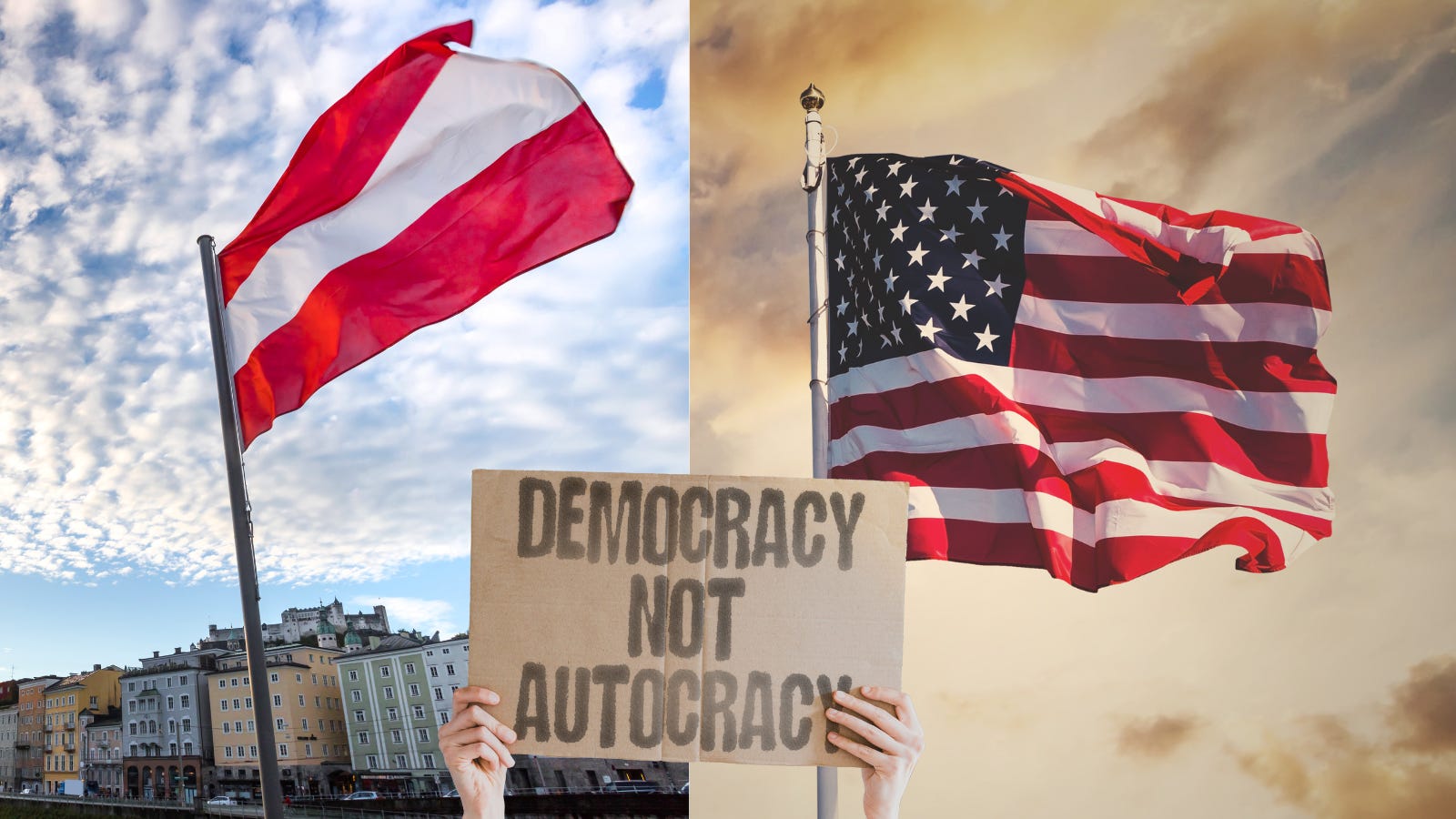
In Baker’s Vienna, the welcome is not merely private agreement. It is public performance: flags, salutes, slogans, crowds. Participation communicates safety and belonging; abstention invites scrutiny. In the United States, political identity in the Trump era has also become markedly performative, less a quiet preference and more a public signal of membership. This is not inherently authoritarian; democracies have always had political symbolism. But it becomes politically consequential when displays of loyalty begin to function as proxies for moral worth or civic legitimacy. The mechanism here is social rather than legal: visibility creates momentum, and momentum can imitate unanimity.
One of the most studied dynamics in authoritarian consolidation is anticipatory obedience: people and institutions begin behaving as though the leader’s preferences are binding before formal orders arrive. In Austria, institutions aligned quickly and citizens adjusted behavior preemptively. That is part of what Baker captures: a city recalibrating itself in real time. In the Trump era, anticipatory obedience shows up when officials, organizations, and corporations modify behavior to avoid retaliation or preserve access, before any explicit instruction is issued. You can see the institutional stakes particularly clearly in ongoing debates about the independence of law enforcement and prosecutions. Contemporary reporting and analysis have described concerns about politicization of the Justice Department in a second Trump term, and recent legal disputes over interim U.S. attorney appointments highlight how appointment strategies and enforcement choices can become flashpoints for the norm of prosecutorial independence. The mechanism is simple: power expands fastest when it does not have to speak in orders, when people learn to predict what power wants and move first.
Austria 1938 also involved a rapid narrowing of who counted as fully inside the national “we,” and who could be treated as suspect or contaminating. In practice, such redefinitions don’t require everyone to embrace the full ideology; they only require enough people to accept that some fellow residents have weaker claims to dignity and rights. In the United States, Trump-era rhetoric frequently frames “real” or “true” Americans against internal enemies, elites, the “deep state,” disloyal opposition, and against out-groups cast as threats. When disagreement becomes a signal of illegitimacy, when opponents are treated not as rivals but as enemies of the nation, the civic basis of pluralism weakens. The “poisoning the blood” language, whatever its intent, operates as a stark example of organic purity rhetoric, language historically associated with exclusionary politics.
Another lesson from Austria is that the takeover did not immediately abolish institutions. It redirected them. The most important change was not that courts, civil service, and police disappeared, but that independence gave way to political loyalty. In the United States, the same structural possibility exists: institutions remain. The question is the strength of norms that keep them from becoming extensions of partisan will. Organizations like the Brennan Center have documented patterns of attacks on judicial legitimacy and the rule-of-law ecosystem during the Trump era, and more recent legal conflicts, such as judges disqualifying improperly serving acting U.S. attorneys, illustrate how institutional constraints become sites of open contest rather than shared guardrails. The mechanism here is gradual. A democracy can keep its institutional shell while the inside is increasingly defined by loyalty and retaliation.
Baker’s diary is useful precisely because it shows the pace. Speed itself inhibits coordinated resistance. People cannot respond to what they cannot fully process. Modern democracies can experience a different version of speed: not tanks in the streets, but a constant churn of conflict, norm-breaking, and attention capture. When politics becomes an unending sequence of emergencies, each controversy is normalized before the next arrives. In that environment, democratic erosion thrives less on persuasion than on fatigue, the wearing down of collective attention and the collapse of shared reality into tribal narratives.
In Austria, early Nazi rule featured highly visible humiliation and coercion, punishment performed in public, witnessed by crowds. Such acts served two audiences at once: they harmed the targeted group, and they instructed everyone else about who now belonged. In the U.S. comparison, the scale and severity are not the same, and it would be irresponsible to suggest otherwise. The relevant mechanism is narrower: the use of public hostility and humiliation as a loyalty signal, where norm violations become proof of authenticity, and the willingness to demean out-groups becomes a marker of political belonging. This is one reason rhetoric matters: it shapes what supporters come to regard as permissible, even admirable.
If comparative history has a discipline, it is this: hold the differences firmly, and still refuse comfort. The United States today still has competitive elections and changes of power in recent history; an opposition party ecosystem; independent journalism and civil society; and courts that continue to constrain executive action, including in high-profile disputes. Those stabilizers are real. But they are also conditions, not guarantees. Democracies rarely “flip” in a day. They corrode through repeated exceptions, through delegitimizing language treated as normal, through institutions framed as enemies, through neutral governance recoded as loyalty tests. The danger is not only what power does. It is what everyone else learns to do around it.
Helen Baker did not think she was watching the birth of atrocity. She thought she was watching a country stabilize, a population relieved, a people reclaiming pride, history happening quickly. That is the enduring lesson of her diary excerpt: the moment that feels like restoration can also be the moment when public life begins to reorganize itself around fear of standing out. Because the first victories of democratic erosion are often small, social, and strangely ordinary. A flag goes up. A slogan becomes a greeting. Silence becomes prudence. A joke becomes a test. An institution chooses caution over principle “just this once.” A neighbor decides it’s safer not to ask questions. A professional learns which words to avoid. A citizen learns which truths are “unhelpful.” Each step is survivable. Each step is rational. Each step makes the next one easier.
Comparative history is not prophecy. It does not say, this will happen again. It says, this is how it happened before, and it points to the mechanisms that made it feel, to many people, like something good was happening.
Austria in 1938 and the United States today are not the same story. They do not share the same institutions, the same international context, the same degree of repression, or the same outcomes. The comparison matters only where it is disciplined: in recognizing patterns of power consolidation, public performance of loyalty, anticipatory obedience, moralized belonging, institutional hollowing, exhaustion, and the normalization of humiliation as politics.
And here is the unsettling part, Baker’s line about “Flags all over town…” keeps whispering across decades: by the time history finally calls itself catastrophe, it has usually already taught people how to live inside it. The most consequential question is rarely what a leader will do. It is what a society will learn to accept, what it will applaud, what it will excuse, what it will perform, and what it will stop noticing. And that learning doesn’t happen in secret. It happens in daylight. It happens on streets full of people. It happens at the speed of belonging.
Excellent analysis.
Are there enough of us who "hold the differences firmly" to stop the corrosion?
Your best column ever. Hands down.