

Good morning! Wednesday afternoon, fresh off Marine One after greeting Chinese President Xi Jinping at Joint Base Andrews, where the red carpet had been rolled out, the band had played, the cannons had fired and B-1 bombers had crossed overhead, Trump pointed to his new helipad and declared it “the most beautiful helipad ever built by far,” and reviewed the state of the nation’s standing in the world.
“Two years ago, we were laughed at. We were mocked. We were like a bunch of fools,” he said. “We’re the most respected country anywhere in the world by far.”
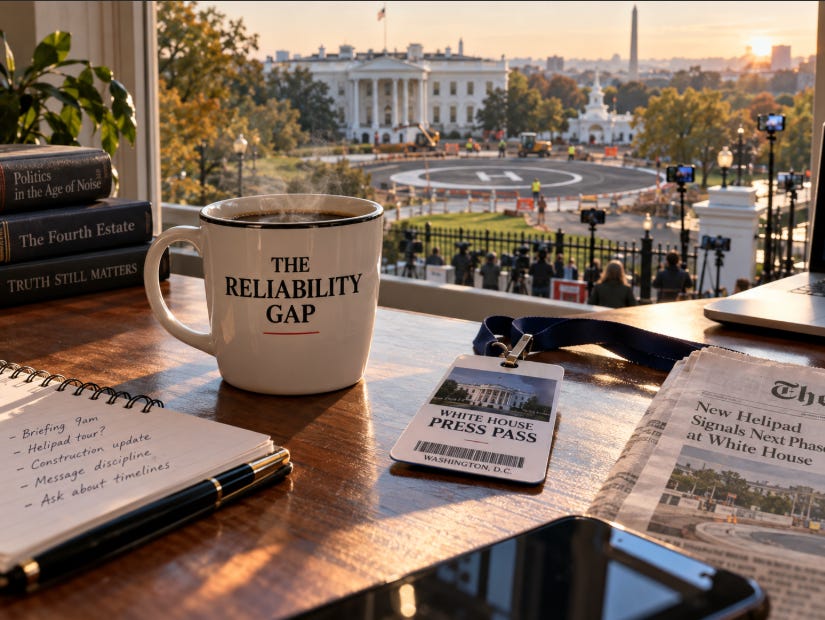
The usual network television pool was missing. Since Monday, the major television networks had stopped covering presidential pool events. They were protesting the White House’s decision to block CNN from its assigned pool rotation, after the President banned CNN, MS NOW and Politico from the grounds by Truth Social post over their reporting. The White House now decides which outlets make up the pool. The questions that afternoon reflected that. One reporter praised his “very powerful speech” at the UN and asked him to share his conversations with world leaders. Another asked which celebrities would attend Thursday’s state dinner for Xi Jinping.
The claim was made to a press pool shaped by the same administration making it. In the 48 hours around that gaggle, the claim met five tests it didn’t choose: the guest he rolled out the red carpet for, the allies who talked around him, a federal judge he appointed, a press corps that held together, and a planet that doesn’t respond to spin.
For a president preparing for one of the most consequential state visits of his second term, Trump had quite a bit on his mind.
The helipad, for example.
He praised it as perhaps the most beautiful helipad ever built, explained the advantages of landing on pavement instead of grass, reminisced about generations of presidents and staff apparently trudging through White House mud and declared that the new landing area finally provided a “proper entrance” to the executive mansion.
Then there was the facade, which he said had been largely falling off and had now been rebuilt.
Then the ballroom.
“We’re ahead of schedule,” Trump reported. The first column was up. The north portion had been built structurally. Soon it would be enclosed in “very powerful glass.” He wished the ballroom were ready in time for Xi’s state dinner because, he explained, the guest list was packed. The “entire tech world” wanted in. The “entire banking world” wanted in. It was, by Trump’s description, the “ultimate crowd.”
Somewhere underneath the helipad, the glass, the ballroom and the seating chart lay American foreign policy.
Trump said there had been “some good meetings in terms of various things.”
He would not go into details. Eventually a reporter asked about Trump’s meetings with other world leaders at the United Nations. That was when he offered his assessment of America’s standing in the world.
The guest of honor offered the first test.
When Trump arrived in Beijing in May, Xi Jinping didn’t come to the airport. China sent Vice President Han Zheng, along with a few hundred young people waving flags in uniforms matched to the colors of Air Force One. That’s standard Chinese protocol, and it was the same in 2017.
This week, Trump went further than American protocol requires. He met Xi on the tarmac at the foot of a 100-foot red carpet, instead of waiting for him at the White House. Melania explained that her husband chose to greet Xi personally because “they have a great relationship,” and that on American soil “we need to welcome them with the most respect.”
Respect traveled in one direction on the tarmac. The same afternoon, Treasury Secretary Scott Bessent announced that the trade truce with China would be extended until January, with both sides easing tariffs. At the gaggle, asked about fentanyl, Trump said China had been “really penalized very strongly.”
The penalty had just been extended as a truce.
Fortunately, some of America’s closest allies have been talking about international respect this week too, although they are using rather different vocabulary.
British Prime Minister Andy Burnham gave us a small master class in diplomatic footwork during his meeting with Trump at the United Nations.
A reporter asked about Britain’s decision to sanction organizations involved with Israeli settlements in the West Bank.
Trump appeared unfamiliar with the move.
“I don’t know about the move,” he said, before turning toward Burnham. “Do you know about the move?”
Burnham did.
“Yes,” he replied. “Obviously we took that decision, the foreign secretary and I, and, you know, we did call you just to say why we had taken that.”
It was exquisitely done. Just a gentle diplomatic nudge toward the previous conversation, wrapped in enough verbal cushioning to land a sofa.
Burnham then moved immediately back to policy.
He explained that Britain had spent years supporting a two-state solution and argued that governments eventually have to demonstrate that their words mean something when policies threaten to make that solution impossible. If politicians repeatedly make commitments and then refuse to act on them, he said, people begin to conclude that they are “all talk.”
He was talking about the West Bank.
But the sentence travels rather well.
There was no need to speculate about why Trump did not appear to recall the previous discussion. The observable moment was interesting enough: the prime minister of a close American ally found himself gently reminding the president of a substantive foreign-policy conversation they had already had.
Mark Carney supplied the larger thesis. Speaking about the international system this week, the Canadian prime minister described a world in transition. The postwar order, he argued, is ending, but the problems that made international cooperation necessary certainly are not. Climate change does not stop at customs. Pandemics ignore tariffs. Artificial intelligence, financial shocks, wars and supply-chain disruptions do not become manageable merely because a powerful country decides it would prefer to handle them alone.
Carney called his alternative “values-based realism”: cooperate deeply with countries that share your values, remain clear-eyed about those that do not, and build coalitions around problems that governments are actually prepared to solve.
And then came the line.
“Partners are working with Canada because Canada is predictable, reliable, and principled in a world that’s anything but.”
He didn’t need to say who had become unpredictable.
Carney has been making this argument for some time. Earlier this month, speaking directly to “our American friends,” he said Canada’s reputation as a “reliable, predictable partner” had rarely been more valuable in a world where “transactions are replacing relationships” and “zero-sum is favoured over win-win.”
Canada, he said, possesses plenty of valuable commodities.
“But we have earned our most valuable asset - trust.”
That is a remarkably polite way to describe a geopolitical market opening.
Power is more than aircraft carriers, armies, GDP, energy, technology, and the ability to impose costs on somebody else.
Credibility and predictability are forms of power too, and so is knowing that an agreement reached with Washington on Tuesday will still mean roughly the same thing on Thursday, that a security guarantee can survive a change in mood, and that months of negotiations will not be discarded because somebody posted something overnight.
Countries make investments, construct supply chains, deploy military forces and enter alliances based partly upon those expectations.
When predictability becomes scarce, predictability becomes valuable.
Which brings us back to Washington, where the question of what an official commitment is worth received another test before most Americans had finished their first cup of coffee.
Early Thursday, U.S. District Judge Timothy Kelly, a Trump appointee, temporarily blocked the President’s ban on CNN, MS NOW and Politico. He ruled narrowly, not on the First Amendment fight still ahead, but on due process. The D.C. Circuit has long held that an issued White House hard pass can’t simply be taken away without notice, a chance to respond, or clear standards, and the outlets got none of those.
Kelly also wasn’t persuaded by the administration’s national security argument. He found that nothing predating the lawsuit suggested security had motivated the ban, which Trump himself had announced as a response to “fake news.” The Pentagon officials who submitted declarations had no direct knowledge of White House reporting, and in most of the stories cited, the reporters didn’t even hold hard passes.
His order was plain: “immediately return, reinstate, and restore” the credentials. The administration had asked him to delay it. He declined.
Then Thursday morning arrived. A Politico reporter was turned away at the gate, and according to Politico, the Secret Service confiscated his pass. CNN and MS NOW reported that their people were turned away too.
There may be a mundane explanation, since court orders don’t reach checkpoints instantly. But the administration managed to deactivate those credentials over a weekend. Restoring them “immediately,” on a federal judge’s order, apparently proved harder.
Kelly set the outlets’ bond at one dollar. The republic may be expensive to run, but due process still has a bargain rack.
Respect is difficult to measure. But credibility leaves evidence. You can watch how allies behave and listen to the words they choose.
One prime minister carefully reminds the president of a conversation they already had. Another advertises his own country as “predictable, reliable, and principled” because those qualities have become increasingly valuable in an unstable international environment. News organizations withdraw their cameras rather than participate in a pool system from which one of their members has been excluded. A federal judge tells the White House that constitutional procedures still apply even when the president dislikes the coverage.
All this gives us considerably more to work with than Trump’s “by far.”
There is one realm where reliability is no longer a diplomatic virtue or a geopolitical advantage. It is a physical requirement of civilization.
The latest Planetary Health Check finds seven of Earth’s nine planetary boundaries outside the ‘safe operating space’ in which civilization developed, with pressure across the breached boundaries continuing to worsen. Climate is only one of them. Biodiversity, freshwater and land are all degrading. Ocean chemistry is shifting, the nitrogen and phosphorus cycles are overloaded, and synthetic chemicals and plastics are accumulating throughout the environment.
These systems also act on each other. Ecosystem loss weakens the planet’s ability to absorb carbon, and warming disrupts freshwater cycles. Deforestation reduces the rainfall forests depend on, and melting ice exposes darker surfaces that absorb more heat. Scientists now report early warning signs of tipping behavior where those pressures compound, as one failing system pushes another closer to failure.
That separates this moment from the environmental debates many of us grew up with. The question used to be whether summers would get somewhat hotter, or whether a particular forest was worth the economic cost. Now it’s whether the planetary machinery that delivers dependable rainfall, fertile soil, livable temperatures and functioning oceans keeps running. Food systems, cities and economies are all built on the assumption that it will.
Against that measure, the report card is unforgiving. Summits, net-zero pledges, subsidies, electric vehicles, and carbon markets have produced real progress in places. Taken together, they haven’t bent the trajectory fast enough.
This week put a number on that failure. NOAA confirmed the current El Niño has broken its own 150-year temperature record months before its expected peak, and researchers at the Climate Impact Lab project it will drive 450,000 additional deaths worldwide over the next six months; concentrated in Nigeria, Indonesia, Sudan, India and Brazil. The United States, which bears far more responsibility for the emissions driving these systems, is expected to lose 3,500 people over the same span.
The ozone layer is recovering because scientists identified the threat, governments cooperated, industry replaced the chemicals, and regulation held. The Planetary Health Check cites that recovery, along with improving aerosol levels, as proof that humanity can change its impact on the planet for the better.
The planet grades us on outcomes. So the problem is the gap between action and enough action. Politicians can argue about reputation and respect all they like. Physics only checks the results.
“We the people” have two powers: greater numbers than MAGA and personal agency to say no with our votes.
Early voting for the 2026 midterms is starting. Vote.org and state election websites provide everything we need to know to have our say (and hopefully way) on or before November 3.
Nicely written, Mary. trump, as always, is delusional. Actually, I think he is also predictable in that he will always say and do the inconceivable.