


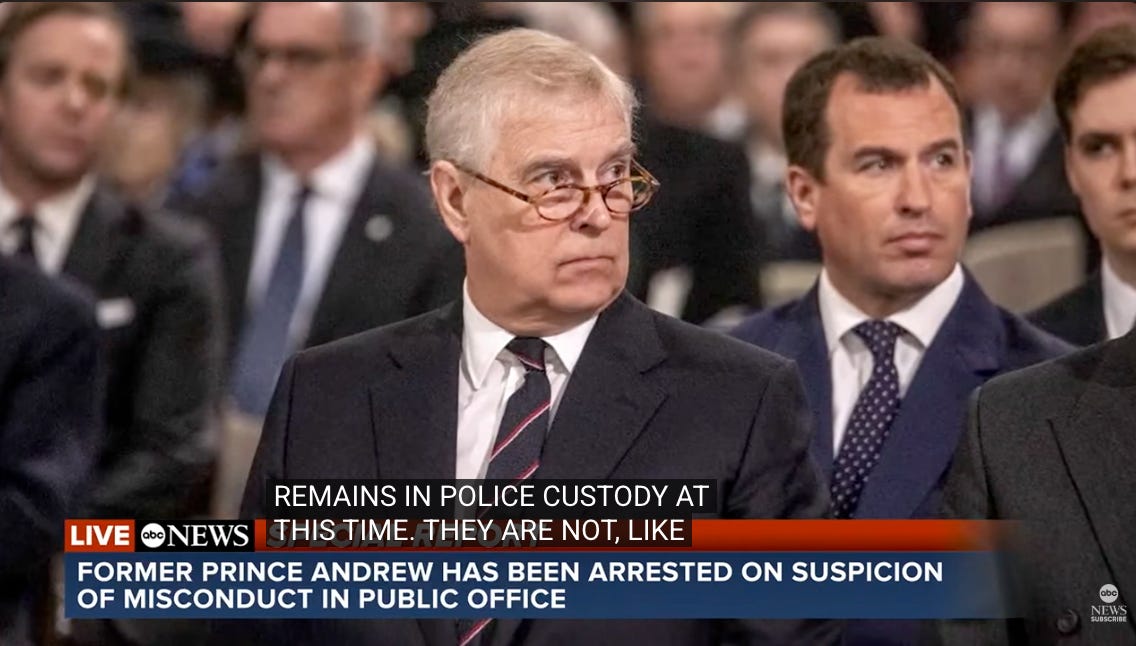
The British have arrested Andrew, formerly known as prince. Andrew Mountbatten-Windsor, formerly Prince Andrew, was arrested on suspicion of misconduct in public office after the release of millions of pages of Epstein-related documents suggested he may have forwarded confidential trade envoy material to Jeffrey Epstein while serving in an official British role.
Let that sink in. The King’s brother arrested, with police cars at Sandringham, and searches of royal properties. On his birthday, no less. If this were a Netflix script, editors would reject it as implausible.
Before anyone hyperventilates into either triumph or conspiracy, let’s ground this. He has not been charged as of this writing. He is under arrest on suspicion of misconduct in public office, specifically tied to alleged forwarding of sensitive diplomatic reports to a convicted sex offender while serving as a UK trade envoy. Not trafficking, or the sexual assault allegations themselves.
Not the 2019 BBC “I don’t sweat” catastrophe. This is about whether a public official abused his position and shared confidential information with Jeffrey Epstein after Epstein was already a convicted predator.
For those keeping score at home, is not a minor paperwork infraction. In British law, misconduct in public office is essentially an abuse-of-trust charge. It requires a willful misuse of official power serious enough to damage public confidence. It carries, in theory, a maximum life sentence. That doesn’t mean he’ll face one, but it does mean prosecutors are not playing.
And here’s the part that should make Americans sit upright in their chairs.
The British authorities moved. They didn’t just sigh heavily, or convene a blue-ribbon commission. No blathering on about “deep concerns,” they arrested a royal.
In the United States, the birthplace of the Epstein network, the jurisdiction with three million pages of correspondence, the country where Epstein died in federal custody under what can only be described as cartoonishly suspicious circumstances, there has been almost no comparable law enforcement action.
The New York Times couldn’t resist drawing the contrast: Britain has moved aggressively. America has not.
Over there, police walk up a gravel drive at Sandringham, private royal property, and take the King’s brother into custody. Over here, we debate whether releasing flight logs would be “divisive.”
Let’s also be clear about why Europe cares. This isn’t just a morality play about one deeply problematic aristocrat. Andrew was a trade envoy for a decade. That role involves access to diplomatic briefings, economic positioning, strategic conversations. If sensitive reports from visits to Hong Kong, Singapore, Vietnam, or elsewhere were forwarded to Epstein, a man later exposed as running a trafficking and blackmail network, then this stops being tabloid fodder and becomes a governance question.
The UK is embedded in NATO, intelligence-sharing networks, sanctions coordination, and financial systems that intertwine with Europe. Trust is infrastructure. If a senior envoy is vulnerable or reckless with sensitive material, every allied government quietly reviews its files. Europe is watching this as equal parts “scandal” and “security exposure.”
The monarchy appears, in this moment, to understand that perfectly. King Charles’ statement, “the law must take its course,” was not just noble sentiment but survival strategy. An unelected institution lives and dies on public legitimacy. If the crown appears to shield its own, the ground shifts under the entire structure.
Charles did the only thing he could do: publicly back the police and insist on process. If Britain can arrest royalty, it signals something profound: elite status does not automatically confer immunity.
Will this end in charges? We don’t know. Due process matters, especially in a case this explosive. But the mere fact of arrest changes the atmosphere.
She is at peace now, but I wish Virginia Giuffre had lived to see this moment. It tells victims that at least somewhere, someone is willing to test the walls of power.
And it tells the world that the Epstein archive is not just a social embarrassment file; it is a potential roadmap of systemic rot.
A reader messaged me this morning. Why is it that Britain, with a literal hereditary monarchy, appears more willing to interrogate elite misconduct than the self-proclaimed beacon of democratic accountability? Why does a constitutional monarchy look more comfortable applying the phrase “no one is above the law” than a republic that engraved the concept into its founding mythology?
The Epstein files, by sheer scale, suggest something much larger than one predator. Three million pages of correspondence released so far do not represent an isolated deviant, but a network.
Networks operate on influence. When one node cracks, ask, “how far does this architecture extend?”
Britain has chosen, at least for now, to stress-test its institutions publicly. America appears content to let the dust settle quietly. Perhaps that will change, and perhaps prosecutors here are building cases we can’t see. Perhaps the silence is strategic.
Or we are watching two democracies reveal very different comfort levels with confronting elite entanglement. One arrested a prince; the other holds press conferences about transparency. History will remember which one meant it.
With all due respect to the Epstein survivors—and they deserve justice and a culture shift—we’re now getting to the larger Epstein scandal, the one harder to address. It’s the way global elites operate, trading the lives, safety, and well-being of the rest of us as commodities in their power games. Bless the UK for keeping its eye on the big picture.
Your final paragraph indicated where we (the US) are…a monarchy is showing it is more of a democracy than the nation credited to be the founder of Constitutional democracy… and as the trump US scuttles our nation, we can’t avoid the conclusion that under trump, we are failing.