

Good morning! There is a hot dog cart at the 11th hole of Trump National Golf Club in Virginia, and it may be the single most honest metaphor currently operating anywhere in the federal government.
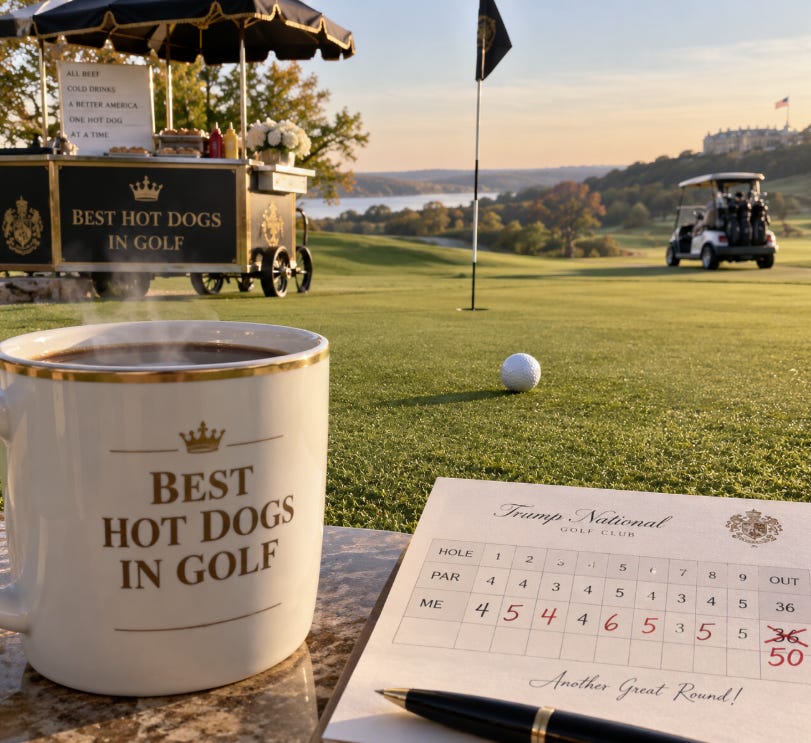
Per Forbes senior editor Dan Alexander’s reporting on what it’s like to golf with the President of the United States: Trump pulls up to the tee box, announces, not for the first time, according to his sources, that these are “the best hot dogs in golf,” and orders one for everyone in his thirty-cart entourage. Fifty hot dogs, give or take. A nice gesture, on its face, except Secret Service agents protecting him are bound by strict rules against accepting gifts from the person they protect. So Trump’s own club solves this delicate ethical puzzle by billing the Secret Service for the hot dogs Trump just ordered. Which the Secret Service pays for. Which is to say: you pay for it.
One all-beef transaction, as Alexander puts it, is the Trump presidency in miniature, an arrangement dressed up as generosity that functions as a small, cheerful wealth-extraction device, funded by the public, delivered with a wink and a golf cart full of federal agents standing guard over the mustard.
It doesn’t stop at lunch. The same reporting has the Secret Service also covering rooms and meals at Trump properties. His campaign spends at his own courses. Other campaigns and political committees do too. Foreign money flows into his cryptocurrency ventures. The wall the family swore they’d build between the business and the presidency fell over, and everyone just kept playing through.
Trump’s golf course is a place where the world quite literally reorganizes itself around him. He plays astonishingly fast. He hits, jumps into his cart and races to the next ball while everyone else catches up. Groups ahead clear the way for the presidential motorcade. Putts that are close enough and do not matter to the match may simply be swept aside. There is another hole waiting, another drive to hit, another destination ahead. Members may be inconvenienced, but many are delighted by the spectacle: Trump jokes with them, poses for photographs, asks whether they realize how lucky they are to belong to his club. Forbes reporter Dan Alexander described him as a “tornado” moving through the course.
There is something almost too neat about the metaphor. The big swing receives enormous attention. The tedious work around the green, considerably less. Everyone else adjusts to the pace. And when the ball is six feet from the hole and the shot seems unnecessary, there is always the option of picking it up and moving along.
There are also the club championships. Trump claimed to have won 36 of them earlier this year. By the time the White House press shop got involved in fact-checking a story about hot dogs with, Alexander notes, more granular urgency than he’s seen from them on stories that actually matter, the number had crept up to “almost 50.” A fair question might be: is he getting better at golf, or is the golf getting better at flattering him? Either way, it’s the same reflex Forbes has clocked for years: pricing his real estate, now metastasized into his handling of foreign policy, war, and, coincidentally, the federal budget. Whatever the true number is, it’s never enough, and someone standing nearby will always be willing to round up.
Which brings us to a much bigger number: $5,000. The Commerce secretary was asked this week a fairly straightforward question about Donald Trump’s promise to give every adult American a $5,000 “dividend” if Republicans retain Congress: Where does the money come from?
Howard Lutnick’s answer was wonderfully expansive.
“There are so many ways,” he said, that Trump can use the enormous value of the American economy to produce money that is “not tax money.” His favorite example was the proposed Trump Platinum Card, under which wealthy foreigners would make a $5 million payment to the government in exchange for special immigration and tax treatment. Lutnick said more than 100,000 people were waiting to participate. Five million dollars times 100,000 applicants, he explained, equals $500 billion.
The multiplication is impeccable, everything surrounding it is less settled. The Platinum Card is not yet operating. A place on a waiting list is not a $5 million payment. Even if every one of those prospective applicants eventually produced the money, $500 billion would still cover less than half the estimated cost of sending $5,000 to every adult American. And once money is collected by the federal government, calling it “non-tax money” does not make the Appropriations Clause disappear. Congress still has something to say about how federal funds are spent.
Then there are the tariffs. The Tax Foundation’s own estimate has the tariffs producing roughly $125 billion a year going forward, meaning it would take the better part of a decade of collections to cover one round of checks, assuming Republicans don’t spend the money on anything else in the meantime, which they will.
But there it was again: the big swing first, the six-footer later.
Trump promised the dividend. Lutnick supplied an enormous number. The mechanics could apparently be sorted out somewhere between the tee box and the green.
Perhaps that is the better way to understand an administration that so often speaks in the language of inevitability. The question becomes whether possessing power has gradually become confused with possessing control over whatever outcome they announce.
By Saturday, the President of the United States was in Dublin, which meant it was someone else’s turn to watch a number, or an entire geopolitical settlement get invented on the spot.
Asked about the Falkland Islands during a press conference with Taoiseach Micheál Martin, Trump produced an answer that would earn a gentleman’s C in a ninth-grade history class: something about a “different country” having controlled the islands once, a vague sense that someone “went in and took it over,” and a real concern about how long a naval voyage that far would take. He landed, unprompted, on the observation that the whole thing sounded like “a potential disaster” he’d “probably be called into.” One British academic, Josephine Harmon, watching from a studio in London put it more gently than the answer deserved: he “doesn’t understand the context in general of these things. He’s just throwing stuff out there.” That’s the polite, tenured version of what your grandmother might call winging it or this grandmother might call BS.
Minutes later, he did the same thing to a subject with rather higher stakes than a British-Argentine sovereignty dispute last fought over in 1982. Irish reunification. Asked for his view, Trump acknowledged upfront that weighing in “could cause trouble” and then weighed in anyway, calling a united Ireland “a great feather in everybody’s cap” and predicting it’s “going to happen eventually.” It should be noted, Trump has no portfolio on Northern Ireland’s constitutional status, no evident awareness of what three decades of careful diplomatic language exist to prevent, and no apparent interest in finding out before speaking. He also told reporters he had seen no protests, despite demonstrations having been publicly organized for weeks.
Somewhere in the same string of remarks, he informed the assembled press that the U.S. Navy is interdicting an average of twenty-five boats a day in the Strait of Hormuz, a specific, checkable operational claim, that Reuters has repeatedly reported Kpler shipping-data figures directly contradict Trump’s Hormuz numbers throughout this year.
Micheál Martin, for his part, opened the whole encounter by thanking Trump personally for “the investment of your family” in Doonbeg, a sitting head of government offering diplomatic gratitude for a golf course. Which is its own small, tidy irony: the same conflation of public office and personal enrichment that funded fifty hot dogs in Virginia was, an ocean away, being toasted as statesmanship.
It’s a pattern worth naming plainly: an American president freelancing opinions on sovereignty disputes he hasn’t researched, on operations he may be exaggerating, in a country whose leader is busy being grateful for his golf resort. Which makes it a fitting warm-up act for what his own Treasury Secretary was doing to Japan’s central bank that same week, not freelancing on someone else’s country this time, but on someone else’s currency.
Scott Bessent has a story he likes to tell about himself, and it happens to be true: at 29, working for George Soros, he helped assemble the $10 billion short that broke the pound in 1992. British officials had insisted, loudly and repeatedly, that devaluation would never happen. Then it happened, and Norman Lamont, the Chancellor of the Exchequer, Britain’s Treasury secretary, never politically recovered. Bessent was on the team that cashed in on that particular species of overconfidence. Which makes it a genuinely remarkable career turn that he is now the one standing in Lamont’s shoes, telling traders “I am the house now... and you can bet against me if you want,” about a currency and a central bank that are not his own.
Japan noticed. Former Bank of Japan officials warned that Bessent’s boasts, including his claim to have “asymmetric information” on the BoJ’s next move risk making the central bank look like it’s taking orders from Washington, which is its own kind of damage, independent of whether Bessent is bluffing. Japan’s finance minister said, diplomatically, that “I am the house now” sounded “a little scary” once translated. That is what a friendly government sounds like when it’s trying not to say “please stop.”
Back home, the boast has already been tested once, and failed. Bessent announced enhanced Treasury bond buybacks to calm a “fever” in the markets; yields dropped, then, within twenty-four hours, round-tripped straight back to where they started, and follow-up media appearances didn’t help. His own mentor, Stanley Druckenmiller, wrote in the Wall Street Journal that liquidity tools can’t buy your way out of a solvency conversation, only postpone it at a higher price. A former Paulson aide put it more bluntly: the market already knows Bessent doesn’t have any tools beyond the ones it can already see. Days after all of that, Bessent gave a prime-time convention speech, the first sitting Treasury secretary to do so in fifty years, praising Trump and attacking Democrats from a partisan stage, which is precisely the kind of overt politics his own predecessor, Janet Yellen, said she avoided on principle.
Worth noting, too, that the confusion isn’t confined to Bessent. When August’s jobs report came in nearly triple expectations, precisely the kind of data that normally argues for holding rates steady or raising them, Trump demanded the Fed cut anyway, reasoning on Truth Social that “a strong country means a lower interest rate, it’s a better credit... very simple!” That’s household credit-score logic, applied wholesale to central bank policy, and betrays a clear weakness in Trump’s understanding of economics.
In fairness, economist Paul Krugman makes a real case that the domestic rate spike probably isn’t Bessent’s fault at all. Long-term yields are rising across the US, Germany, France, Italy, the UK, and Japan alike, which looks a lot less like markets punishing American dysfunction and a lot more like a global scramble for capital driven by AI investment. That’s worth holding onto: not every failure here is self-inflicted. The convention speech, the insider-knowledge boast, and the instinct to talk big before you’ve confirmed you’re holding a big stick, well, that part’s entirely his own.
It also turns out to be the whole difference between Bessent and the one figure who’s actually run a central bank instead of just talking a big game about one.
Mark Carney has spent this year absorbing nearly everything the previous four sections describe: tariff threats, a trade war framed as a personal grievance, a Commerce Secretary publicly accusing his government of bad faith, and he has yet to raise his voice once.
When Lutnick claimed Ottawa scuttled trade talks for political reasons, Carney didn’t fire back. He corrected the record, once, in a single sentence: “I don’t think, with all respect, appointed, unelected Cabinet members in the United States are experts on Canadian politics.” No adjectives. No theater. Just a quiet reminder of who was actually elected to speak for whom.
When Trump revived his favorite line about Canada becoming the 51st state, Carney’s answer was just as flat: “Canada never, ever will be part of America in any way, shape or form.” When a fresh round of tariffs landed this month, he didn’t escalate, he downgraded them, calling the measures “relatively modest,” which is its own quiet act of aggression: refusing to grant a threat the drama it came dressed for.
None of this is an accident of temperament. Carney ran the Bank of Canada, then the Bank of England, which is to say, he has spent a career doing, for real, the thing Bessent narrates from a podium. One foreign-affairs commentator put the contrast plainly on air this week: Carney is “in a very fortunate position as a politician right now” precisely because he has “very good knowledge of the economy, the economic levers that can be pulled, the damage that can be done by pulling the wrong ones.”
That is not a charisma assessment. It’s a literacy assessment. And it happens to double as the most damning thing anyone has said about the last four men in this essay, none of whom it was said about.
I have been here before. In April 2025, barely three months into Trump’s second term, I wrote an essay called “Trump Got Played: The Grownups Are Quietly Running the World.” Carney had just arrived as prime minister, Trump was discovering that tariffs did not automatically produce surrender, and I wrote that the difference was between people who understood actual economic leverage and a White House treating “be cool” as fiscal policy.
A year and a half later, I would amend the thesis slightly.
Credentials alone do not make someone a grownup. Scott Bessent has credentials to spare.
The grownup is the person whose expertise teaches him where his power stops.
The clearest single image of that difference arrived in January, when Carney gave a speech at Davos, restrained, structural, built around the idea of a “rupture” in the global order, and received a rare standing ovation. Trump’s rebuttal landed the next day: “Canada lives because of the United States.”
Read back to back, it’s almost unbearably tidy. One man says something true, carefully, and the room stands up. The other says something loud in response, and the room just waits for him to finish.
This is the part of the essay where the thesis stops being implied. The alternative to a government that mistakes volume for strength was never going to be a louder government from the other side; a left-wing Trump, an American Jack Reacher, whatever shape that fantasy takes.
It’s this: someone whose command of the actual mechanism is secure enough that they never have to perform having it.
Carney doesn’t need to say “I am the house,” because he built the house. He knows exactly how many rooms are in it, and he’s not interested in telling you it’s fifty when it’s thirty-six, or very probably much less.
That’s the whole argument, really, dressed up as a hot dog and a currency dispute.
Competence doesn’t need volume, it’s the only thing in this entire story that hasn’t had to lie about its numbers.
Back to the 11th tee, one last time. Dan Alexander’s closing observation about Trump on a golf course was this: he likes the bigger swings, and gets bored somewhere around the green, where the actual precision lives. Read the whole week back with that in mind and it stops being a metaphor about golf. The tariffs were the drive; big, satisfying, aimed at nothing in particular. The $5,000 dividend was the drive. “I am the house now” was the drive. What nobody in this administration seems willing to do is the six-foot putt: the part where you have to slow down, do the actual arithmetic, and live with a number you didn’t get to just announce into existence.
When I wrote last year, how Carney forced Trump’s tariff retreat by quietly making the bond market nervous instead of making noise about it. It felt like an isolated humiliation, a single grownup showing up to a room full of children and getting the outcome he wanted without raising his voice. Eighteen months and one cabinet’s worth of new characters later, I’m less inclined to call it isolated. It’s the operating manual. Different men, different hot dogs, same tee box.
Somewhere out there is a version of American leadership that could deliver a line quietly enough to make every other man in this essay sound ridiculous by comparison. This being America, of course, our Mark Carney would probably need the résumé of a central banker, who knows how to putt, and the build of Jack Reacher, because competence goes down easier here when it has shoulders. It isn’t on the ballot this cycle, but it exists. You can watch a version of it govern a country of forty million people from just across a border that, for now, still knows where it is. That has to count for something, even from way out here in rural Oregon, watching the scorecard get rewritten in real time.
I love how perceptive you are, Mary, and how you calmly “tell things as they are” in such a clever, insightful and gutsy way.
Put Iran into this analogy. Big bombs good. Peace talks boring.