


Good morning! The Iran war has entered its “everybody won” phase. A top Iranian general says Tehran has won and now needs to consolidate its victory. Trump, rejecting Iran’s seven-day plan to reopen the Strait of Hormuz, says Iran only offered it because it’s “losing so badly.” Meanwhile, Hormuz remains constrained, gasoline remains expensive, and diplomats are still arguing over how to end a war both sides insist they’ve already won.
Everybody gets a trophy, except the people buying gasoline.
In a gaggle before leaving for Chicago, where he’s honorary chairman of a golf tournament, Trump helpfully expanded upon his definition of victory.
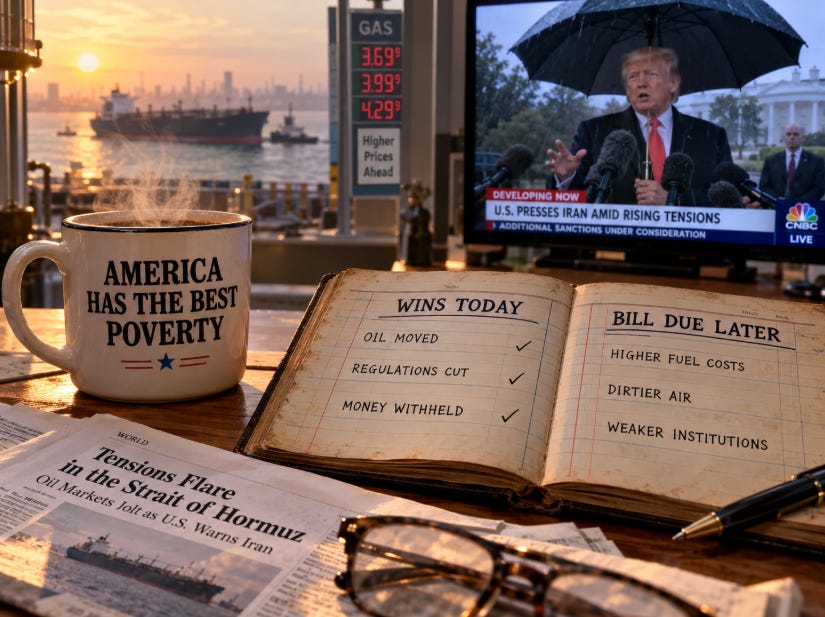
“We have the best employment numbers that came out in the history of our country,” he told reporters. “More people working today than at any time ever before.”
Then he arrived at poverty.
“We have the best uh I guess you could say poverty. They talk poverty,” Trump said, before announcing that “we have the best poverty numbers ever in the history of our country.”
Best poverty (n., Trumpolinguistics): The grading of human hardship on the same scale as hotel ballrooms and golf courses. Usually preceded by a brief pause while the speaker locates the word, which he attributes to others: “They talk poverty.” Compare Trumpetitive.
From there came the “best income numbers per individual in the history of our country,” grocery prices that have supposedly “come way down,” oil that he said is cheaper than under Biden and, finally, a claim that the United States moved a “record amount of oil” through Hormuz overnight — more, he said, than before the war.
It was a 1:38 rollout of Trumperbolic superlatives, delivered in the rain while holding an enormous umbrella.
Trump had apparently spent Saturday marinating in good news. On Truth Social he announced that, since the “Fake News” refused to report his achievements, he had assumed a new responsibility: reporting them himself. There was the fastest U.S. business growth in more than five years, record real median household income, record-low poverty, surging exports and “Trillions and Trillions” in new investment.
S&P Global really did report the fastest growth in U.S. business activity in more than five years. It also reported input costs rising at nearly a four-year high, selling-price inflation still well above a pace consistent with the Fed’s 2 percent target, and an economic indicator sitting “very much in rate hike territory.” That part somehow failed to make the presidential clipping service.
Natalie Harp, Trump’s executive assistant, may or may not have delivered this particular briefing. She is, however, known around Trump’s orbit as the “human printer,” carrying hard copies of news articles and social-media posts for a president who prefers paper, and she routinely types and posts Truth Social messages for him. CBS has also reported that she is quick to provide favorable news coverage for his perusal.
Whatever the provenance, we know what survived the editing process. By Sunday morning, record household income had become the “best income numbers per individual,” strong business activity had joined the general atmosphere of triumph, and record official poverty had blossomed into best poverty.
One banner was technically genuine. The official poverty rate fell to 10.2 percent in 2025, a record low. But that yardstick dates to the 1960s and ignores what housing costs. The Census Bureau’s Supplemental Poverty Measure, which does account for rent, taxes and medical bills, put poverty at 13.1 percent, unchanged from the year before.
Others require more creative bookkeeping.
The household employment survey does not show more Americans working than ever before. Grocery prices are higher than when Trump returned to office. Regular gasoline averaged nearly $4.49 nationally last week, compared with about $3.11 when Joe Biden left office. West Texas Intermediate crude was trading around $96 a barrel early last week, roughly twenty dollars above its level during Biden’s final days.
As for the new Hormuz record, Trump provided no number. The most recent independent shipping data available before his remarks showed a recent surge in crude traffic but not a return to ordinary prewar commercial traffic.
Perhaps that hardly matters in the emerging grammar of victory.
Iran remains at war but has won, and is offering negotiations because it is losing. Oil remains expensive but Trump says it is cheaper. Groceries cost more but have come way down. The Strait remains the central bargaining chip in a seven-month war, yet a successful convoy becomes proof that the underlying problem is practically solved.
Count whatever moved today. Declare the transaction complete. Leave tomorrow in the footnotes.
Nowhere is that accounting method more perfectly illustrated than in what Trump announced Saturday: while the United States is fighting a war centered on one of the world’s most important oil chokepoints, his administration wants American cars to use more gasoline.
The federal government first required automakers’ fleets to meet fuel-economy standards in the 1970s, after the 1973 oil embargo. Gas prices were soaring, supply was choked off, and Congress decided American drivers shouldn’t be so exposed to whoever controlled the flow of oil out of the Middle East. Dave Cooke, who studies fuel efficiency at the Union of Concerned Scientists, says we’re reliving “exactly the moment” the standards were designed for.
Trump announced his answer to that moment on Truth Social: “I have just approved new Fuel Economy Standards that TERMINATE Sleepy Joe Biden and Pete Boot-EDGE-EDGE’s ridiculous EV Mandate.”
He promised LOWER PRICES.
The Biden-era rules aimed for a fleetwide regulatory average of roughly 50.4 miles per gallon by 2031. The Trump administration’s proposal lowers that to roughly 34.5 mpg. NHTSA still describes the replacement as a proposed rule.
Transportation Secretary Sean Duffy says the old standards were an electric-vehicle mandate in disguise, and the White House says they would have added nearly $1,000 to the price of a new car.
That’s the first column.
The government’s own analysis supplies the second.
For a model-year 2031 vehicle, the weaker standards could mean roughly $1,400 more in lifetime fuel costs. NHTSA’s modeling also projects thousands fewer auto-industry jobs in 2031 under its preferred alternative and greater economic vulnerability to global oil shocks as vehicles consume more fuel. Increased emissions bring additional asthma attacks, emergency-room visits, heart attacks and premature deaths.
NHTSA nevertheless concludes that the proposal produces net savings overall, because it places greater value on lower vehicle-compliance costs than on the additional fuel and other costs. This really ends up as a dispute over which side of the ledger gets the larger number.
The analysis even finds a safety benefit.
Traffic deaths fall partly because, when each mile costs more, people drive fewer of them, so one way to make the highways safer is to make filling the tank sufficiently unpleasant.
The same ledger turned up when EPA repealed the greenhouse-gas Endangerment Finding in February. Administrator Lee Zeldin advertised more than $1.3 trillion in savings, largely from lower vehicle-technology and charging-equipment costs.
EPA’s own regulatory analysis contains the second column again. Depending on the assumptions, it calculates between roughly $420 billion and $1.47 trillion in offsetting costs from additional fuel, maintenance, insurance, congestion, noise, energy-security effects and related consequences. Under EPA’s reference-price scenario, repeal produces about $180 billion in net societal costs at a 3 percent discount rate.
Congress had already set the civil penalty for violating fuel-economy standards at $0, largely stripping the program of its primary enforcement mechanism. Now the administration is lowering the standards themselves.
The same bookkeeping runs through the federal budget. Friday, Trump asked Congress to cancel $810 million it had already appropriated. The timing is the whole trick. Under the Impoundment Control Act, Congress normally gets 45 days of continuous session to consider a rescission request. Trump filed five days before the fiscal year ends Wednesday, leaving nowhere near enough time for that process to run before the money expires. The maneuver is known as a “pocket rescission,” and the Government Accountability Office considers it illegal because it allows a president effectively to rewrite the law by running out the clock.
The law the administration is using for the maneuver was passed in 1974 in response to Richard Nixon’s impoundments. That was one year after the oil embargo that produced the fuel-efficiency standards Trump is now weakening.
More than half the proposed cuts, $567 million, come from HHS services for refugees and unaccompanied children. The rest target migrant students, mental-health and social services for migrants, housing counseling, a Justice Department office that works to ease racial tensions, and the Minority Business Development Agency. The administration called the programs “wasteful” and “harmful.”
Sen. Susan Collins, the Republican chair of Senate Appropriations, called the move illegal. She said OMB deliberately held the money for months to set it up and that OMB does not get to decide which programs are worth funding. Sen. Patty Murray, her Democratic counterpart, said Vought was effectively telling Republicans that their votes don’t count.
Trump has run this test before. In 2025 he attempted the same maneuver with a $4.9 billion foreign-aid rescission package. The Supreme Court later stayed a lower-court order requiring roughly $4 billion of those funds to be spent before they expired, but it did not decide whether pocket rescissions themselves are lawful. Congress could appropriate new money for the same programs next year if it chooses.
The pocket rescission doesn’t just ignore the next accounting period. It weaponizes the end of this one.
Congress will decide whether to defend its power of the purse. Ballots are harder to cancel by running out a clock, which may be why experts expect the pressure to shift to the clock that starts when polls close.
Congress will decide whether to defend its power of the purse. Ballots are harder to cancel by running out a clock, which may be why experts are increasingly focused on the clock that starts when polls close.
The administration’s pre-election court record is mixed. This month the Supreme Court left in place an injunction blocking the Postal Service’s new ballot-mail rules, while separately allowing DHS’s expanded citizenship-verification system to operate during its appeal. On Friday, the Court also kept Missouri’s Trump-backed 2025 congressional map out of the midterms, leaving the state’s 2022 map in place. Against that unsettled legal backdrop, former federal officials at a Brennan Center briefing warned that the hours and days after polls close may present a different vulnerability: the period when legitimate ballots are still being counted but the public does not yet have a final result.
Caitlin Durkovich, a former deputy homeland security adviser, said she expects claims of foreign interference to be used as a pretext for seizing voting equipment or ballots, whether or not there is any legal basis. Some states take days to count, and California can take weeks. Control of Congress may depend on those results. Durkovich called the waiting period the point where doubt begins to surface.
The administration’s warnings about foreign threats come with a second column of their own. It has sharply cut election security staff and funding at CISA. Geoff Hale, a former CISA official, said the nation-state threat briefings that states once received dozens of times a year now happen rarely or not at all. Beth Sanner, a former deputy director of national intelligence, said there are no known examples of a foreign country manipulating the technical vote count, including in 2020.
Federal election-related activity, meanwhile, has hardly gone quiet. DHS is still pursuing state voter rolls, and a whistleblower told Congress last week that its non-citizen voter initiative relies on highly questionable data.
Larry Norden of the Brennan Center, who calls the counting window the biggest threat right now, says voters still have extensive options for casting ballots before Election Day. Military and overseas ballots are already out nationwide, and mail and early-voting periods are opening on different schedules across the states.
Casting a ballot early does not necessarily mean it will be counted early; state laws determine when election officials may process and tabulate it. But voting before Election Day can reduce exposure to last-minute problems such as lines, illness, transportation trouble or mail delays. The count itself will still follow the timetable set by state law.
What voters control is simpler: make a plan, check your registration, and sign up for ballot tracking where your state offers it. Oregonians can track theirs through the Secretary of State’s site once ballots go out.
I’ve been stretched a little thin this week. Much of my reporting time has gone into a deeper look at sustainability and the climate crisis, along with a decidedly more local project: our upcoming sheriff’s race here in Coos County.
So this weekend is partly an exercise in catching up, sorting notes, reading reports, watching the stories I temporarily shoved to the side reproduce when I wasn’t looking.
Washington has shown no inclination to slow down while I reorganize my desk.
Back tomorrow, hopefully with fewer open tabs and at least the illusion of being caught up.
My Dear Mr. President:
If the White House is “a very sacred place” as you recently stated in defiance of a court order regarding press access for CNN and MSNow, why would the American electorate allow the devil incarnate to reside there?
…and what have you done to the East Wing of that “sacred place?”
Regards,
thank you - as always! - for this, Mary. It is important to notice the constant assaults on environmental protection, many of which measures being attacked also protect consumers, or just residents of the country.
And re not counting the problems: we should not forget that the federal government stopped studying and reporting on hunger in the US (because the results tended to be 'politicized'!) a few weeks before the Big ... bill radically cut SNAP payments.
Harm is not done if nobody can measure it... Trumpenomics/Trumpolitics in a nutshell.