


We were on our way into Powell’s City of Books when we stopped to talk to a young man trying to save a little of the world outside it. He was fundraising for The Nature Conservancy, work he told us he had been doing for nine years. He knew the organization, its projects, and the places it was trying to protect, and there was something captivating about listening to a person who had spent that much of his life asking strangers to care. We were anxious to get inside the bookstore, because I’ve never possessed the emotional discipline required to stand near that many books without immediately wanting to adopt several, but we stayed.
He told us we were his first donors of the morning. No one had stopped for him, and he said that having someone finally respond lifted his spirits. In his experience, it made the rest of the day easier. I keep thinking about that, how a few minutes of our morning could change the weight of the hours someone else still had ahead of him. While we talked, his colleague kept trying to catch the attention of people passing on the sidewalk. They continued walking. Between those attempts, she made funny faces at Ezra, who laughed at her with the beautiful generosity of a baby who hasn’t yet learned to ration his delight.
There we were, outside a building full of everything people have thought important enough to write down, while two people on the sidewalk tried to get someone to stop for the living world. I don’t know what everyone passing us was carrying. People have appointments, worries, bills, and lives that can become so crowded there’s hardly room for one more request. I understand that. I’ve hurried past things I should’ve noticed, and there are days when my own responsibilities make the rest of the world feel very far away. But I was moved by how much it meant to him that someone stopped. After nine years of doing this work, he could still be encouraged by a stranger. He could still begin the next conversation with a little more hope because the last one had gone well.
We saw extraordinary trees in Portland and on the drive. I kept looking at them, at the way their branches held the light, at all the different greens gathered in one place. Sometimes a landscape catches me so completely that I almost grieve while I’m looking at it. There’s so much beauty here, so much life already doing the difficult work of being alive, and I cannot understand how we keep making its destruction sound reasonable.
At home, my husband and I are trying to diversify our little forest with native plants, choosing what might offer food and shelter to the creatures who live around us. Oregon State University Extension describes native planting as a way to support birds, insects, and other wildlife, and the more we learn, the more a plant becomes a whole set of possibilities. A place to nest, something to eat, a flower opening when a small creature needs it. I still love a beautiful plant simply because it’s beautiful. My nursery purchases have made that abundantly clear. But now I find myself wondering who else might love it, who might arrive because it’s there, and what we could make possible by choosing carefully.
We go out and remove ivy from the trees, working around the trunks and returning to the places where it grows back. Some days the work feels almost absurd in its repetition. We have other projects waiting, children who need us, and a house with a seemingly inexhaustible imagination for repairs. Still, there is the ivy, and beneath it there is a tree whose life deserves some of our afternoon. Learning how to help is important. We have to be careful with the bark, careful with the roots, and careful that our urgency doesn’t become another injury. The forest asks us to pay attention to what our hands are doing.
That has changed the way I understand love. I can look up into a tree and feel overwhelmed by its beauty, but the tree still needs room to live when I go back inside. The plants we nurture need more than the happiness they give us. They need us to learn about their soil, their light, their water, and the other lives around them. Affection brings us close enough to notice; then we have to decide what we are willing to do. This week, I found myself thinking about people who made that decision beside a tree they could no longer look up into.
On September 28, 2023, the beloved Sycamore Gap tree beside Hadrian’s Wall in Northumberland was illegally cut down. Three years later, the National Trust has released photographs showing a thick ring of new shoots around its stump, now two to three feet tall. Staff attribute the encouraging growth to protective measures that reduced soil compaction and disturbance around the roots. The charity also distributed 49 saplings through its Trees of Hope initiative to communities across the United Kingdom. I keep coming back to the people who protected that stump.
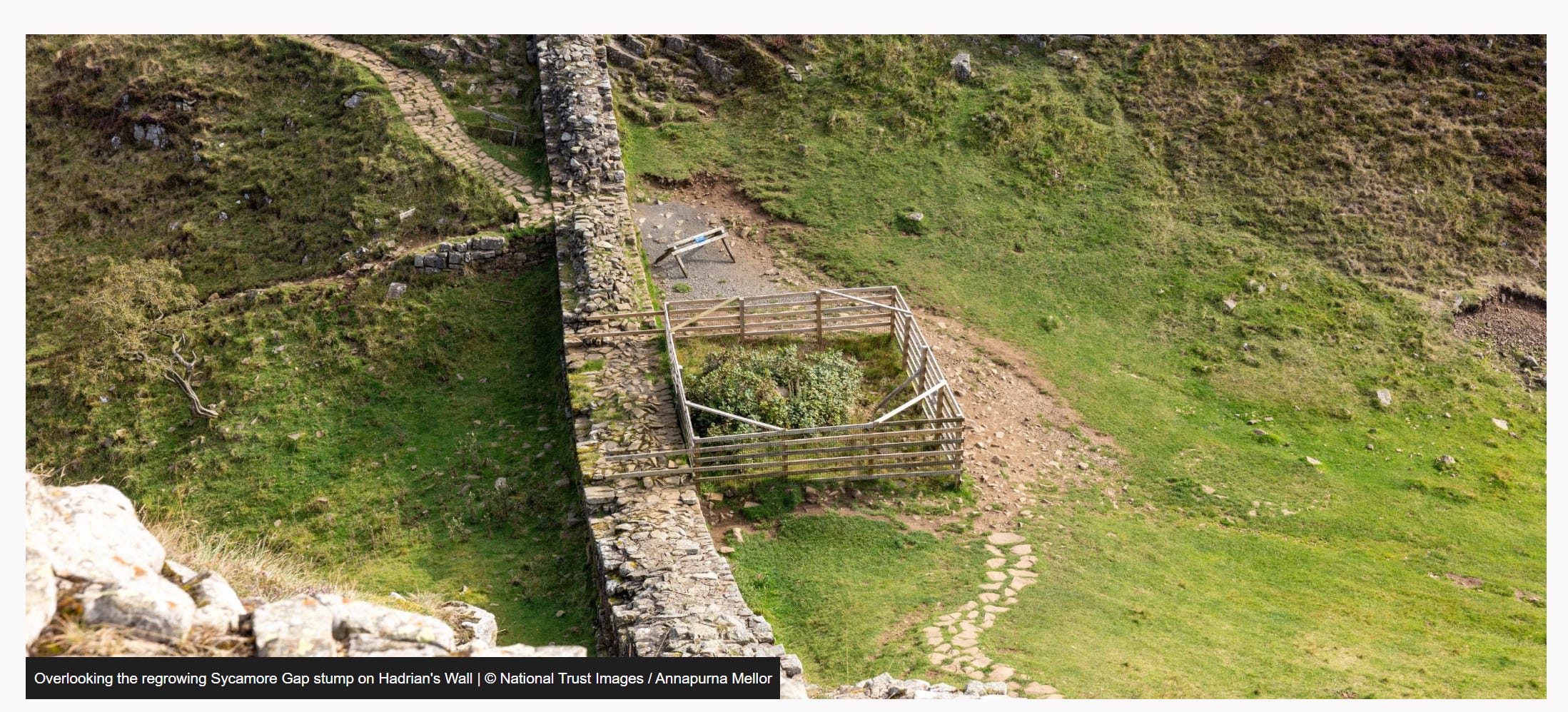
It must have been painful to return to a place so defined by what was missing. Where there had been branches, there was open sky. Where people had known the familiar shape of a tree, there was the evidence of how quickly something cherished could be taken away. And still, someone had to consider the roots. Someone had to ask what remained alive, what it needed, and how to give it a chance. The wound was visible to everyone who came there, but the possibility required a different kind of attention.
The loss of the tree remains, and the care will have to continue. But I find something profoundly moving in the fact that people stayed involved through the years between the destruction and these photographs. They protected something whose future they couldn’t promise. When I look at that new growth, I see the tree’s living roots, and I also think about all the human decisions surrounding them. The knowledge, restraint, patience, and willingness to keep a wounded place safe while it changed.
There is hope for humanity in that, and I want to let myself fully feel it. We are capable of terrible carelessness and deliberate cruelty. We know this, sometimes so thoroughly that we begin to mistake the people doing the damage for the whole of our species. But the people tending those roots are human, too. So is the young man who has spent nine years asking strangers to help protect the natural world. So is the woman who kept trying to reach people on the sidewalk and, between disappointments, found a moment to make our baby laugh.
That tenderness belongs in our understanding of who we are. I keep thinking about how much love must exist in the world without ever becoming a headline. People learning the names of plants so they can choose the right ones, checking on saplings through dry weather, caring for injured animals, and spending their weekends restoring places they could have simply walked past. People accepting responsibility for lives that will never know their names.
There is something beautiful about being a species capable of that kind of concern. We can imagine another creature’s hunger, recognize a wounded place, and decide that some portion of our time should belong to helping it. We can plant something whose fullest life will unfold after ours. We can stand beside what remains of a beloved tree and make careful arrangements for a future we can’t see. Those people give me hope because their care is already happening. While we’re frightened, while the news is terrible, while we wonder whether anyone else understands how much there is to lose, someone is out there learning how to protect it.
I wish we could make them more visible to one another. I wish every person doing that work could feel the company of all the others, could know that their tenderness has allies. Perhaps that’s part of what these Sunday pieces can offer: a way to recognize one another across the distance, and a reminder that the world still has so many people willing to love it with their hands.
I want our children to learn how to be those people. I want them to know the names of the plants around them, to notice what’s growing and wonder what it needs. I want them to understand why we return to the ivy, why we make room for native plants, why a creature small enough to escape our attention can still have a claim on our kindness. Their childhood is happening inside this living world. Every ordinary day we love has weather in it, water in it, something grown from soil. There are trees along the roads we drive, birds outside the windows, and shade over places where our children will make memories we can’t yet imagine.
I want to protect their chance to have those memories. But the forest deserves care beyond what it gives my family. A bird’s life matters even if my children never hear it sing. A tree has been reaching into the light for years before we arrive to admire it. There are whole lives unfolding around us whose meaning doesn’t depend on whether we find them useful, beautiful, or convenient. Teaching that to our children feels like one of the most important things we can do. I hope they grow up able to recognize a responsibility that extends beyond themselves, and confident enough to act on it.
I also hope they won’t have to spend their lives repairing everything we were too distracted to protect. That’s where the tenderness in this story becomes urgent for me. Our gardens matter, the trees we free from ivy matter, and the people working for conservation deserve our attention and support. Those acts also belong to a much larger responsibility. We need laws that protect living places, public decisions that take ecological harm seriously, and limits on what powerful interests are allowed to destroy for profit.
Our children will live with the consequences long after the people making those decisions have finished explaining why there was supposedly no other choice. I don’t want to hand them a diminished world and ask them to be grateful for whatever survived. I want them to inherit adults who tried, institutions that protected, and places still alive enough to welcome them. That begins with paying attention, and it has to grow into participation. We can learn, plant, restore, support conservation work, and insist that the people making decisions about our shared future answer to more than the next financial quarter. We can speak about the living world with enough love and precision that other people begin to see what’s at stake.
I think again of the young man outside Powell’s, encouraged because someone had finally stopped. His colleague was making our baby laugh while trying to reach the next stranger. Neither of them could know who would listen that day, but they were there, giving people another opportunity to care. We encouraged him, and he encouraged me. I hope he knew that. I hope he understood that his willingness to keep asking reminded a tired mother that other people are carrying this love for the world, too.
There are so many of us. We may meet outside a bookstore or work quietly in separate gardens, never knowing one another’s names. Still, our efforts can reach toward the same future. The place one person protects may shelter a bird another person will someday hear. A child watching her father care for a tree may grow into someone who protects a forest. A conversation on a sidewalk may stay with a stranger long enough to become a story, and that story may help someone else begin.
I hope the plants we nurture become shelter. I hope our children return to the trees we have cared for and remember that we found happiness in helping something live. Most of all, I hope they discover that the world is full of other people who feel that way, and that they can spend their lives in good company.
Somewhere beside Hadrian’s Wall, green shoots are rising from the remains of a beloved tree. People are giving them time, space, and protection. Somewhere ahead of us, a child may come to that place and know it for what’s growing. I imagine that child resting beneath its branches, looking up through the leaves into a little moving light. They may never know how many people cared for the roots before there was shade. But they will be held by that care all the same.
And perhaps that is the hope I want to leave you with this Sunday: there are people alive right now making the world gentler for someone who hasn’t arrived yet. We can be among them.
If this piece reminded you that your tenderness has company, I hope you’ll restack it or share it with someone who needs that reminder. The people caring for this world deserve to know how many others are beside them, and sometimes a story is how we find one another.
If you’d like to help our family keep planting, tending, exploring, and bringing these Sunday stories home to you, you can leave a little extra love here.
Your kindness helps with the projects, plants, and everyday adventures that so often find their way into these pieces, including my ongoing conviction that we have room for one more native plant. There’s no obligation. Having you here, caring about this beautiful world with us, already means so much.
Children learn best by watching & working with adults. The lure is your passion. No coercion is needed. Digging in the moist earth is a sensuous delight. Standing back with pride at their accomplishments.
This essay made me weep. Now, maybe I was tired and vulnerable, but maybe your writing caught my earth-grief and turned on the faucet. I thought you should know. You drew tears.