


There are two kinds of diplomatic crises. The first kind involves solemn speeches, choreographed handshakes, and serious men in serious coats saying “sovereignty is not negotiable” into microphones that cost more than your rent.
The second kind involves a Danish guy in a grocery store pointing his phone at a candy bar like it’s a suspicious package, while an app named something like Made O’Meter tells him, in crisp Scandinavian efficiency: That is American. Put it down. Welcome to the newest genre of international relations: barcode-based heartbreak.
According to the Associated Press, Danish-made apps designed to help people identify and boycott U.S. goods surged in downloads after tensions flared over Donald Trump’s renewed Greenland fixation. Greenland, if you haven’t been following the “Greatest Hits of Unforced Errors Tour,” is a strategically important, mineral-rich Arctic island that is, how do we say this gently, not a piece of furniture you buy on Craigslist. It is not “available,” it is not “priced to move,” and it does not come with “lightly used NATO vibes.”
Yet here we are. Again. And because nothing says “the West is doing fine” like a trans-Atlantic alliance being partially expressed through snack choices, Denmark responded the way any modern country does when it feels disrespected: it downloaded an app. Lots of them. Tens of thousands in days. A diplomatic incident, but make it UX.
The article’s core idea is simple: people want to boycott American products, but in practice, global capitalism is basically one big corporate nesting doll. You think you’re buying a friendly little Danish cookie, and surprise, its parent company is headquartered in the U.S., incorporated in Delaware, and spiritually owned by a private-equity firm that would monetize oxygen if it could.
So, these apps offer a kind of moral GPS for the grocery store. Scan the barcode, and it tells you whether the brand is U.S.-owned, and then recommends a European alternative. This is like Shazam, but instead of identifying a song, it identifies who has disappointed you geopolitically today.
The funniest detail (and by “funniest” I mean “the bleak comedy of our era”) is that Denmark apparently doesn’t even stock that many American grocery items. A behavioral economist quoted in the piece says U.S. products are something like 1–3% of Danish shelves, nuts, wine, candy. Which means the boycott, at least in supermarkets, is mostly symbolic. But symbolism is kind of the whole point of politics now, especially when the other side is running on pure, weaponized vibes. Also: if you’re in Denmark and you’re mad at America, what are you supposed to do, boycott aircraft carriers? No, you boycott what you can: a bag of almonds. A bottle of California wine. A candy that tastes like freedom, corn syrup, and regret.
The reason this pops isn’t just that Trump said another thing. It’s that the thing he said was the exact sort of thing that makes allies feel like they’re not allies; they’re inventory. There’s a particular flavor of humiliation that comes from realizing your long-standing friend sees you as a resource package. Like: “Oh, I thought we were in a decades-long security partnership.” And the reply is: “Yes. And I’ve decided to acquire you.” It’s the diplomatic equivalent of your partner looking up your organs on Zillow.
And Trump’s special talent, his true, God-given gift, is taking relationships that took 80 years to build and treating them like they’re a group chat he can ruin in two messages and a thumbs-up reaction. He doesn’t just burn bridges. He live-streams it, sells merch, and then complains the bridge was “very unfair” and “probably woke.”
So now we have Danes saying they feel like they “gained the power back” by scanning products. This is what happens when leadership turns international trust into a prank: regular people go looking for some tiny lever they can pull, even if the lever is attached to, like, pistachios.
The economists in the story gently point out the obvious: the real American presence in Denmark isn’t Hershey’s; it’s iPhones, Microsoft Office, Apple’s App Store, and Google Play. Which means the boycott apps are a little like launching an anti-smoking campaign sponsored by Marlboro.
Even the act of downloading “NonUSA” requires interacting with… the USA. “Hi, I’d like to reduce my reliance on American companies. I’ll be doing that through Apple.” It’s not hypocrisy. It’s the structure of modern life. We live inside a handful of operating systems. The West is basically three tech platforms in a trench coat pretending to be civilization.
Still, the supermarket version of the boycott matters in a very human way. Because it isn’t really about collapsing the U.S. economy (which the app creator openly admits won’t happen). It’s about sending a message: We noticed. We’re not comfortable. Please stop turning our friendship into a hostage negotiation. And that’s the part where Trump’s approach looks especially idiotic. Because if you treat allies like enemies, eventually they start doing the math. And then they start scanning the math.
One guy in the piece talks about “losing an ally and a friend.” That line is almost embarrassingly sincere, like someone describing a breakup where one person suddenly starts threatening tariffs and insisting they “need” your mineral-rich territory.
And that’s the tragedy under the jokes: alliances are emotional, too. Not in a Hallmark way, but in a “shared history, shared threats, shared commitments” way. You can’t just swap out trust like a battery. It takes forever to build, and about three Trump press moments to puncture. Diplomacy depends on the assumption that the other side is serious, stable, and not currently posting at 3 a.m. about annexing your semi-autonomous territory because it “would be so great, everybody agrees.”
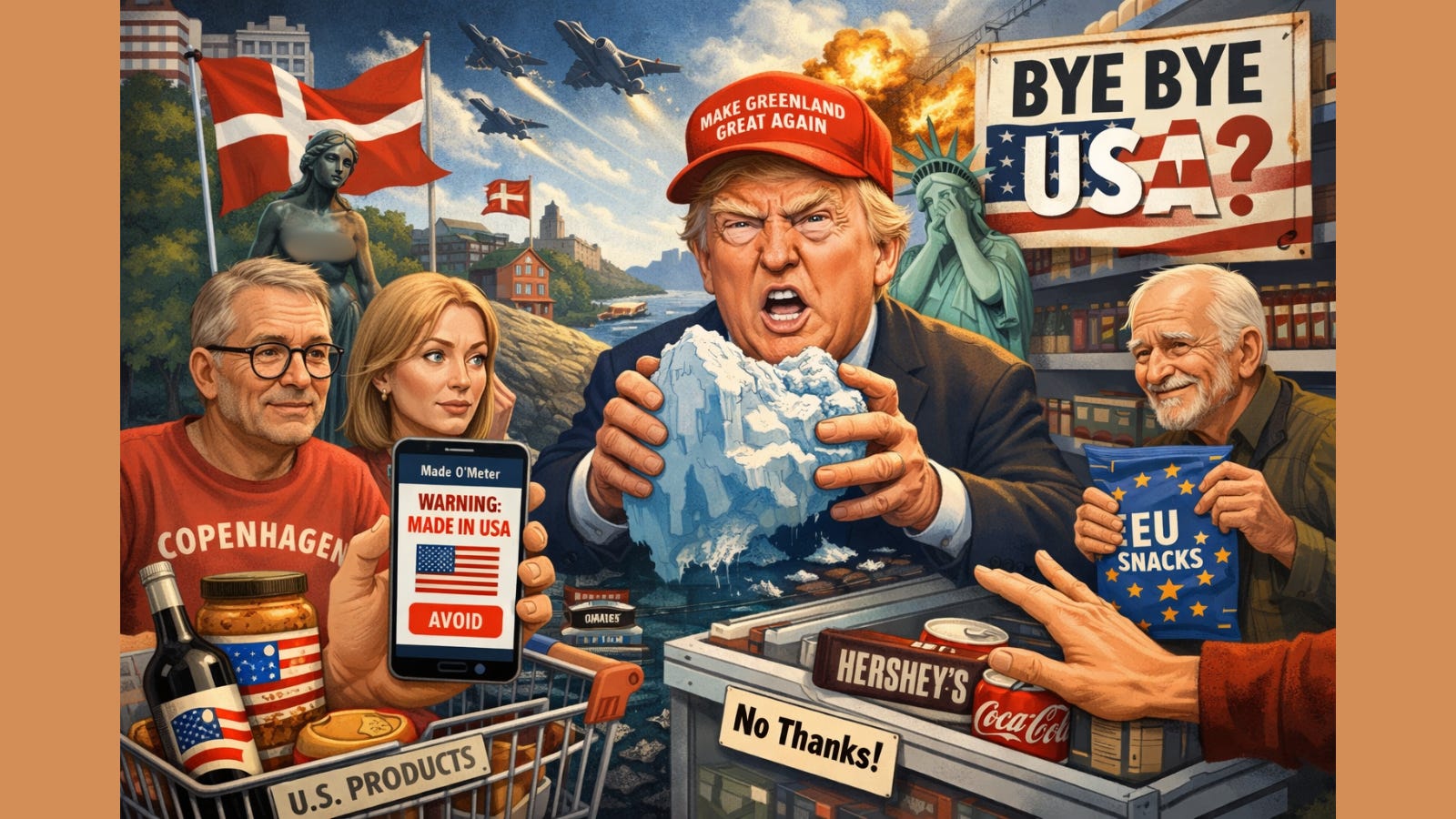
When that assumption collapses, people turn to what they can control: their purchases, their habits, their tiny daily rituals. A boycott is a consumer’s version of an embassy memo: politely furious. And yes, it might fade, boycotts often do. But the memory doesn’t. The feeling doesn’t. Countries are like people: they remember who made them feel small.
Maybe the practical impact is limited. Maybe it’s mostly nuts and candy. But the existence of these apps is a signal flare: America’s reputation has become so unstable that people are building tools to route around it. This is what “soft power” looks like when it hard-crashes. For decades, the U.S. exported not just products but a sense of partnership, imperfect, often hypocritical, but broadly legible. Now it’s exporting chaos with a logo, and Europe is responding by holding up its phone and asking: “Is this owned by the country currently threatening my friend?”
You can laugh at the apps. You can laugh at the idea of geopolitical resistance expressed through snack substitution. You can even laugh at the fact that the resistance is powered by the same American tech ecosystem it’s trying to resist, because that part is darkly hilarious. But the bigger joke is the one Trump keeps telling: that alliances are optional, trust is for suckers, and every relationship is a deal to be squeezed until it squeals. The punchline, increasingly, is that other nations are laughing too, right up until they stop picking up the phone. And then, quietly, they start scanning.
Good for the Danes. Every little effort counts. They may be starting small but hopefully it will build to something bigger. Building alliances with true allies that actually speak truthfully, follow through on treaties and look after each other. It's time everyone in Europe sees the US as it now is...a rogue nation not to be trusted or relied upon in any way.
very nicely done. I just read something more substantial: France dropping American platforms for government worker. Bag Microsoft, bag Apple, bag Google....