


Good morning! As of this writing, a Trump-backed deal to end the government shutdown is wobbling in the House. The Senate passed the package easily, and Trump supports it. In theory, this should be routine. Instead, it’s stuck because Trump no longer controls the machinery. Democrats are demanding limits on his aggressive immigration enforcement after federal agents killed two U.S. citizens in Minneapolis last month. Hardline Republicans are trying to hijack the bill to force voter ID and proof-of-citizenship requirements, smuggling Trump’s election fantasies into must-pass legislation. And with a one-seat House majority, Trump can’t compel either side to stand down. He’s pleading with Republicans not to touch the bill because reopening negotiations would expose how little leverage he actually has.
Trump’s vulnerability surfaces when his supporters bypass him for negotiations. This context matters because it reframes everything else Trump has been shouting into the void lately, especially his latest declaration that Republicans should “nationalize the voting.” It’s a tantrum dressed up as authoritarian cosplay. Trump isn’t talking about national standards or uniform rules; he’s talking about federal takeover in Democratic-run states only, the places that refuse to deliver outcomes he likes. The Constitution explicitly denies the president any such power, but the point isn’t legality; it is selectivity. He wants control where he loses, autonomy where he wins.
The contrast is almost elegant. Trump is demanding federal authority over blue states’ elections while being unable to pass a basic funding bill through his own party. He can’t govern, so he fantasizes about command. He can’t discipline Republicans, so he blames states. Strongmen do this when the floor starts wobbling under their feet: they stop arguing legitimacy and start choosing which votes are allowed to count.
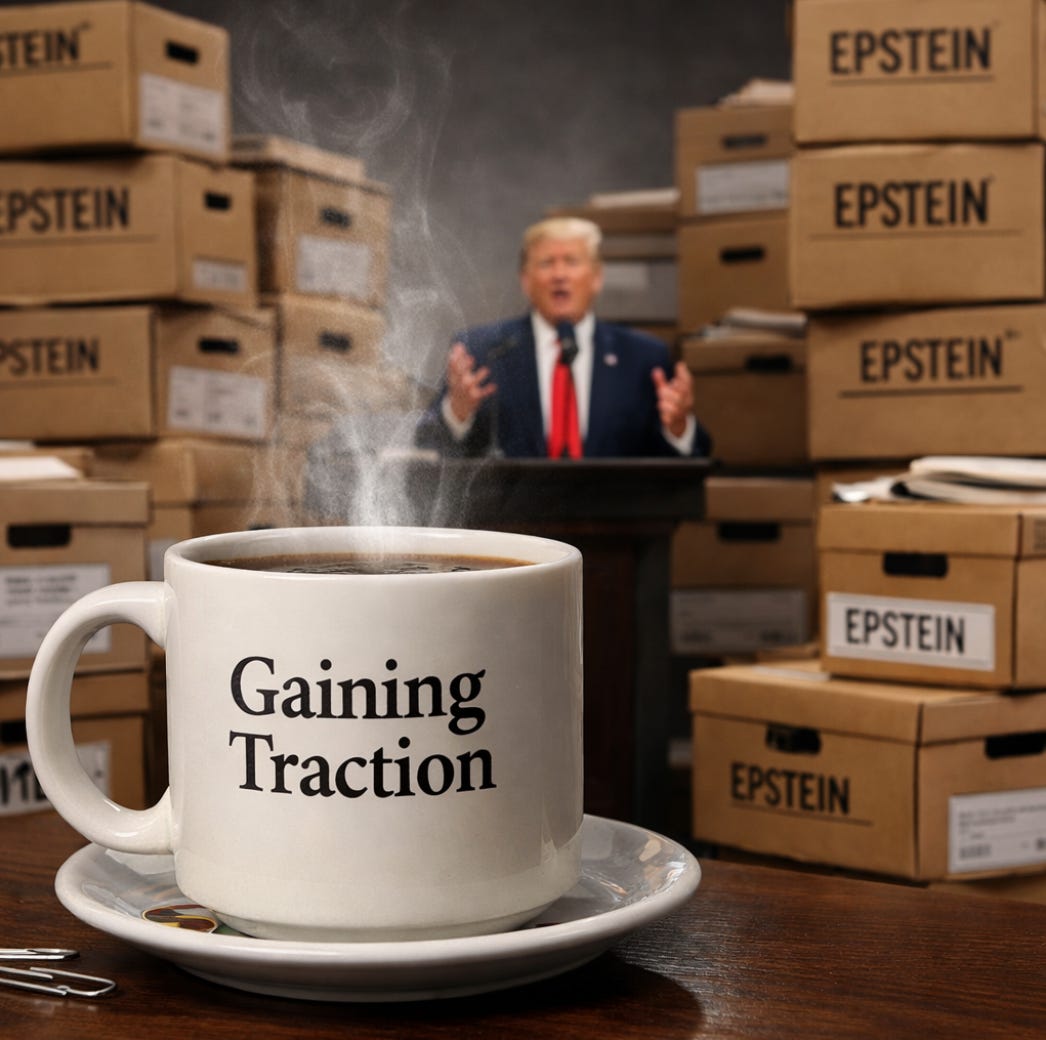
And while Trump is busy auditioning for the role of Supreme Ballot Czar, the ground beneath him keeps giving way. The Epstein files are no longer a scandal. They’re a systems failure, and Trump is in the middle of it whether he likes it or not. His name reportedly appears roughly 38,000 times across more than 5,000 documents in the partial release, with an estimated millions more records still sealed. Trump’s response has been pure whiplash: one moment claiming total vindication, the next spiraling into late-night rants and conspiracy theories. The administration’s defense strategy, such as it is, has been outsourced to Todd Blanche, Trump’s former criminal defense lawyer, now the deputy attorney general, who went on Fox News to reassure the public that “it’s not a crime to party with Jeffrey Epstein.” Which is technically true, politically grotesque, and a spectacularly bad sign that this is the best argument they’ve got.
In the DOJ’s massive Epstein data dump, Donald Trump’s face was redacted from images, while survivors’ faces were not. Former federal prosecutor Harry Litman didn’t mince words: this was either staggering incompetence or breathtaking callousness. The law required DOJ to protect victims and to explain every redaction it made. The department failed on both counts. Dozens of survivors’ full names were left unredacted, some appearing over a hundred times, along with images that re-traumatized people who were supposed to be protected. Advocates and journalists found the errors within hours, despite DOJ claiming it had spent months with thousands of lawyers reviewing the material “around the clock.” Meanwhile, Trump-linked material received noticeably more careful handling.
DOJ’s explanation amounted to a shrug and a spreadsheet: mistakes happen, only “0.002%” of the files were affected. As if trauma can be averaged away. As if the optics don’t scream exactly who this department was worried about protecting, and who it wasn’t.
All of this would be bad enough on its own. But it’s colliding with something even more corrosive: proof that Trump’s presidency is entangled with foreign money so tightly you’d need a machete to separate governance from grift.
Both the Wall Street Journal and the New York Times have now confirmed that an Emirati-backed investment firm quietly purchased 49 percent of the Trump family’s crypto company, World Liberty Financial, in a $500 million deal signed just days before Trump’s 2025 inauguration. Eric Trump personally executed the agreement. Two senior lieutenants to Sheikh Tahnoon bin Zayed, the U.A.E.’s national security adviser and one of the most powerful sovereign investors on Earth, joined the company’s board. This meant that as President Trump negotiated foreign policy and approved exports of highly sensitive AI chips to the Emirates, his family business was financially partnered with the same foreign power.
One of the most consequential international deals of the Trump presidency isn’t a rally rant or a rage-posted typo, but a quiet, high-stakes reversal of U.S. technology export policy with real geopolitical consequences. Under President Joe Biden, the United States placed strict limits on exporting advanced AI semiconductors, especially Nvidia’s high-end chips, the literal jet fuel of modern AI, to prevent them from reaching strategic rivals like China. Those controls were a central pillar of Washington’s attempt to slow Beijing’s access to cutting-edge compute power in what analysts increasingly describe as an emerging “AI Cold War.”
The Trump administration has now largely flipped that script. Answering Trump’s call to expand U.S. tech diplomacy in the Middle East, the U.S. agreed to let the United Arab Emirates import up to 500,000 advanced AI chips per year and build one of the largest AI data centers outside the United States to house them. The move was sold as a win-win: tighter ties with a regional partner, new markets for American tech firms, and a show of U.S. leadership in global AI infrastructure. What it also represented was a sharp departure from the logic that had previously governed AI export controls.
That departure, unsurprisingly, triggered alarms inside the national security apparatus, including among officials serving under Trump. The central concern: the deal could function as a convenient back door for Chinese access to U.S. technology. The flashpoint is G42, an Emirati AI firm chaired by Sheikh Tahnoon bin Zayed Al Nahyan, who also happens to be the same royal-family power broker behind a reported half-billion-dollar investment in the Trump family’s crypto venture. G42 has a documented history of close engagement with sanctioned Chinese firms, which previously raised red flags in Washington about whether sensitive U.S. technology could be indirectly exposed through those relationships. Critics argue that letting G42 anywhere near advanced U.S. chips, even with supposed safeguards and U.S. partners involved, meaningfully raises the risk of leakage, transfer, or “oops, how did Beijing get that?”
As a result, senior U.S. officials have at times slowed or partially stalled implementation of the chip exports, debating whether G42 should be cut out of direct access altogether and what additional restrictions might reduce the risk. The internal tug-of-war highlights the broader problem: trying to juggle tech diplomacy, commercial incentives, and strategic competition with China while pretending those priorities never collide. Trump allies continue to hail the deal as a geopolitical masterstroke; intelligence professionals see a security headache waiting to happen.
In other words, while the White House insists there was no explicit quid pro quo linking the UAE chip deal to the Trump family’s crypto windfall, the overlapping incentives, access points, and leverage involved have set off genuine alarm bells in U.S. national security circles. If advanced American compute hardware can be routed through a third country with deep business ties to China, critics warn, it risks hollowing out one of Washington’s most important tools for maintaining an edge in the global AI race, all while everyone involved insists this is totally fine and nothing to see here. Trump’s defenders say holding his family business to a higher ethical standard is “un-American,” which is a bold thing to say while foreign governments are literally buying into a sitting president’s company.
If this all sounds familiar, it should. Newly released Epstein files add another dark connective thread: allegations, supported by intelligence reporting and discussed openly by former MI6 Russia desk chief Christopher Steele, that Epstein’s unexplained wealth and influence may trace back decades, possibly involving Russian organized crime, Soviet-era money laundering, and kompromat operations designed to cultivate leverage over powerful figures. This is not proven in court. It is, however, consistent with what keeps emerging: Epstein wasn’t just a monster, he was a node. Money, secrecy, power, protection, over and over again.
While Trump’s defenders try to wave this off as ancient history or partisan obsession, Europe is doing something refreshing: enforcing laws. French authorities raided X’s Paris offices as part of a criminal probe into Holocaust denial content and the distribution of child sexual abuse material. Europol is involved, and Elon Musk has been summoned. No one is asking whether this is good for vibes or innovation. They’re asking whether laws were broken, and acting like the answer matters.
The contrast could not be clearer. Abroad, accountability, here at home, genuflection, which brings us back to that shutdown vote. Trump wants elections nationalized, but he can’t even nationalize his caucus. He wants absolute authority, yet he can’t move a funding bill without begging Republicans not to blow it up. His DOJ is fumbling releases, re-traumatizing victims, and making his problems worse. His foreign entanglements are now documented by multiple outlets, and his polling is underwater with nearly every demographic outside his base. Cracks are appearing not just on the left, but inside the right, among Republicans who are quietly, and sometimes loudly, deciding this is no longer worth it.
This feels like a power shift in motion, the kind that starts before anyone admits it’s happening. Not complete collapse a la Nicolae Ceaușescu, or even Silvio Berlusconi. Think friction, resistance in boring places. Procedures that stop working, allies who hesitate, and institutions that strain instead of snapping into line.
Here’s the part worth holding onto this morning: pressure is working, especially when it’s applied sideways. Trump doesn’t bend when yelled at; he weakens when Republicans have to own what he’s doing. When institutions have to explain why survivors were exposed while a president was shielded. When governing becomes harder instead of easier the longer he’s in charge.
We, the resistance, have traction, so stay focused. Keep the pressure institutional. Reward every crack, every defection, every moment where the machinery refuses to cooperate. This isn’t about waiting for one big reveal. It’s about letting the weight of all of it keep bearing down.
For the first time in a while, Trump isn’t advancing; he’s defending. That, finally, is something new. Coffee helps.
What a difficult read that was. Neither coffee nor tequila will make it better.
Thanks, Mary, for doing the work necessary to make it possible for me to stay informed.
It used to be, the office of the President of the United States was the most morally scrutinized, ethical and diplomatically sensitive office in the U.S. If you look back in history, the times that the U.S. found itself on-the-ropes as it were, you would also find Presidents like Kennedy, Roosevelt and Lincoln NOT giving in to hysteria, excuses or conspiracies but as anchors.
The term "Class", similar to the term "Goodwill" as it pertains to a business is almost impossible to define in words. But, the idea of "class" is very easy to see. Margaret Thatcher had it, so did Ronald Reagan. Vladimir Zelenski also has class (which is not always defined by family or wealth).
The office of the President has always been the pinnacle of Political achievement. But, also the best in everything the U.S. had to offer. The Emily Post of etiquette, the empathy of the sick and infirmed and the big brother of all those nations struggling to keep democracy alive.
Fast forward to today. In the light of 500 mil going from the U.A.E. to Trump's family business and advanced AI chips going to the U.A.E.; the Assistant Attorney General stated that the Trump family business need not be a role model for America.
No rules. No world order. Just greed.