


Good morning! Since it’s President’s Day, we are apparently obligated, by law, by tradition, or at least by the ghost of civics class, to pause and reflect on the presidency as an institution. Which is why it feels almost cruel to replay Kennedy’s famous line: ask not what your country can do for you… when the modern White House slogan seems to be: ask not what your country can do for you, ask how much you can wire for a photo op.
The Oval Office is no longer an office so much as a showroom. The administration that preaches austerity for everyone else has turned the presidency into a monetized access point, a kind of executive branch VIP lounge where the price of admission is measured in millions.
Reuters reports that Trump’s budget chief Russell Vought, the Project 2025 architect who helped dismantle USAID, now enjoys a permanent taxpayer-funded security detail, paid for with what remains of USAID’s operating budget. Fifteen million dollars to protect the man who set fire to the agency. It’s almost performance art: starving the world’s poorest, then billing them for your bodyguards.
Then there’s the “Freedom 250” celebration, America’s 250th anniversary, now apparently sponsored by oligarchs. Donors who give a million dollars get invitations to private receptions with Trump. Two-and-a-half million buys you a speaking role. Nothing says democracy like tiered pricing for the republic.
But the grift isn’t just domestic, the most troubling version is geopolitical. Tim O’Brien laid out one of the clearest examples: the UAE. Under Biden, exports of high-end AI chips to the Emirates were restricted out of concern they could become a transit point to China, a national security issue, not a culture-war talking point. Those chips are the backbone of advanced AI development and modern military systems.
Within weeks of Trump taking office, the ban was lifted. And just days before the inauguration, a powerful Emirati figure reportedly invested roughly half a billion dollars into Trump-linked enterprises, with nearly $187 million flowing directly into the Trump family’s coffers. That’s influence peddling so blatant you could project it onto the White House lawn.
The presidency is being treated like a vending machine: insert investment, receive policy. Insert donation, receive access. Insert stablecoin, maybe receive a pardon. It’s a government where the national interest is negotiable and the price list is off-menu but very real. The founding mythology of President’s Day was about service, sacrifice, and civic trust. The current reality is a shingle hung on the Oval Office door: Now Open for Business.
America’s closest ally just quietly signaled that the postwar order is over. Canada is preparing to redirect billions of dollars in military spending away from U.S. defense contractors and toward domestic manufacturers. Prime Minister Mark Carney is expected to unveil a new defense strategy that would shift roughly 70 percent of procurement to Canadian firms, dramatically reduce reliance on American suppliers, and grow Canada’s defense-industrial base by an estimated 240 percent over the next decade.
For decades, Canada sourced roughly 70 to 75 percent of its weapons systems from U.S. companies. NORAD remains a joint command. The two militaries are deeply intertwined. That arrangement assumed something fundamental: that the United States was a stable anchor. That assumption has cracked.
Trump’s tariffs on Canadian industries. Repeated jokes, or not jokes, about Canada becoming the “51st state.” Trade brinkmanship, sanctions unpredictability, NATO antagonism. Message received.
Carney has framed the moment in stark, almost historical terms. Speaking in Davos, he warned: “We are in the midst of a rupture, not a transition. The old order is not coming back.” And he went further, invoking Václav Havel capturing the psychological break now spreading through the alliance system itself: “The system’s power comes not from its truth, but from everyone’s willingness to perform as if it were true… It is time for companies and countries to take their signs down.”
Europe is making similar noises. Germany and France are openly talking about military autonomy. Canada is reviewing its F-35 purchase. It’s shopping for submarines from South Korea and Germany. It’s tying defense contracts to domestic industrial policy.
This is truly a tectonic shift, not with dramatic speeches, but with procurement spreadsheets.
Secretary of State Marco Rubio is in Hungary visiting Viktor Orbán, weeks before Hungarian elections in which Orbán faces a serious challenge. Trump has praised Orbán as “phenomenal.” Orbán rails against “pseudo-civil organizations” and “bought journalists” in language that sounds eerily familiar to American ears.
Canada diversifies away. Hungary leans in. That’s the split-screen.
Back home, the Justice Department would like you to stop asking about Jeffrey Epstein now. In a Saturday night letter to Congress, because nothing says transparency like a weekend document drop, DOJ declared that it has released all records required under the Epstein Files Transparency Act. Included was a list of more than 300 “politically exposed persons” mentioned in the files.
The problem? The list lumps together people with documented connections, people mentioned in passing, and cultural figures who died decades before Epstein’s crimes came to light. Janis Joplin appears. Elvis Presley appears. Marilyn Monroe appears. So do living political figures across the spectrum. It’s less a roadmap to accountability and more a celebrity census.
Even lawmakers who forced the Act forward aren’t buying it. Ro Khanna accused DOJ of “purposefully muddying the waters.” Nancy Mace says key names are still missing and privilege claims won’t hold up in court. The administration ran on “release the files.” What we got was a list and a shrug.
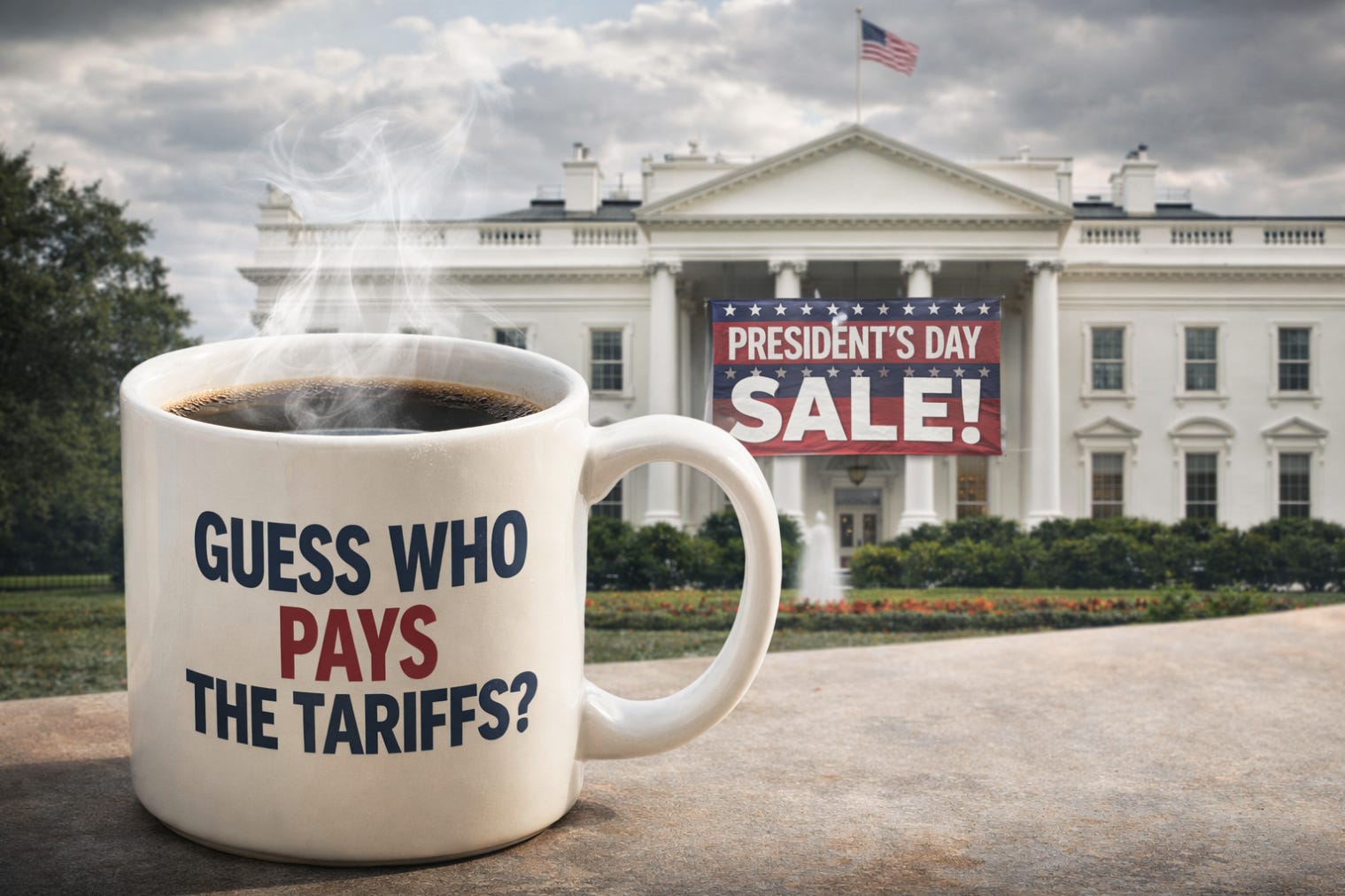
The Wall Street Journal Reports the price breaks are over. After holding off during the holidays, companies are raising prices again. Levi’s added $5 to $10 to staple jeans. Columbia Sportswear is rolling out high-single-digit increases. McCormick says tariffs will add another $70 million in gross costs this year. Small construction firms are pushing through 10 to 15 percent hikes because steel, wages, and health insurance all jumped at once.
Harvard data shows imported goods ticking back up since late November. Adobe reports the largest monthly online price increase in over a decade.
Tariffs, it turns out, are not paid by “other countries.” They are paid by you.
While companies quietly reset price tags, administration officials keep pointing to the stock market like it’s a cure for inflation. The Dow above 50,000. The S&P smashing records. Look at the charts, they say, but you cannot sauté the Dow.
The January jobs report looked solid on the surface, 130,000 jobs added, unemployment at 4.3 percent, until benchmark revisions quietly erased nearly 900,000 previously reported jobs from 2025.
Job growth is narrow. Health care and social assistance dominate. Construction gains appear tied to data centers, highly specialized, temporary builds that do not translate into broad wage growth. The engine hums, but it’s not moving the middle class.
Housing affordability? Home builders in South Texas are warning that aggressive immigration raids at construction sites are scaring off workers and driving up costs. One builder who voted for Trump put it bluntly: “South Texas will never be red again.” Turns out you cannot deport your way to cheaper homes.
If you’re in the mood for a little economic karma, Tesla just posted its first-ever annual revenue decline. Revenue fell year-over-year. Fourth-quarter profits collapsed 61 percent. Deliveries dropped again in a global EV market that continues to grow.
Europe is brutal: Tesla sales fell 28 percent across a continent where EV demand rose 27 percent. Germany down nearly half. Sweden down two-thirds. China’s BYD overtook Tesla globally.
The Cybertruck is underperforming, and the promised $25,000 Tesla never materialized. Now the grand plan is to spend $20 billion chasing robo-taxis and humanoid robots that remain perpetually two years away.
When you turn your car company into a culture-war megaphone, people notice. Turns out meme governance does not refresh product lines. Nonetheless, the stock remains priced as if the robots will save us all.
Before we end on spreadsheets and subpoenas, a reminder that the world still produces small, defiant moments of light.
Ukrainian freestyle skier Kateryna Kotsar qualified for the Olympic big air medal round by finishing 11th, just clearing the cutoff, after a hard crash sent her skis flying. Minutes later, on the slope, her boyfriend dropped to one knee and proposed. She said yes.
On her glove: “Freedom of memory,” a quiet act of solidarity with fallen Ukrainian defenders and athletes. The brave find happiness.
It’s raining hard on the Southern Oregon Coast but Marz is insisting on a romp anyway, at least until he realizes, you know, that it is really raining.
My little north coast town is getting wet, too. But we have a peaceful protest rally planned for this day precisely because of it being President's Day and the position is not held by a president, but a sickly, demented, greedy, insatiable dictator who is seeking to destroy everything that is good. So, the message is onward to victory and an America for all the people!!
Two comments: Proximity matters. When Canada is talking about a rupture, risking retaliation from the babe-in-office, and shifting its defence spending away from the US, it's not a frivolous policy position. We've been very slow - this should have started in 2017 - but we now have a PM who is less interested in smug pronouncements and more interested in accomplishments. In the same vein, when the Baltic states are telling us what the Soviet Un oops I mean Russia is doing/planning, we should all listen closely.
The second point is the Dow being up to 50,000 should be taken in context. If the Dow hits that milestone but all other indices and economies are hitting much better milestones, the Dow at 50k starts looking like an admission of poor performance. Sidenote: The Dow is an index of a few companies, it's not the economy. Here's an excellent explainer from Justin Wolfers, if you have ten minutes:
https://www.youtube.com/watch?v=QYL5DslMZEE