


Nine people connected to a Fourth of July protest in Texas were just sentenced to a combined 450 years in prison. The sentences are the story, but not for the reason the government wants you to think.
In September 2025, the president signed an executive order purporting to designate “antifa” a domestic terrorist organization, the first such designation of a domestic movement in American history. Its language is candid about its reach. It directs every agency to “investigate, disrupt, and dismantle” the operations of antifa “or any person claiming to act on behalf of antifa.” Investigate, disrupt, dismantle, a mandate against a category, not a list of offenses.
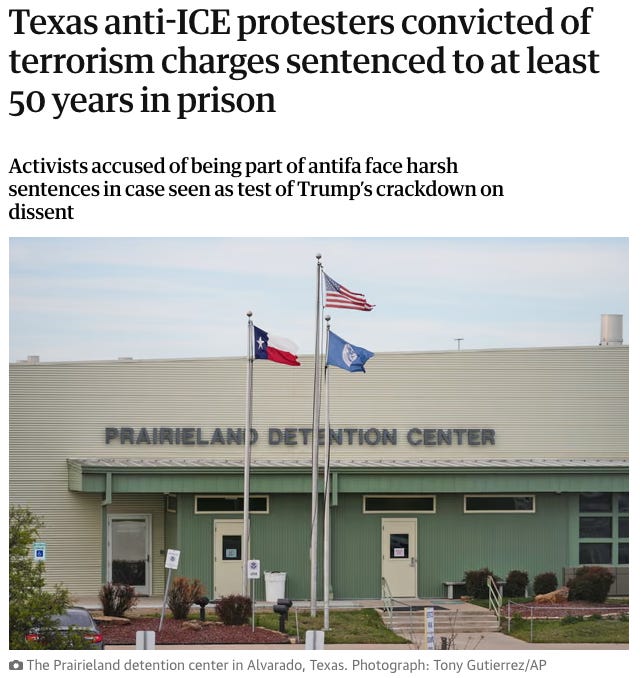
A group of protesters connected to a Fourth of July demonstration outside the Prairieland Detention Center in Alvarado, Texas, have now received sentences ranging from decades in prison to a century behind bars. Benjamin Song, who was convicted of firing the shot that wounded a police officer, was sentenced to 100 years. Others who fired no shot received sentences of 50 and 70 years. One defendant, who was not at the protest at all, received 30 years for moving his wife’s political zines after she was arrested.
There was real violence that night. A police officer was shot, and property was vandalized. Fireworks were brought to a protest outside an immigration detention facility. None of that should be minimized, and none of it needs to be minimized to see the larger danger.
The danger is the leap. The government did not simply prosecute a shooting, it constructed a political category. It took a protest that turned violent, defined the defendants as part of an “antifa cell,” and then used terrorism-adjacent language and charges to transform a criminal case into a demonstration of state power. That transformation is the story.
If one person shoots a police officer, prosecute the shooter. If people vandalize property, prosecute the vandalism. If people conspire to commit violence, prove the conspiracy. The criminal law already has tools for all of that.
But this case is about something more ambitious. It is about the state’s effort to turn dissent into affiliation, affiliation into conspiracy, and conspiracy into terrorism. It is the machinery.
“Antifa,” as used by the right, has always functioned as a political incantation. It is invoked as if it names a formal organization with founders, membership rolls, bank accounts, headquarters, officers, dues, and a chain of command. But anti-fascism is not one thing. It is a political tendency, a moral position, a protest tradition, a set of tactics, a subculture, a label, and sometimes a self-description. It is not a centralized organization in the way officials pretend it is when they need a domestic enemy.
That fiction is useful. If “antifa” can be treated as an organization, then anyone accused of sympathy with anti-fascist politics can be treated as adjacent to a network. If they are adjacent to a network, then their speech, reading material, clothing, encrypted messages, friendships, and protest attendance can all be arranged into a narrative of conspiracy. If that conspiracy is then linked to violence committed by one person, the entire category becomes available for extraordinary punishment.
This is how enemy manufacture works.
The state does not need to ban dissent outright. It can do something more durable and more deniable. It can designate a political identity as suspicious, associate that identity with violence, and then claim that it is not punishing belief at all. It is only punishing “terrorism.” It is only punishing “extremism.” It is only punishing “criminal networks.”
But the network is the thing being manufactured.
That is why the phrase “anti-antifa” is insufficient on its own. It sounds like a culture-war posture, another round of performative outrage, another costume in the endless theater of American grievance.
“Anti-antifa” is kayfabe.
Anti-anti-fascism is the politics.
Enemy manufacture is the machinery.
The double negative matters. To organize politics around being “anti-antifa” is to organize against opposition to fascism. Intent is beside the point; the phrase performs its function regardless of who speaks it. And the function is specific: it makes anti-fascism itself the suspect category. It turns opposition to authoritarianism into the object of state suspicion.
Most people do not need to be arrested for a message to be understood. Most people do not need to be sentenced to decades in prison to change their behavior. A few spectacular cases can do the work of thousands of threats. They teach people which protests are dangerous to attend, which chats are dangerous to join, which books are dangerous to read, which causes are dangerous to support, which words are dangerous to say.
The formal right to dissent remains on paper. The practical cost of dissent rises.
That is how democracies degrade.
The most effective repression often does not announce itself as repression. It announces itself as public safety. It announces itself as law and order. It announces itself as concern for officers, concern for property, concern for national security, concern for “terrorism.” It takes a real act of violence and uses it to discipline a much larger field of political activity.
That is why it is important to be precise here. The issue is not whether violence should be prosecuted. Of course it should. The issue is whether the government can use one person’s violence to build a dragnet around a political identity.
The issue is whether being anti-ICE, anti-fascist, pro-immigrant, abolitionist, left-wing, or simply present in the wrong circle can be converted into evidence of terrorism.
The issue is whether the state can pretend a loose political tendency is a formal organization whenever doing so makes repression easier.
The issue is whether dissent can be punished not by criminalizing the opinion directly, but by surrounding the opinion with a theory of affiliation.
This is the old logic of guilt by association dressed in contemporary counterterrorism language.
And it is especially dangerous because it speaks in the vocabulary of neutrality. It does not say, “We are punishing people for opposing ICE.” It says, “We are prosecuting an antifa cell.” It does not say, “We are making an example of left-wing protesters.” It says, “We are dismantling a terrorist network.” It does not say, “We are criminalizing anti-fascist politics.” It says, “We are protecting democracy.”
But a democracy that treats anti-fascism as terrorism is not protecting itself. It is confessing something about itself.
There is a reason authoritarian movements need internal enemies. They require a permanent threat to justify permanent escalation. The threat does not have to be coherent. In fact, it is often more useful when it is not. A vague enemy can be expanded. A vague enemy can absorb contradictions. A vague enemy can be anyone the state needs it to be.
That is the utility of “antifa” in the current political imagination. It can mean a person who commits violence. It can mean a person who attends a protest. It can mean a person who dresses in black. It can mean a person who uses Signal. It can mean a person who reads left-wing literature. It can mean a person who opposes ICE. It can mean a person who believes fascism should be opposed.
The category stretches because stretching is its purpose.
And once the category has stretched far enough, the punishment no longer appears to be about what a specific person did. It becomes about what the state says they represent.
That is why these sentences should alarm anyone who cares about civil liberties, regardless of their view of the defendants, their politics, or the protest itself. A 100-year sentence for the person convicted of shooting an officer is severe but comprehensible within the logic of the criminal system. But 50 and 70 years for non-shooters raises a different question: what exactly is being punished?
The act?
The association?
The ideology?
The example?
The sentences answer the question by their own arithmetic. Enrique Tarrio, who led the Proud Boys and was convicted of seditious conspiracy for his role in the attack on the Capitol, was sentenced to 22 years. Stewart Rhodes, who founded the Oath Keepers and was convicted of the same offense, received 18. These were the leaders of organized groups — real groups, with names, rosters, and chains of command — convicted of conspiring to stop the peaceful transfer of presidential power.
In Texas, defendants who fired no shot received 50 years. One received 70. The man who was not present at all received 30. The protester convicted of the shooting received a century.
So the comparison is not exact in legal terms, but it is damning in democratic ones: in this prosecution, participation in an anti-ICE protest that the government framed as an antifa conspiracy produced penalties that dwarf what the Capitol’s convicted seditionists received. Whatever is being punished in Texas is not being measured only by proximity to violence. A non-shooter outside an ICE facility was sentenced to more than twice what the leader of the January 6 conspiracy received. The math does not look like a justice system weighing conduct alone. It looks like one weighing identity, association, and example-making.
Return to those verbs: investigate, disrupt, dismantle. Not a list of offenses, but a mandate against a category. We have heard them before.
In 1956, the FBI launched COINTELPRO with a stated objective to “expose, disrupt, misdirect, and discredit” the groups it had decided were threats: the targets included Black freedom organizations, antiwar groups, socialist organizations, and civil-rights leaders, including Martin Luther King Jr. The targets were chosen first; the justification followed. The vocabulary has barely changed because the function has not changed. A government that sets out to “disrupt and dismantle” a political tendency, rather than to prosecute proven crimes, has already told you what it is doing. It is not policing conduct. It is policing a category, and the category is the point.
That is the question at the center of this case: whether the state is punishing conduct, or using conduct as a gateway to punish identity.
A free society punishes conduct. An authoritarian one punishes identity through the language of conduct. It claims to see not people, not individual actions, not degrees of responsibility, but enemies.
Once the enemy has been manufactured, proportionality becomes weakness. Mercy becomes betrayal. Dissent becomes threat. Politics becomes conspiracy.
The Texas case matters beyond Texas, because it is a template.
Define the enemy. Inflate the enemy. Attribute coherence to the enemy. Tie the enemy to violence. Use the violence to justify extraordinary punishment. Then point to the punishment as proof that the enemy was real all along.
That is the self-supplying architecture. The designation produces the threat; the threat justifies the designation in a self-feeding cycle.
Once that machine is built, it will not stop with the people nobody wants to defend. It never does. It moves outward from the unsympathetic defendant to the inconvenient activist, from the activist to the organizer, from the organizer to the donor, from the donor to the writer, from the writer to the reader, from the reader to the person who simply refuses to pretend not to see what is happening.
This is why the language matters.
Being anti-fascist is not terrorism.
Being pro-democracy is not terrorism.
Opposing abusive immigration enforcement is not terrorism.
Believing that the state should not disappear people into detention centers is not terrorism.
The government may prosecute violence. It may prosecute vandalism. It may prosecute conspiracies it can actually prove. But it must not be allowed to manufacture a domestic enemy out of dissent and then use that enemy to normalize extraordinary punishment.
“Anti-antifa” is kayfabe. Anti-anti-fascism is the politics. Enemy manufacture is the machinery, and the machinery is now operating in plain sight.
Really chilling. I never thought this “antifa” idiocy would actually gain traction because it is so patently ridiculous. I mean, what’s that slogan? “If you’re not anti-fascism, then what are you?” I credit Fox News with cementing and fomenting the “antifa” fallacy, but now the Trump administration has codified the label and conflated it as terrorism, which as you do deftly describe is designed to chill dissent and punish anyone even vaguely associated with political opposition. I can’t believe it has come to this. Where are all those 2nd amendment zealots who are so terrified of a tyrannical government?
Many of us wonder how deep the hatred or the actions will go before midterms, impeachment,the Blue Wave can happen.
This article is pure affidavit of the continued obsession of what Trump,his lackies -the loyalists, and those of his dwindling base intend…and that is for an authoritarian government to rule,fool, and tool the law for self grandizement, continue vindictive policy ,while living posh and untouchable ON YOUR DIME…shall I repeat the ‘10 per sense’s-worth’?
A lot of money ,specifically yours and mine , is being covertly pocketed while the grifters and geesers play the Project 2025 Fiasco, planned and implemented even while perfecting their mistakes -since 1980.
It has damaged America’s standing. It has imprisoned innocent people. It has plainly committed murder, bodaciously blaming others.
It has undone working and effective law, protections purposely planting confusion , chaos, and conceit.
And it divided us with propaganda, and openly snuggled with the practiced despots.
The loopholes are raw enough , hopefully -with money the greedy catalyst.
The plan to wear the waking public down is palpable. That is so successfully corrupt, it’s said “unprecedented “-even as ‘shadows’ of society at the top scotus…are either bought or threatened
…well worn techniques of terrorists.
Thank you Mary for succinct posts naming this throughout its circus of ruin with nail on the head accuracy…
So sad our laws couldn’t
We Can Change That…
VOTE 💙
Stop the Coup
..then hold the politicians feet to the fire…so it never again happens