


Good morning! There’s a particular sadness in loving your country, its institutions and its place in the world, while being unable to admire the person who represents it.
I felt it sharply this week watching Richard Engel’s long interview with Volodymyr Zelenskyy in Kyiv. Zelenskyy answered in English rather than his more familiar Ukrainian or Russian. He occasionally searched for words, but seldom for answers. What emerged was a man thinking carefully and speaking precisely, in a language not quite his own, about a war his country never asked for and cannot escape.
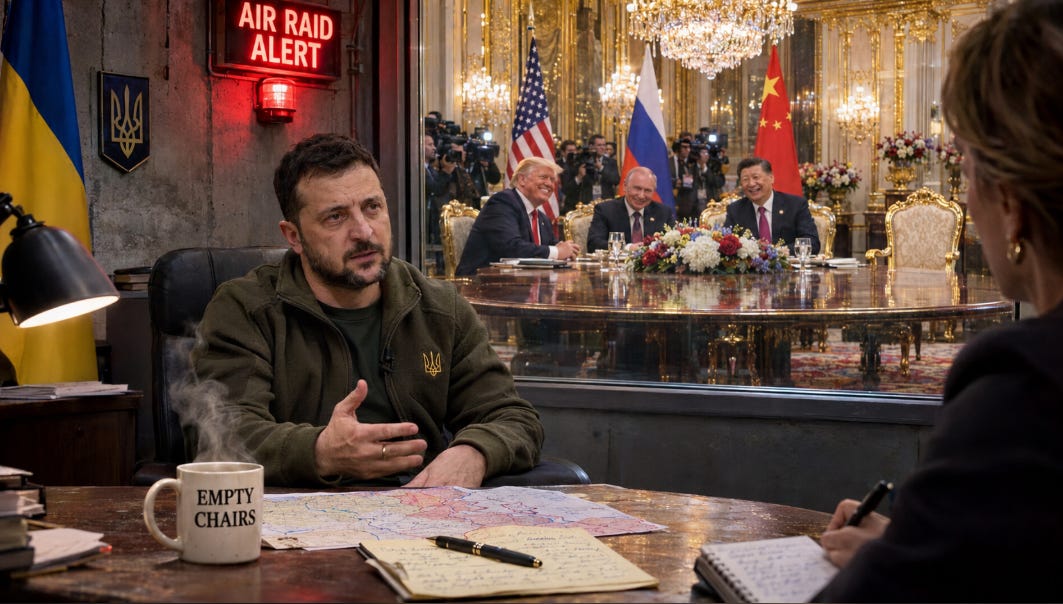
Partway through, an air-raid siren went off. Zelenskyy barely broke stride. He glanced at the alert, identified the threat as drones, and folded the interruption into his explanation of Ukraine’s defenses against Russia’s increasingly sophisticated aerial attacks.
What I felt watching that was something uncomfortably close to envy.
Zelenskyy’s answers stood out less for eloquence than for command of detail. Roughly 65 to 70 percent of the Russian jet-powered drones Ukraine manages to shoot down, he said, are now intercepted by F-16s. Ukraine has the capacity to destroy a thousand aerial targets a day. What it cannot reliably stop is ballistic missiles without American and European interceptors, and he said U.S. Patriot deliveries this year have fallen to a third or a quarter of their former pace.
On sovereignty, he drew a hard line. Ukraine accepted an unconditional ceasefire, he reminded Engel, when Trump’s team proposed one in Saudi Arabia in 2025. But accepting a ceasefire is not the same as recognizing occupied land as Russian. “I didn’t do it the first day of the war,” he said, “and I will never do it” while he is president.
He also offered the sharpest diagnosis of this war I’ve heard in months. People who start wars, he said, are “weak people in a strong position.” Ukrainians, by contrast, are strong people in a weaker one.
Some of his numbers, including his estimate that 54,000 Russian soldiers were killed or severely wounded in October alone, are Ukraine’s own and cannot be independently verified. He is a wartime leader making a case. The case was coherent, consistent and anchored in specifics.
Asked about the gathering in Shenzhen, he insisted that powerful countries cannot decide the future of smaller ones without their consent. He went on to identify exactly where he believed the leverage lay. The United States and China together, he said, have enough economic power to stop Putin “during one meeting,” simply by threatening to cut off trade.
Whether economic pressure could end the war so quickly is another question. Zelenskyy’s point was about the willingness to use that leverage. “If you can’t stop Putin, you are not interested.”
At that very moment, the three leaders were gathering in Shenzhen.
On Thursday, at a villa in Shenzhen, Donald Trump walked into a meeting room, spotted Vladimir Putin, pointed and asked, “Who is he?” Then came the punchline: “He’s my friend.” Putin laughed. Even before the meeting, Trump’s political operation had shared RT footage of the leaders together, captioned “Trump 🤝 Putin 🤝 Xi.” It took Laura Loomer, of all people, to ask why an American presidential account was promoting video from Russian state television.
The two men spent about forty minutes together before joining Xi Jinping for the first-ever summit of the three. Afterward, the Kremlin said Putin had left his session with Trump in an “excellent mood.”
What did the three produce? A four-point “Declaration toward Peace” covering UN reform, refined petroleum supplies, the immunity of state officials and limits on the International Criminal Court, and reducing nuclear risks. Fuel supplies and official immunity made the cut.
That ICC language deserves a moment. The court has had an arrest warrant out for Putin since March 2023, over the deportation of Ukrainian children. The American president has now signed a declaration emphasizing official immunity and warning against abuses of jurisdiction by the very court that issued a warrant for his friend.
Ukraine and Iran weren’t mentioned at all, let alone addressed through binding commitments. Nothing in the text obliged China to pressure Moscow or Tehran. Trump called it “a Great and Highly Consequential Trip,” then boarded Air Force One without a word to reporters.
Ukraine was not in the room. Kyiv had signaled that it wanted a seat at any talks touching its future, but three men discussed that future without the country whose territory and people were at stake. “You can’t decide about some country, even a small country, without this country,” Zelenskyy told Engel.
Certain big countries keep trying.
Overnight into Friday, Russia launched one of its heaviest barrages of the war, striking Kyiv and Lviv, the western Ukrainian city not far from Poland. This time Russian weapons also landed inside Poland. Polish officials reported three objects in the southeast: two apparent missiles, one of them a Kh-101 cruise missile, and a jet-powered drone.
Where they landed matters. European troops from 11 countries were drilling in Poland for a possible postwar mission in Ukraine, rehearsing the deployment of a reassurance force intended to help secure any ceasefire. Defense ministers from France, Britain and the Baltic states were there to observe. One Russian missile came down roughly 35 kilometers from the exercise, a few minutes’ flight away.
When a Russian missile fell in a Polish field in July, Prime Minister Donald Tusk chose his words carefully: there was no reason, he said, to believe Poland had been the target. This time his assessment was considerably more pointed. “It seems that we are dealing with an intentional provocation,” he said.
Russia makes its own targeting decisions and I’m not suggesting that the Shenzhen handshake caused the missiles. The sequence, however, is worth sitting with. On Thursday, the American president greeted Putin as his friend. By Friday, Russian missiles were landing near a European rehearsal for Ukraine’s postwar security.
Whatever put Putin in such excellent spirits, it wasn’t followed by restraint.
The Economist this week published an anatomy of the Geran-4, the jet-powered drone that has been battering Ukraine since spring and the kind of weapon Zelenskyy was describing as the air-raid siren sounded. According to Ukrainian intelligence cited by the magazine, it descends from an Iranian design. Its jet engine is made in Russia to a Chinese design. Its cameras, modems and anti-jamming antennas come from China, and its Western chips arrive through intermediaries in China and Hong Kong. Assembly happens at Russia’s Alabuga plant in Tatarstan, where as many as 25,000 North Koreans are thought to work.
The Economist calls this an “axis of malice,” an unmistakable echo of George W. Bush’s “axis of evil.” Two of Bush’s three original members, Iran and North Korea, are still on the roster. Iraq has dropped out; Russia and China have joined. The membership has expanded along with the armory.
It is a network, not a formal alliance. Its members spy on one another, hoard their best technology and chase conflicting goals; China wants the Strait of Hormuz open, while Russia benefits from instability and higher oil prices. Still, the cooperation is real and deepening. By the Economist’s reporting, China supplies as much as 90 percent of Russia’s imported dual-use goods and buys about 90 percent of Iran’s oil exports.
The United States is not part of that network. Our president has simply made a habit of cultivating personal friendships with two of its anchors while their governments exchange military technology, equipment and expertise with the other two. Trump says he and Xi agreed in Shenzhen that Iran cannot have a nuclear weapon. He came home with no public commitment from Beijing or Moscow to stop helping Tehran acquire the means to wage war.
To understand how power actually works in this war, look at what happened to Ukraine’s satellite communications this fall.
Some of Ukraine’s interceptor drones rely on Starshield, the military version of Elon Musk’s Starlink network. They depend on that connection to chase down Russia’s faster jet-powered Shaheds. In the interview, Zelenskyy mentioned almost in passing that Ukraine used more interceptors “when we didn’t have any questions with Starlinks.”
The questions began in October. On October 9, Trump announced a deal with Putin to supply Russian diesel to world markets, temporarily easing U.S. sanctions. On October 10, irritated that Ukraine kept striking Russian refineries, he said, “I suggest they get a new leader who can make a deal.” Overnight on October 13–14, Ukrainian Starshield terminals began losing their connection when traveling faster than about 100 miles per hour, below the speeds some interceptors needed to catch the Russian drones.
Timing is not proof, but what we do know is how the explanations unfolded. Musk said Starshield was controlled by the U.S. government. Defense Secretary Pete Hegseth insisted, “We haven’t pulled anything back,” and pointed to Starlink’s terms of service. Trump said the U.S. hadn’t restricted anything. Reuters, citing two U.S. officials and a Western official, traced the order to the White House; The Wall Street Journal later reported that Musk himself ordered the reduction.
Ukraine reported service restored on October 24. Then on November 12, Zelenskyy reported fresh restrictions. SpaceX first replied, “That is false. No changes have occurred,” then attributed the problem to a “technical issue” without further explanation. Zelenskyy had already answered that theory in October: “It was not a technical problem; it was the will.” “Seven days without answers is seven days too many,” Ukraine’s senior diplomat in Washington said on November 16.
So there is a way to cripple part of an ally’s air defenses by changing the conditions under which its communications work. The capability clearly exists. Who authorized the restrictions remains disputed.
Simon Marks recently wondered whether Xi, Putin and Trump might settle into a standing G3. I suspect the real format would be G3+2, with a couple of tech titans along for the ride. The difference is who answers to whom. Beijing has demonstrated its willingness to discipline billionaires such as Jack Ma, who retreated from public view after criticizing regulators. In Moscow, Mikhail Khodorkovsky spent a decade in prison. Here, a billionaire’s company operates infrastructure an ally’s military depends on, and we still don’t have a clear public account of whether the government directed the restrictions or the company imposed them.
Who needs a chair at the table when you own the Wi-Fi?
Congress, at least, wants to know. Senators Jeanne Shaheen and Chris Coons have asked SpaceX to preserve records dating back to September 1, including communications among Musk, his executives, the White House and the Pentagon, and to provide answers by November 30. Four Republican senators have also joined Democrats in pressing the Pentagon for answers on whether its officials ordered the restrictions.
Accountability doesn’t need a chair either. Sometimes it starts with a letter demanding the receipts.
There was another empty chair this week, in Antalya, Turkey, where the COP31 climate talks fell apart. Close to 200 countries spent two weeks, and then some, negotiating an agreement on the climate crisis. The final proposed text failed even to mention fossil fuels, its principal cause. The EU, the UK, small island states and some of the world’s poorest countries refused to endorse it. “It fails to meet the moment,” said Ireland’s environment minister, speaking for the EU. A few narrower decisions survived; the centerpiece did not.
The official American seat sat empty for the second year running. The White House explained that it was “focused on common sense, not climate nonsense.” Refined petroleum supplies, you’ll recall, did make the Shenzhen peace declaration.
Americans showed up anyway. More than 120 governors, mayors, members of Congress, business leaders and other representatives came through the America Is All In coalition. They had no authority to negotiate on behalf of the federal government. They came to tell the world that the United States is more than its current administration.
Near the end of the interview, Engel asked whether the midterm results had changed how Zelenskyy saw the United States. He didn’t celebrate or flatter. It would depend, he said, on the reaction of Congress: whether lawmakers actually step up, or whether it was all election-season talk.
That’s a standard that applies to us as much as to him. A president can embarrass a country. He can call a dictator his friend, wave off a climate summit as nonsense, and leave an ally wondering who restricted its defenses while his officials point fingers at a contractor. What he cannot do is become the whole country. There are senators demanding records, governors flying to Antalya, a Congress just reshaped by voters, and millions of Americans who still believe our word to an ally should mean something.
Loving your country has never meant defending everything done in its name; sometimes it means the opposite.
Yes, I envy Ukrainians their rational, articulate and thoughtful president. I don’t envy them their war. I’m also not ready to give up on a country that still has the institutions to hold its leaders to account.
Provided we insist that they do.
On a more personal front, tomorrow I meet with my orthopedic surgeon about my knee. The cortisone shot hasn’t done much to improve my mobility, so I’m hoping we’ll come up with some palatable options. Aging, it seems, involves an ever-increasing demand for lubrication and replacement parts. Having already acquired two replacement hips, I’d appreciate it if the rest of the original equipment would hold up a little longer.
Marz, meanwhile, remains completely unrepentant about choosing a squirrel over my knee. Since our outings have been necessarily curtailed, I’ve put him on a reduced-calorie diet. He is not amused. Accountability is something that should apply to world leaders but not to him.
Thank you, as always, for spending part of your morning with me.
It’s reassuring to catch glimpses of what genuine leadership looks like. You can see it in Canada and in Ukraine … strong, smart and thoughtful. It gives me hope for our post-Trump future; can’t wait!
America’s adversaries are building a strategic partnership while our so-called president mistakes personal relationships for diplomacy.
Putin and Xi got the photo op. Trump got played.