


Good morning! At 4 P.M. today, by his own announcement, the water will start flowing. The President wants you to know this. He took to Truth Social to report, with the precise civic tenderness of a man dedicating a cathedral, that “the final coat of protection will be completed on the Reflecting Pool that sits between The Washington Monument and The Lincoln Memorial, at 4 P.M., today.” The walking paths will be “cleaned, sandblasted, and finished soon.” And then the line that earns its place in the permanent record: “This will be the first time since the day it was built, 1922, that it has worked, and worked wonderfully, indeed!”
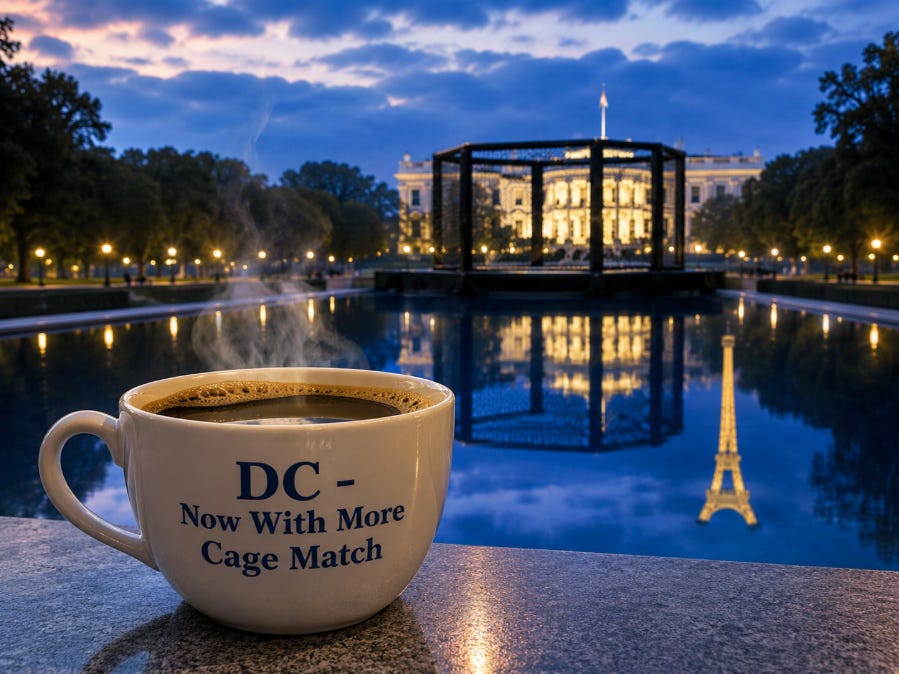
Set aside, for a moment, that the Lincoln Memorial Reflecting Pool has been working since the day it was built. Marian Anderson sang beside it on Easter Sunday in 1939, after the Daughters of the American Revolution decided Constitution Hall was too good for her voice. Martin Luther King looked out over it in 1963 and told the country about a dream. It reflected the sky through every defining moment the National Mall ever staged. The one time it genuinely stopped working, sunk a foot into the Potomac marsh it was built on, hemorrhaging half a million gallons a week through the cracks, it was rebuilt from the pilings up between 2010 and 2012, with thirty-four million dollars of Obama stimulus money, new circulation, ozone filtration, the works. So the “first time since 1922 that it has worked” was, in the most literal accounting, a project completed under the last Democratic president but one.
What is actually being completed today is a paint job. Thirteen million dollars, funded in part by the fees tourists pay to visit eighty national park sites, to coat the pool in what the President calls “American flag blue.” It is contested even as decoration: the Cultural Landscape Foundation has sued, its founder arguing that the blue coating alters the monument’s historic character without anyone’s authority to do so. This is the artifact to hold in your mind as the day unfolds. A man repainting a working monument a color it was never meant to be, getting sued for defacing it, and announcing the result as the first time in a century the thing has ever functioned.
It is a small lie, told with enormous specificity. And specificity, this morning, is the tell.
The pool gets a deadline. The war does not. We are in the fourth month of the conflict with Iran, and the President’s posts about it run to grievance and vapor “final negotiations,” “not a big thing” while the pool gets resurfacing schedules accurate to the hour. This is the toll-booth presidency in its native habitat: lavish, granular attention to the trivial thing it controls, and a fog machine wheeled out over the costly thing it set in motion.
The cost is not abstract. American oil inventories have fallen to their lowest level in two decades, the Financial Times reports off federal data, the entire buffer the shale boom built, drained away to paper over a war of choice. Gasoline is up roughly fifty percent since the fighting began. The Strait of Hormuz, through which a fifth of the world’s oil moved before the war, sits very nearly shut. The administration is bleeding the Strategic Petroleum Reserve to keep prices from telling the truth at the pump. The Treasury Secretary calls the resulting inflation “a short-term blip,” which is the sort of thing one says about a thing one is hoping nobody times to the minute.
We will treat the economics at their proper length elsewhere; the self-inflicted wound deserves its own table. For today it is enough to set the two announcements side by side. Seven minutes, by one outlet’s count, on the resurfacing of a reflecting pool. “Not a big thing” for a war that has drained the nation’s oil reserves to their lowest ebb since 2004. The President is not failing to communicate. He is communicating exactly what he wants seen, and routing the rest into the blue paint.
If the pool were a one-off, it would be a curiosity. It is not. It is the morning’s governing logic, and the rest of the feed is the corroboration. He is going to the G7 in France, he announced “immediately following” what he promises will be “one of the Most Entertaining Nights in American History,” the UFC World Championship fights on the South Lawn of the White House. Read the sequence again. The cage match leads; the gathering of the world’s democracies is the thing he gets to afterward, the chaser. He assures us that while lesser fights were staged at the People’s House across its “long and storied History,” nothing close to this, “the Greatest Fighters in the World, CHAMPIONS ALL” was ever even contemplated for the lawn. In this we can believe him.
He paused, between the octagon and the summit, to ask the philosophical question of the age: “Has anyone ever seen a Happy Communist?” He then answered himself at length, explaining that Communists do well with the voters in “the Early Years” before the country “GOES TO HELL” amid “Great Violence” and “guaranteed DEATH AND DESTRUCTION.” It is unclear which communists he had in mind, or whether the question was rhetorical, or whether anyone has been Happy on the South Lawn in some time.
He congratulated Steve Hilton on “coming in first” in the California governor’s race, a race that has not been called, in which ballots are still being counted, and in which the top-two primary may not resolve for weeks. No matter. Hilton is “a hard driving WINNER,” and the part to underline, “the Federal Government will be there, with him, to help.” A premature victory lap is ordinary Trump. A promise of federal partisan muscle for a candidate in an uncalled state election is the same instinct as the pool: announce the outcome you want, in loving detail, as though saying it finishes it.
Yesterday, the throughline made text: Vice President Vance and the Republicans, he wrote, are “doing a great job hunting down Fraud in the various States,” where “Billions of Dollars is being found,” enough that “we would literally be able to balance the Budget” if only the “Dumocrats” weren’t “in on the act.” He filed this discovery, without apparent irony, in the same sentence as “Men playing in Women’s Sports” and “the Transgender Mutilization of our Children,” the standing inventory of things he summons when the actual ledger is unflattering. The fraud is always hundreds of billions, always just discovered, always about to balance the budget. It is the fiscal equivalent of a pool that has never worked until today.
Then there is the one thing this week he could not narrate his way out of. On Wednesday the House voted 215 to 208 to rein in his power to keep waging the war in Iran without the consent of Congress, directing him to withdraw American forces unless lawmakers authorize the fight. Four Republicans crossed the aisle to do it: Warren Davidson, who had broken once before and been whipped back into line and broke again anyway; Tom Barrett, a former Army helicopter pilot with deployments to Iraq and Kuwait, who wanted the mission defined and limited; Brian Fitzpatrick, the former FBI agent who decided the sixty-day clock in the War Powers Act had simply run out; and Thomas Massie, who lost his own seat last month to a Trump-anointed challenger and cast the vote anyway. The measure faces long odds and would be fought even if enacted. Its significance was never mechanical. It was that the President’s own chamber, in the fourth month of his war, told him no.
His response was to call it “meaningless,” the four Republicans “GRANDSTANDERS” who “should be ashamed of themselves,” the Democrats sufferers of “Trump Derangement Syndrome” who would rather the country fail than hand him “another, of many, victories.” The whole thing, he complained, came “right in the middle of my final negotiations to end the War.”
Hold that phrase against the morning’s actual wire. As he typed “final negotiations,” Israeli strikes were continuing across Lebanon hours after a ceasefire had supposedly been reached, a truce the President has installed himself as “direct guarantor” of, and which Hezbollah’s own leader denounced as “surrender and defeat.” Iranian attacks had struck Kuwait and Bahrain; American forces had hit targets near Hormuz. There is a ceasefire and there is not a ceasefire. The war is ending and it is in its fourth month. The negotiations are final and there is no sign they are negotiations. We have called this Schrödinger’s War, and the President has obligingly written its definition for us in real time: a thing that is simultaneously a triumph nearly closed and a subject too small to discuss, “not a big thing,” depending entirely on which post you read.
The same instinct moved into personnel. Trump announced he will nominate Todd Blanche, his former personal lawyer, the acting Attorney General, to the job permanently. Blanche is the man who, since taking over the Justice Department in April, secured a second indictment of former FBI director James Comey after a judge threw out the first, and who signed off on the immunity provision shielding the President, his family, and his businesses from IRS audits. The sword and the shield in a single nominee. The administration has, under bipartisan fire, scrapped the $1.8 billion “anti-weaponization fund” that was to pay Trump’s aggrieved allies, but the Treasury Secretary this week pointedly would not say whether the audit immunity survives the fund’s death. Drop the optics; keep the substance. Promote the man who applied the coat.
This is where the despair usually sets in, and where, for once, there is a crack worth pointing at. Recall how the audit shield was built, because readers asked after the last essay how something so brazen could possibly stand. The President sued the IRS over a contractor’s theft of his tax records, a breach that originated, as it happens, inside his own first administration, the IRS in question being the one he then ran, claiming it had harmed him to the tune of billions, on a statute that provides a thousand dollars per disclosure. The arithmetic was always strained. But the deeper problem was who, exactly, was facing whom across the courtroom. The plaintiff was the President. The defendant was a federal agency the President commands, defended by a Justice Department the President controls. He was, in any meaningful sense, suing himself, as he had, in a darker sense, been on both sides of the original breach, the leak having happened on his own watch.
Before that uncomfortable symmetry could be examined, Judge Kathleen Williams in Miami asked the parties the dangerous version of the question out loud: was there even a case here, or was the President quietly controlling both sides of it? Rather than answer, the Justice Department dismissed the suit and attached a settlement, the one that conjured the fund and the audit immunity into being, hung off the caption of a case it had just abandoned.
Now thirty-five former federal judges, led by the conservative former appeals-court judge Michael Luttig, have asked Williams to reopen it. And as Harry Litman has argued, the legal hook is real: under Rule 60, a court can reopen even a final dismissal where there was fraud on the court, or where there was never jurisdiction in the first place, a question a judge may revisit entirely on her own motion. The settlement needs the case to look legitimate, because tapping a congressionally created fund presumes you were settling a bona fide lawsuit. Litman’s read is that if Williams expressly finds there was no case or controversy, that this was, in plain terms, the President settling with himself; she pulls the proffered legal basis out from under the whole arrangement. Williams has already ordered Trump to respond by June 12.
Temper the hope honestly, because the situation rewards clear eyes over cheerleading. This is a crack, not a collapse. Litman is the first to say the administration will simply insist the matter is settled and dare anyone to make them litigate it; the standing rules still make it hard for an ordinary citizen to challenge the fund head-on; and the ultimate remedy, he concludes, is political rather than purely judicial. Which is exactly why the Senate matters in the same breath. The retiring Republican Thom Tillis, who sits on the Judiciary Committee that will weigh Blanche’s confirmation, has already called the fund “an embarrassment” and said he wants to know “whose fingerprints were on it.” The legal motion and the confirmation fight are the same pressure arriving from two directions: a judge in Miami who can say out loud that the thing was bogus, and a Senate that can make the man who signed it answer for it before it hands him the department for good.
The water starts flowing at 4 P.M., American flag blue, over a monument that was never meant to be painted and is now being litigated for precisely that reason. The President will call it restoration. It is closer to camouflage: a working thing declared broken so its cosmetic rescue can be announced as history.
This week the White House is also being prepared for a UFC championship fight on Trump’s birthday, a cage match staged at the People’s House before he departs for the G7. Because the sentence apparently had not yet humiliated the republic enough, Trump compared the temporary UFC structure to the Eiffel Tower and floated the possibility that it might never come down. Paris got an iron lattice monument to engineering, radio, and modernity. Washington, in Trump’s imagination, may get a permanent fight cage on the South Lawn. Proof positive that money cannot buy taste.
The interruption to his “final negotiations” does give him the escape door he has long wanted. Not in reality, but in the reality tv show he is running in its place. The challenge you have taken up is to keep a gap between the two as he tries to close it. Thank you for keeping your foot firmly in that crack between door and frame.
Wonderful column. Love the assessment of the time he spends on things big and small.