


Good morning! This morning’s essay is going to feel different, because this morning is different. I’m not doing a standard roundup. There are no tidy segments, no brisk pivots, no attempt to balance the unbearable with the absurd. What happened overnight in Venezuela isn’t just another foreign policy story to slot between court filings and poll numbers, it is a rupture.
As a mother who has already sent a child off to war, I do not look at military action as a thought experiment or a messaging opportunity. I know what it costs, who pays it, and how long it lingers. I do not ever want to do that again, especially not over lies, ego, or the kind of imperial fantasy that treats other countries as props and other people’s children as expendable.
So today we’re staying with one story, one throughline, and one uncomfortable question: how did we get here, and what just broke when we did?
Before we get to the bombs, the abduction, and Donald Trump’s gleeful talk of “running” Venezuela like a hostile takeover gone feral, we need to start with the lie that lit the fuse.
Trump has spent months insisting that fentanyl deaths in the United States justified lethal force against “narco-terrorists” operating from Venezuela, first against small boats at sea, then against Caracas itself. That claim is false. It was false when he made it. It remains false now. And it collapses the moment you actually read the indictment he keeps waving around like a permission slip for murder.
Nicolás Maduro is not charged with fentanyl trafficking. Not even close. The indictment out of the Southern District of New York accuses Maduro and his associates of cocaine trafficking conspiracies, corruption, and weapons charges of the familiar prosecutorial variety, add-ons designed to increase leverage, not evidence of some fentanyl superhighway into the United States. Venezuela is not a fentanyl source country. It is not even a meaningful fentanyl transit route. The drugs killing Americans are overwhelmingly synthetic opioids made from Chinese precursors, processed in Mexican labs, and trafficked across the U.S.–Mexico border. Venezuelan cocaine, such as it is, largely flows to Europe.
Trump knows this, or at least his own intelligence agencies know this. Yet he repeated the fentanyl lie anyway, because without it, there is no moral fig leaf for what came next.
That lie was used to justify killing people on small boats without due process, without congressional authorization, and without any imminent threat to the United States. For decades, the U.S. has interdicted drug trafficking at sea by seizing vessels and arresting suspects. We did not summarily execute crews, but Trump changed that. The boat strikes were not a sideshow; they were the opening act, more accurately snuff films. Once extrajudicial killing is normalized, escalation becomes a matter of timing, not principle.
That lie was used to justify killing people on small boats without due process, without congressional authorization, and without any imminent threat to the United States. For decades, the U.S. has interdicted drug trafficking at sea by seizing vessels and arresting suspects. We did not summarily execute crews. Trump changed that. The boat strikes were not a sideshow; they were the opening act. Once extrajudicial killing was normalized, escalation became a matter of timing, not principle.
Which brings us to the oil, the other justification Trump keeps blurting out, usually with the confidence of a man who learned everything he knows about energy from the phrase “we’re taking it back.”
A brief note of humility here: I am not a fossil fuel energy analyst. In fact, I’m a relatively new EV owner who never expected to spend this much time learning about the many different kinds of crude oil on the planet. Yet here we are, because once you strip away the slogans, the oil story Trump is telling only works if you ignore how oil actually gets refined.
Venezuelan crude is overwhelmingly extra-heavy, sour oil from the Orinoco Belt, thick, sulfur-laden, metal-contaminated stuff that is expensive to extract, expensive to transport, and expensive to process. It requires complex refineries with coking units, hydrotreaters, and a steady supply of lighter diluents just to make it usable.
The United States does have some of the most sophisticated refineries in the world, particularly along the Gulf Coast, and many were originally built to handle heavy sour imports. But in practice, that capacity is already optimized, largely for Canadian heavy crude, and U.S. oil companies have spent the last decade pulling back from exactly the kind of high-risk, capital-intensive overseas investments Venezuela would require.
By contrast, China and India have been actively building and upgrading refineries specifically designed to process discounted heavy sour crudes, and they have been the primary buyers of Venezuelan oil in recent years. They took the long view. U.S. majors did not, and show little appetite to start now, especially in a country under military occupation, legal uncertainty, and political chaos.
Which makes Trump’s oil talk revealing in an entirely different way. This is not about Exxon executives popping champagne corks. It is about imperial fantasy, the belief that resources can simply be seized, that “oil will pay for it,” and that costs magically disappear once you start pointing at barrels. It is Iraq-era mythology resurrected without even the courtesy of a PowerPoint slide.
Crucially, it fits perfectly with everything else Trump has said. “We’re going to run the country.” “We’ll sell the oil.” “It won’t cost us anything.” None of this is the language of a planned operation. It is the language of a man intoxicated by the opening move, with no idea what comes next.
Because what comes next is chaos, and Trump appears to have no plan for it whatsoever. There is no articulated end state, transition framework, and no legitimacy pathway. Hell, there isn’t even a cost estimate or a timeline. “We’ll run Venezuela until we figure it out” is not a strategy; it’s an admission of vacancy where planning should be. History is brutally consistent on this point. Removing a leader without managing the political, military, and economic body beneath him produces power vacuums, violence, and endless entanglement. Iraq. Libya. Afghanistan. Different countries, same movie, same third act.
Venezuela is not a blank slate. It has armed loyalists, fractured opposition groups, Cuban security involvement, regional spillover risks, and millions of civilians already crushed by sanctions and misrule. Decapitating the head of state does not make those problems disappear. If anything, it detonates them.
While all of this was unfolding, while bombs were falling and a foreign capital was being struck, the President of the United States was flooding social media with conspiracy theories about the CIA stealing the 2020 election, defaming a sitting governor by implying he ordered an assassination, threatening multiple foreign countries, and posting cartoonish fantasies about dominating the Western Hemisphere under something he calls the “Don Row Doctrine.” Not exactly command under pressure.
It is precisely this kind of conduct that prompted House Democratic Leader Hakeem Jeffries to call for a formal hearing to evaluate Trump’s capacity to serve as president as a constitutional safeguard. When a president is simultaneously initiating military action abroad and unraveling in public view at home, lurching between wars, conspiracies, and personal grievances, the question isn’t rhetorical; it is operational. The country is entitled to know whether the person wielding unilateral war powers is capable of exercising them with judgment, coherence, and restraint.
That behavior matters because a president who cannot maintain coherence during a war he initiated without Congressional authorization cannot be trusted with open-ended war powers. This is precisely why Democrats like Ruben Gallego are moving to force a War Powers vote, because Congress is not supposed to outsource decisions of war and occupation to a man who mistakes impulse for authority and spectacle for strategy.
Strip away the lies, and the picture sharpens. This was not about fentanyl, or justice, or even about oil in any serious economic sense. It was about power, about setting a precedent that the United States can bomb, kidnap, occupy, and extract at will, laws and norms be damned.
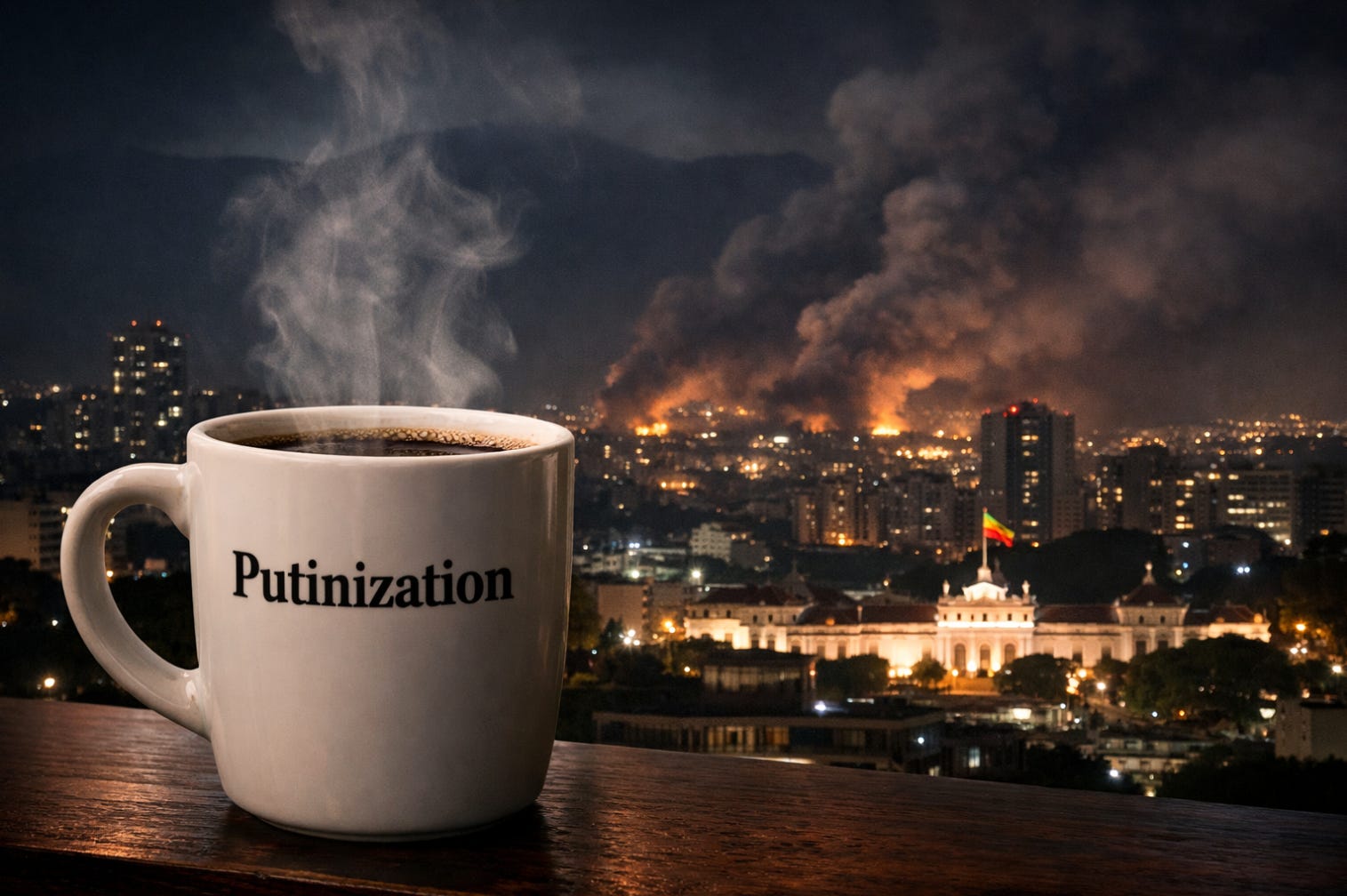
That is why the Guardian’s description of the “Putinization” of U.S. foreign policy lands so hard. This is not America bending the rules. It is America discarding them and daring the world to adjust. Once that line is crossed, every future escalation becomes easier to justify, from Venezuela to Cuba to Mexico and beyond.
This is why this moment matters so much. When the lie that starts a war is exposed, the war itself does not become more defensible, it becomes more damning.
Late last night, after the headlines stopped updating and the rain settled into that steady, whispering kind that makes everything feel heavier and quieter at the same time, Marz and I went outside for an extra-long moonbeam vigil. It wasn’t ceremonial or performative. Just two small beings under a wet sky, standing still, breathing, and putting something better into the universe than what we’d been handed that day.
I don’t pretend that intention fixes broken systems or undoes violence or restores the rules Trump is so casually discarding. But I do believe it matters to refuse the emotional gravity he’s trying to impose, to insist on clarity over chaos, care over cruelty, and presence over numbness. We sent that out, quietly, in the rain. And this morning, I’m sending this out too.
I am appoplexically furious with the GOP majority in Congress. They passively acquiesced and compliantly capitulated to the stream of incompetent and unqualified nominees, remained mute to the naked lawlessness and power grabs, ignored the overt constitutional violations, and dismissed the overwhelming corruption transactions as our democracy buckles and our economy tanks.
Now, as Trump's fantasy dungeon and dragon escapades crosses into international affairs, you accurately identify a crossing of the Rubicon moment.
There is no good outcome to this spiraling descent except for the aggressive assertion of Article I powers by Congress. We are in a political DEFCON 1 crisis. How can the GOP remain so blind to the history they are actively creating which will determine the fate and legacy of our nation??
Ending your commentary as the rain settles is poetic and apropos. For the fallout from this intrigue is soggy, dark. I agree, for Trump there is no clear end state. No strategy. It is compounded by a sycophantic, ideological national security structure. As you note, it is about oil. Not democracy for the Venezuelans. Not drugs (hell he pardoned Hernandez). And, even in his narrow focus on “our” oil it is inchoate. The description of sour oil was interesting. What has yet to be seen is the international reaction, least of which is China. We indeed crossed the Rubicon. A shining city on the hill, we are not. Sadly, the GOP has seemingly abandoned in full their notion of a great USA. We are becoming like Russia in Ukraine.