


A brief note before we begin: this week’s Sunday reminder is arriving significantly closer to Monday than intended because I finally understand why men who enter Home Depot sometimes never return. I spent the day completely enamored by cabinets, appliances, lighting, lumber, and approximately twelve thousand other things I suddenly believe our house cannot survive without. Somewhere between comparing drawer pulls and gazing longingly at all-in-one washers and dryers, several hours simply disappeared, so please forgive the late arrival. Apparently, homeownership has turned me into the kind of person who can lose an entire afternoon beneath fluorescent lighting and consider it an adventure.
Well, folks, a few short months ago my family was facing incredible hardship, and today I’m happy to report that Ezra’s MRI is officially on the books, our fairy garden is becoming a real garden rather than a distant piece of our collective imagination, and all the crazy things we talked about when this house and land were merely a rental we would someday have to leave are slowly becoming reality.
We’ve spent an enormous amount of time discussing how to make a staircase fit inside a five-foot neutral zone in our soon-to-be-converted attic, so neither child will have to cross the threshold of the other’s sovereign territory. Believe it or not, this is more difficult than you might imagine, unless you’re willing to surrender nearly all walkable space to the gods of the underworld, who apparently moonlight in residential design and have very strong opinions about headroom.
Ezra has taken up dancing, which currently consists of standing while holding onto something sturdy and bouncing up and down in absolute glee whenever he hears music. His technique is still developing, but his enthusiasm is flawless, and I would pay unreasonable amounts of money to preserve the look on his face when he realizes the world has once again produced a beat exclusively for his enjoyment.
My ADHD buddy has his good days and his bad days, but every day he seems to get a little closer to happy, which is all I could ever ask of him. Happiness isn’t always a place children arrive all at once, especially when their minds and hearts are carrying more than the people around them can see. Sometimes they reach it inch by inch, with a few detours, a little backtracking, and someone beside them reminding them that they are still moving forward.
My daughter is a firecracker, except that isn’t quite the right word because I’m fairly certain she would take a firecracker out back and whoop its butt if it looked at her sideways. She’s currently passing through the developmental stage in which she believes crying is a reasonable and effective way to secure favorable terms during negotiations. Her commitment is strong, her stamina is impressive, and while the performance itself could use some polishing, there’s no question that the actress has range. Beneath all that ferocity, though, she remains one of the most bighearted people I know, and I have no doubt she will eventually redirect these considerable powers toward something slightly more useful than obtaining a second snack.
Odin, meanwhile, is conducting a forbidden romance with the golden retriever who lives down the street. He sits at the window yearning for her and, at the first available opportunity, takes off in search of his beloved. Yesterday, on my way to the grocery store, I found him two blocks away pretending he had done absolutely nothing wrong. The moment he noticed me, he climbed into the car and refused to make eye contact, which is apparently how one preserves dignity after being apprehended mid-courtship.
Then there’s my husband, who has decided to take a break from traveling so he can focus his considerable energy on designing our home. There are now twelve project lists, an unreal budget, numerous mock-up drawings, and the determination of a man who believes our tiny woodland cottage should double as a regal resort with pristine finishes and sleek curb appeal. If confidence alone could complete renovations, we would already be living in a handcrafted architectural wonder with heated floors, perfect trim, and a staircase that obeys the known laws of physics.
It’s beautiful, this little family on this little piece of land, changing our lives for the better while learning how to be human, learning how to love, and having the extraordinary privilege of doing it together every day. There’s not a thing I wouldn’t do for the people I call my own. I would push mountains aside, sail treacherous waters, face the beasts of the wilderness, and bargain directly with the staircase gods if it meant I could see those smiles one more time. Perhaps that’s why the story of two women and a young boy, stranded for three days in the Michigan wilderness, tore my heart in two and filled it with hope for humanity all at once.
The two women, Jazman Hock and Sarah Vida, had taken Sarah’s nine-year-old son, Kayden, tubing on the Muskegon River when their inflatables broke apart and left them stranded in dense woods. They were barefoot, without adequate supplies, and unable to find their way back. For three days, they drank river and swamp water and ate whatever the wilderness offered them, including bark, wildflowers, and ants. What little food they had, they saved for Kayden. Of course they did.
There are moments when love stops being an idea and becomes something almost unbearably physical. It becomes the food you don’t eat because a child needs it more. It becomes the hand you keep holding even when you’re frightened, dehydrated, and no longer certain anyone is coming. It becomes the voice that says we’re going to make it, even when the person speaking has no evidence beyond the fact that surrender isn’t an available option.
Love may have helped them survive, but love was also moving toward them from the other side of the forest. Conservation officers, state police, firefighters, K-9 teams, emergency responders, and volunteers kept searching. Officers followed fragments of evidence that could easily have been overlooked, including a damaged inner tube, trampled plants, and muddy footprints disappearing into thick undergrowth. Eventually, after nearly three days, the rescuers called into the woods and heard an answer. The family was found alive.
This story isn’t hopeful because nothing terrible happened. Plenty of terrible things happened, and surviving them required endurance most of us would prefer never to test. The hope lives in the fact that while those women were rationing food for a child, other people were reading the forest for signs of them. It lives in the refusal to let a broken tube, a muddy footprint, or a bent piece of grass mean nothing. It lives in the moment a voice called through the trees and three lost people realized someone had come.
Human beings, however, don’t hold a monopoly on sounding the alarm when someone we love is in danger. Sometimes the guardian standing between a family and disaster has feathers, webbed feet, and no apparent concern whatsoever for local noise ordinances. In Texas, a young goose named Goosey began honking and pacing frantically outside his family’s barn after a fire broke out during the night. Bert Gerber had fallen asleep inside the house, but Goosey’s relentless commotion woke him. When Bert went outside to investigate, he found flames inside the barn and managed to extinguish the fire with a garden hose before it spread. The chickens, turkeys, and other animals inside survived.
Goosey had joined the family only months earlier, after their daughter fell in love with him at a poultry expo. Her mother had previously been afraid of geese, which feels like exactly the sort of information a goose would store away for future leverage, but she agreed to bring him home anyway. Then, when the barn began to burn, the animal they had made room for refused to be quiet until everyone else was safe.
There’s something nearly perfect about that. Sometimes love looks like saving your food for a child in the wilderness, and sometimes it looks like searchers crawling through dense brush to find a muddy footprint. Sometimes, apparently, it looks like a furious goose raising absolute hell in the yard until a sleeping human finally takes the hint.
An alarm can save a barn in a matter of minutes, but other rescues unfold so slowly that the people who begin them may not know whether they’ll live long enough to see the result. Some acts of love require more than bravery in a single moment. They require years of patient preparation, scientific study, cooperation, habitat restoration, and the stubborn belief that absence doesn’t always have to be permanent.
More than seventy years ago, tigers disappeared from the wilds of Kazakhstan. Hunting, habitat destruction, and the loss of prey had erased them from landscapes where they had lived for generations. The Caspian tiger was eventually declared extinct, and for decades its return seemed to belong to the same unreachable category as so many other losses, something humans could mourn but never repair. Then science revealed that the extinct Caspian tiger and the surviving Amur tiger were nearly genetically identical, and a possibility appeared where there had previously been only an ending.
Kazakhstan began preparing for a return. The country established the Ile-Balkhash Nature Reserve, restored habitat, strengthened protections, rebuilt populations of wild boar, deer, and other prey, constructed veterinary and monitoring facilities, and trained people to manage encounters between tigers and nearby communities. For more than a decade, people worked to make the land capable of holding a tiger again. Then, on July 31, a wild-caught female Amur tiger stepped out into that landscape. Her name is Umit, which means “hope” in Kazakh.
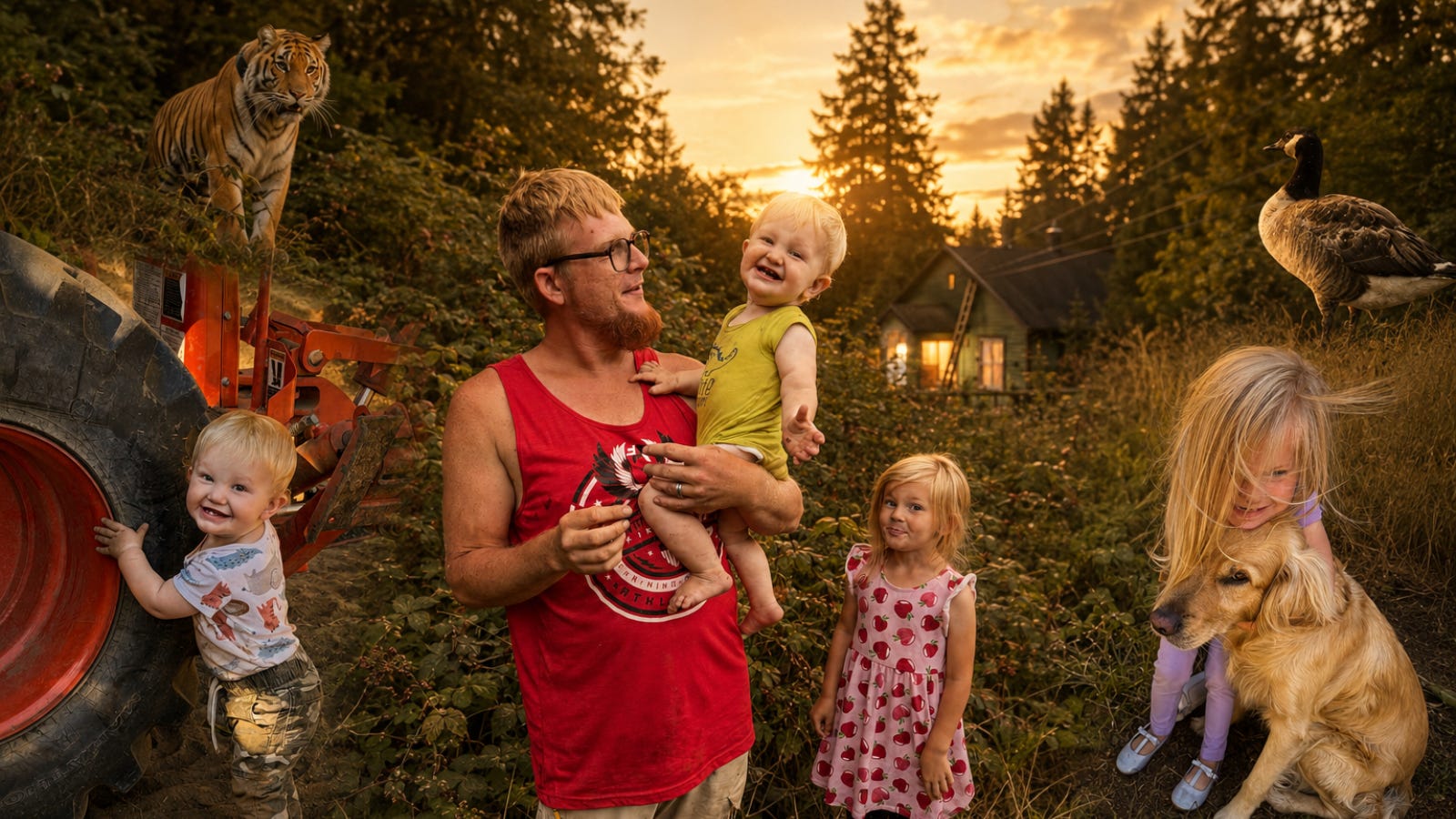
She now moves through the Ile-Balkhash reserve wearing a satellite tracking collar while scientists monitor her progress. A male tiger may eventually join her, two cubs are being raised with as little human contact as possible, and the long-term plan is to establish a self-sustaining population of approximately fifty tigers.
One animal can’t reverse extinction, and Umit’s release doesn’t guarantee success. The habitat must remain protected, prey must remain abundant, and people and predators must learn to live alongside one another. Hope has never been the same thing as certainty, though. Hope is what asks us to prepare the ground even when the outcome isn’t guaranteed.
Perhaps that’s what we have been doing here on our little piece of Oregon land, although I recognize that comparing our attic renovation to an international tiger restoration program may encourage my husband to create several additional project lists.
We’ve been preparing the ground. We’re making room for children to grow, even if they require separate attic territories and a staircase designed by someone with a working knowledge of spatial sorcery. We’re turning an imagined fairy garden into soil, stone, roots, and pathways. We’re placing an MRI appointment on the calendar and moving toward answers. We’re helping one child inch closer to happiness, teaching another that tears are a form of emotional expression rather than an internationally recognized currency, and cheering while the smallest among us bounces joyfully to music.
We’re even retrieving the dog from his illicit neighborhood romance and allowing him to preserve the fiction that the entire misunderstanding was our fault. A few months ago, hope meant that perhaps we might be able to stay. Today, hope means deciding what we will build because we did.
This week, hope looked like muddy footprints that searchers refused to overlook, it sounded like a goose honking into the night because the barn was burning and everyone inside needed someone to wake up, and it moved on four enormous paws through reeds and forest in a country where tigers had been absent for more than seventy years.
Here at home, it looks like an MRI appointment, an impossible staircase, a fairy garden taking shape, and a baby dancing because somewhere nearby, music has begun. Hope isn’t the promise that nothing will burn, break, vanish, or leave us frightened in the wilderness. Hope is what keeps calling until someone answers, what keeps searching until the lost are found, and what spends ten patient years preparing the ground so that, against every reasonable expectation, something dearly loved can finally come home.
In this era of Donald Trump and perpetual bad news your essays on the good side of human existence is truly refreshing. Thank you.
If I believed in a God, I’d say thank God. But Mary, Shanley, and all your family, I so much appreciate your intellect, your knowledge, your research, and your humor. You are good people, so very needed in this world. Thank you so much.