


There is something almost unbearable about the thought of a mother holding her baby in a place that can no longer keep them safe.
I think it’s the smallness of what she needs that gets me. Enough food to keep going, somewhere to rest, a way through the world with her child still beside her. An entire future can depend on such ordinary things, and the loss of them can make even a forest terribly small.
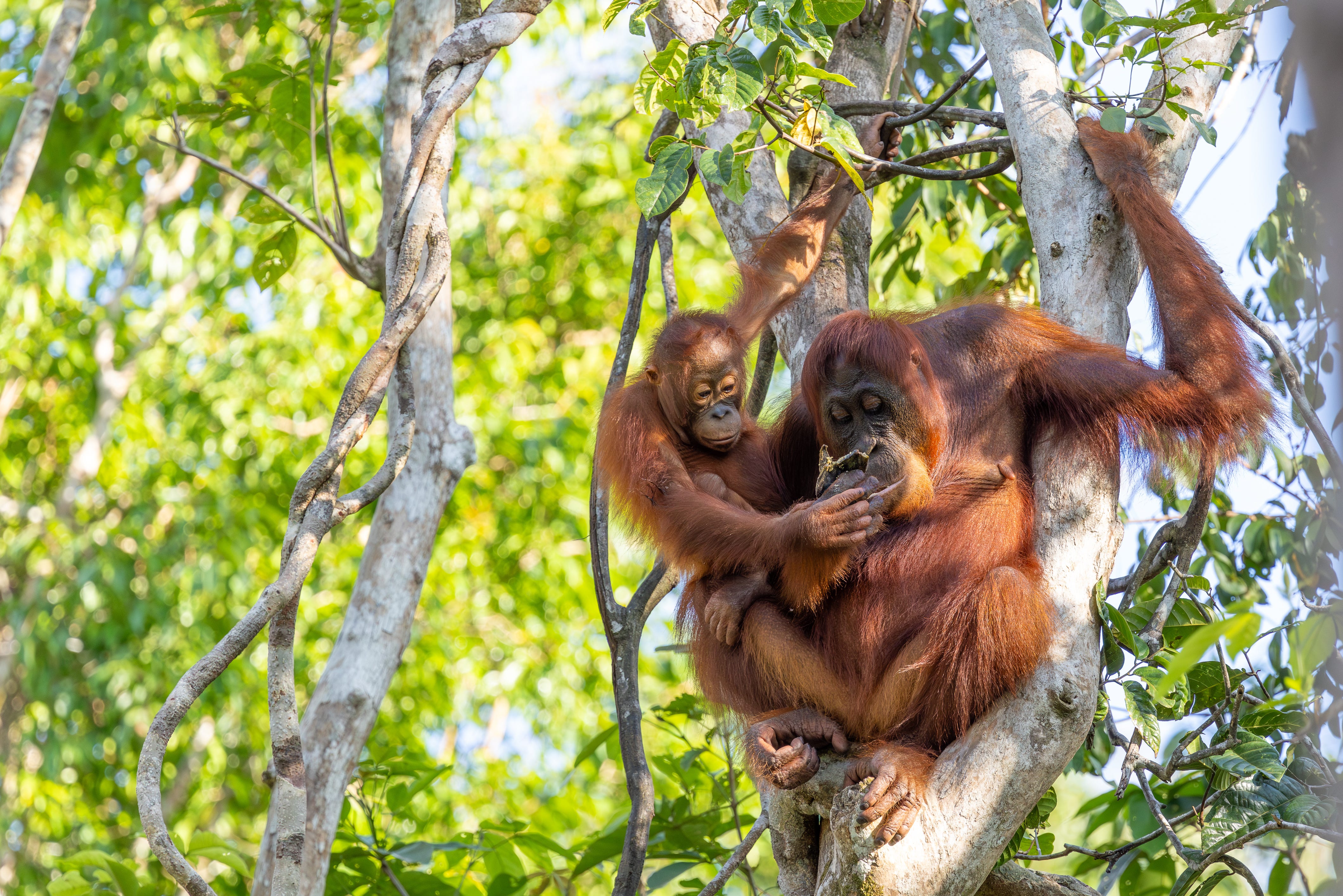
In Indonesian Borneo, eight orangutans rescued after wildfires have been given another chance at those ordinary things. Three mothers with their infants and two adolescent males were released into the Batu Nyambu Protection Forest on October 9, after care from YIARI, the Indonesian conservation organization that led the effort. Their rescue partner, International Animal Rescue, shared the news this week.
Among them were Mama Lifa and her infant, Lifa. Rescuers found them stranded in a patch of acacia trees covering about 400 square meters, surrounded by oil palm plantations. Their remaining habitat could no longer feed them. I keep returning to that little patch of trees. A mother, her baby, and a world that had narrowed around them until there was hardly anywhere left to go.
We use the word habitat so easily that sometimes I think we forget what it holds. We can say it in a meeting, put it in a report, measure how much of it has been lost, and somehow get through the sentence without feeling the full weight of what we’ve described. But to the creature living there, it’s the whole arrangement of being alive. Every familiar way to find food, every place to shelter, all the small possibilities that make tomorrow possible.
When I think about my children, I understand how much can be contained in the word home. It holds the place where I expect to find them, the things they need, the little routines through which I try to make the world feel dependable. There’s so much love tucked into the everyday business of keeping someone safe.
An orangutan’s life has its own shape, most of which I’ll never understand. That seems to me a good reason to approach it with more care. There is an entire existence there, being lived from the inside, whether I can fully imagine it or not. And somewhere in Indonesia, people recognized that existence as something they were responsible for helping protect.
Getting the orangutans to the release site required six hours of travel by land, an hour by boat, and another two hours on foot. Local people helped carry the transport crates along the trail while veterinarians checked the animals along the way. I find that detail almost impossibly moving. Someone had to take hold of the actual weight.
It is easy to care for a moment when a photograph finds us. We feel that little ache of recognition, wish the animal well, and return to whatever was already demanding our attention. I know how crowded a day can become, how quickly our own worries fill every available space. But these people made room in their day, in their work, in the strength of their bodies, for lives that belonged to another species. Across that distance, care became something you could carry.
I wonder how much of the goodness in the world begins there, in the moment when another being’s need becomes important enough to alter our plans. We notice that something living is in trouble, and our own life changes direction a little to meet it. A phone call gets made, a journey begins, somebody reaches for the other end of a crate. There is an enormous moral world inside that small movement.
The orangutans were going back to a forest where they could find food and water, build nests, and move into connected habitat. The people helping them had to consider what would make a life possible after the rescue, when the journey was over and the animals were beyond their immediate care. I love the tenderness in thinking that far ahead for someone whose future you may never see.
So much of loving anything involves doing work whose full meaning will arrive later. We plant a tree while it’s still small enough to lose in the grass. We comfort a child who will grow up carrying some part of that comfort into rooms we’ll never enter. We protect a place because something will need to live there, and we accept that much of what we make possible will happen beyond our sight.
An orangutan in a forest has no obligation to understand any of this. She gets to be occupied with her own life. She gets to find food and attend to her baby and exist in all the ordinary ways the rescue was meant to preserve. Whatever she may understand about the people who helped her, her life is worth the effort.
There is a generosity in that which makes me feel a little less afraid of us.
We are capable of recognizing value that has nothing to do with what we can collect from it. We can look at another creature and understand that its place in the world matters. We can allow that understanding to cost us time, money, effort, and the use of our hands. We can take responsibility for keeping something safe simply because its loss would be a loss to the world. And we can do that across the boundary between species.
I think about the smaller boundaries we sometimes find so difficult to cross among ourselves. The unfamiliar language, the distant country, the person whose life looks different enough that we let their suffering become abstract to us. Yet here is this capacity within us, reaching all the way toward a wild creature whose experience we can only partly comprehend. What might happen if we practiced it more often? If we became a little slower to decide that another life was too distant from ours to place any responsibility upon us?
I know we can’t each carry every crate. We have children to feed, bodies that tire, bills waiting on the kitchen counter, and days when getting ourselves through the afternoon requires most of what we have. But responsibility can be shared. Someone knows how to care for the animal, someone knows the route, someone has the strength to help with the journey. Together, people can make a way that none of them could make alone.
That is one reason I can still find hope for humanity, even after another week of reading what humanity has been up to, which is occasionally an activity best undertaken with a blanket and a trusted woodland creature. There are people doing this work while the rest of us struggle to believe that people like them still exist. Their care has practical effects. Because they showed up, eight lives have another chance to unfold.
The fires and the danger to the remaining forest continue. The conservationists themselves emphasize that rescue must go together with protecting habitat. There is still work waiting beyond this happy moment, and these animals will need a living forest long after the relief of their release has passed.
I think hope becomes deeper when we can hold both truths together: our joy at what’s been saved, and our willingness to remain responsible for what happens next. Because a life is so much more than the moment in which we rescue it. It’s all the mornings that might follow, all the ordinary hours in which a creature gets to inhabit the world. When we protect that possibility for another being, we make room for a future that belongs to them.
Somewhere in Borneo, three mothers and their babies have been returned to a forest with room for them. There are two young males there too, each with a life of his own to continue. I hope their days are full of things the people who helped them will never know about.
I hope there is food where they look for it. I hope their babies grow up beneath trees that will still be standing when they have babies of their own. And I hope we remember the people who helped carry them there, because they’ve shown us something worth keeping about ourselves. Our care can reach beyond everything familiar and recognize a life we have the power to protect. Then, our actions can answer.
This is inspired & inspiring writing. The web of Life includes all of Us; there is no Other. Thank you for reminding us to be care-full.
Such a thoughtful article, one that touched me deeply. Thank you!