


For Denmark and Greenland, Wednesday’s White House meeting was never going to be easy. But the fact that Denmark’s foreign minister felt compelled to say, on the record, that it is “not easy to think innovatively about solutions when you wake up every morning to different threats” tells you just how far relations have deteriorated.
The threats he was referring to were not coming from Russia or China. They were coming from the President of the United States.
After weeks of escalating rhetoric in which Donald Trump declared that “anything less than” U.S. ownership of Greenland would be “unacceptable,” Danish and Greenlandic officials finally sat down with Vice President JD Vance and Secretary of State Marco Rubio in Washington. Trump himself stayed out of the room, but not out of the pressure campaign. Even as the talks were underway, the White House continued to push aggressive messaging through social media, amplifying claims about Chinese and Russian activity that Danish officials would later publicly dispute.
The meeting itself lasted under an hour. No breakthroughs were announced, but what followed was striking: a series of unusually candid statements from Denmark and Greenland that quietly dismantled Trump’s argument while exposing the cost of his approach.
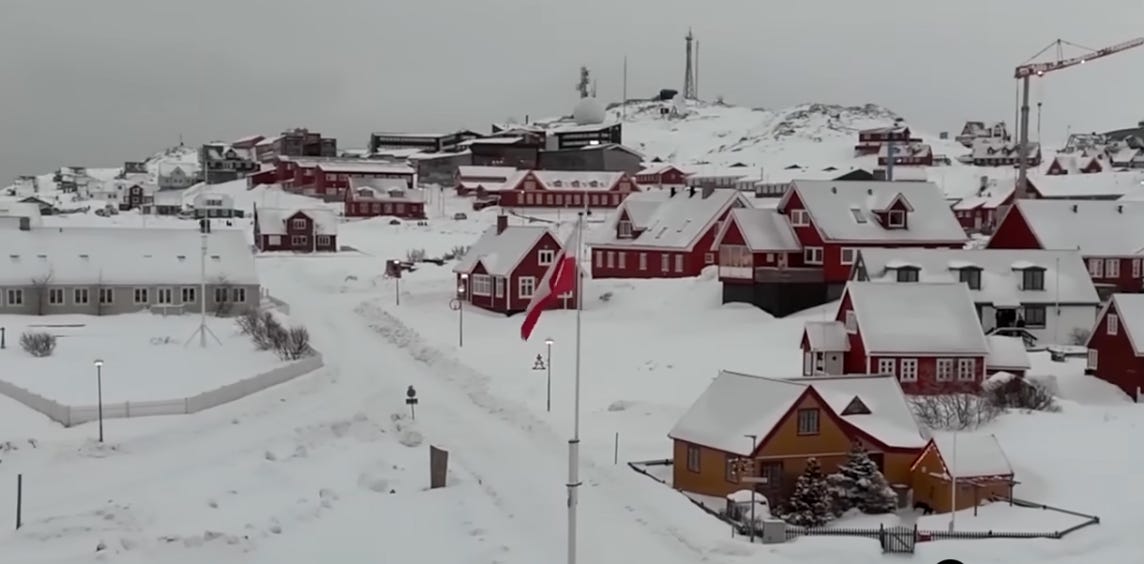
Denmark’s foreign minister, Lars Løkke Rasmussen, acknowledged the reality Trump keeps invoking. Yes, there is a new security situation in the Arctic. Yes, the so-called “peace dividend” is over. Climate change, new shipping routes, and increased great-power competition have made the region more strategically important than it has been in decades. But Rasmussen drew a bright line between recognizing a problem and embracing Trump’s solution. The idea that this new security environment requires U.S. ownership of Greenland, he said flatly, “is absolutely not necessary.”
More pointedly, Rasmussen reminded Washington, without rancor, but without ambiguity, that the current military posture in Greenland is the result of American choices. Over the years, the United States itself reduced its presence there from roughly 10,000 personnel to around 200. The implication was clear: you don’t get to hollow out a security arrangement and then use that hollowing to justify a territorial grab.
He also corrected Trump’s claims directly. Despite repeated assertions from the White House about Chinese military encroachment, Rasmussen said there has not been a Chinese warship in Greenland for roughly a decade. That kind of factual rebuttal is rare in alliance diplomacy, and it signaled that Denmark and Greenland were no longer willing to let exaggerations pass unchallenged in the name of courtesy.
Crucially, Rasmussen’s position is not at odds with NATO’s own military leadership. Just days earlier, NATO’s Supreme Allied Commander Europe, Gen. Alexus Grynkewich, described the Arctic as a zone of increasing strategic competition, but emphasized that deterrence there is being strengthened through coordination, integration, and shared command structures, not territorial seizure. With seven of the eight Arctic nations already inside NATO, Grynkewich said, the alliance is positioned to “get this right.”
Asked directly whether Trump’s recent rhetoric had changed NATO’s priorities, the general declined to engage politically, noting instead that alliance discussions remain ongoing and constructive, a carefully worded signal of continuity, and a quiet effort to firewall military strategy from political volatility.
In other words, the generals are acknowledging the same risks Trump cites, Russian and Chinese cooperation, hybrid threats, increased activity in the high north, while rejecting the premise that those risks require breaking alliance norms or undermining allied sovereignty. From NATO’s perspective, the answer to Arctic competition is more cooperation, not coercion.
Greenland’s foreign minister, Vivian Motzfeldt, struck the same tone. There is room, she said, to strengthen cooperation with the United States. There is room to talk about security, investment, and defense. But none of that requires Greenland to be owned by the U.S. Sovereignty, she made clear, is not a bargaining chip.
What came through most strongly, though, was exhaustion and something close to hurt. Rasmussen spoke emotionally about how Denmark and Greenland see themselves: as some of America’s closest allies. He reminded U.S. officials of Denmark’s sacrifices alongside the United States in Afghanistan. He stressed that Denmark wants to fulfill its commitments, wants to work closely with Washington, and understands that the future cannot be hostage to the past.
Cooperation, he said plainly, has to be respectful. “It is of course very emotional for all of us,” Rasmussen said, for Greenlanders, and for the Greenlandic community in Denmark. And then came the line that may end up defining this episode: it is not easy to innovate, not easy to think creatively about shared solutions, when each morning begins with new threats from your supposed ally.
That comment reframed the entire crisis. The problem is no longer simply Trump’s fixation on Greenland. It’s the way his rhetoric has poisoned the diplomatic environment so thoroughly that even good-faith security discussions become almost impossible.
The European response reflects that reality. France has announced it will open a consulate in Greenland, explicitly framing the move as a geostrategic decision. Germany has confirmed it will send a Bundeswehr reconnaissance team to Greenland to assess how it can support Denmark’s security presence in the region, a quiet but unmistakable signal that Europe is closing ranks. NATO’s own military leadership has emphasized that deterrence in the Arctic is already being strengthened through alliance cooperation, not unilateral control.
As Trump insists that Greenland must be “in U.S. hands” to be secure, America’s allies, and its generals, are saying the opposite: Greenland is already secure because it is embedded within NATO, protected by collective defense rather than domination.
Rasmussen was careful to describe the meeting as constructive. He said it helped lower tensions and return the conversation to dialogue. And he went out of his way to say that Denmark and Greenland are willing to explore whether some U.S. concerns can be accommodated as long as that exploration respects the territorial integrity of the Danish Kingdom and the self-determination of the Greenlandic people. That condition is the line Europe is now holding.
This is no longer just a dispute about Arctic strategy. It is a test of whether the United States still understands the difference between leadership and ownership, and whether alliances can survive when one partner treats sovereignty as a starting bid instead of a boundary.
Good job, Denmark, Greenland and NATO! Its always a pleasure reading how well informed, intelligent people handle conflict.
Ever since February 2022 when Russia invaded Ukraine, I have been impressed how Europe and NATO, at large, have handled crisis. Of course there have been issues, struggles, and decisions made that, looking back, may not have been ideal; but, European decisions by-in-large have been measured and well thought out. Not so easy when you have a war raging on your continent.
I’ve begun grading Trump’s stunts based on three criteria: (1) Does it undermine Trump politically? (2) Will it cause minimal suffering or death? (3) Is it reversible once we rid ourselves of Trump?
The Greenland caper, like the Jerome Powell criminal investigation, gets high scores on all three counts and is therefore more benign than, say, cutting aid to children in Africa, which resulted in countless deaths, and didn’t seem to harm Trump at all.
Venezuela concerns me more than Greenland given its potential to destabilize the region and its lack of reversibility.