


Good morning! Yesterday, I wrote about communism, Joseph McCarthy, Roy Cohn and the political education of Donald Trump. I had hoped the history might be allowed to sit quietly for at least twenty-four hours before becoming breaking news again.
Senate Republicans mistook it for an instruction manual.
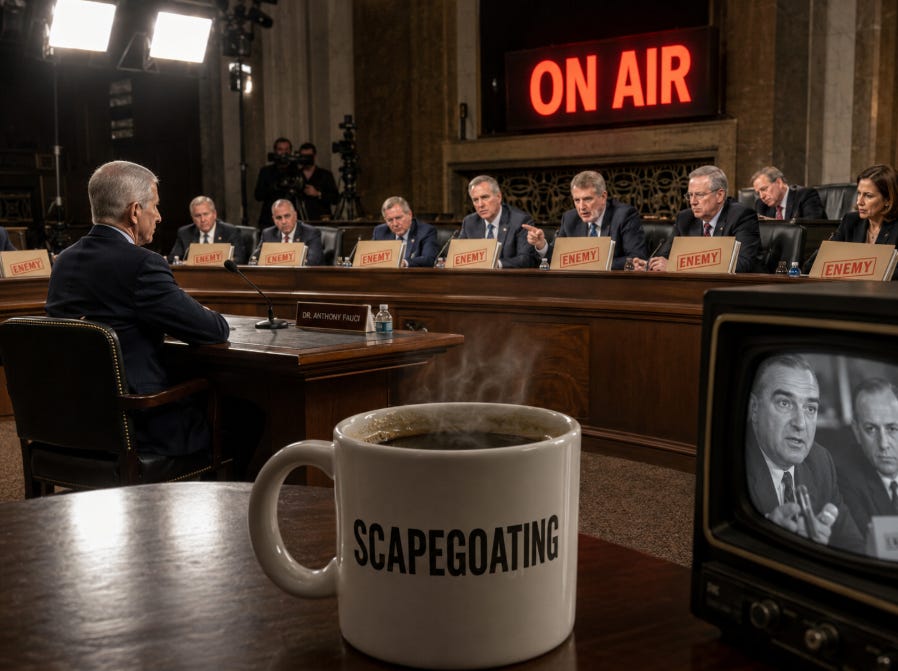
On Wednesday morning, the Senate Homeland Security and Governmental Affairs Committee convened what was officially called a hearing to take the “Testimony of Anthony Fauci.” Its ostensible purpose was to investigate the origins of COVID-19, a subject that remains genuinely important, scientifically unsettled, and deserving of far more sober attention than the United States has managed to give it.
Its actual purpose was to place an 85-year-old scientist in a chair, accuse him of crimes and then turn his refusal to assist in his own prosecution into the day’s principal evidence.
Fauci invoked the Fifth Amendment more than 100 times. Before doing so, he explained that Rand Paul’s years-long campaign against him, including repeated demands that he be prosecuted and imprisoned, had made any new testimony legally perilous. “The sole reason he is calling me before this committee,” Fauci said, was “to get me to say something, anything” that might vindicate Paul’s public pledge to put him “behind bars.” Although invoking the Fifth “pained” him, Fauci said he would follow his attorneys’ advice rather than provide another transcript that could be combed for inconsistencies and repackaged as perjury.
Paul responded by announcing that the committee would vote the following week on whether to hold Fauci in contempt. When Fauci’s attorney, David Schertler, attempted to intervene, Paul ordered security to remove him from the room. Schertler later called the ejection “outrageous” and said it demonstrated “the completely biased and baseless nature of this proceeding.”
Thus commenced the Senate’s latest experiment in making constitutional rights available only to people Republicans like.
There is a legitimate legal question here. Joe Biden granted Fauci a sweeping pardon covering federal offenses he might have committed between January 1, 2014, and January 19, 2025, arising from his government service. A pardon can remove the danger of prosecution for pardoned conduct and therefore narrow the Fifth Amendment privilege. It does not, however, pardon future testimony, immunize someone against a new perjury charge, or guarantee that an intensely political Justice Department will not search for conduct outside the document’s boundaries. Courts may eventually have to decide how much protection remained.
What required no judicial interpretation was the intent of the people asking the questions.
Rand Paul did not approach Fauci as a witness who might help him discover what happened. He approached him as a defendant whose guilt Paul had already announced. Paul has spent years calling Fauci a liar, accusing him of helping cause the pandemic and demanding criminal prosecution. He released more than a thousand pages of Fauci’s personal diary shortly before the hearing, apparently hoping that somewhere amid the reflections on scientific meetings, White House arguments and unexpected celebrity attention would be the long-awaited entry reading, “Note to self: create global pandemic, deceive Congress, become magazine cover model.”
The same-day reporting found that the diaries provided no dramatic new evidence tying Fauci to the origin of COVID-19. Some passages showed scientists privately considering a laboratory accident in the earliest days of the outbreak, which we already knew. Others showed Fauci concluding that natural transmission remained more likely. An entry describing the Wuhan market as an “amplifier” rather than necessarily the original source closely tracked what he was saying publicly at the time. Mostly, the journals revealed a scientist trying to understand an emerging pathogen while serving under a president he privately found rambling, erratic, and desperate to reopen the economy.
After years of investigation, subpoenas, document demands, email excavation and diary publication, the committee arrived at the hearing with the same theory it had before and approximately the same amount of proof.
Uncovering the origins of COVID was never the operative goal.
Harry Litman immediately recognized the older template. He described the proceeding as a revival of the Red Scare or the Inquisition, driven by malicious efforts to construct a perjury prosecution and made genuinely dangerous by a Justice Department whose independence has been badly compromised. In that environment, Litman argued, Fauci’s attorneys could not safely treat Paul’s questions as a good-faith invitation to clarify the record.
Stuart Stevens reached for the same history. “What this really was,” he said, “was a page from two despicable, sad events.” The first was the McCarthy era: “There he is, Joe McCarthy with Roy Cohn, who is, by the way, our current president’s hero.” Stevens saw in the hearing the same use of official power to isolate a target, pronounce guilt in advance and turn public accusation into political theater.
He also compared the spectacle to the struggle sessions of China’s Cultural Revolution, when students were encouraged to drag professors, doctors, lawyers and other members of the educated class before the public for denunciation. “That’s what this was about,” Stevens said, “trying to humiliate Anthony Fauci.”
The scale and violence of those historical events were far greater than anything that happened in a Senate hearing room Wednesday. But Stevens identified the shared political logic: the verdict comes first. The witness is not summoned to provide knowledge but to be degraded. Expertise is not weighed; it is placed on trial. Refusal to confess becomes further evidence of guilt.
That was precisely the trick Roy Cohn learned beside Joseph McCarthy.
A congressional investigation does not have to prove the accusation if the accusation itself is the product. It needs a government seal, a television camera and a politician willing to say “evidence suggests” immediately before presenting no evidence whatsoever. The target will spend years explaining. The senator will already be on the evening news.
Josh Hawley understood his assignment. He asked Fauci what day it was and what color tie he was wearing, then treated Fauci’s consistent invocation of the Fifth as proof that he could not answer even innocent questions. Hawley later advertised the principle that no honest person takes the Fifth, apparently forgetting that Donald Trump invoked it more than 400 times during a single 2022 deposition. Perhaps honesty begins at invocation 401, or constitutional self-protection becomes socialism when extended to anyone else.
Trump himself once asked why innocent people would take the Fifth. After taking it hundreds of times, he discovered that politically motivated investigations can make silence prudent. That insight, like Medicare and constitutional due process, apparently becomes socialism when extended to anyone else.
Then came Bernie Moreno, who said pandemic restrictions had driven him from business into politics and brought him, six years later, to this question for Fauci:
“Who the fuck do you think you were?”
It was less a question than a performance of blame. Moreno held Fauci personally responsible for lockdowns, school closures, damaged businesses and suffering families, although Fauci was neither a governor, mayor, superintendent nor president and lacked the authority to impose most of those decisions.
The display was especially striking because Moreno has shown considerably more restraint toward Rep. Max Miller, the Republican congressman and former husband of his daughter, Emily. She has accused Miller in court filings and police interviews of serious domestic abuse, including holding a gun to her head. Their young daughter was also hospitalized with bruising and a broken collarbone. Miller denies the allegations, no criminal charges have been filed and investigators did not substantiate abuse.
Allegations are not convictions. But the contrast remains.
For Fauci, Moreno summoned obscenities and camera-ready fury on behalf of injured families. Asked about allegations involving his own daughter, granddaughter and a Republican colleague, he called it a private matter.
The anger was never uncontrollable. Its target was carefully selected. Moreno has a fully developed theory of lockdowns as the enemy and no comparable public theory of accountability when the accused remains inside the Republican tent. Paul, likewise, has a fully developed theory of Fauci as the enemy and no evident theory of what pandemic oversight is actually for.
The hearing’s largest absence was Donald Trump, who at the actual moment of governing had no discernible theory of the pandemic beyond managing the news cycle around it.
Republicans could only present Fauci as the singular author of America’s pandemic trauma by removing the president of the United States from the story. Fauci became responsible for every mask recommendation, school closure, state emergency order, economic loss, vaccine requirement and changed scientific judgment. Trump, who actually possessed executive power, was left somewhere offstage, presumably golfing with the concept of federalism.
The Woodward tapes make that erasure particularly grotesque.
On February 7, 2020, Trump privately told Bob Woodward that the virus spread through the air and was considerably deadlier than the flu. On March 19, he explained his communications strategy: “I wanted to always play it down.” Publicly, during the same period, Trump said the virus was under control, would be “just fine” and might disappear like a miracle. It is a public-relations strategy standing in for a pandemic policy.
Trump spent the early months of 2020 treating the pathogen as a hostile story rather than a biological threat. Trump spent the early months of 2020 treating the pathogen as a hostile story rather than a biological threat. His public communications strategy was not designed to prepare Americans for difficult measures or explain uncertainty honestly. It was designed to keep the numbers and news coverage from damaging him politically.
Viruses do not watch cable news and cannot be bullied into signing nondisclosure agreements.
By April, Trump was publicly speculating about whether disinfectant might somehow be introduced into the body “by injection inside” and whether powerful light could be brought inside patients. That sentence comes from the archived White House transcript.
Fauci and other public-health officials then had to perform one of the most exhausting jobs in modern government: translating the president’s improvisational medical podcast into advice that would not kill anyone.
None of this means Fauci was infallible. Public-health guidance changed. Officials initially discouraged widespread mask use, partly amid concern about shortages for medical workers. School closures and other restrictions deserve careful examination, particularly where they continued after the balance of risks had changed. The government must answer serious questions about laboratory safety, research funding, vaccine communication, nursing-home policy, China’s obstruction and whether agencies were sufficiently open to competing theories about the virus’s origin.
A real investigation would pursue those questions wherever the evidence led, distinguishing among a scientific judgment that changed, a recommendation that proved mistaken, bureaucratic defensiveness and a deliberate lie. Responsibility would be assigned according to the powers each official actually possessed. Decisions by the White House, Congress, governors, health agencies, school districts and private institutions would all receive scrutiny rather than compressing the entire federal system into one man named Fauci.
Most importantly, it would ask what must change before the next pandemic.
How should the United States detect emerging pathogens more quickly? What research should be prohibited or subjected to stricter oversight? How do we protect whistleblowers without turning every scientific disagreement into evidence of conspiracy? How much domestic manufacturing capacity do we need for protective equipment, tests, medicines and vaccines? Who communicates with the public when evidence is incomplete? How do we preserve trust when recommendations must change? How do we balance public health against education, employment, civil liberties and the enormous social consequences of prolonged restrictions?
Those would be difficult questions. They might require expertise, humility, and perhaps even legislation. Much easier to ask Anthony Fauci what color his tie is.
That is the emptiness behind Wednesday’s aggression. These are politicians in search of policy, flailing in the wind until they strike an enemy.
Rand Paul does not need a plan for the next pandemic if he can persuade enough people that Anthony Fauci was responsible for the last one. Bernie Moreno does not need a framework for balancing health, education and economic disruption if he can shout an obscenity at the man Republicans have designated as responsible for all three. Trump does not need to explain why he knowingly played down a deadly airborne virus if his party can transfer ownership of the entire catastrophe to the scientist who repeatedly contradicted him.
Punishing the person associated with the last crisis substitutes for preparing the country to survive the next one.
That brings us back to Roy Cohn.
Cohn taught counterpunching, denial, and enemy-manufacture as though they formed a complete political philosophy. Never apologize. Never concede. Attack the accuser. Declare victory. Repeat the accusation until everyone is too exhausted to remember that no proof ever arrived.
It is an effective toolkit for winning fights, but worthless for running a health agency, conducting congressional oversight, or governing a country.
Joseph McCarthy could destroy careers without substantiating the vast conspiracy he claimed to have uncovered. Roy Cohn could help Donald Trump survive scandals without making him honest, competent, or fit for office. Trump could dominate the pandemic news cycle without controlling the pandemic. Rand Paul can spend years prosecuting Anthony Fauci in public without bringing Americans one step closer to understanding where COVID came from or what we should do when the next outbreak arrives.
The names and the technology had changed. The product had not: an accused enemy, an official stage, and an image built to travel farther than any correction ever could.
Fauci sitting silently was not an accidental consequence of the hearing. Fauci sitting silently was the hearing’s principal deliverable.
Cohn understood that the accusation reaches the public long before any acquittal does, if an acquittal ever comes at all. Rand Paul adapted the method for the clip economy: the image now reaches the public before the accusation has even finished.
Yesterday, the Senate did not discover the origins of COVID-19. It produced a picture of Anthony Fauci invoking the Fifth Amendment and gave every Republican senator a turn posing beside it.
The investigative hearing room was nothing more than a studio.
I remember a few things about the pandemic. I remember that the Obama admin had constructed a detailed playbook after the first SARS crisis, and the Trump admin ignored it. I remember the shortages of PPE and Kushner advising delivering only to red states, because blue states weren't our people. I remember that there were early warning systems in place until Trump dismantled them. And I suspect that the Woodward tapes you mention hold a lot of things that I've forgotten. Moreno trotting out the F bomb to show his fury was so juvenile. Johnson's performative stupidity (I admit I've only seen clips - I wouldn't watch these clowns if you paid me) makes my fillings ache. Fauci's words at the beginning were dead accurate. His lawyer getting tossed was probably planned just to emphasize that the whole thing was performative nonsense. Here's hoping there aren't another 8 or 10 hearings like the Benghazi crap that Hillary went through. Real oversight is important, but it's not on the menu with these twits.
Well hell I think Fauci Saved all our asses!