

Good morning! For one glorious moment on Veterans Day, someone in Washington remembered that rules are supposed to apply to everyone.
The wreath had been laid, the president had spoken, and the crowd at Arlington National Cemetery was thinning when Defense Secretary Pete Hegseth’s party decided the moment called for photos.
So they gathered on the empty steps overlooking the Tomb of the Unknown Soldier: Hegseth, his wife Jennifer, his chief of staff and several senior aides, posing and chatting. As they began to leave, someone laughed, loudly enough to carry across the plaza.
The Army sentinel stopped his patrol, turned toward them, and delivered a command that could probably have been heard at the Pentagon without benefit of a telephone.
“All visitors will maintain an atmosphere of silence and respect at all times!”
All visitors.
Tomb guards deliver that same warning to noisy school groups and wandering tourists. The sentinel didn’t make an exception for rank, and nothing in his orders told him to.
Even the Pentagon acknowledged that the soldier had acted correctly.
Hold on to that image: a soldier standing guard over America’s unknown war dead, enforcing a rule without regard to who was standing in front of him.
Elsewhere in Washington, and particularly in Silicon Valley, some very powerful people are discovering that the rules have an inconvenient habit of catching up with them.
On Sunday, Nvidia’s board announced an “independent investigation” into reports that its founder and CEO had been the target of a foreign intelligence operation, and declared its confidence in Jensen Huang. By Thursday morning he was gone: resigned as CEO, president and board member, effective immediately.
Whether the espionage allegations or a second reported affair with a subordinate finally prompted Huang’s departure matters less than the consequences. Nvidia has abruptly lost the CEO who built it amid a national-security scandal. CFO Colette Kress is now doing double duty as interim CEO, while the board has appointed its first chairman and must find a permanent successor.
For a company worth trillions, that’s quite a lot of emergency housekeeping. Apparently, being indispensable isn’t much of a succession plan.
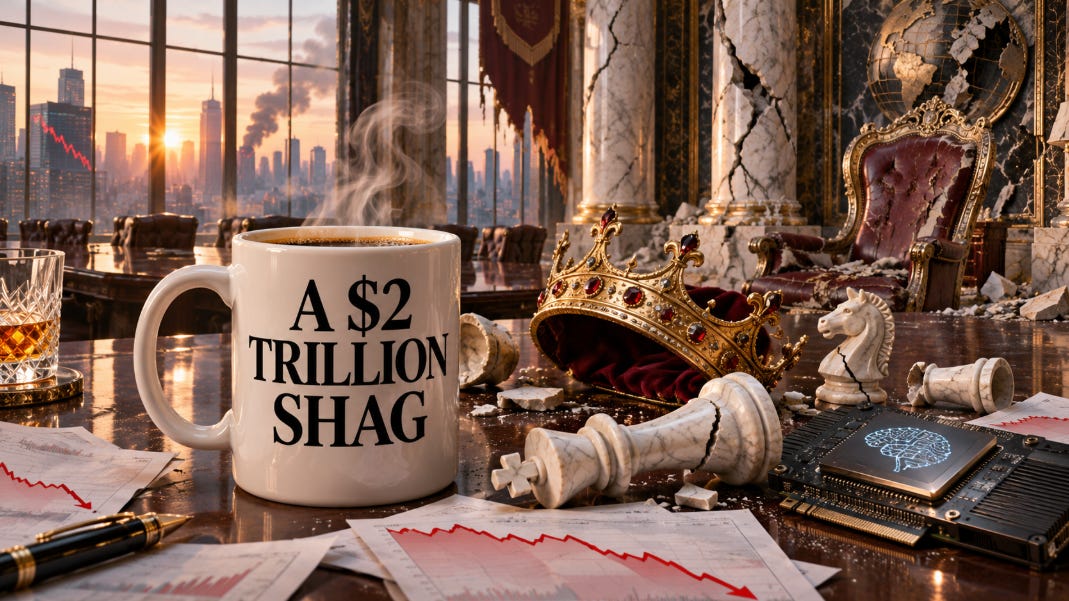
Investors have noticed. Nvidia has lost market value, now pushing $2 trillion since its October peak. Not all of that belongs to Huang’s scandal; broader anxiety about the AI boom was already weighing on the stock. But the leadership crisis has added another rather expensive problem.
Then there is the husband.
According to the Wall Street Journal, Huang was introduced to Alice Huang by Kang Wei, a Chinese businessman he had known for a decade. Kang was also Alice Huang’s husband. Associates told the Journal that he seemed to accept the relationship for two years, sometimes joking that his wife was Jensen’s personal assistant.
It helps to separate what is documented from what remains alleged.
Corporate records show that the couple helped establish Megaspeed’s Singapore operation in 2023, with Alice Huang serving as a director. The company became an Nvidia cloud partner and purchased billions of dollars’ worth of chips and servers. China’s securities regulator fined Kang and his investment firm in 2018 over disclosure violations. Taiwan has now revoked Alice Huang’s entry permit.
U.S. officials suspect Chinese intelligence recruited Alice Huang because of her access to Nvidia’s CEO. Sources told the Journal that Megaspeed shipped restricted chips into China, while prospective investors described the couple pitching data-center projects with promises that they could get Nvidia technology past American export controls.
Beijing denies the espionage allegations. Megaspeed maintains that it operates lawfully. The Journal also reports that Singaporean authorities detained Alice Huang in 2025, although Singapore has not confirmed that account and says it did not investigate her alleged intelligence connections.
Whether Jensen Huang knew he was being targeted is almost beside the point. The purpose of an intelligence operation is often to exploit someone who doesn’t realize he’s being exploited.
What we do know is that one of America’s most strategically important technology companies sold billions of dollars’ worth of advanced equipment to a business whose principals enjoyed unusually close personal access to its CEO.
The espionage and illegal-export allegations remain unproven, but the questions are no less serious. What did Nvidia know about its customer? What warnings did American intelligence agencies provide? And why were those sales allowed to continue?
Those questions lead directly to Howard Lutnick’s door.
Before Trump’s May trip to Beijing, the Commerce Secretary received a highly classified memo, prepared under Secretary of State Marco Rubio, warning about Huang’s relationship with Alice Huang. It drew on U.S. surveillance of her and a chip-smuggling investigation into Megaspeed. Around the same time, Reuters reported that Commerce had cleared ten Chinese companies to purchase advanced Nvidia chips, although some approvals predated the warning. Megaspeed and its affiliates, meanwhile, had purchased at least $4.8 billion in Nvidia equipment and still hadn’t landed on the export-control blacklist.
It gets more awkward.
The New York Times reports that Commerce handed its Megaspeed investigation to the Justice Department after Nvidia’s general counsel contacted investigators, invoking permission from a senior Trump appointee. According to Axios, Trump authorized action against suspected chip diversion three separate times, only for Lutnick and his deputy Jeffrey Kessler to resist moving forward. Commerce disputes the reported confrontation in which Treasury Secretary Scott Bessent demanded answers from Lutnick last week.
Republicans are now joining in. Sen. John Kennedy says Lutnick needs to explain himself “in front of God and country,” and expects a congressional investigation. House Republicans want testimony. Three GOP committee chairs have requested that Huang appear behind closed doors on November 18, just as Trump heads to the APEC summit in Shenzhen, where he expects to meet Xi Jinping. Subpoenas are being discussed.
As for Trump, his recollection is conveniently flexible. He learned of the allegations “not too long ago.” Intelligence officials might have briefed him, but he couldn’t recall. If they did, he acknowledged, “it didn’t make much of an impact on me.”
That last one is the most believable.
Not everyone has given up on Huang. As Nvidia’s board was weighing his future, ZeroHedge posted a modest proposal: “Elon please hire Jensen.”
Musk replied: “That would be an honor.”
Five words from the man who runs SpaceX, a company that launches satellites for America’s intelligence agencies. The FBI is examining Huang’s relationship with a suspected Chinese intelligence asset, and three Republican House committee chairs want him answering questions behind closed doors next week.
It isn’t a job offer, just a warm thought from one billionaire to another. Still, the vetting interview would be worth watching.
Another courtier has flown too close to the sun. Alina Habba Mildon, Trump’s former personal lawyer, has lost her $50 million contract with the family of a Venezuelan banker Trump later pardoned. She signed it while serving as acting U.S. attorney, then began collecting from the private company while working as a senior Justice Department adviser.
Trump called the deal “totally obnoxious and outrageous,” although the New York Times reports he privately suggested some of the proceeds ought to find their way to his future presidential library. Even an obnoxious contract is subject to the Trumptithe.
Her employer fired her for “failure to perform duties.” New Jersey’s ethics office has also filed disciplinary charges over a settlement she arranged at Trump’s Bedminster golf club, potentially putting her law license at risk.
Unlike Icarus, she reportedly keeps $14.5 million on the way down.
While Washington argues over accountability, voters have been making personnel decisions of their own.
Democrat Scott Colom has unseated Cindy Hyde-Smith in Mississippi. Yes, Mississippi. In Alaska, Mary Peltola still leads Dan Sullivan, although that race remains uncalled.
Committees move slowly and boards move only when cornered. The voters have already moved.
Wednesday was Veterans Day, and also an anniversary. On November 11, 1921, America’s first Unknown Soldier was laid to rest at Arlington. The laughter on those steps came 105 years to the day after his burial.
This week it took a board meeting that ran into the night to remove a CEO. Senators and three House committees are demanding answers about intelligence warnings, chip sales and the Commerce Department. It may take the New Jersey Supreme Court to decide whether a former Trump lawyer keeps her license.
The sentinel’s task was simpler, but the principle was the same. He had an order, a voice, and no interest in anyone’s rank. Institutions only work if the people inside enforce the standards, no matter who is standing in front of them.
In a week of courtiers, the only person who knew exactly where he stood was the one standing guard.
I accompanied a class of french school kids to the Coleville cemetery in Normandy.Before entering I explained to them the importance of good behaviour as there were almost certainly descendants of the deceased visiting graves at the same time. The kids (15-16) showed so much decorum and respect I was proud of them. Fast forward to Hegseth’s performance of yesterday and to think he has not yet issued a spoken public apology makes my heart bleed.
Dear Secretary Hegseth:
I stand with the 3rd Infantry Regiment ‘Old Guard’ Soldier standing watch at our sacred Tomb of the Unknown. He, on Veterans Day, in words more delicate than these, told you to “shut the hell up.”
The young man demonstrated duty, honor, courage and dedication to an ideal larger than self ~ all characteristics seemingly foreign to you. (And your boss, for that matter.)
He deserves your hat-in-hand praise.
Sincerely,
CC: Donald J Trump, President