


For the second day in a row, the Justice Department assured the country that it had thwarted a sweeping domestic terror plot, this time with the aid of dramatic wire photos showing folding tables in the desert covered in enough PVC pipe and charcoal powder to make even the most patient Home Depot employee contemplate early retirement. Four alleged members of the Turtle Island Liberation Front, a group that, until approximately five minutes ago, enjoyed all the national prominence of an abandoned Reddit forum, were arrested near Twentynine Palms as they allegedly prepared to test improvised explosive devices in the sands of Lucerne Valley. The FBI, to its credit, did the gritty work of showing up in the middle of nowhere, detaining four increasingly bewildered defendants, and ensuring that no one’s New Year’s celebration would intersect with an amateur chemistry project.
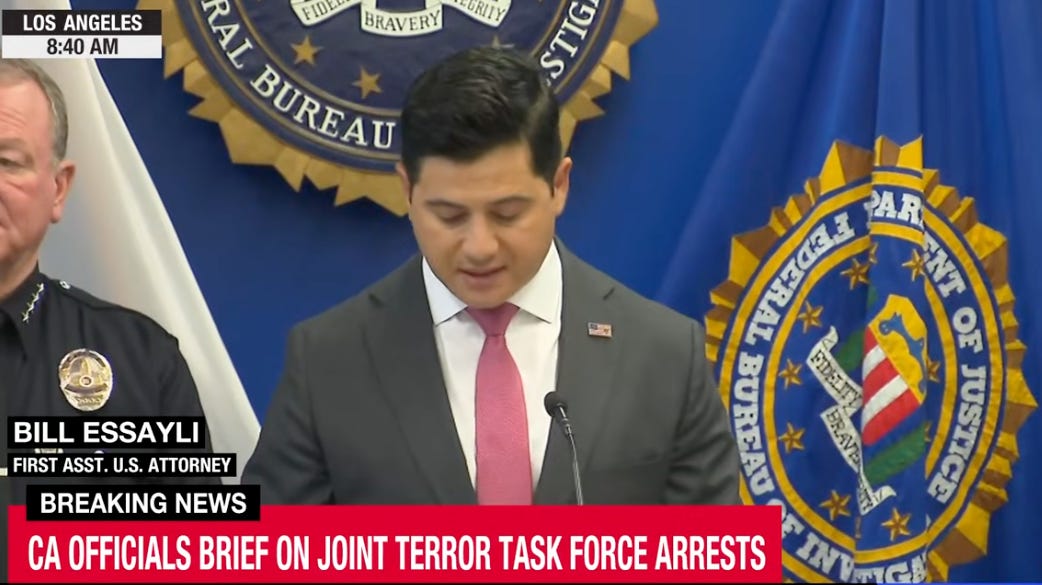
Inevitably, the cameras were handed to First Assistant U.S. Attorney Bill Essayli, whose version of events bore the unmistakable fingerprints of Pam Bondi’s political dramaturgy. Yes, the defendants possessed potassium nitrate, charcoal, sulfur powder, PVC pipes, and fuses, the standard shopping list of every bomb case back to 1996, but the Justice Department’s insistence that this was a sophisticated, highly organized extremist syndicate was again at odds with the imagery: a campsite that looked less like a terror training ground and more like a failed Burning Man DIY workshop abandoned after someone realized they forgot the measuring cups.
There is a particular kind of cognitive whiplash that comes from hearing federal officials describe a group as “organized, sophisticated, and extremely violent,” only to discover that this same group maintained a public Instagram profile, held in-person meetings like a book club, and allegedly brought PVC pipes to the Mojave Desert as the building blocks of their revolutionary arsenal. The DOJ would like us to imagine a clandestine terror network operating with strategic discipline, yet the defendants’ operational security appears to have begun and ended with a private Instagram account called the Turtle Island Liberation Front. Real clandestine groups do not leave digital breadcrumbs scattered across Meta’s servers for federal agents to retrieve before their morning coffee cools.
Essayli pressed on, repeating his claim that the group belonged to a “radical anti-government offshoot” of a pro-Palestinian movement, a description crafted with enough ideological cross-stitching to satisfy every cable news chyron writer within a fifty-mile radius. The defendants, we were told, had drawn up “step-by-step instructions” for IEDs and identified five or more targets for coordinated bombings across Southern California. It was the sort of sweeping plot outline beloved by prosecutors in need of narrative heft, though the charges remained stubbornly modest: conspiracy and possession of a destructive device, the statutory combo reserved for plots that never progress beyond aspiration and PVC pipe assemblies.
Officials also highlighted that the suspects were camped near Twentynine Palms, home to a Marine base, an undeniably attention-grabbing detail, though one that says more about California geography than terroristic strategy. Everything from Joshua Tree tourists to juggalos has been arrested near Twentynine Palms; proximity to the Marines does not magically transform a desert picnic table into a forward operating base. And yet here was Essayli, flanked by law enforcement leaders, delivering a monologue that strained to elevate what the affidavit depicts as a chaotic desert rehearsal into a coordinated multi-county insurrection.
Then there’s the equipment. If Essayli and Bondi are to be believed, this group of hardened extremists was moments away from detonating synchronized bombs across Los Angeles and Orange County. Yet the evidence photos show what looks suspiciously like the clearance rack of a big-box hardware store: PVC pipes, charcoal, sulfur powder, and a handful of fuses. Technically, one can assemble a crude explosive from these materials. But if your plot depends on plastic plumbing, a material known for splitting harmlessly rather than building pressure into shrapnel, you are likely not a master tactician, but rather a walking advertisement for why the phrase “don’t try this at home” exists.
Then, of course, we have the flourish that ties the whole spectacle together: the creation of an alleged inner circle called the “Order of the Black Lotus,” a name that sounds less like an insurgent faction and more like a video-game guild one joins for extra mana points. Bondi and Patel may have hoped this branding would lend the defendants an aura of menace, but it has instead had the opposite effect, underscoring the theatricality of the presentation. When your terror cell sounds like the villain-of-the-week from a CW drama, the audience is entitled to raise an eyebrow.
None of this undermines the serious work done by the FBI. Agents and bomb technicians trekked into the Mojave to prevent something dangerous from evolving beyond theory. They executed warrants, seized real precursor materials, and ensured that four people who may indeed have intended harm will now face a federal judge instead of a fireworks mishap. Their professionalism underscores what makes the DOJ’s theatrical flourishes so galling. When the people actually doing the work bring competence, and the people narrating it bring hyperbole, the result is not public reassurance, it’s public skepticism.
And skepticism is well-earned. This is the same Justice Department whose leadership has spent nearly a year pumping out political narratives thick enough to require environmental permits. Kash Patel has treated reality as a customizable template, and Pam Bondi has presided over so many misrepresentations, from the Maxwell fiasco to her “closeout memos” and her uncanny knack for omitting exculpatory details, that her role as an information source now requires an asterisk. When these same figures roll out an extremist group with a cinematic name and insist that the entire operation was moments away from a multi-city detonation sequence, skepticism isn’t cynicism, it’s a survival skill.
Maybe these four truly believed they were launching a revolution. Maybe this was the tragic convergence of ideology, instability, and access to sulfur powder. Or maybe this was another case where the FBI prevented a dangerous but amateurish plan from stumbling forward while political appointees rushed to inflate the narrative into a sweeping victory over a fearsome domestic army. A functional Justice Department could let the evidence speak for itself. This one insists on shouting over it.
If the DOJ wants the public to take its word at face value, it might start by offering a version of events that doesn’t read like an unlicensed Marvel spin-off. Until then, the FBI will continue doing real work while Bondi and Patel try to turn a campsite full of PVC pipes into the Siege of Los Angeles.
When I first read about the uber-nefarious plot, my first thought was they've got to be the dumbest would-be bombers in history.
Then I remembered we're living in the dumbest timeline imaginable, and it made sense. 😂
From what are they trying to distract people now?
If you too are familiar with Jana DeLeon and her Miss Fortune series, you may also have thought “Gertie Hebert”. If you know, you know. If you don’t, try the books.