

The ink is barely dry on what European officials are calling the “mother of all deals,” and already the most conspicuous feature of the agreement is who wasn’t invited to the table. Hint: Donald Trump
Instead, after nearly twenty years of stalled, resurrected, and re-stalled negotiations, the European Union and India quietly did the thing Trump insists is impossible: they finished a massive free-trade agreement without blowing anything up, threatening anyone on social media, or demanding loyalty tests disguised as tariffs. Two billion people, roughly a quarter of global GDP, one fifth of world trade, and zero participation from Washington.
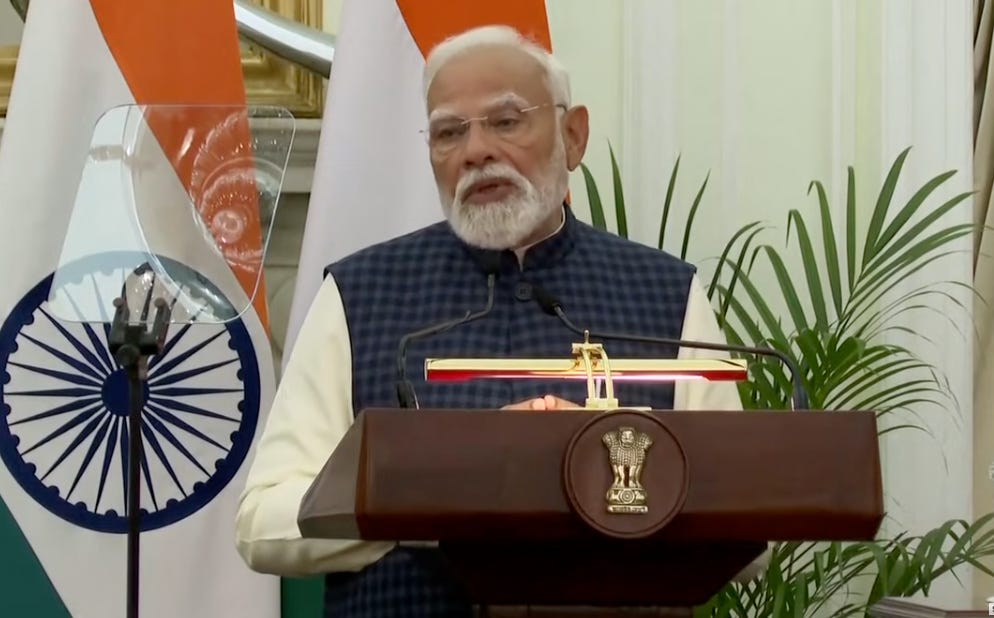
From the outside looking in, and the outside is where the most revealing reporting is coming from, this wasn’t a snub so much as a workaround. The BBC framed it calmly but unmistakably: this wasn’t just about tariffs. It was about supply chains, investment, innovation, and security in an “increasingly insecure world.” Ursula von der Leyen called it a blueprint for shared prosperity. Narendra Modi called it historic. Both emphasized something that used to be boring and is now radical: predictability.
The deal slashes tariffs across most sectors, opens protected markets (especially autos), and, in a notable escalation, launches the first-ever EU–India security and defense partnership. Not as a symbolic add-on, either, but as a recognition that trade, technology, and security now travel together. Cooperation beats coercion, and trust sure as hell beats tantrums.
And hovering over every sentence, even when not named directly, was the same unspoken catalyst: the United States under Donald Trump. CNBC didn’t mince words. The agreement is widely seen as a hedge against volatile U.S. trade policy. A hedge, as in insurance. A way to keep the global economy functioning even if Washington wakes up tomorrow and decides to punish someone for something unrelated.
Trump has imposed tariffs, reversed them, reimposed them, threatened allies over Greenland, punished India for buying Russian oil, slapped Europe with duties despite an existing deal, and then acted shocked when other countries stopped taking American commitments seriously. Even his own Treasury Secretary couldn’t hide the resentment, complaining on television that the U.S. made “bigger sacrifices” only to watch Europe go ahead and sign a deal with India anyway.
That complaint, unintentionally, says everything. It assumes the world exists to absorb U.S. self-inflicted damage as proof of loyalty. Europe and India politely declined the premise.
What’s striking in the foreign coverage isn’t outrage, it’s emotional distance. European analysts speak of “tariff fatigue.” Indian officials urge everyone to “chill a bit.” Trade ministers describe a world where a new threat from Washington arrives weekly, and people simply… adjust. Skin thickens, exposure is reduced, and alternatives are built. Think of it as a reasonable adaptation to irrational volatility.
The BBC correspondent in Delhi put it plainly: the urgency to finish this deal increased as both sides ran into dead ends with the U.S. India couldn’t close a trade agreement with Washington because of oil purchases Trump disapproved of. Europe was dealing with tariff disputes and geopolitical whiplash. So the conversation that began in 2007 and limped along for years suddenly accelerated because uncertainty accomplished what trust hadn’t.
The result is a free-trade zone covering two billion people, accounting for roughly 25% of global GDP and population, paired with a defense partnership meant to outlast electoral cycles and social-media meltdowns.
Trump, at least publicly, has said nothing at this writing. That silence has its own gravity. Abroad, it’s understood not as restraint but as a pause before reaction. Retaliation is assumed, and the only open question is whether it comes as tariffs, threats, or some new grievance pulled from the geopolitical suggestion box.
European officials aren’t pretending this is cost-free. There’s wariness about provoking Washington at a moment when NATO commitments feel less than rock-solid. But even there, the language has shifted. A senior member of the European Parliament summed it up with unusual bluntness: Europe needs to “grow up,” become more sovereign, more competitive, more capable of acting on its own interests while still preferring a cooperative transatlantic relationship, if one is available.
That last clause is doing a lot of work, because what this deal ultimately signals isn’t hostility toward the U.S. It’s contingency planning for an America that can no longer be relied upon to behave consistently from one week to the next.
Trump promised tariffs would make America strong. Instead, they’ve made America optional.
America...optional. That sums it up nicely.
And, doesen't the world feel a bit firmer and solidified and even friendlier.