


The recent news cycle has settled into a grimly familiar rhythm: public goods treated as private property, public money treated as a personal account, and public institutions bent toward the political needs of the people entrusted with protecting them. I can’t say I’m surprised, but I’m still taken aback by the latest reporting on the use of the White House Situation Room as a staging ground for damage control over a dead pedophile.
It is the room of wars, raids, hostage crises, and national security briefings, which is why the new account from Maggie Haberman and Jonathan Swan in The New York Times lands with such peculiar force. According to their reporting, Trump’s senior advisers gathered there on the evening of July 17, 2025, without the president, to discuss how to contain the political crisis created by the Epstein files.
This wasn’t, in the usual sense, a foreign threat. It wasn’t a military escalation, a terror plot, or a sudden constitutional rupture, although one could argue that the distinction becomes blurry in an administration where everything eventually becomes a matter of personal exposure. The immediate problem was that the files Donald Trump and his allies had spent years invoking as a symbol of hidden elite corruption had begun to behave less like a slogan and more like a set of records.
That is where the trouble starts, because slogans are wonderfully obedient things. They stay where you put them. They appear on hats, in fundraising emails, in interviews, in rally chants, and in the background hum of a political movement that has trained itself to believe that somewhere, just out of view, the final document exists that will prove everything. Documents are less cooperative.
Ten days before the Situation Room meeting, the Justice Department and the FBI had released a memo saying their review found no Epstein “client list,” a conclusion apparently intended to close the matter. It didn’t close the matter, because there are few audiences less likely to be calmed by an official government memo than one that has spent years being told official government memos are where the coverup lives.
That is the difficulty with building a politics around suspicion. Eventually, you may find yourself issuing the sort of institutional reassurance your supporters have been trained to treat as evidence.
The administration was now in the awkward position of trying to soothe the very people it had helped unsettle. The Epstein files had been useful as a promise, a symbol, and a permanent accusation aimed outward at a corrupt ruling class. They became more complicated once the demand for disclosure moved from theater to process, and once the question was no longer whether the files should be released in some satisfying abstract sense, but what might happen if they were released in the ordinary, inconvenient sense of the word.
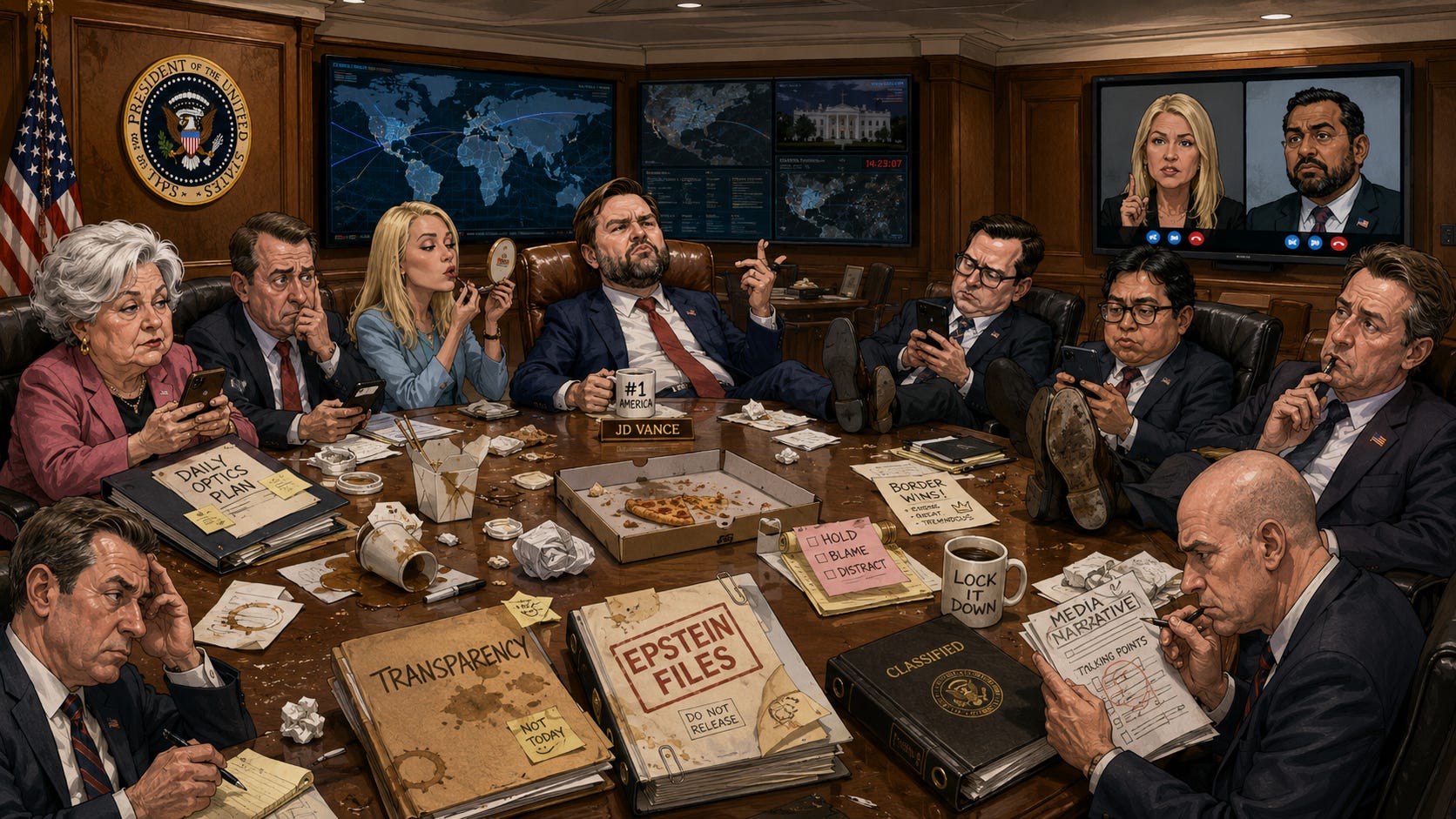
According to the Times account, Vice President JD Vance sat at the head of the table and told the group, “This is a huge problem.” He was reportedly worried about the way the issue was dividing the MAGA coalition, and he argued that the administration should release everything in the Justice Department’s possession, including whatever material existed about Trump, because Congress would likely force the release eventually.
There is a kind of practical clarity in that argument. If the records are going to come out anyway, it is better to be seen opening the door than standing in front of it. The reported pushback from others in the room is where the story becomes something more revealing than a simple fight between secrecy and transparency. The administration didn’t appear to lack a position on transparency, the challenge was finding one that looked sufficiently transparent to satisfy the people demanding disclosure, while preserving enough control to keep disclosure from becoming the governing principle.
This is the point at which Washington reveals its true genius, which isn’t secrecy exactly, but the production of a process that allows every participant to say the correct public thing while arranging the practical conditions under which the correct public thing doesn’t happen too quickly, too completely, or too close to anyone important.
One reported option was to ask federal courts in Florida and New York to unseal grand jury materials related to Epstein cases, despite the fact that grand jury materials are notoriously difficult to release. As a strategy, it had a certain elegance. The White House could ask for disclosure, the courts could refuse it, and responsibility for continued secrecy could relocate from the administration to the judiciary. It was a transparency plan with a built-in alibi.
That may be the most Washington sentence imaginable, and it is probably why the option had appeal. No one has to say they oppose releasing the material. No one has to stand up and defend withholding records that supporters have been promised for years. Everyone can favor disclosure, provided disclosure is routed through a legal mechanism very likely to prevent it.
There is an entire theory of governance contained in that maneuver, that the public may know once the request has passed through enough offices, courts, memos, sealed procedures, adverse rulings, and disappointed press briefings to ensure that everyone involved can say they tried.
The Maxwell discussion, as described by the Times, is darker and stranger, which is saying something given the subject matter. Vance had reportedly floated the idea of enlisting Tucker Carlson to interview Ghislaine Maxwell in prison, apparently in the hope that she might say Trump had not been involved in wrongdoing with Epstein. Todd Blanche, who had represented Trump personally before becoming deputy attorney general, reportedly suggested that Justice Department lawyers could question Maxwell and release the transcript.
At some point, according to the account, the question arose of whether Maxwell’s cooperation might come with expectations, and the White House counsel reportedly laid out possibilities that included a pardon or a sentence reduction. Several people in the room immediately recognized the danger of offering any benefit to Maxwell, which is reassuring in the limited way it is reassuring when the obvious is still able to secure a majority.
The fact that the idea was apparently rejected does matter. It is better, clearly, not to pardon Ghislaine Maxwell than to pardon Ghislaine Maxwell. Still, the conversation itself is difficult to move past, because it suggests an atmosphere in which one of Epstein’s closest convicted accomplices could be considered not only as a witness or a defendant or a person central to a sex trafficking case, but as a possible communications asset in a political crisis. That isn’t normal, even by the generous standards of modern Washington, where many abnormal things have received the gift of repetition.
A movement that promised to expose hidden networks of powerful men found itself, according to this reporting, discussing whether a convicted accomplice of Jeffrey Epstein might help manage the president’s exposure to the Epstein story. The details don’t need much embellishment; they simply need to be placed on the table and allowed to sit there.
None of this proves every allegation that has ever attached itself to the Epstein universe, and it doesn’t turn political panic into criminal proof. The point is narrower than that, and in some ways more damning.
The Epstein files became a crisis for the Trump White House because Trump and his allies had helped make them a test of truth. They had encouraged people to believe that disclosure would expose hidden corruption, only to discover that disclosure is easier to demand when the direction of exposure is assumed in advance.
For years, “release the files” functioned as a kind of political spell. It suggested courage without requiring much specificity, and accountability without naming the conditions under which accountability might become uncomfortable, it also allowed people to stand with victims in the abstract while turning those victims into props in a broader story about enemies, elites, and secret knowledge. The trouble with spells is that occasionally someone asks you to perform the actual task.
The Epstein story has always deserved more seriousness than the political culture has given it. The victims deserved justice long before the files became a partisan obsession, and they deserve something better now than to be used as scenery in another round of reputational management. Their lives shouldn’t be converted into a messaging problem every time the names, relationships, and failures surrounding Epstein become inconvenient for someone with power.
That may be the most important thing to remember beneath the absurdity of the Situation Room meeting. The room matters because of what it reveals about priorities, a government that can summon senior officials into a secure bunker to discuss the politics of the Epstein files is plainly capable of urgency, the question is urgency for whom.
Was the emergency that survivors still don’t have the full truth? Was it that powerful institutions failed for years to protect girls and young women from Epstein and the network that enabled him? Was it that public confidence in justice had been corroded by delay, secrecy, and selective disclosure? Or was the emergency that the demand for transparency had started moving in the wrong direction?
The answer, as always, is likely to be dressed in process. There will be legal considerations, procedural hurdles, privacy concerns, evidentiary questions, redaction debates, and the familiar Washington vocabulary that makes every moral issue sound as if it has been referred to subcommittee. Some of those concerns may be real. Some may even be necessary. But the Times account suggests that the political management of disclosure was not merely incidental to the discussion. It was the discussion.
There is a lesson in that; power often likes transparency in principle, especially when the principle applies to someone else. It becomes more cautious once the windows face inward.
That caution isn’t new, and it isn’t unique to Trump, but the irony here is unusually clean. The administration that inherited and amplified the rhetoric of full disclosure found itself trying to contain the consequences of its own mythology. It had helped persuade millions of people that the Epstein files represented the hidden truth about power, and then it had to explain why the hidden truth about power should perhaps proceed through normal channels.
The result is a very modern kind of scandal, not only about what may be in the records, but about the elaborate effort to manage the meaning of wanting them released. Everyone can be for transparency, in the same way everyone can be for accountability, reform, fairness, and the American people. The question is what happens when transparency is no longer a word in a speech, but a folder on a desk.
In the end, the most revealing thing about the Epstein files may not be that they confirm the grand theory of a hidden cabal, it may be that they show, once again, how quickly powerful people become fluent in caution when disclosure threatens to become mutual.
The public deserves the truth, the victims deserve seriousness, and the powerful deserve the kind of transparency they spent so many years promising everyone else.
The Epstein files aren’t buried—they’re jammed in DOJ purgatory, with nearly half still withheld while officials trip over their own redactions. And while the news cycle has moved on, Blanche’s slow‑roll has turned “transparency” into a bureaucratic hostage situation that only an audit is now prying open.
In the meantime, let's not forget who Trump is and just why all these files are being withheld. It's no secret that Donald Trump has a --let's call it, shady past. Correlation is not Causation but, c'mon -- does anyone really think he wasn't involved?
https://jaywilson1.substack.com/p/sex-lives-of-the-rich-and-famous?r=10sd39&utm_campaign=post-expanded-share&utm_medium=web
Everyone who is privy to any information that is in those files that incriminates not only Trump but the other perpetrators,are, and should be, scared shitless. Rich people have lots of money to do “shady” things to protect themselves and the law would be remiss if all of them aren’t charged with obstruction minimally.