

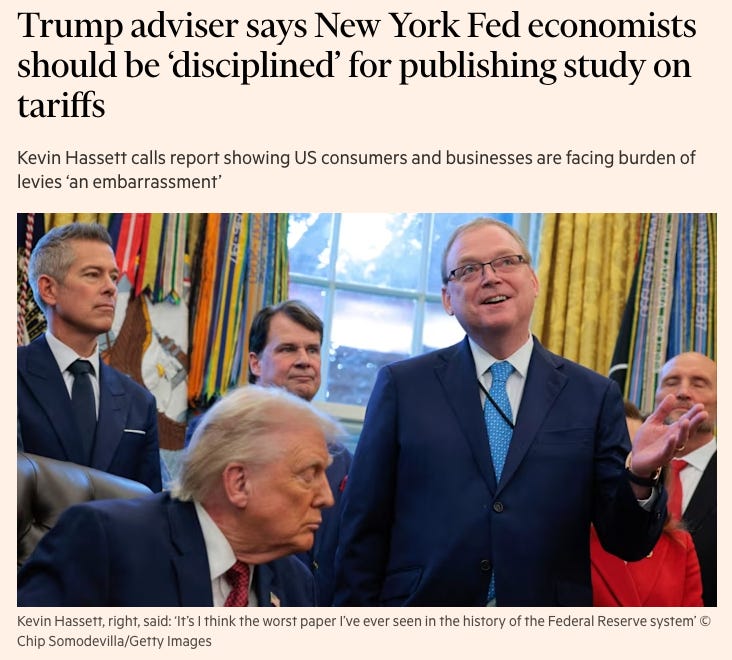
The Trump administration is now doing that thing authoritarian movements always do when reality refuses to cooperate: it’s trying to discipline the economists. This week, Kevin Hassett, director of Trump’s National Economic Council and longtime court jester of trickle-down economics, went on CNBC to denounce a New York Federal Reserve study that committed the unforgivable sin of noticing something true about tariffs.
The study found that in 2025, nearly 90 percent of the cost of Trump’s levies has been paid not by foreign exporters, not by China, not by some mythical overseas villain, but by American businesses and consumers. Tariffs are doing what tariffs have always done since the dawn of trade policy: acting like taxes.
Hassett’s response was not to dispute the findings with evidence, or commission competing research, or even pretend to be having a normal grown-up policy disagreement. Instead, he declared the paper “an embarrassment,” called it “the worst” in the history of the Federal Reserve system, and suggested that the economists involved should be “disciplined.” Not debated or challenged, punished. Apparently the real problem here is not that tariffs raise prices; the real problem is that someone wrote it down.
The timing is almost too perfect. Just hours later, the Federal Reserve released the minutes from its January policy meeting, and they read like a calm, bureaucratic dispatch from the last remaining adults in the room. Fed officials warned that progress toward the inflation target “might be slower and more uneven than generally expected,” and that the risk of inflation remaining persistently above 2 percent is “meaningful.”
Meaningful, persistent, and uneven. These are not the words of a central bank preparing to throw a “Mission Accomplished” banner over the CPI chart.
The Fed held rates steady after three straight cuts, and the minutes make clear that most policymakers are in no hurry to resume easing. Some even noted that a rate hike could be appropriate if inflation stays above target. Which is central banker code for: please stop screaming at us to cut rates while you light price pressures on fire.
The minutes also reveal something else: the Fed is increasingly focused on inflation rather than employment. Officials no longer see major downside risk in the labor market. In their view, hiring has stabilized. The bigger danger is price growth that refuses to behave. Hovering behind all of this, like a foghorn in the background, are the tariffs.
Policymakers expressed cautious confidence that the effect of tariffs on prices should decline this year, but they also cited business contacts who expect tariffs and demand pressures to keep fueling price increases.
Translation: companies are still telling the Fed that tariffs are making things more expensive, no matter how many times the White House insists foreign exporters are politely paying the bill out of gratitude.
So here is the collision course. The administration needs tariffs to be politically magical: a tax foreigners pay, a free lunch that funds government revenue while boosting domestic wages, a patriotic cheat code that somehow produces prosperity with no cost.
Hassett even claimed consumers are “made better off” by tariffs, a statement so upside-down it belongs on an Econ 101 exam with a big red circle around it and the words “Kevin, please see me after class.”
The Fed, inconveniently, lives in the world of arithmetic. Tariffs raise costs. Businesses pass them along. Inflation does not care about campaign messaging. When economists publish research confirming what decades of trade literature already suggest, that Americans bear most of the burden, the administration does not respond with analysis.
It responds with threats as part of a pattern so obvious you could set it to a metronome.
Trump has attacked Jay Powell personally, calling him a “moron” and a “stubborn mule.” His Justice Department has opened a criminal investigation into the Fed chair. He has attempted to remove Fed officials. He has already sacked the head of the Bureau of Labor Statistics after an unfavorable jobs report.
Now his top economic adviser is floating the idea that Fed economists should be disciplined for publishing data-driven conclusions.
Talk about institutional capture. It begins with the insistence that experts are partisan. It escalates into punishment for analysis. And eventually, the only “acceptable” economics is whatever flatters the leader’s preferred storyline.
The danger here is larger than one working paper or one set of meeting minutes. The entire monetary system depends on credibility, credible data, credible analysis, credible independence. Markets can survive bad news. They cannot survive a government that tries to break the instruments measuring the news.
The Fed is telling us inflation progress may be uneven. The New York Fed is telling us Americans are paying the tariff bill, and the White House is telling us the economists should be disciplined for noticing.
And, meanwhile, the lamestream media (thanks Sarah Palin, but you were a decade or so early with that) just ignores any news detrimental to their dear leader, the shithouse king.
In addition, I am fairly certain that they are cooking the books on inflation numbers.