

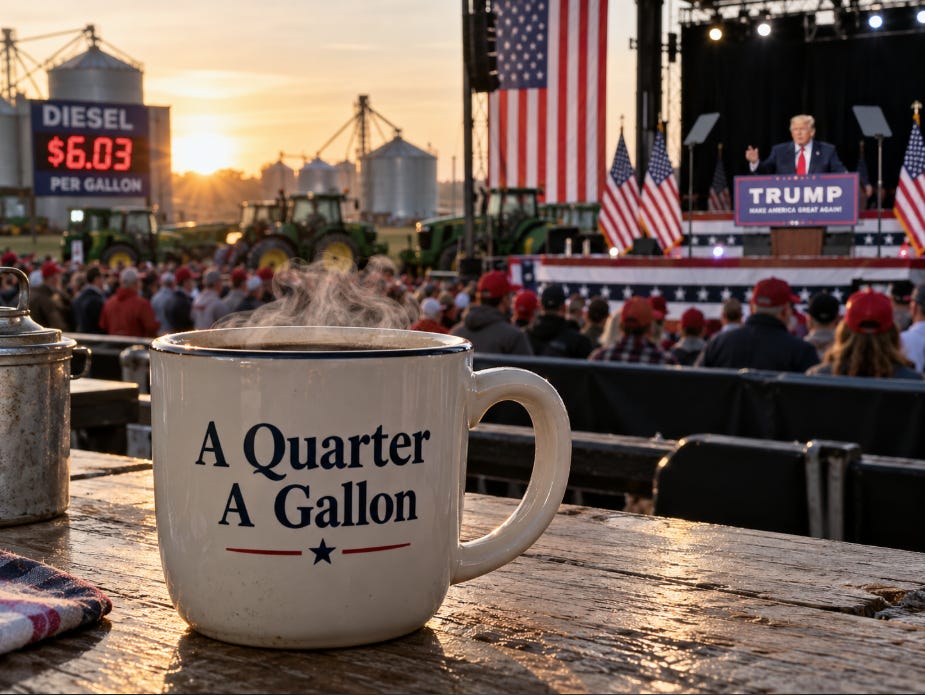
Grand Island got the full Trumpian show Monday night.
For roughly eighty minutes at the Nebraska State Fairgrounds, Trump ran through his regular repertoire. The war with Iran was “essentially almost over.” Every adult citizen would get $5,000 if Republicans held both chambers. He riffed about Iran taking out Los Angeles and San Diego, and the crowd applauded.
He also offered two lines that explained why he was there at all.
“They’re all saying we’re in trouble in the midterms,” he admitted, before asking the crowd to “pretend I’m on the ballot.”
About half an hour in, the rally paused for a piece of governance.
Natalie Harp carried a document to the lectern, and Trump announced “a historic executive order” on red-dyed diesel, the lower-taxed fuel used primarily in farm and other off-road equipment. First, he asked the audience whether they knew what red-dyed diesel was.
“I don’t know what the hell it is,” he said, “but whatever it is, it’s supposed to be very good.”
Then he polled the crowd on whether to sign, signed, and compared the handoff to The Price Is Right.
The prop was chosen with care.
Nebraska is mid-harvest, diesel is near record highs, and Pete Ricketts is facing an unexpectedly competitive Senate race against independent Dan Osborn. In yesterday’s piece, we identified diesel as the cost bearing down hardest on Nebraska farmers this fall.
Less than a day later, the president signed an order aimed at exactly that pressure point, on a stage built for a Senate campaign.
So the fair question is what that signature is actually worth to the people who cheered it.
Start with what it doesn’t touch.
Diesel burned in tractors, combines and irrigation engines was already exempt from the federal highway tax and treated separately under Nebraska’s fuel-tax rules; that is the whole reason red-dyed diesel exists.
Nothing changes in the field.
The relief applies to the trucks.
Grain trucks and semis hauling to the elevator travel public roads, and highway vehicles have ordinarily been required to burn clear, taxed diesel, farm plates or not. Through December 31, Trump’s order directs the IRS to suspend federal penalties for using dyed fuel on highways and tells Treasury to determine whether it can defer the federal excise tax of 24.4 cents a gallon.
Nebraska had already handled its share.
On September 24, Gov. Jim Pillen lifted state penalties for dyed diesel in highway vehicles and made state diesel taxes on harvest hauling refundable for 90 days. The American Farm Bureau then asked the White House, in an October 1 letter, to waive the federal piece.
Monday’s order answers that request, at least in part.
Pillen’s other ask, a 90-day pause on diesel exports, went unanswered.
Now the math.
With farm diesel in the Corn Belt near $6 a gallon and the national highway average at $6.38 on October 1, 24.4 cents amounts to roughly 4 percent of the pump price. A year earlier, national diesel was about $3.70 a gallon, meaning the federal relief offsets only about 9 percent of the increase.
The White House’s own example puts the savings at about $60 on a 250-gallon fill.
Onstage, Trump promised that “the typical trucker will save over $100 every time they fill up.”
That larger number requires states to contribute their own tax relief, something Nebraska had already done before Trump arrived.
Three caveats shrink even the federal benefit.
The order defers the tax rather than waiving it, and no one has said whether the deferred amount will ultimately be forgiven or billed later. Treasury has five days to determine whether federal law permits the deferral at all.
Nothing in the order touches the wholesale price of diesel, still being driven by a global supply squeeze involving the Iran war, disrupted trade through Hormuz and damaged refining capacity.
The timing is the order’s genuine strength. Nebraska is in the heart of harvest, which means much of the season’s grain still has to move from field to elevator. Farmers with dyed-diesel supplies on hand can begin using that fuel in qualifying highway vehicles without facing the usual federal penalty.
The verdict: real relief, narrow in scope, uncertain in form and small against the problem. Trump called it “historic” and “unprecedented.” Readers know the word: Trumperbole. A quarter a gallon, maybe, recast as history.
The diesel order was official business, the event wrapped around it was a Senate campaign rally. Federal rules have long required political committees to reimburse the government for campaign-related use of government aircraft and other transportation. The formula is not simply the operating cost of Air Force One. Depending on who is traveling and on whose behalf, reimbursement can be based on a pro-rated comparable charter rate or another prescribed commercial-equivalent rate.
Taxpayers continue to absorb much of the extraordinary cost of presidential travel, including security, because the president does not stop being president when he campaigns.
Mixed trips are where things get interesting.
FEC guidance says that if substantive campaign activity occurs at a stop, that stop is considered campaign-related. An official event on the same trip does not simply make the political portion disappear. Costs instead have to be allocated between official and campaign purposes under rules the public rarely gets to watch being applied.
Quartz later estimated that Air Force One travel to more than 40 Trump rallies before the 2018 midterms cost roughly $17 million. During one two-month period it examined, the campaign reported about $112,000 in Treasury reimbursements, although additional payments could follow.
The Air Force One tab is only the federal half.
The other half lands on whoever hosts.
A presidential rally means city police on overtime, deputies and troopers pulled from regular duty, fire and EMS on standby, and public works crews closing roads around a line Trump himself pegged, generously, at “three, four miles long.”
The precedent for who covers those costs is not especially kind to the hosts. By 2019, at least 10 local governments said Trump’s campaign owed them more than $841,000 for public-safety expenses tied to rallies. Federal law does not automatically require campaigns to pay every local police invoice, which is part of the problem: cities can be left carrying costs generated by someone else’s political event.
So far, nobody has reported what Grand Island, Hall County or the Nebraska State Patrol spent Monday night.
That leaves some fair questions.
How was the Grand Island trip classified? What portion was allocated to official business? Which political committee will reimburse the Treasury for the campaign portion, and how much? And what did the rally cost the local and state taxpayers who supplied the security and services?
Trump asked the crowd to pretend he was on the ballot.
Local taxpayers may be asked to pretend he paid.
Monday was not an isolated collision between public office and political promotion.
A week earlier, taxpayer-funded TV ads praising Trump aired under the remarkable tagline “Paid for by the U.S. government.” After bipartisan criticism and calls for watchdog investigations, Trump said Monday that MAGA Inc. would pay for such ads going forward.
He did not say whether taxpayers would be reimbursed for the ads that had already aired.
In both cases, public money came first. Political money entered the conversation only after the arrangement drew scrutiny.
The boundary between the presidency as public office and the presidency as campaign machinery is precisely why reimbursement and anti-propaganda rules exist in the first place.
On Monday night, that boundary ran directly through the middle of the stage.
Then there was California.
Here is the relevant passage:
“It’s a small price to pay for keeping the world safe, keeping our country safe. If they could take out a city — let him take out Los Angeles. Let him take out San Diego.”
Conservative defenders say the “small price” referred to higher fuel costs, not the destruction of American cities. The White House says the same: Trump was describing what the war is meant to prevent, not inviting Iran to attack California.
On the grammar, that is probably right.
Grammar isn’t the problem.
On video, Trump delivered Los Angeles and San Diego as a quip for the room, and the room applauded. He needed examples of American cities a nuclear Iran might someday threaten.
He chose two blue ones.
About 13 million people live in Los Angeles and San Diego counties, and San Diego is home to critical U.S. military infrastructure.
Iran’s hypothetical target list, apparently, gets drafted with an eye on the Electoral College.
California officials objected immediately. Gov. Gavin Newsom accused Trump of advocating an attack, which goes beyond what the surrounding remarks support. San Diego Mayor Todd Gloria’s response was narrower and harder to dismiss: his city is “not collateral damage” and never “a small price to pay.”
Two facts puncture the premise anyway.
U.S. defense officials say Iran currently lacks the ability to launch a direct missile attack on the U.S. mainland. And the war Trump says will be “over very soon” is the same one in which he rejected Iran’s latest ceasefire proposal last week.
Trumpology Dictionary readers will recognize the maneuver.
Trumpotato: minimizing one cost by placing it beside a vastly larger hypothetical catastrophe.
Your $6 diesel looks smaller next to a nuked San Diego.
Monday’s version came with Nebraskans applauding the thought.
Eighty minutes also produced a few new claims worth pulling from the pile.
Nebraska farmers, who know right-to-repair better than anyone, heard Trump say, that people used to go to jail for fixing their own tractors and that he had pardoned “numerous people” for it. The right-to-repair fight is real, and Trump has in fact pardoned several people convicted in Clean Air Act emissions-tampering cases. What he changed was the reason. They were not imprisoned for repairing tractors. Troy Lake, the case Trump has cited before, served seven months after his company disabled emissions-monitoring systems on hundreds of commercial trucks. The pardons are real, but the tractor story is not.
Trump said Becton Dickinson had just announced $3 billion and that the “biggest expansion” was headed to Nebraska. The $3 billion is real, but it is a national manufacturing commitment, part of a much larger new U.S. investment agreement. More than $1 billion is slated for Nebraska. The specific Columbus expansion announced in January was $110 million and about 120 jobs. Real investment, but three different numbers folded into one applause line.
The night’s most consequential distortion involved someone in the room. Trump introduced Jacqueline Medina, whose 16-year-old daughter, Lizbeth, was murdered in Edna, Texas, in December 2023. Lizbeth was born in Grand Island, which is why her mother was on that stage; she has said she accepts these invitations to honor her daughter, not to endorse anyone. The killer, Rafael Govea Romero, pleaded guilty and is serving two concurrent life sentences.
Trump said Romero had been “arrested many, many times and released again and again,” and offered Lizbeth Medina’s murder as proof of what Democratic border policies had allowed.
The record tells a different story.
We found one prior felony case, a burglary conviction, and Romero was on probation for it when he killed Lizbeth. We found no record supporting Trump’s claim of repeated arrests and repeated releases.
More importantly, Romero did not enter the country through the Biden-era southern border Trump was describing. Police said at the time that he was living in the United States on an expired visa, and later reporting says he entered legally on a work visa in 2018.
That was during Trump’s first term.
Romero later overstayed that visa and became undocumented. But the immigration system that first admitted him was not Joe Biden’s. It was Donald Trump’s.
Monday night ran on a single technique: start with something true and build a bigger story on top of it. The diesel crisis is real, though the signing’s federal benefit is about a quarter a gallon and may yet come due. Farmers do fight over repair rights; none went to prison over a tractor. Nebraska is getting a factory expansion, just a smaller one than advertised. Lizbeth Medina was murdered by a man whose path into the country doesn’t match the speech. And the war that pushed diesel past $6 became material for a Los Angeles joke and another promise of “very soon.”
Wholly invented claims are the easy part of the next four weeks. The harder work is separating the fact underneath from the campaign story built around it. The facts belong to everyone. The narrative belongs to the campaign.
Twenty-eight days remain. We’ll keep separating.
On a much happier note, Ezra’s MRI results came back “unremarkable.”
Ezra himself remains a very remarkable little person, and all of us who love him felt an enormous sense of relief reading that word.
Finally, thank you to everyone who kindly alerted me that I had somehow managed to double-paste yesterday’s newsletter.
I would especially like to thank everyone who noticed and chose not to say anything.
Some acts of mercy are small. They still count.
So happy to hear about Ezra💕
Thank you for your remarkably even handed treatment of the day's Trumpirrhea. I don't trust any hyperbole. Having moderated a few playground disputes, I know truth usually lives somewhere in the middle of the claims.