


Good morning! Alex Pretti’s parents did what the Trump administration could not: they told the truth plainly and without euphemism. In a statement released Saturday night, they said they were heartbroken and furious at what they called the “sickening lies” told about their son after federal agents shot him dead in Minneapolis, lies amplified not just by DHS officials, but by Donald Trump himself, who helped circulate an image of the so-called “gunman’s gun” and cast their son as a threat. Their words cut through the fog instantly. Alex was not a “gunman.” He was not “approaching officers with a weapon.” He was holding his phone; his left hand was raised; he was trying to shield a woman that ICE had just shoved to the ground while he and other protesters were being pepper-sprayed. “Please get the truth out about our son,” they wrote. “He was a good man.” That plea now stands in direct opposition to a federal government that seems determined to launder a killing into a talking point, even as multiple witnesses and bystander footage contradict the administration’s version of events.
Pretti, 37, was an American citizen, an ICU nurse at the Minneapolis VA, and a legally licensed gun owner, facts that make the administration’s response not just dishonest but revealing. In a country that wraps itself in the Second Amendment like a security blanket and insists it is powerless to enact even modest gun safety laws, the reflexive condemnation of a lawful gun owner as an inherent threat exposes a contradiction too large to ignore. Either the right to bear arms is sacrosanct, or it becomes a convenient excuse to justify lethal force when the wrong person happens to exist in the wrong place. You don’t get to have it both ways, no matter how loudly you shout “self-defense” after the fact.
The evidence continues to pile up, inconveniently immune to spin and official talking points. Multiple media analyses and bystander videos show that in the seconds before the fatal shots were fired, a federal agent secured the handgun Alex Pretti was carrying, a firearm he legally owned and had not brandished, even as other agents restrained him on the ground. Videos reviewed by The Washington Post and The Guardian depict Pretti holding only his phone while attempting to help others, being pepper-sprayed, wrestled to the ground, and then accosted by agents; one officer is then seen emerging from the melee with the weapon in hand, a split second before at least ten shots rang out within five seconds. Only after the weapon was already removed and Pretti was partially subdued did someone shout “gun!”, a detail that directly contradicts the initial claim from the Department of Homeland Security that he had approached officers armed and violently resisting. The administration’s response was not to slow down or acknowledge this discrepancy but to stage a rebuttal: releasing an image of the recovered handgun and branding it “the gunman’s gun,” as if a photograph could overwrite what people watched happen in real time. Narrative, meet reality, and so far, reality is winning.
As protests spread from Minneapolis to cities across the country, a federal judge quietly did something radical: he ordered federal agencies to preserve evidence related to Pretti’s death. That ruling came in response to Minnesota officials accusing federal authorities of actively obstructing investigations, a charge that could win the understatement of the year award. When judges have to step in to prevent evidence from disappearing, the problem is no longer “engineered chaos,” it’s full-on institutional panic.
Panic is the most honest explanation on offer. A Vietnam-era platoon sergeant once quipped that “the most dangerous thing in the world is a teenager with a rifle.” Minneapolis is showing us a modern corollary: an ill-trained, frightened federal agent with a gun and unchecked authority. What’s unfolding here is not a city spiraling out of control, but the predictable danger of unleashing armed agents into civilian neighborhoods, unfamiliar with the terrain, primed to expect violence, and then calling the resulting volatility “law enforcement.”
In legal terms, this isn’t mysterious; it’s textbook. Misfeasance is the improper performance of a lawful act, and that’s exactly what happens when agents conducting immigration operations behave like an occupying force, escalate routine encounters into lethal confrontations, and fire on a man already restrained on the ground. Nonfeasance is the failure to perform a required duty, and the Minnesota Bureau of Criminal Apprehension has now described that failure in stark, unusually blunt terms. As BCA Superintendent Drew Evans explained, his investigators were “blocked by federal agents with the Department of Homeland Security from accessing the scene,” even after securing a signed judicial search warrant, a step he called “an unusual move in a public area,” taken only because access had already been denied. Evans told reporters plainly: “We had a warrant and we were still denied access to the scene. That’s accurate.”
Evans did not dramatize the stakes, but he did not soften them either. “We’re in uncharted territory here,” he said, noting that in his over two decades with the BCA, he could not recall a single instance in which federal authorities had barred state investigators from a shooting scene where there was concurrent jurisdiction. Without cooperation, he warned, “it will be difficult to obtain all of the evidence and information contained” in the case, a measured way of saying that accountability is being actively obstructed. When the FBI briefly exited the scene and federal agents failed to maintain it, Evans acknowledged that the area was overrun and evidence was lost before state investigators could return. “We were not able to do really any work at the scene once we had access,” he said. “That process was disrupted.”
And then there is malfeasance, the willful abuse of power. That appears not only in the decision to block investigators, but in the deliberate effort to misrepresent what happened afterward: smearing the dead as “terrorists,” amplifying images divorced from context, and using official communications to intimidate state officials who insist on independent review. When law enforcement leaders say, as Evans did, that the public “expects and deserves an independent, thorough, and transparent investigation,” and the federal government responds by denying access, withholding identities, and threatening those who ask questions, the failure is no longer operational, it is intentional. This is misfeasance on the street, nonfeasance in the chain of command, and malfeasance in the response that follows.
This is where Pam Bondi’s letter enters the picture, not as an isolated outrage, but as documentary evidence of how the system enforces silence once violence occurs. The letter was sent directly to Minnesota Governor Tim Walz, and its tone makes far more sense when placed in context. Walz had not limited himself to careful legal critique. In condemning the federal deployment and the lethal force used by ICE and Border Patrol agents, he deliberately escalated the rhetoric, comparing the surge of immigration enforcement in Minneapolis to the Gestapo, the secret police of Nazi Germany. Pointing to masked, militarized agents, fast-tracked deportations, and people being seized off the streets, Walz said that “Donald Trump’s modern-day Gestapo is scooping folks up off the streets,” a comparison intended to shock, provoke, and underscore what he argued was a wholesale erosion of due process and civil liberties. For the record, I’d say “gestapo” is quite apt.
Bondi’s response to that escalation was not to address the substance of the charge, but to shut it down. Her letter is remarkable less for what it says than for what it pointedly refuses to acknowledge. She does not mention Alex Pretti by name, and does not reference Renée Good. She does not address the obstruction of state investigators, the denial of access to crime scenes, or the mounting video evidence contradicting federal claims. Instead, she reframes the crisis as one of state defiance and rhetorical irresponsibility.
In the letter, Bondi accuses Minnesota officials of a “failure to cooperate with federal immigration enforcement” and warns that any “interference with federal law enforcement operations” is unlawful. She asserts federal agents are acting “consistent with federal law” and insists that state and local authorities must not “impede, obstruct, or otherwise hinder” DHS and ICE activities. The posture is unmistakable: federal conduct is presumed lawful by definition, while state oversight, especially when it comes wrapped in language as inflammatory as “Gestapo”, is treated as illegitimate and dangerous. For the record, Gestapo is pretty damned apt.
Stripped of its legal varnish, Bondi’s letter reads less like guidance and more like an ultimatum. It makes three demands. First, Minnesota must stop what she characterizes as “interference,” which in practice means ending independent investigations, public criticism, and the documentation of federal actions. Second, the state must affirmatively cooperate on federal terms, with Walz instructed to “direct all state and local officials” to assist DHS and ICE absent any reciprocal obligation for transparency, evidence sharing, or accountability. And third, the letter issues a warning: continued resistance, Bondi writes, “will not be tolerated,” making clear that the Department of Justice is prepared to take action against state officials themselves.
Bondi does not frame this as a dispute between sovereign governments with shared responsibilities to the public. She frames it as a command. Her letter does not ask whether federal agents acted lawfully; it declares that they did. It does not engage with the charge that federal enforcement has begun to resemble secret policing; it treats the accusation itself as the offense. Nor does it confine itself to immigration enforcement. In a striking escalation, Bondi also demands access to Minnesota’s voter rolls, folding election administration into a dispute ostensibly about immigration and public safety. The implication is unmistakable: resistance on one front invites scrutiny on another.
This is not the Department of Justice acting as a neutral guarantor of the rule of law. It is the DOJ positioning itself as an enforcement arm whose power flows in only one direction, asserting federal supremacy, presuming federal innocence, and expanding the scope of its demands until oversight itself becomes suspect. When lethal force, investigative obstruction, and election infrastructure are collapsed into the same letter, the message is no longer subtle. Compliance is expected, and the consequences of defiance will not be limited to the issue at hand.
In the language of accountability, the letter is devastating. It represents nonfeasance in its refusal to ensure independent investigation, misfeasance in its misuse of DOJ authority to shield federal agents from scrutiny, and malfeasance in its explicit attempt to chill oversight through threat and intimidation. Pam Bondi did not merely fail to restrain abuse. She formalized it on letterhead.
When force is prioritized over competence, when fear substitutes for judgment, and when oversight is treated as an inconvenience rather than a safeguard, this is the inevitable result. Agents are placed in situations where instinct, not discipline, determines outcomes, where a split second of panic can decide who lives and who dies. And when the institutional response is to close ranks, distort evidence, and threaten those who ask questions, the problem is no longer a single shooting or a single city. It is a system that has abandoned its duties in every direction at once. It’s misfeasance with a badge, nonfeasance in the chain of command, and malfeasance at the very top.
Amid the federal stonewalling and DOJ threats, there is at least one point of light breaking through: Minneapolis itself is no longer pretending this is normal. Mayor Jacob Frey stepped to the podium alongside Sen. Amy Klobuchar and said out loud what federal officials keep refusing to acknowledge, that the chaos consuming the city is not organic, not homegrown, and not the fault of its residents. “The chaos that we are seeing is caused directly by ICE, border control, and this federal administration,” Frey said, announcing that the city has filed a declaration urging a judge to grant immediate relief through a temporary restraining order to halt the operation that has already resulted in “multiple shootings and tragic deaths.”
Frey did not posture as a strongman or scold the public into silence. He sounded exhausted, and human. “Our community is tired. Our officers are tired. Our businesses are tired,” he said, explaining his request for National Guard assistance not as an escalation, but as a necessity given the strain placed on a police force of roughly 600 officers now being forced to manage the fallout of federal operations they did not initiate. Importantly, he did not cast protesters as the problem. He described community members escorting workers to their jobs, helping with daycare, delivering food to families afraid to leave their homes. “It has been extraordinary how people around our city have stepped up during this difficult time,” he said, a direct rebuke to the administration’s portrait of Minneapolis as a city overrun by agitators.
That same distinction carried through in remarks from Minneapolis Police Chief Brian O’Hara, who emphasized de-escalation as the department’s guiding principle and acknowledged openly that the pressure has been building “for weeks.” O’Hara described a volatile situation in which local and state officers were caught between protesters, agitators, and federal activity, forced to respond to fires and barricades while trying to prevent further harm. Even as he defended the use of less-lethal munitions to create safe egress, he made clear that the department’s priority was protecting life, not asserting dominance, and that most demonstrations have remained peaceful.
What’s striking is not that Minneapolis police are maintaining order; it’s how they are doing it, and what they are refusing to say. Neither Frey nor O’Hara blamed protesters for the deaths that set this all in motion. Neither adopted the language of “domestic terrorism”, or pretended that this wave of unrest emerged spontaneously. Instead, city leadership and local law enforcement are openly acknowledging what federal officials will not: that Minneapolis has been placed on the front lines of a federal operation it did not ask for, cannot control, and is now being forced to absorb.
In a moment when federal power is being used to intimidate, obscure, and silence, that alignment matters. It shows that the choice is not between “law enforcement” and “the public,” but between accountable governance and unrestrained force. Minneapolis, battered and exhausted, appears to have chosen a side, and it is not the one demanding silence.
The political response is finally beginning to match the gravity of what’s unfolding. Senate Democrats have said they will block any funding package that includes money for the Department of Homeland Security, citing the killings and the agency’s escalating pattern of abuse. Meanwhile, Vice President JD Vance took to social media to insist, without evidence, that the chaos is the work of “far-left agitators” colluding with local officials. It’s a familiar move: deny the facts, blame the witnesses, criminalize dissent, and hope the noise drowns out the truth. But this time, the truth has parents, videos, sworn testimony, court orders, and a growing public unwilling to accept yet another official story that collapses on contact with reality.
From outside the United States, none of this looks confusing. It looks familiar. International media and foreign commentators have increasingly framed Minneapolis not as a local breakdown, but as part of a broader pattern in Trump’s second term: power asserted through spectacle, chaos used as cover, and institutions deliberately overwhelmed. From Al Jazeera to European press, the question being asked isn’t whether America is “polarized,” but whether it is abandoning the idea that law constrains power at all. Masked federal agents in residential neighborhoods, state investigators blocked from crime scenes, an attorney general threatening governors while demanding voter rolls is not how a stable democracy behaves.
Beyond our borders, what’s happening in Minneapolis has not escaped notice. International media outlets have described the killing of Alex Pretti and the earlier shooting of Renée Good as emblematic of when the United States’ claims about the rule of law are being tested, not just domestically, but in the court of world opinion. French, Spanish, and other global outlets have highlighted the contradictions between official narratives and video evidence, noting that legally armed citizens were killed in a federal enforcement operation that continues to be shrouded in official spin and conflicting accounts. Foreign commentators, looking in from societies that take civil liberties and transparent procedure for granted, increasingly frame the unrest not as isolated chaos but as a systemic problem, and some have even suggested that the relentless barrage of crises here serves, intentionally or not, to distract from other unresolved national controversies like the heavily redacted Epstein files.
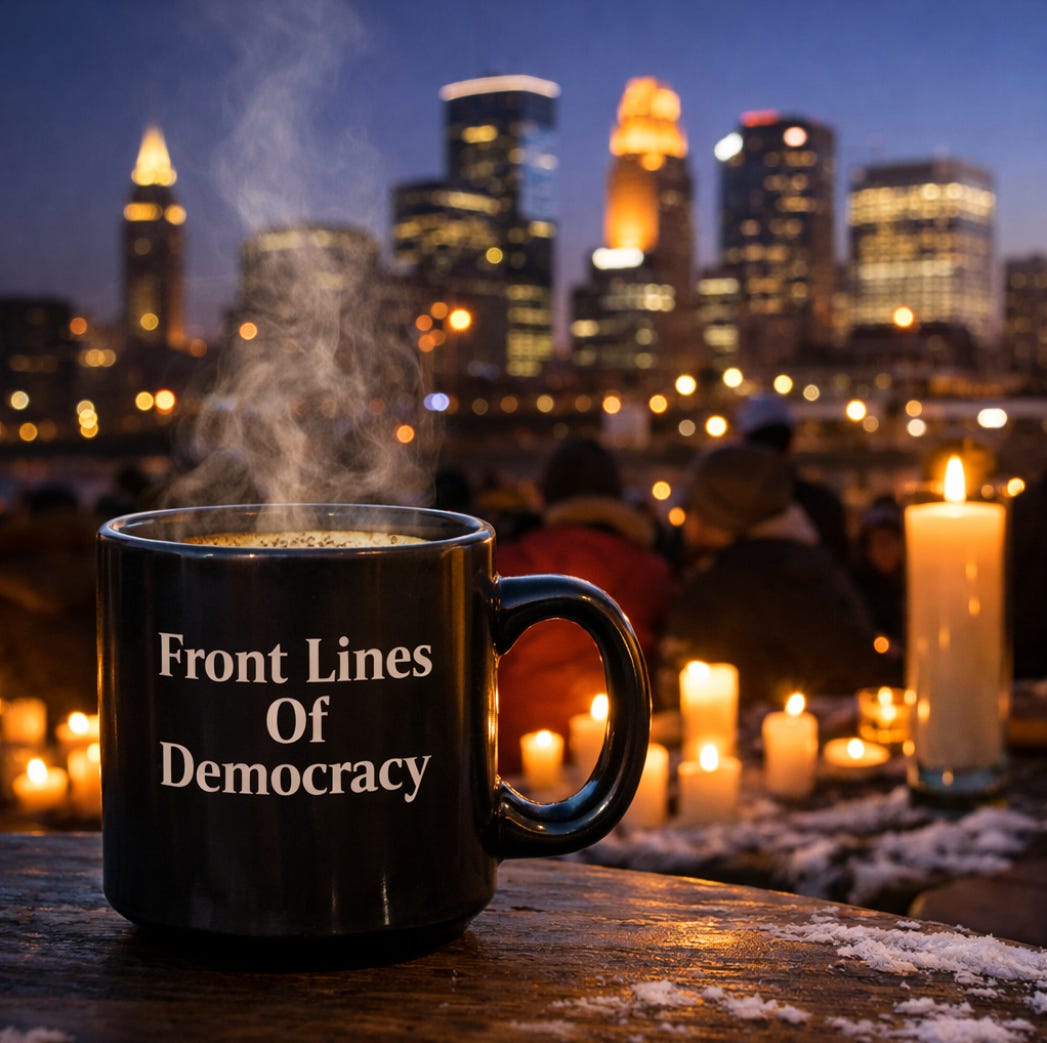
In Minneapolis, you understand the stakes so few outsiders can, and as Marz and I hold Minnesota dear in our moonbeam vigils each night, we recognize what this moment and your sacrifice mean for the future of this country. It is not just a city under strain; it is a test case for whether a free society still answers to its people. Love you Minnesota!
#Impeach #Prosecute #Imprison #Bondi #Noem #Patel #Bovino #Trump #Vance ... and for #Miller #McLaughlin #Lyons #Prosecute #Exile ...
Hitler promoted and facilitated the Holocaust; Trump promoted and facilitated the murder of Alex Pretti. Trump and his regime should be expelled from office.