


Donald Trump would probably like us to believe that a grand White House ballroom is just a classy upgrade, the sort of thing any sensible nation would want if only it had enough taste, enough money, and enough gold trim. The official line from his White House is that he is, of course, “a builder at heart,” which is a wonderful phrase if you are selling condos and a slightly less comforting one if you are talking about the symbolic home of a constitutional republic. Builders build projects, presidents are supposed to preserve institutions. Those are not the same impulse, and it is becoming harder to pretend they are.
It is tempting to laugh the whole thing off because a ballroom sounds ridiculous. It sounds like a place for donor selfies, bad shrimp, and people who say “elegance” when they mean “expensive.” But that is also why it matters. Authoritarian politics does not always arrive looking like a tank. Sometimes it arrives looking like a renovation. Sometimes it arrives under soft lighting, with polished floors, patriotic drapery, and a giant room built so the leader can imagine himself more beautifully reflected in the state. When that leader is Donald Trump, a man who has spent his adult life slapping his name onto buildings, planes, steaks, golf clubs, water bottles, and his own mythology, the ballroom does not look like a side project. It looks like the point.
This is where the Hitler comparison enters, and this is also where it has to be handled with care. The useful comparison is not that Trump is literally Hitler, or that America in 2026 is Germany in 1939. The useful comparison is that both men understood architecture as political theater. Hitler’s New Reich Chancellery, completed in 1939, included a marble gallery, banquet halls, and ballrooms. It was built to project scale, wealth, permanence, and awe. Timothy Ryback’s recent essay in The Atlantic describes Hitler’s obsession with an expensive new wing for the Reich Chancellery as part of his grandiose architectural vision for the capital. The point was not simply to have more room for parties. The point was to make power feel enormous, sacred, and physically undeniable.
That is why the ballroom matters. Not because chandeliers are fascist, and not because every ceremonial room is a step toward the Third Reich, but because strongmen have always loved to turn public buildings into emotional arguments. The building says what the regime wants people to feel, you are small, and the leader is large. The state is not a boring set of rules and institutions, it is a stage, and the ruler is the main attraction. This is especially useful for men who are not content merely to govern. They need to be admired, they need the office to become a flattering mirror. They need marble to do what the law will not.
Trump’s White House ballroom fits that pattern with embarrassing neatness. The project was announced in July 2025 as a major addition to the White House complex, initially presented as roughly a $200 million undertaking on the East Wing site. As of this week, Associated Press reporting says the project has grown into a 90,000 square foot, $400 million addition, with the East Wing already demolished. A federal judge temporarily halted construction unless Congress authorizes it, writing that the president is a steward of the White House, not its owner. And then, because satire now writes itself faster than any columnist can, the National Capital Planning Commission still gave the project final approval days later. The absurdity is almost too tidy. Even the legal fight sounds like the punch line to a joke about monarchy. No, sir, you do not actually own the palace.
What makes Trump different from Hitler is obvious and important. Hitler was a genocidal dictator with a coherent, exterminatory ideology and a totalitarian state. Trump is not that, and saying otherwise is sloppy. But what makes Trump comparable, in the narrower way that should worry us, is his instinct to transform government into branding. He does not merely want to occupy public institutions. He wants to stamp them with his taste, his face, his slogan, and his appetite. NPR reported in February that Trump’s name and image have spread across government programs and public messaging to such a degree that historian Ruth Ben-Ghiat described it as the construction of a personality cult. That is the larger context in which the ballroom should be understood, it is not just a room, it is a decorative expression of a governing philosophy that treats the state as a vehicle for personal glorification.
And that is why the ballroom is funny in the way all dangerous things are funny at first. It is tacky. It is vulgar. It is cartoonishly on brand. It sounds like the sort of idea a casino owner would have after two glasses of wine and a flattering sketch from an architect who knows where the money comes from. But if it were merely tacky, it would not be worth writing about. The trouble is that tackiness can be politically useful. It can normalize appetite. It can make vanity look harmless. It can train people to treat every excess as one more episode in the Trump show, one more weird bit, one more day in the content mill, instead of what it actually is, which is another attempt to teach the country that public things exist for the ruler’s pleasure.
Trump has always understood the power of surfaces. He understands logos, spectacle, backdrops, entrances, applause lines, carefully staged abundance, and rooms that are meant to look rich even when they mostly look loud. In that sense, the ballroom is perfect. It is architecture as self-portrait. It says that the White House is not a civic inheritance to be guarded, but a premium venue awaiting an upgrade from the master brand. It says that the presidency is not an office of restraint, but a franchise opportunity with better columns. It says that if the people’s house cannot be turned into a Trump property on paper, it can still be turned into one aesthetically, emotionally, and symbolically.
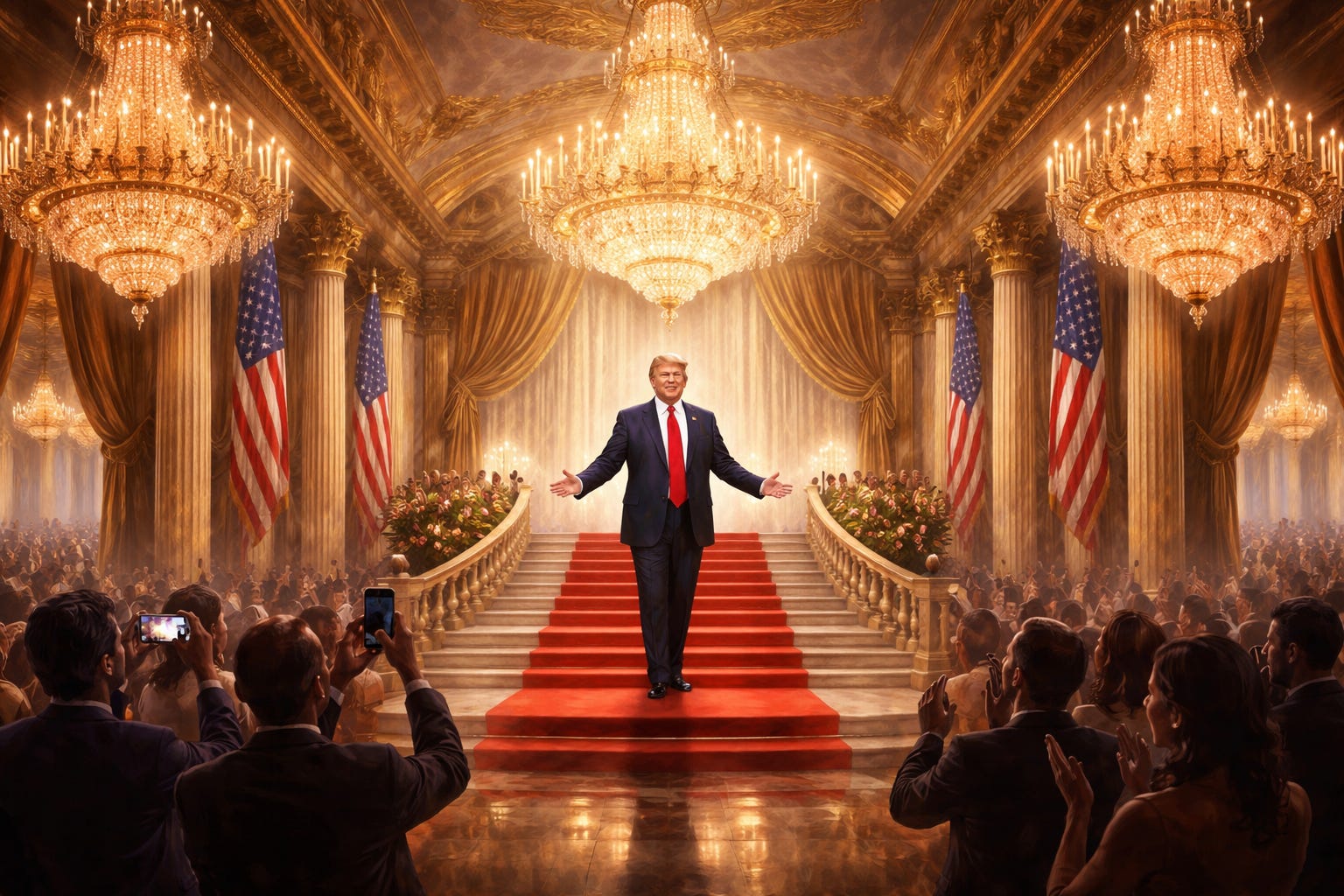
That is also where the Hitler parallel gets sharper, though still not identical. Hitler’s Chancellery was built to overwhelm and to elevate the leader above ordinary politics. Trump’s ballroom is less ideologically grand and more personally gaudy, which is its own American variation on the same old authoritarian temptation. He is not trying to build a thousand year Reich. He is trying to build a better photo op. But one of the ways democracies get themselves into trouble is by assuming that vanity is unserious. Vanity can be a delivery system for power. Grandiosity can be a political method. A leader who wants the state to admire him will eventually want the law to flatter him too.
So no, Donald Trump is not Hitler, and nobody serious needs to pretend he is. The more interesting, and more unnerving, truth is that he is a familiar species of authoritarian showman in a deeply American key. He is less interested in doctrine than display, less interested in theory than dominance, and fully convinced that government should reflect his brand the way a lobby reflects a developer. The ballroom is silly, and the ballroom is vulgar, and the ballroom is somehow exactly the kind of thing that should make us sit up straighter. Because when a man spends years branding everything he touches, the thing to watch is the moment he decides the republic itself could use his logo.
a subtle and powerful (and of course scary) analysis!
I think you are afraid to call out the ways Trump is exactly like Hitler. I returned from a trip to Berlin recently where it was made crystal clear by tour guides that the SS was a para-military "off the books" outfit intended to locate and detain undesirables in extra-judicial locations with no warrants or due process. Shooting was OK. They recruited older teens and young 20-somethings because they could be more easily indoctrinated than adults. Blueprint for ICE. Remember Bovino's trench coat/jackboots outfits?
Some of the third reich buildings in Berlin were ballroom-like in their grandiosity, etc., with the former Luftwaffe HQ now Germany's taxing agency HQ.