


In Greenland, the ice used to be a kind of memory you could walk on. Sea ice wasn’t just weather. It was a road, a pantry, a calendar, even a language. It was the difference between “we can go” and “we can’t,” between “the dogs eat” and “the dogs don’t,” between “we are who we are” and “we are forced to become something else.” Now that road is thinning, arriving late, leaving early, sometimes failing to show up at all. In the far north, residents of Qaanaaq described a winter when the sea ice didn’t form the way it normally does, when the “frozen highway” that supports dog sleds and hunting simply… disappeared, and darkness made boat travel difficult, trapping people on land and cutting income from fishing and hunting.
Thousands of miles away, people who will never set foot on that ice are making spreadsheets about how to monetize its absence. That’s the dirty trick of climate change under capitalism: it doesn’t just heat the atmosphere.
It also turns destabilization into a business model, and makes the most impacted communities into bargaining chips. The warming isn’t abstract. It’s measured in gigatons and missed meals. Greenland’s ice sheet is losing mass at a staggering rate. NASA’s GRACE satellite record estimates Greenland shed about 264 gigatons of ice per year between 2002 and 2023, contributing roughly 0.8 mm of sea level rise per year. And the IPCC’s polar regions fact sheet is blunt: it’s very likely the Arctic has warmed at more than twice the global rate over the past 50 years, and Arctic warming is virtually certain to remain more pronounced than global warming this century. But “gigatons” is the kind of number you can say without tasting it.
So translate it into what it means on the ground: thinner ice means more dangerous travel routes; unpredictable seasons mean disrupted hunting; disrupted hunting means food insecurity; and food insecurity means decisions nobody should have to make, whether you pay the bill or feed the family, whether you keep the sled dogs or surrender a part of your identity. Climate change is a violence that arrives politely, like a scheduling conflict. It doesn’t kick down the door. It just makes the doorframe warp until the whole house doesn’t fit you anymore.
Capitalism loves a crisis, especially one it can pretend it didn’t cause. The Arctic becomes “valuable” in a warming world for reasons that sound neutral until you listen closely: longer seasonal shipping windows, more navigable waters, greater military interest, easier access to minerals and infrastructure corridors. The IPCC, NASA, and Arctic researchers describe the warming; strategists and investors take it as an invitation. And then the pitch arrives, glossy as a bottle label. Greenland: the next frontier. That phrase, “frontier,” is the oldest colonial euphemism in the book. It means: “somewhere other people live that we have decided to imagine as empty, available, and waiting for our flag.”
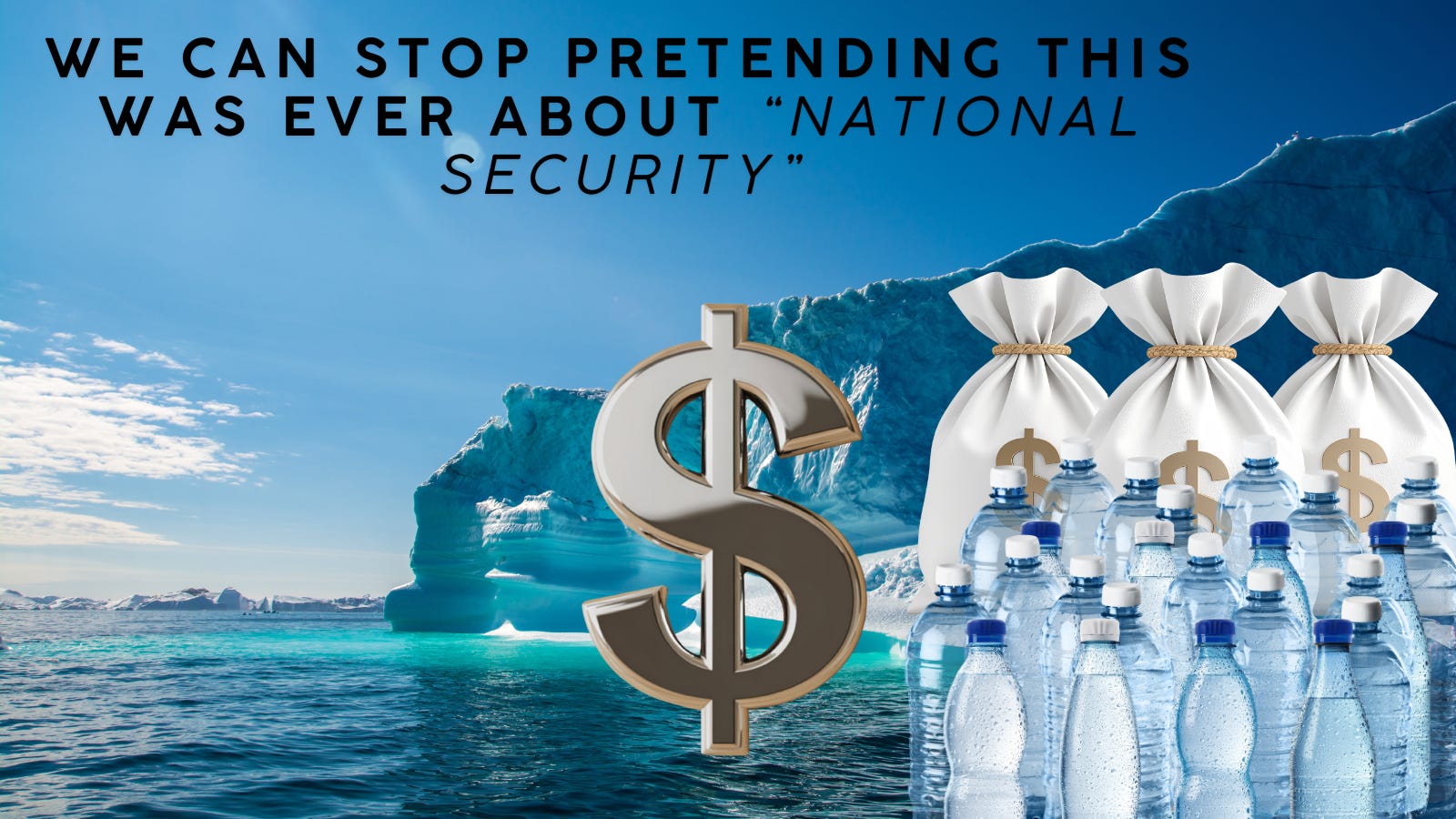
Enter bottled water: capitalism’s most sincere joke. If capitalism were a person, bottled water would be its party trick: it sells you something that is often already available, wraps it in plastic made from fossil fuels, ships it around the world, then calls you “eco-conscious” if you recycle the bottle. The environmental math is grim. A University of Michigan life-cycle assessment found that single-use bottled water consumes 11–31 times more energy than tap water systems. It also found that making the plastic bottles accounts for over 70% of energy use for regional bottled water, and transportation can dominate when water travels far. And globally, the recycling story is not the redemption arc people want it to be: the OECD reported that only 9% of plastic waste is successfully recycled worldwide.
So bottled water is not just hydration. It’s a fossil-fueled ritual of inconvenience, a recurring subscription to landfill. And now, in one of the places on Earth most visibly altered by climate change, bottled water becomes a symbol of the whole nightmare: the melting world marketed as “purity.”
“Imivik”: when a spring becomes a brand, and a brand becomes a wedge. Greenland has a bottled-water product with a real origin story: Lyngmark Spring in Qeqertarsuaq, Disko Island. In 2016, Greenlandic outlet KNR reported that Svend Hardenberg and Jørgen Wæver Johansen were launching a “luxury” bottled water from that spring under the brand name Imivik. More recent Greenlandic reporting notes Greenland Water Bank has long sold Imivik locally and has aimed to expand production and exports. That’s the local side. Then the international money arrives.
ArcticToday, summarizing a Politiken investigation, reported that Ronald Lauder, Estée Lauder heir and longtime political donor, has taken ownership stakes in Greenlandic companies, with his involvement first becoming visible through Greenland Water Bank. In that account, Hardenberg told Politiken the investor group’s value wasn’t just cash, it was access to the luxury market, the holy of holies where water becomes a status symbol instead of a public utility.
And that’s where the satire writes itself: A planet overheats because fossil-fueled systems treat the atmosphere like a free sewer. The Arctic melts. Greenland’s communities absorb the shock. And somewhere, someone decides the correct response is to bottle “true purity” and sell it to people who already own water filters. It would be funny if it weren’t also a kind of tragedy bookkeeping.
The chopping block isn’t just environmental, it’s geopolitical. When climate change shifts the map, powerful states and wealthy actors don’t just see risk, they see leverage. That’s what makes Greenland so fraught: it’s not merely a “climate story.” It’s a sovereignty story, a story about how quickly a people can be reframed from citizens into “assets,” and a homeland into “strategic real estate.” And then comes Donald Trump, who treats world affairs like a group chat argument. Trump shared a message exchange that included his response to Norway’s Prime Minister Jonas Gahr Støre, where Trump complained that Norway “decided not to give” him the Nobel Peace Prize and used that as a launching pad for Greenland rhetoric, questioning Denmark’s claim and insisting, “The World is not secure unless we have Complete and Total Control of Greenland.”
There’s an almost poetic self-incrimination to it: the leader of a nuclear superpower writing, in effect, “Since you didn’t give me my gold star, I’m going to think about what’s ‘good and proper’ for the United States, and by the way, I require complete control of Greenland.” It is, how do we put this delicately, not normal diplomacy. It reads like a toddler discovering geopolitics: “I wanted a trophy. I didn’t get one. Now I want to steal an island.” And the irony is almost like a car crash, I so badly want to look away but I just can’t bring myself to: Norway doesn’t “award” the Nobel Peace Prize in the way Trump frames it. The Peace Prize is decided by the Norwegian Nobel Committee, a five-member body appointed by Norway’s parliament. So, the letter’s blame logic is off from the start, whether by confusion, indifference, or strategy. But even if it’s performative, the performance matters. It normalizes the idea that sovereignty is negotiable if you’re loud enough, rich enough, or simply shameless enough.
Here’s the factual core, without turning it into a conspiracy novel: according to former U.S. national security adviser John Bolton, Ronald Lauder first put the idea of “buying” Greenland into Trump’s mind, and that Lauder later offered to act as an intermediary with Denmark when Trump explored the idea. It’s also been reported that Politiken’s investigation found Lauder investing directly in Greenland via a Delaware-registered consortium (Greenland Development Partners) that bought into Greenland Investment Group, with interests stretching beyond consumer products.
This is where the story stops being merely absurd and becomes structurally alarming: A powerful politician flirts with controlling Greenland. A wealthy ally is reported to have introduced the idea. That ally, per the same reporting, invests in Greenlandic ventures. Analysts warn it’s hard to view the investments as purely commercial given the political context. You don’t need a secret handshake to see the issue. You just need to recognize how power works: not always through official memos, but through dinner invitations, phone calls, donor networks, and the soft currency of “I can open doors.”
If Greenland’s future is being tugged by those forces, Greenlanders are not just dealing with melting ice. They’re dealing with melting boundaries, between commerce and policy, between investment and influence, between diplomacy and bullying. The same ArcticToday report describes Greenland Investment Group expressing interest in bidding for a major hydropower project at Lake Tasersiaq, envisioned as the energy source for a future aluminum smelter.
This lines up with Greenland’s own public planning. The Government of Greenland has moved to bring the Tasersiaq and Tarsartuup Tasersua hydropower sites into a public tender process for industrial use. And as of January 2026, Greenland’s hydropower program described completing the framework for upcoming tenders for those sites. Hydropower is often presented as the “green” alternative, clean electricity, national revenue, jobs. And yes: it can be part of an energy transition. But it also becomes a magnet for energy-intensive industry. Aluminum smelting is one of the classic use cases, historically studied in Greenland’s hydropower context.
That’s the fork in the road Greenland is being pressured to walk: develop and diversify, or get locked into extractive trajectories where “green” power becomes a sales pitch for projects whose social and ecological costs are shouldered locally. Lauder’s Greenlandic partners are politically connected, and this blend of influence and private investment has drawn domestic criticism, particularly around representation at a Washington trade event. Reports say that Greenland’s minister for business and minerals told Politiken that investment cases are processed under established governance rules and that an investment-screening law was expected in 2025.
This is what sovereignty looks like in the modern era: not just flags and constitutions, but procurement rules, screening laws, tender frameworks, and the constant question of whether “development” is being defined by the people who live there, or by outsiders who see a warming Arctic as a new marketplace. Capitalism has a talent for treating places like fruit: squeeze until there’s no juice, then blame the fruit for being empty. If Greenland becomes valuable because the ice melts, that “value” is built on loss. It is monetized grief. And the same systems that profit from turning the Arctic into a frontier also deepen the conditions that will eventually make the frontier unlivable, unstable, and “not worth it.”
That’s the inevitable arc of a system built on extraction and the monetization of chaos: Climate change accelerates, The Arctic opens and investors begin to arrive with “purity” and “green growth.” Power politics escalate, often wrapped in childish ego. Projects multiply, plastic multiplies, transport multiplies and communities absorb the volatility. Eventually, the “frontier” stops being romantic and starts being expensive, the money moves on, leaving the people with the consequences. Bottled water is the perfect emblem of that cycle: it takes something essential, makes it into a premium product, and then leaves behind the trash.
What these events are truly saying, when you take a step back to listen, is that climate change isn’t only an environmental catastrophe, it’s a political one. It rearranges the map in a way that invites predation. It turns survival into a revenue stream, and it gives authoritarian posturing a fresh stage “Complete and Total Control,” written like a tantrum in all caps. And it creates space for wealthy intermediaries to operate in the blur between “investment” and “influence.” And it’s saying this, too: If you want a snapshot of capitalism’s spiritual condition, look at the image it can’t resist selling, a melting world labeled “pure.”
Today we stand in a world where the most basic human rights, our right to drink, to breathe, to live without being bartered, have been repackaged as revenue streams for people who will never pay the true cost. Water is no longer a commons to be protected; it’s a brand to be trademarked. And when the planet buckles under the weight of that logic, when the ice thins, the seasons fracture, the ground shifts beneath communities who did not cause this, capital doesn’t pause to mourn, no, it drafts a prospectus. It sees a melting coast and imagines a “frontier.” Nothing more than a net profit margin.
Today, it is Greenlanders who are asked to carry the bill for forces far larger than themselves: for centuries of extraction, for decades of emissions, for a global economy that treats collapse as an opportunity, and for the grotesque spectacle of billionaire ego playing statecraft like a game. What is “complete and total control” if not the tantrum of a grown man translated into foreign policy? What is a threatened homeland if not proof that, in this system, the vulnerable are always expected to negotiate with the powerful, politely, quietly, and gratefully, while the powerful treat greed as destiny.
But Greenland is not an empty canvas. It is not a prize or a brand refresh for an overheated world. It is a home, a language and lineage and labor and memory. It is a future that belongs first, always, to the people who live there. Those same people who spent centuries fighting for their right to decide.
The question isn’t whether we are shocked by the audacity. The question is whether we will keep letting audacity pass as leadership. Whether we will keep accepting a world where the right to drink water is something you buy back from the very people who polluted it, where the consequences of climate change are handed to those with the least power.
Today, it is the people of Greenland who are facing the hefty tax of billionaire ego. Who will it be tomorrow? And what are we willing to do about it, today, before the next homeland becomes a headline, the next necessity becomes a luxury, and the next human right becomes someone else’s business plan?
There's so much to comment about in this excellent article, but I'll limit myself to bottled water. I shop at Costco. Every time I go there, I see people with carts or flatbeds loaded with cases of bottled water. In a country where nearly everyone has access to clean drinkable water, I find this astounding. The reasons people give are convenience, my water tastes bad, etc. These issues are easy to address, and the solution is much less expensive, both financially and environmentally.
I live in an area where the city water supply is stored in old gravel pits that line a river. Although the water is clean and drinkable, frankly it's hard and tastes like rocks. To address this admittedly "first world problem," we rent a water softener, a reverse osmosis (RO) water purification system, and a bottle-free hot/cold water dispenser from Culligan. In addition to the water dispenser, the RO system is connected to our refrigerator ice maker and a dedicated faucet at the kitchen sink for filling cooking pots.
We pay $21 a month for the RO system and water dispenser. With it we have an unlimited supply of bottled-water-quality purified water that we can use for cooking, drinking (either alone or as a brewed beverage), and filling our reusable water bottles. A case of bottled water (12-40 single-use plastic bottles, shrink wrapped) costs from around $9 to $25, depending on whether you buy the Kirkland Signature brand (16.9 oz. per bottle, 40 bottles) or one of the "upscale" brands like Fiji (23.7 oz., 12 bottles).
Assuming two bottles of water a day for a month for one person, with none of it used for cooking or for preparing hot or cold beverages, buying bottled water in areas that have access to clean, drinkable water makes absolutely no sense financially. Furthermore, almost every single bottle ends up in a landfill because although they're "recyclable," the vast majority are just thrown away.
Again, another very well documented writing. One other thing that is not nearly talked about as much; permafrost. Greenland's frozen ground is a repository for carbon and methane. When that ground thaws, methane is released into the atmosphere. And, methane is much more destructive than CO2.